Ant Digital Agentar 2.0: Turning Agent Development into an Assembly Line
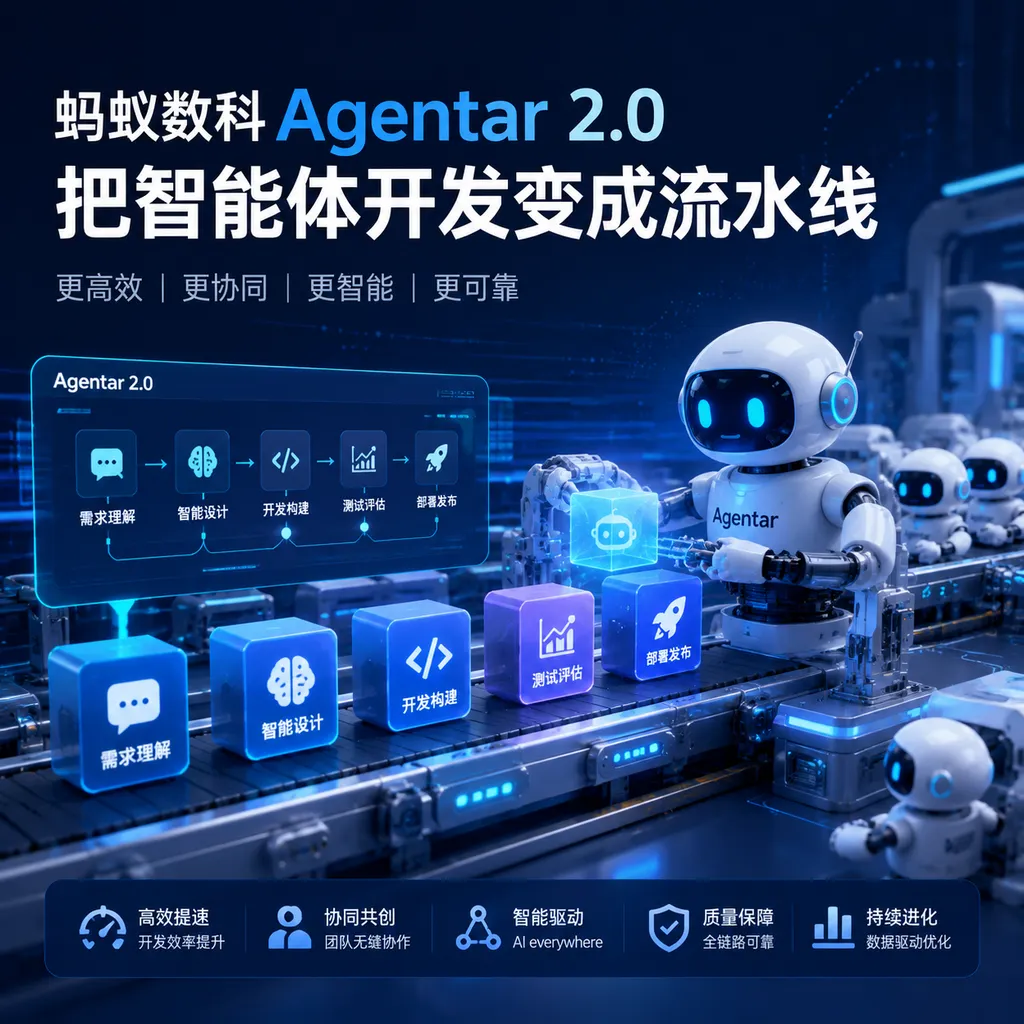
At the 2026 WAIC, Ant Digital Technology released Agentar 2.0, featuring nearly 200 preconfigured role-level digital expert templates and hundreds of subscribable Skills tools, highlighting the "out-of-the-box" capabilities for enterprise intelligent agents. According to IDC data, it ranks first in China’s privatized intelligent agent development platform market among non-cloud vendors.
Ant Digital Technologies Agentar 2.0: Turning Agent Development into an Assembly Line
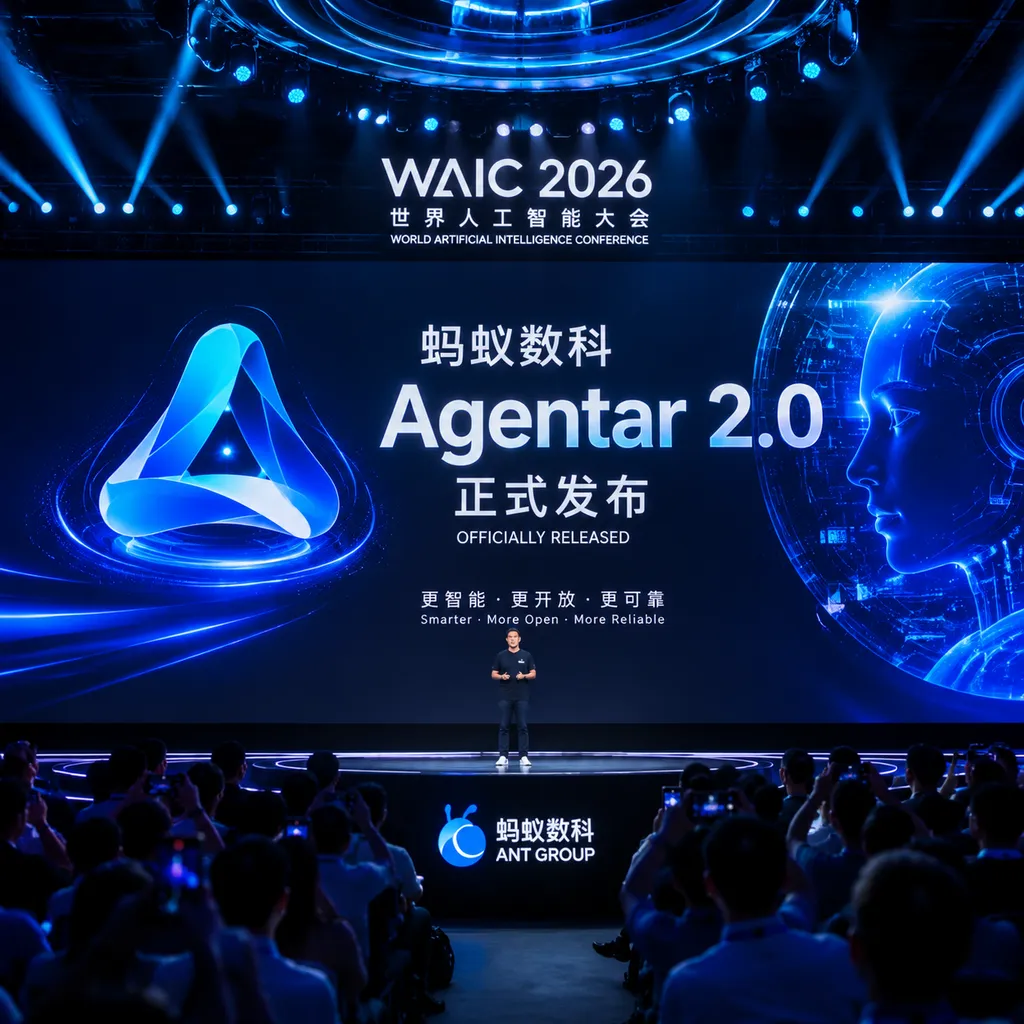
On July 19, at the 2026 World Artificial Intelligence Conference, Ant Digital Technologies showcased its new-generation enterprise AI solution, Agentar 2.0, positioned as the “core platform of a super factory for intelligent agents.” The platform comes with nearly 200 preloaded job-level digital expert templates and hundreds of subscribable Skills-level agent tools—meaning enterprises no longer need to start from scratch. They can simply pick a “Digital Store Manager” or a “Digital Risk Controller,” click, and start using it immediately.
This is already the second generation of Agentar. When Ant Digital Technologies first unveiled Agentar at the Digital China Summit in April 2025, it was still an agent development tool focused on the financial industry, emphasizing low-code, financial MCP service marketplaces, and pluggable industry know-how. Over a year later, Agentar has expanded beyond finance into sectors like dining, retail, and energy, and its product logic has shifted from “helping you build” to “helping you choose.”
From Development Platform to “Super Factory”: What’s the Difference?
The term “super factory for intelligent agents” may sound convoluted at first, but the factory analogy is quite literal: the first generation of Agentar gave you lathes, drills, and raw materials—you had to design and assemble by yourself; in 2.0, common “products” are pre-made and placed on the shelf for customers to take as needed.
What’s the key difference? Delivery speed and cognitive threshold.
When companies push internal agent projects, the bottleneck is rarely model capability—it’s demand alignment. The business team says they need an “agent that can back up customer service.” The tech team asks: Which scenarios? Which ticketing process? When to escalate to humans? What internal systems to call? Three weeks can pass just on back-and-forth discussions. The nearly 200 position templates of Agentar 2.0 essentially package these “business consensuses” in advance—the digital store manager knows what sales data to view, when to send member coupons, and what time to remind staff for daily inventory.
Ant Digital isn’t the first to take this approach. Salesforce’s Agentforce, Microsoft’s Copilot Studio, and several domestic cloud vendors’ agent platforms share similar logic. But Agentar 2.0 differentiates itself in two aspects:
- Finer job granularity: Instead of generic “Sales Agent” or “Customer Service Agent,” it defines roles by industry and position, cutting down to almost 200 templates. That’s top-tier in China—by contrast, Agentforce’s official template library abroad only numbers in the dozens.
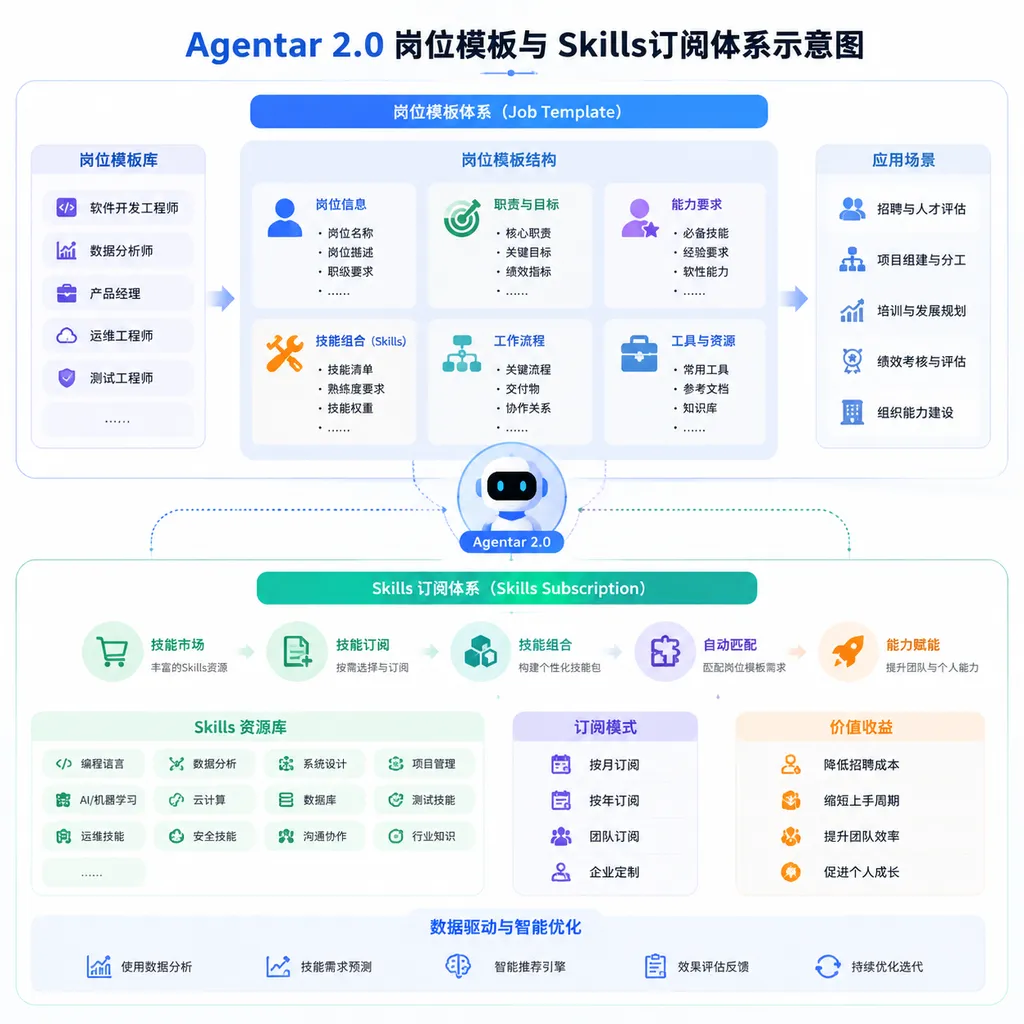
- Subscribable Skills: Hundreds of Skills-level tools are sold as standalone components, like an App Store. If one template isn’t enough, companies can stack more “Invoice Recognition,” “Contract Review,” or “Public Opinion Monitoring” modules.
In short, Ant Digital is betting that the future of enterprise agents isn’t having every client learn Prompt engineering or Workflow design—it’s about installing and using them like Windows software.
What Exactly Are Job Templates?
It’s worth breaking down the concept of a “job-level digital expert” to cut through marketing language.
A job template typically includes four layers:
- Domain Knowledge: The expertise required for the role—for instance, a digital store manager must understand restaurant SOPs, food safety regulations, and staff scheduling logic.
- Business Processes: The routine daily/weekly tasks—for example, morning inventory, daily reports, and anomaly submissions.
- Tool Integration Capability: The internal systems it connects to—POS, ERP, CRM, or enterprise WeChat.
- Decision Boundaries: What can be decided autonomously and what requires human approval.
The first two layers rely on data and knowledge bases, the third on MCP and API integrations, and the fourth—the hardest—on trusted agent frameworks and attribution systems. Agentar emphasized “trust” back in its first generation: full-chain trust across the model layer, provider layer, execution layer, and evaluation/attribution layer. This foundation continues in 2.0—giving it the confidence to “prebuild” job templates. If decision boundaries lose control—for instance, if a digital store manager arbitrarily applies a 50% discount—the financial loss is real.
According to Ant Digital CTO Wang Wei, Agentar has accumulated billions of high-quality financial domain data points and over 100,000 labeled long-chain reasoning datasets simulating expert thinking. Although built for financial agents, this data infrastructure and methodology can be generalized: as long as an industry has enough corpus and labeled data, corresponding digital experts can be “refined.”
Market Positioning: First Among Non-Cloud Vendors
On the same day as the release, IDC reported that Ant Digital ranks first among non-cloud vendors in China’s privatized agent development platform market, and also first in 2025 market share for China’s financial large-model and agent services.
These two “firsts” reveal Ant Digital’s positioning:
- Top Non-Cloud Vendor — Excluding Alibaba Cloud, Huawei Cloud, Tencent Cloud, and Volcano Engine, Ant Digital is the largest independent vendor. Competitors in this track include Zhipu, Baichuan, Moonshot AI, MiniMax, Fourth Paradigm, and Langboat.
- Leader in Financial Sector — Ant’s foundation remains rooted in finance. Its accumulated data and regulatory strength from Alipay, MYBank, Ant Insurance, and Ant Fund form a moat others can’t easily replicate.
“Privatized deployment” is a key term worth highlighting. In China’s B2B market—especially in finance, government, and energy—pure SaaS is rarely accepted; private or dedicated cloud is a must. This differs completely from the public-cloud focus of Agentforce and Copilot Studio abroad. Ant Digital’s years of experience in on-premises delivery is what makes it competitive here—not superior model capability, but the ability to install in client data centers, pass compliance audits, and withstand scrutiny.
A Hidden Signal: AI Employees Are Moving Downmarket
If you only read the WAIC press release, Agentar 2.0 might look like another all-encompassing enterprise AI platform. But an article from Jiefang Daily on July 17 offers a more interesting angle—“Enabling small shops to adopt AI employees.”
That points to a shift: enterprise agents are trickling down from large corporations to small and micro businesses.
Over the past year, the dominant narrative in China’s agent market has been “helping banks build investment research assistants” or “helping SOEs do knowledge management”—high contract value, long cycles, and heavy customization. But that market has a visible ceiling. The real growth lies below—millions of restaurants, tens of millions of small merchants, countless family-run shops. These users don’t write Prompts, don’t call APIs, and may not even understand “multi-agent collaboration.” What they need is: for a few hundred yuan a month, buy a “digital employee” that can mind the store, do the bookkeeping, and reply to messages.
Agentar 2.0’s templated approach is essentially laying groundwork for this downmarket segment. With nearly 200 job templates plus subscribable Skills, it could evolve into an “AI Employee Store”—merchants subscribe monthly for instant use. The market potential here far exceeds serving a few hundred major enterprises.
Developer Perspective: How to Use This System
For developers, Agentar 2.0 functions more as a middle-layer platform. You can:
- Use built-in templates for secondary configuration and rapid client delivery.
- Develop custom agent tools via the Skills SDK and publish them in the subscription marketplace.
- Build industry-specific agents using the trusted framework, skipping model training from scratch.
Compared with fully open-source setups (LangGraph, AutoGen, Dify self-hosted), Agentar’s advantage lies in industry know-how and data assets; its drawbacks are flexibility and community ecosystem. Choosing between them is a trade-off: in highly regulated sectors like finance or government, a platform like Agentar—with private deployment and deep industry grounding—is lower risk; for general SaaS or internet products, open-source stacks with customizable models remain more flexible.
It’s also worth noting that Agentar’s backend isn’t tied to a single model. The MCP protocol enables integration with multiple large models. In real deployments, companies often mix them—Claude for complex reasoning, GPT for general dialogue, DeepSeek for cost-sensitive high-frequency calls, and domestic models as compliance backups. This multi-model orchestration is also where API aggregation platforms like OpenAI Hub come in handy—one unified key to call major models domestically, saving enterprise agent developers substantial integration overhead.
Three Things to Watch
After Agentar 2.0’s launch, three aspects are worth tracking over the next few quarters:
- Actual usage rate of job templates — The headline number is 200, but only 20–30 may see frequent usage. Which roles gain traction or fail will reflect true B2B agent demand distribution.
- Health of the Skills ecosystem — If only Ant Digital builds Skills, the ceiling is low. Third-party contributions will mark the point of real platform maturity.
- Shift in privatization vs. cloud adoption — As small merchants join, pure private deployment becomes unsustainable. Whether Ant offers a lighter cloud version will signal its commitment to downmarket expansion.
In the enterprise agent race, 2024 was about model capabilities, 2025 about engineering, and 2026 begins the competition in productization and scenario penetration. Agentar 2.0 is one of the more representative moves in this productization wave—and one worth close attention.
References
- Millions of Merchants Go AI: Who’s the “Super Agent Factory”? – Zhihu Column — An analysis of Agentar’s job template strategy from a downmarket perspective.