Riemann Dynamics Riemann-1.0: Let robots watch 200,000 hours of humans working
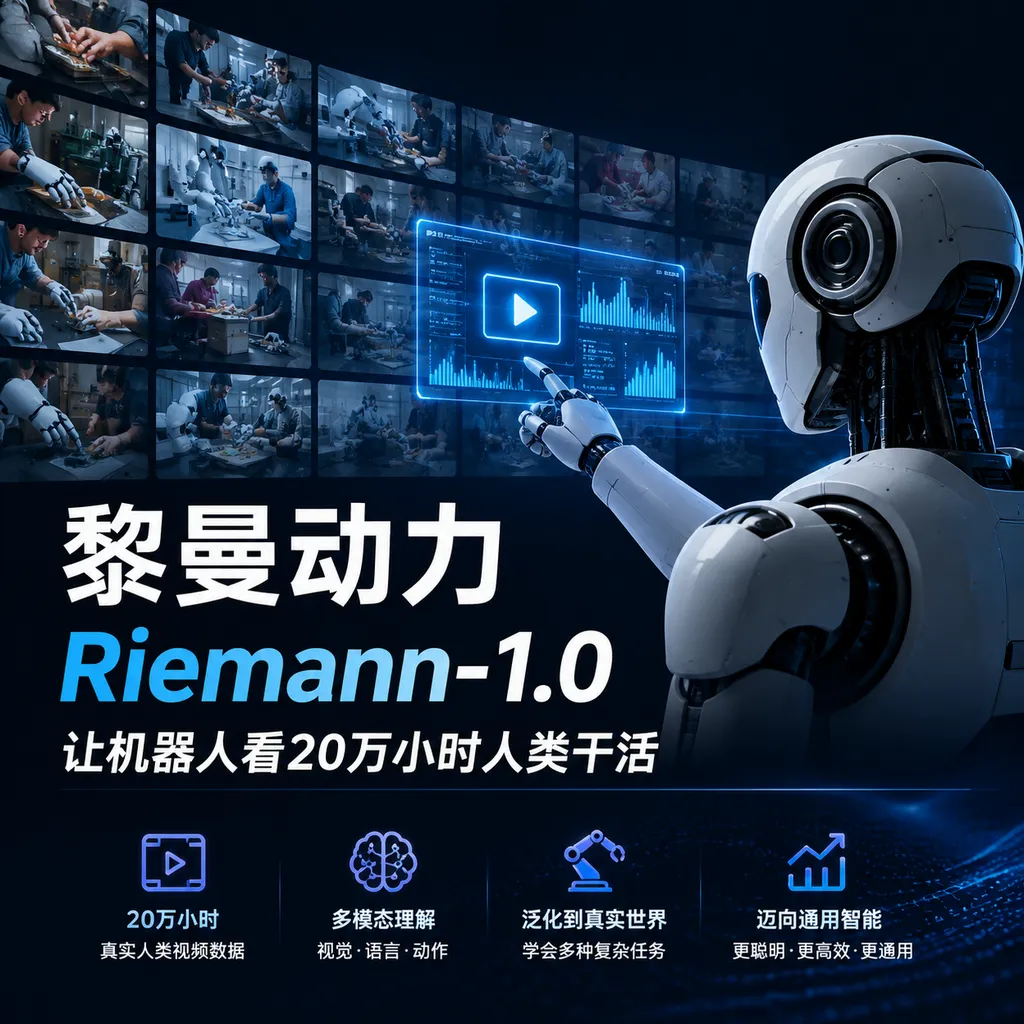
Riemann Dynamics, a subsidiary of Kunlun Wanwei, has released the general-purpose robotics model Riemann-1.0. Trained on 200,000 hours of human first-person task data, it achieves an average task success rate of 85%, outperforming the best open-source model by 15 percentage points.
Riemann Dynamics Releases Riemann-1.0: 200,000 Hours of Human Work Videos Power a General-Purpose Robotic Brain
Yesterday, Riemann Dynamics, a subsidiary of Kunlun Wanwei, officially released its general-purpose robot model Riemann‑1.0. The company has kept a low profile in the past, but this debut comes with some eye-catching figures: an average task success rate of 85.00%, a process completion rate of 94.43%, ranking first among all comparison methods and outperforming the best open-source model by 15 percentage points.
What’s even more notable is its training strategy — 200,000 hours of first-person human task videos. How large is that? For comparison: Galaxy General’s previous “world’s first robotic cerebellum GPT” used 20,000 hours of human motion data; 1X’s world model architecture behind the breakout NEO used 900 hours of first-person footage for mid-phase training. Riemann‑1.0 pushes that scale to a whole new level.
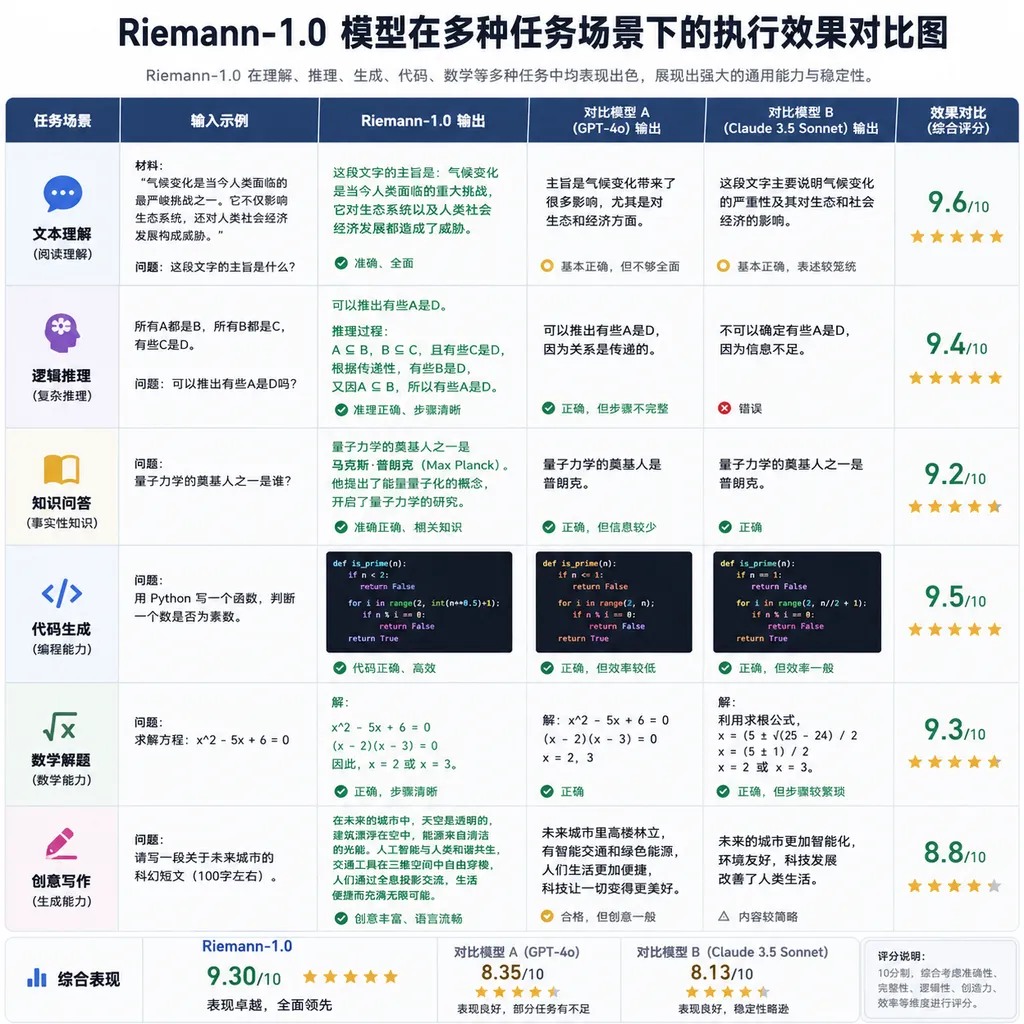
A Proven Path: Let Robots “Watch Humans Work”
Over the past two years, the large robot model field has seen several distinct approaches.
The earliest route was pure teleoperation — buy a bunch of robotic arms, hire operators, have them wear VR headsets for manual demonstrations, and collect data directly from the robots. The problem? It was insanely expensive and limited in scale. Everyone learned that the hard way during Google’s RT‑2 era.
Later, companies like Physical Intelligence (π0) and Figure took another approach: pretrain on massive amounts of human videos first, then align with a smaller set of robot-specific data. The core assumption: human motion intent, hand-eye coordination, and decision logic during task execution are the best “textbooks” — far cheaper than letting a robot learn everything from scratch.
Riemann‑1.0 follows this latter path but on a much larger scale. What does 200,000 hours mean? If a person works 8 hours a day, that’s the equivalent of one person working continuously for 68 years. And this dataset is first-person (egocentric) — the view from the operator’s eyes — which is critical because that’s the exact way a robot “sees” the world through its own sensors.
Why First-Person View Matters So Much
Third-person view videos — like those tutorial clips on YouTube — are of course useful, but they have a fundamental mismatch: the visual frame a robot “sees” during operation comes from its own cameras, which use a completely different coordinate system from an external shooter’s perspective.
For example, if you want to teach a robot to place a cup near the edge of a table, a third-person video would show hands, the cup, the table, and even the person’s body. But when the robot performs the task, its camera — usually on its head or chest — only sees the arm reaching out and the target object; the body itself is mostly invisible. This view difference makes spatial relationships learned during pre-training unusable later.
That’s why datasets like Meta’s Ego4D, 1X’s household first-person footage, and corporate data collected with head-mounted cameras all aim to solve exactly this issue. Riemann‑1.0’s 200,000 hours are largely an accumulation of this type of data.
What Does a 94.43% Process Completion Rate Mean?
Evaluating robot models by only their final success rate can be misleading.
Many tasks are long processes — e.g., “open a drawer, take out a box, put it on the table, close the drawer.” If you only count whether the box ended up on the table, you miss out on whether the robot stumbled midway or executed smoothly; the technical difference is huge.
The Process Completion Rate (Progress Score) measures how far along the task chain the robot got. Riemann‑1.0’s reported 94.43% means that even if it didn’t fully complete the task, it still made significant progress along the sequence. This matters a lot in deployment — on a factory floor, you don’t just care if a robot “eventually placed the box on the conveyor,” but also whether it gripped it correctly, followed the intended path, and placed it neatly.
How good is an 85% average success rate in today’s industry? As a reference:
- Galaxy General’s Wang He mentioned at the 2025 WRC that their handling robots are nearing factory deployment thresholds, with dozens expected to go live by year-end
- π0’s public manipulation tasks typically achieve success rates between 70% and 85%
- Most open-source VLA (Vision-Language-Action) models still struggle at 50–70% on complex tasks
So Riemann‑1.0 leading the best open-source model by 15 points is a solid, not inflated, figure.
Why Kunlun Wanwei Is Doing This
Many were surprised — isn’t Kunlun Wanwei focused on AIGC, the Opera browser, and its Tiangong LLM? Why make a robotic brain?
But zooming out, it’s not unexpected. By 2026, most Chinese foundational model companies face a choice: either keep competing on tokens, context length, and agent architectures — or expand into embodied intelligence.
Riemann Dynamics is a wholly owned subsidiary of Kunlun Wanwei, positioned to build the robot “brain,” not the physical body. The division of labor is clear — let Unitree, Zhiyuan, and Fourier handle hardware, while teams experienced in large-model training handle the model layer. This differs from Galaxy General’s integrated “body + model” approach and Unitree’s “hardware-first, exploratory modeling” route.
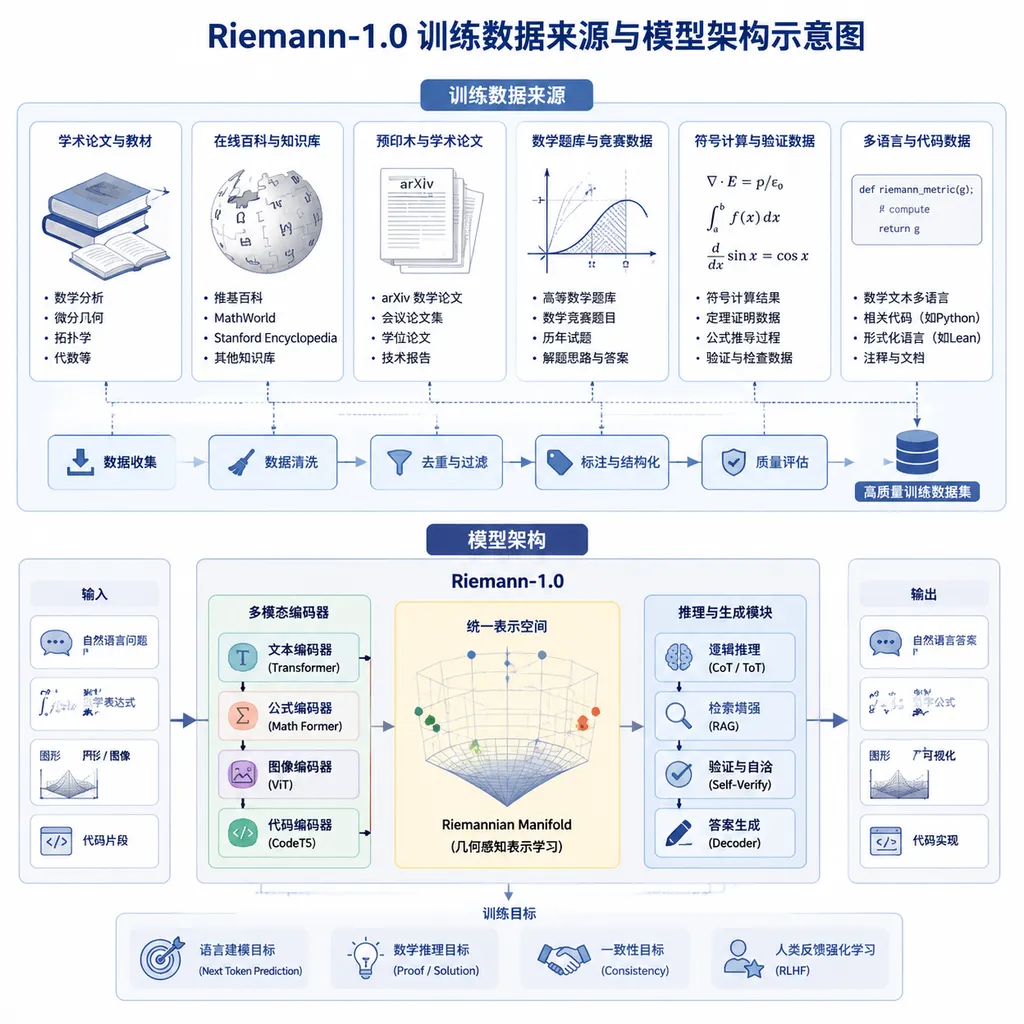
Where the 200,000 Hours of Data Come From
That’s the unavoidable question. Two hundred thousand hours of first-person human-task videos can’t just be scraped together casually.
Possible sources include:
- Public dataset mix: Ego4D (~3,670 hours), EPIC‑Kitchens (~100 hours), the Something‑Something series, HowTo100M’s first-person subset, etc. — altogether only around 5,000–8,000 hours
- YouTube/Bilibili mining: using OCR, pose estimation, and scene understanding to automatically filter first-person “work” videos — an almost unlimited pool
- Self-collected data: hiring people to wear cameras while doing tasks — costly but controllable
- Partner data: collected through partnerships in factories, retail, and home environments
Riemann Dynamics hasn’t disclosed details, but the 200,000-hour scale likely combines “public datasets + large-scale web mining + proprietary collection.” The hardest part isn’t gathering; it’s cleaning and alignment — labeling motion intent, target objects, and task boundaries so the model can learn meaningful representations.
The Inevitable Debate: Simulation vs. Real-World Data
Riemann‑1.0 uses real human video data, but another camp argues simulation is the future. NVIDIA’s Rev Lebaredian said bluntly at the 2025 WRC:
“If we can’t make simulation accurate enough to test robots, then we can’t make reliable robots.”
His logic: real data can’t cover every edge case — e.g., a child suddenly running in front of a car; you can’t ethically capture that in real life.
The real-video proponents counter: the sim-to-real gap is unsolvable in principle. No matter how precise a physics engine is, parameters like friction, material softness, lighting, and sensor noise will always differ from reality. Human video inherently contains physical intuition, intent reasoning, and scene diversity simulations can’t yet replicate.
Riemann‑1.0’s choice of real data seems to have worked — at least for manipulation tasks. But it’s too early to claim it’s superior to simulation-based approaches. Future systems will likely integrate both, just as language models now train on a mix of real and synthetic data.
What It Means for Developers
If you’re developing robotics applications, Riemann‑1.0 is noteworthy in several areas:
- Open-source VLA ecosystem: Current open VLA models include OpenVLA, RDT‑1B, and π0‑open. If Riemann‑1.0 later opens weights or inference APIs, it would become a strong new baseline.
- Data processing pipelines: cleaning 200,000 hours of data is an engineering feat — we’ll see if they release tools for it.
- New evaluation metrics like Process Completion Rate: future robot model benchmarking will use mid-progress metrics, not just binary success rates.
For developers doing multi-model comparisons, OpenAI Hub already lets you test major embodied-intelligence language models — GPT, Claude, Gemini, DeepSeek, etc. — under the same API key for easier robot Agent-level debugging.
A Longer-Term Outlook
Many dubbed 2025 the “first year of embodied intelligence,” but the real inflection point is more likely 2026–2027.
Wang He predicted at WRC: the output value of humanoid robots will grow tenfold every three years — from 1,000 units now to 10,000, then to 100,000. At tens of thousands of yuan per unit, 100,000 robots represent a 100‑billion‑yuan market — surpassing all current industrial robotic arms combined.
Wang Xingxing put it more bluntly: hardware is no longer the bottleneck — model generalization is. The Unitree R1 sells for ¥39,900, proving that costs are under control. The remaining question: who can build a truly general-purpose “brain”?
Riemann‑1.0 arrives at a beachhead moment. Its real capabilities await more third-party benchmarks and real-world deployment feedback, but it already demonstrates something important: Chinese teams building general-purpose robot models can now compete head-to-head with the global front-runners in both data scale and evaluation metrics.
The next question is — can it truly enter factories, stores, and homes? That’s the real finish line.
References
- Zhihu Discussion: The State of Embodied-Intelligence VLA Models — Discussions on vision-language-action technical paths
- Hugging Face – OpenVLA Project — Open-source VLA model benchmark for horizontal comparison with Riemann‑1.0
- Hugging Face – Ego4D Dataset — Resources for first-person human-activity datasets
- GitHub – Physical Intelligence π0 Implementation — Open-source reference for human-video pretraining methods