MiniCPM5-2B by Moonshot AI tops the AA leaderboard: The density law of edge-side models wins again
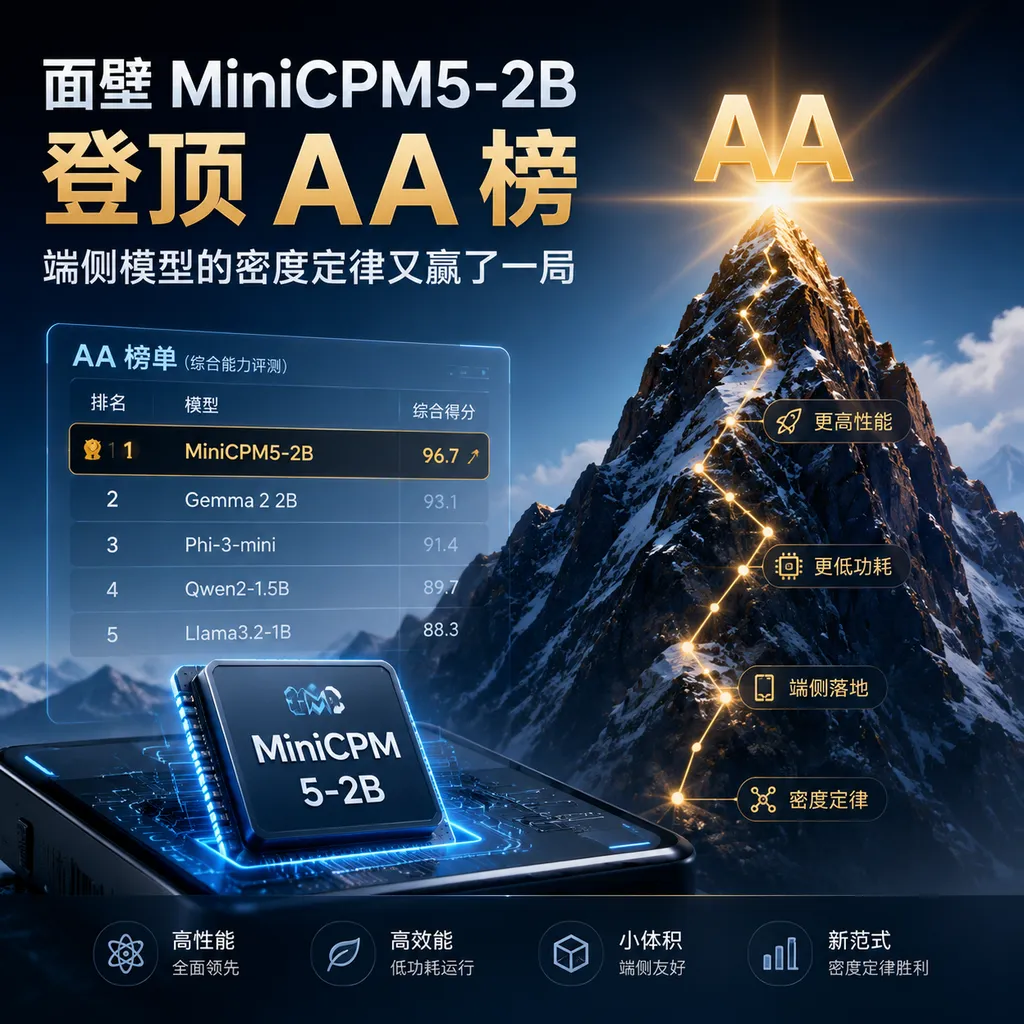
Wall‑Facing Intelligence released MiniCPM5‑2B at WAIC today. It achieved first place on the AA‑Index leaderboard in the under‑4B category with a score of 17. Featuring native hybrid reasoning and a 512K context window, it supports mainstream chips on Day 0 and will be open‑sourced soon.
On July 19, at the 2026 World Artificial Intelligence Conference (WAIC), ModelBest AI and OpenBMB jointly unveiled the new-generation on-device flagship MiniCPM5-2B. The highlights are clear: on the Artificial Analysis (AA) leaderboard, it scored 17 points, topping the global sub-4B parameter category. It also achieved full on-device adaptation for chips from AMD, Intel, MediaTek, and Qualcomm, while collaborating with the FlagOS community to achieve Day 0 readiness for nine domestic and NVIDIA chips.
After more than two years of competition in the on-device field, the “small model catching up with large models” story has been told many times. But ModelBest’s performance this time deserves a deeper look—not for the good score, but because it pushes forward the boundary of “what on-device models can do.”
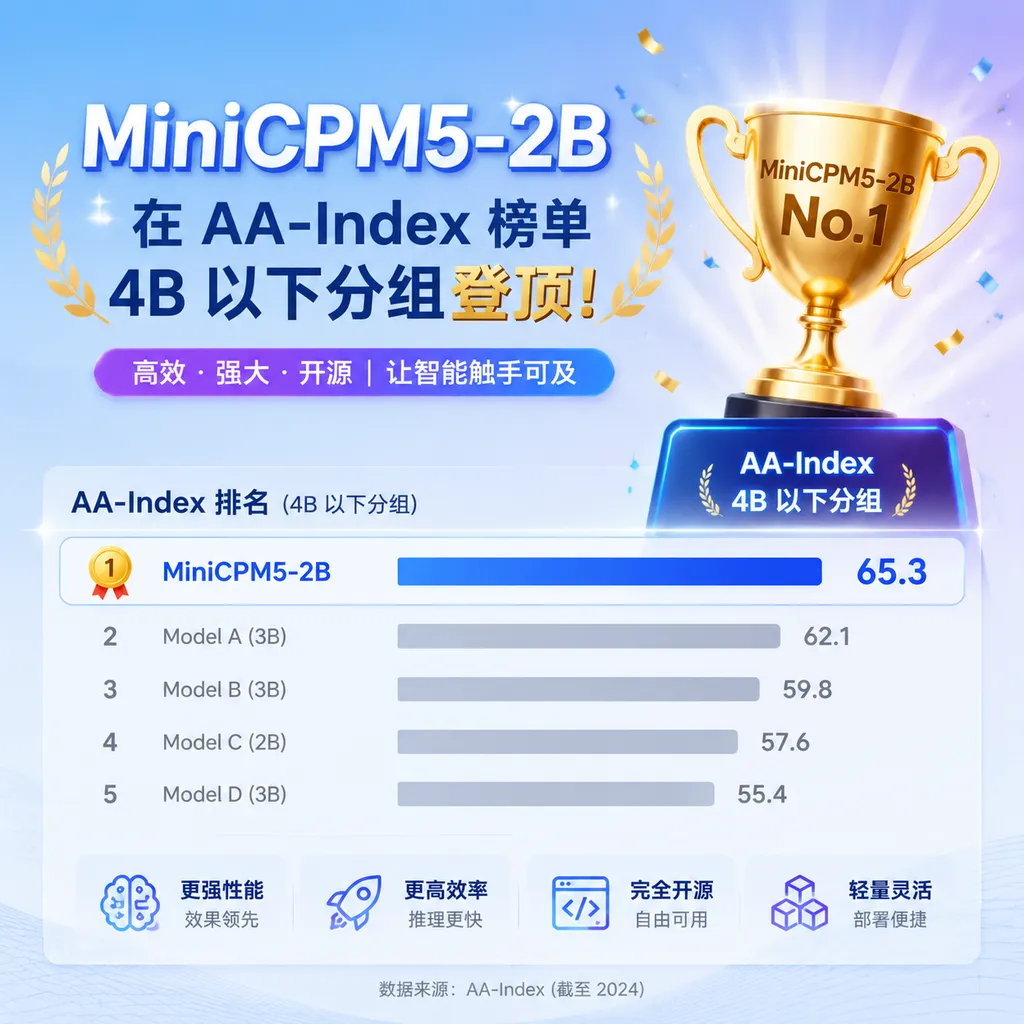
What does a score of 17 mean?
First, to clarify: the AA-Index is a comprehensive capability benchmark maintained by Artificial Analysis. It covers tough tests like MMLU-Pro, GPQA Diamond, AIME, LiveCodeBench, SciCode, and HumanEval. Unlike Chinese-oriented benchmarks like SuperCLUE, AA-Index is entirely in English, focusing on reasoning and coding—making it a go-to metric for overseas developers choosing models.
What does 17 points mean for the sub-4B category? As a reference, the previous champion two months ago was ModelBest’s own MiniCPM5-1B, the first sub-4B model to outperform all 2B-scale competitors. Now, the 2B model hitting 17 points brings it close to models like Qwen3-4B and Llama-3.1-8B—halving the parameter count without losing performance.
Behind this lies ModelBest’s repeatedly emphasized “Density Law”: improving model capability isn’t just about parameter count, but how much knowledge and reasoning can fit per parameter. Back in December 2024, they released a projection predicting that by 2026, on-device models could reach parts of GPT-4o’s ceiling. The MiniCPM5-1B fulfilled that curve in May 2026, and now the 2B version continues right on schedule.
Hybrid Thinking and 512K: On-device models start thinking
The most interesting change with MiniCPM5-2B is that it natively supports hybrid thinking. Quick Q&A takes the fast path, while math problems, coding challenges, and long-chain reasoning switch to the think mode. This mechanism isn’t new for cloud models (Claude, Gemini, the “o” series all use it), but integrating it into a 2B on-device model is another matter—where inference cost is minimal and flexibility still needs to be preserved, it’s an engineering feat.
It also features a 512K context window. The number sounds huge, but its meaning differs from cloud scenarios:
- On the cloud, 512K means “you can stuff in more documents.”
- On-device, 512K means “your phone can hold the entire Three-Body Trilogy or a hundreds-thousand-line monorepo.”
Most importantly, all of that data stays on the device. Long-context processing has real privacy significance only on-device. For instance, in a future smart cockpit, a model could analyze six months of driving history, schedules, and contact lists locally—tasks the cloud would never dare touch.
Agent capabilities: the real differentiator for the 2B model
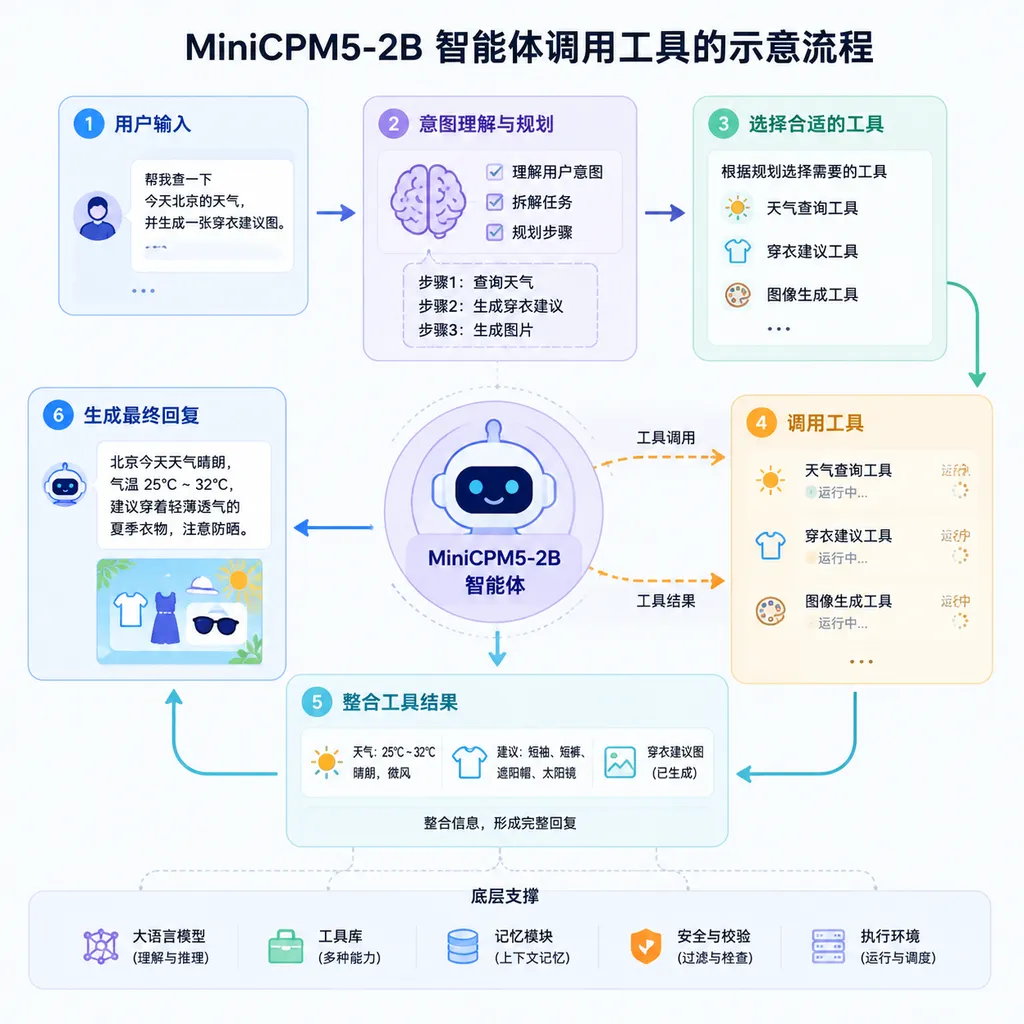
If it were just about scoring high or handling longer context, this piece wouldn’t need to be so long. What truly sets MiniCPM5-2B apart from “just another small but strong model” is its agent training pipeline:
- Agent Midtraining: 200B-token midstage training focused on tool use, task decomposition, and multi-step planning.
- Agent SFT: supervised fine-tuning with over a million high-quality trajectory samples.
- Agent RL: scalable reinforcement learning alignment that prioritizes behavioral stability.
By comparison, most small models train a base model and then do a brief SFT with a few tens of thousands of function-calling examples. Starting agent training from midtraining is almost unheard of at the 2B scale.
The result: it can serve directly as an on-device agent base model. Whether it's a local smartphone assistant, PC copilot, in-car voice butler, or the planning layer in a robot system, this model can handle it without needing a cloud planner + on-device executor setup. It can run fully locally.
This, arguably, matters even more than topping the AA leaderboard—because what limits on-device commercialization isn’t benchmark scores, but whether it can reliably complete full tasks locally. Unstable tool calls, hallucinations, or poor instruction adherence make product teams hesitate.
Chip adaptation: truly “compatible with everything”
Another pain point for on-device models is hardware fragmentation. The same model behaves very differently on Snapdragon 8 Gen 4 versus MediaTek Dimensity—performance, power, and memory usage all vary. Add PC x86/ARM chips, in-car Qualcomm 8295, and domestic chips like Ascend or Cambricon, and adaptation alone can sink a small team.
ModelBest’s solution:
Primary commercial platforms adapted at launch (alphabetical):
- AMD
- Intel
- MediaTek
- Qualcomm
Day 0 adaptation (with FlagOS community) for nine chips:
- Huawei Ascend
- Hygon
- Kunlunxin
- Muxi
- Moore Threads
- Pingtouge
- Qingwei Intelligence
- TianShu AI
- NVIDIA
Also extending to general ARM on-device platforms.
“Day 0 adaptation” means that on the day of open-source release, ready-to-use deployment images and inference frameworks are already available for the respective chips—no need to wait months for vendors to catch up. Very few models (DeepSeek being one) offer such treatment for domestic chips.
For developers, this compatibility list almost covers every available compute option in China. Whether you’re integrating into consumer hardware or doing localized enterprise deployment, this saves massive integration effort.
How it stacks up against competitors in its class
The 2B on-device space is quite crowded now:
- Qwen3-1.7B / 4B — from Alibaba: solid general capabilities, strong in Chinese, but less aggressive in agent training.
- Gemma3-2B — from Google: excels in long context and multimodality, weaker in Chinese and agent ability.
- Phi-4-mini — from Microsoft: strong on reasoning, but conservative on ecosystem adaptation.
- Llama-3.2-1B / 3B — from Meta: widely used baseline, but being steadily overtaken.
MiniCPM5-2B’s differentiation path is clear: AA score + native agent + full chip support + 512K long context—four strengths combined. Every single one can be matched by others, but no other 2B model currently combines all four.
Of course, leaderboard results aren’t everything. AA-Index is just one benchmark. Real-world tasks (especially long Chinese text, complex RAG, structured output) still need developer testing. Topping a leaderboard is just a ticket to enter the game.
Open-source timeline and usage guide
Official statement: coming soon, with weights available via Hugging Face and ModelScope, along with platform-specific deployment images and guides.
Going by past MiniCPM releases, “coming soon” usually means within days or up to two weeks. Given that this time they’re releasing the chip adaptation images simultaneously, we can expect to be hands-on on day one.
Practical advice for developers:
- For mobile tests, once weights appear on Hugging Face, use llama.cpp / MLC-LLM; after INT4 quantization, the 2B model takes around 1.5 GB VRAM.
- For agent applications, check the tool-calling schema—likely OpenAI function-calling compatible.
- For domestic chip deployments, use FlagOS’s prebuilt images to save time.
- For long-context use, while 512K is the theoretical limit, start with 32K–64K to evaluate performance given memory and latency constraints.
The on-device route is becoming viable
Before 2024, on-device models were often seen as “downgraded cloud alternatives”—usable but not serious. That’s changing fast: Apple put a 3B model into iOS for system-level AI; Qualcomm and MediaTek have boosted NPU power every generation; Google rolled out Gemini Nano across all Pixels; Microsoft’s Copilot+ PCs made “local large-model inference” a selling point.
ModelBest, however, takes a purist path: it’s not bound to any specific hardware vendor but instead focuses on maximum on-device model density—then open-sources it for the entire ecosystem. The advantage is a deep moat: once the Density Law curve is accepted, the fastest runner on it captures most of the value.
From MiniCPM-2B (Feb 2024) → MiniCPM3-4B → MiniCPM4 → MiniCPM5-1B (May 2026) → MiniCPM5-2B (today), the update pace in the 2B/4B range has been nearly monthly. Many companies work on on-device models, but only ModelBest has maintained this rhythm for over two years.
It’s also worth noting that the spread of on-device models directly affects cloud API pricing logic. Once a 2B model can reliably run agents locally, simple chat or light tool-use scenarios no longer require cloud calls. Cloud APIs will be reserved for heavy reasoning tasks—a slow but deep shift in the market’s price structure.
For cloud aggregation platforms (like OpenAI Hub, which lets one key access multiple APIs), this on-device/cloud split brings clarity: light, privacy-sensitive tasks move on-device; heavy reasoning, multimodal, or ultra-long-context tasks stay cloud-based. Developers now choose not whether to use LLMs, but which LLM to use for which task—the true form of on-device and cloud coexistence.
In one sentence
MiniCPM5-2B isn’t just another high-scoring small model—it’s further proof that “on-device models can seriously handle agent tasks.” Once it’s open-sourced this week, every developer building on-device applications should give it a spin—especially teams still struggling with “agents that can’t run locally.”
References
- ModelBest releases the on-device model MiniCPM5-2B, topping the AA-Index sub-4B category – IT Home — Official release details and technical summary
- ModelBest and Tsinghua open-source the MiniCPM on-device language model – Zhihu — Background and route overview of the MiniCPM series
- Strongest on-device model: MiniCPM ranks high on the SuperCLUE leaderboard – Zhihu — Historical benchmark performance reference