Facing the wall, pushing VLA to 1.5B: MiniCPM-Robot is open-sourced, charging into the first tier of embodied intelligence
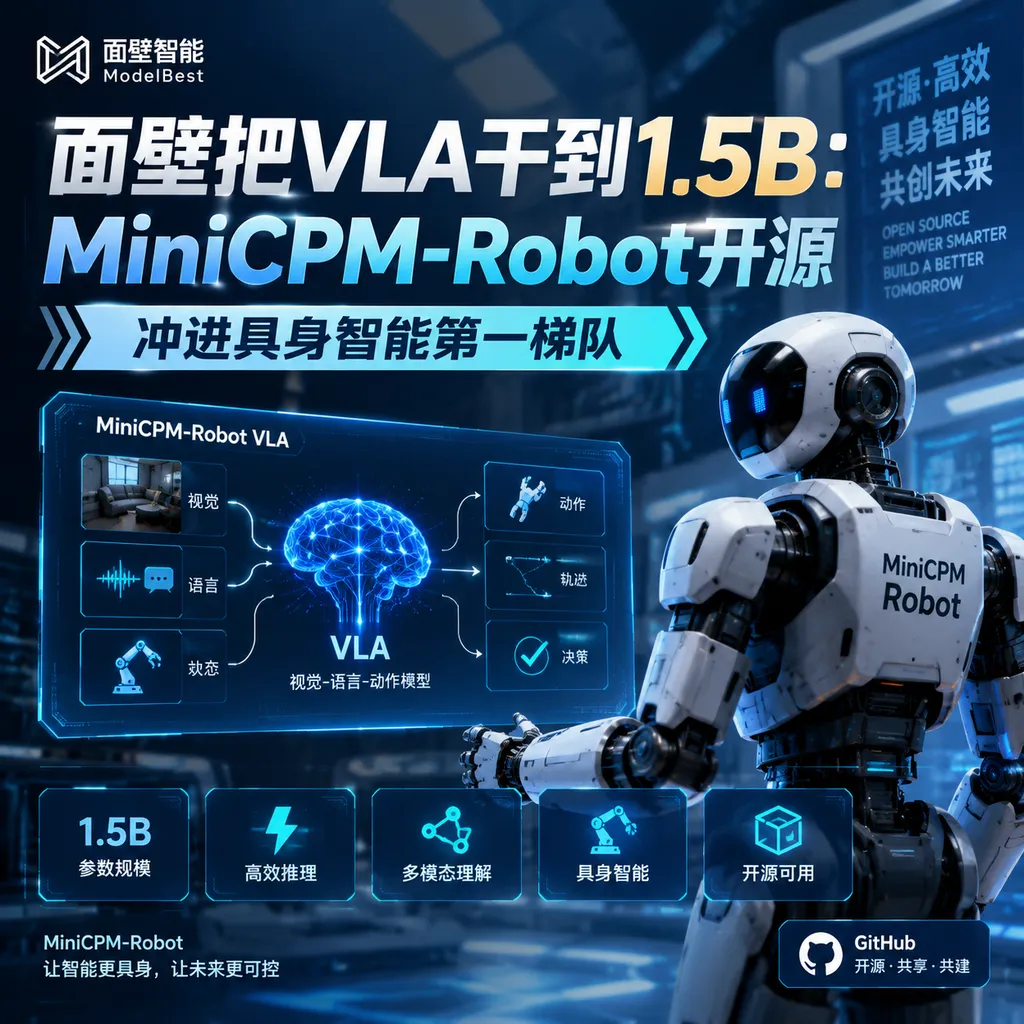
At WAIC 2026, MiniCPM-Robot series was open-sourced by Moonshot AI. Its 1.5B-parameter VLA model has matched or even surpassed 7B-level counterparts on multiple benchmarks, lowering the threshold for embodied intelligence to the edge side.
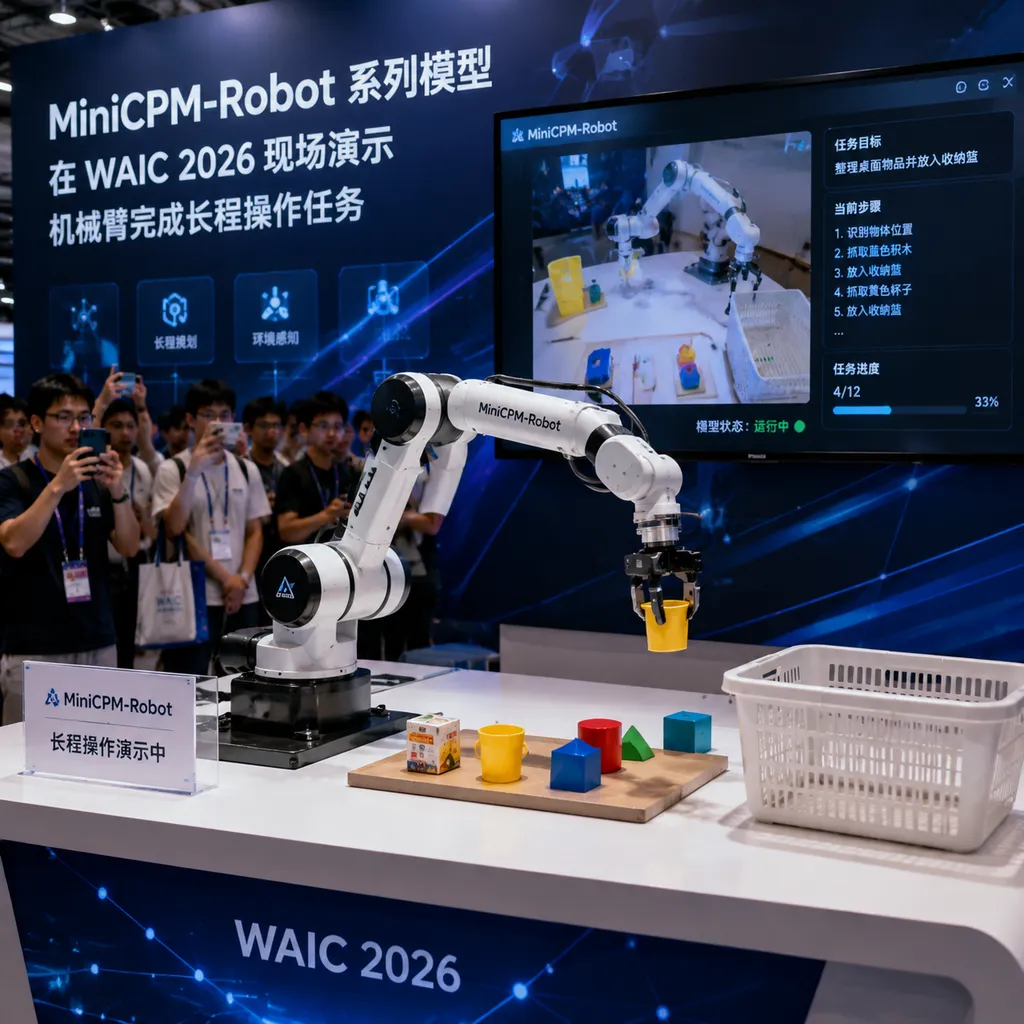
In July at the Shanghai World Expo Exhibition & Convention Center, on the opening day of WAIC, Frontis Intelligence unveiled its first “official foray into embodied intelligence” at booth H1‑C730 — the MiniCPM‑Robot model series, now officially open‑sourced.
The most striking number is 1.5B — the parameter count of its flagship general‑purpose VLA (Vision‑Language‑Action) model. For comparison, over the past year, almost every model claiming to be a "general embodied large model" has started at 7B parameters or above: names like π0, OpenVLA, and RDT often reach tens of billions. Frontis has scaled the parameters down by an order of magnitude — and still claims it has entered the first tier.
First things first: What is a VLA, and why does 1.5B matter?
Unlike pure language models, a VLA must perform three jobs simultaneously: see (Vision), understand commands (Language), and output actions (Action). Traditional robot control follows a three‑stage “perception–decision–execution” pipeline glued together by hand‑written rules. A VLA instead packs the entire loop end‑to‑end into a neural network: given a command like “hand me the red cup on the table,” the model looks at the scene, plans, and outputs motor instructions on its own.
That sounds elegant, but it’s costly. Embodied environments are extremely sensitive to latency — if the model inference lags by half a second, the object’s position may shift, resulting in a miss or even a collision. Hence the industry’s long‑standing dilemma: models that run well in the cloud can’t be deployed on‑robot, while models small enough to fit on‑device can’t handle complex tasks.
Most teams compromise somewhere around 7B parameters; going smaller usually hurts performance. Frontis achieving 1.5B and still performing competitively stems from extending its “small‑model high‑density” philosophy from the MiniCPM‑V series into the action domain. According to its own “density law,” the parameter count required for a given intelligence level halves every 3.5 months — proven once for language models, now tested on VLAs.
What exactly is the MiniCPM‑Robot series?
It’s a series, not a single model. According to public information from Frontis, it includes two components:
- MiniCPM‑Robot‑1.5B – the main general‑purpose VLA model, end‑to‑end “image + instruction → action,” 1.5 billion parameters, optimized for edge deployment
- A complementary base vision‑language model, essentially the “eyes and brain” of the VLA, usable on its own
The design is straightforward: use a strong VLM backbone to handle world understanding, then attach an Action Head for world manipulation. This architecture is mainstream — Physical Intelligence’s π0 and ByteDance’s GR‑2 follow similar patterns — but Frontis’s backbone is its own mature MiniCPM‑V. Since v4.6, downloads have surpassed 2 million in under two months, once topping Hugging Face Trending, with publicly verified multimodal understanding capabilities.
In short, MiniCPM‑Robot isn’t starting from scratch — it refines an already powerful VLM and extends it into the action space.
How does 1.5B compete with 7B?
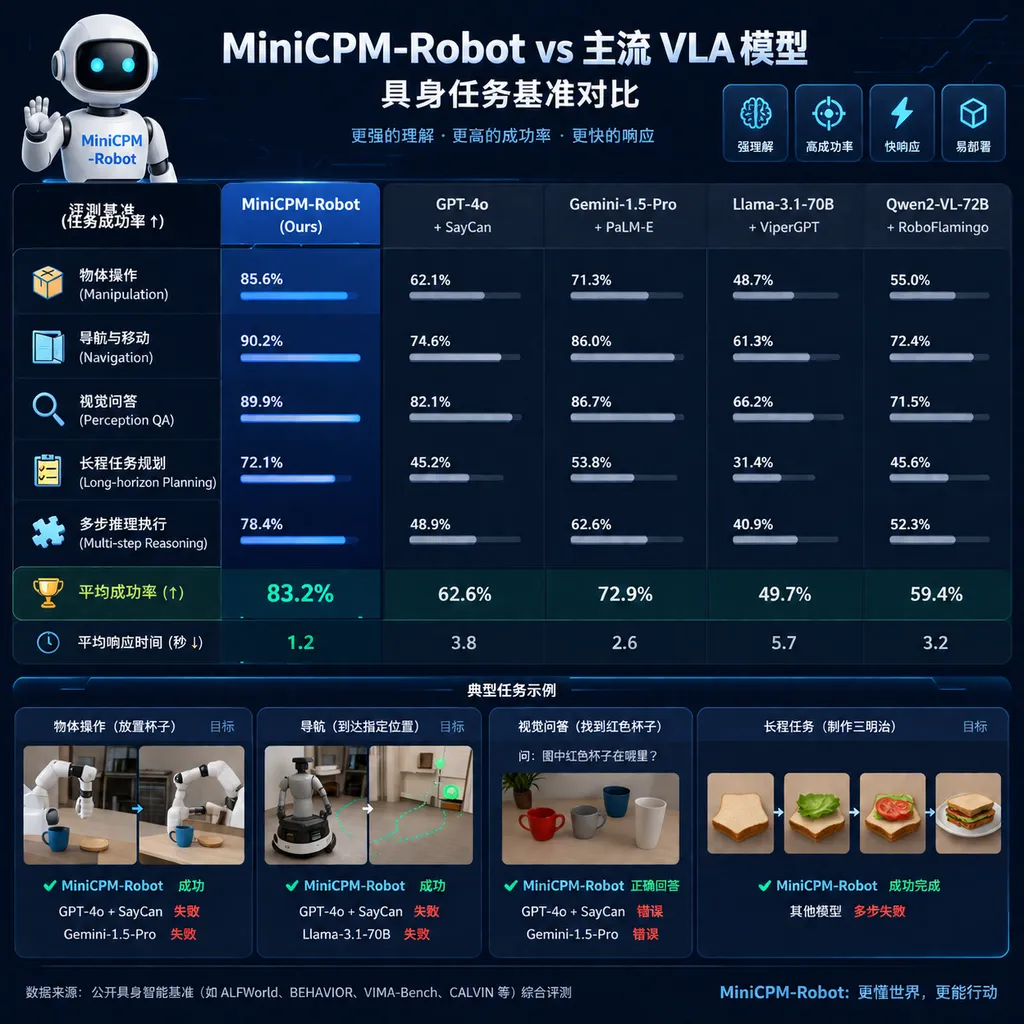
That’s the key question. According to Frontis’s disclosed benchmarks, MiniCPM‑Robot‑1.5B matches or surpasses open‑source 7B‑class SOTA VLAs across several embodied‑AI benchmarks.
Technically, several factors stand out:
1. Efficient action tokenization.
VLA models must discretize continuous joint angles and positions into tokens. The token granularity determines whether the model can learn effectively. Frontis’s custom tokenizer allows a 1.5B model to cover the resolution required for fine manipulation — essentially the same “use architecture to trade for parameters” philosophy that once enabled MiniCPM’s compressed language tokens.
2. Data pipeline.
Data, not algorithms, is the bottleneck for embodied models — real‑world data collection is prohibitively expensive. Instead of Tesla‑style massive real‑world datasets, Frontis uses a hybrid of simulation + real‑robot + human‑video data, scaling generalization first, then aligning with real data. The advantage: cheaper and more scalable; the challenge: robust sim‑to‑real transfer.
3. Reuse of the VLM backbone.
Since MiniCPM‑V 4.6 already leads among edge‑deployed multimodal models, its visual understanding is “gifted” to the VLA. Competitors at 7B often train vision encoders from scratch or patch in CLIP, putting them at a disadvantage from the start.
Keep calm: Is 1.5B really enough?
A dose of realism: matching 7B on benchmarks doesn’t equal “working reliably in the open world.” Current embodied benchmarks — CALVIN, LIBERO, SimplerEnv — cover constrained tasks; long‑horizon control, complex interaction, and cross‑scene generalization remain shared weaknesses.
Frontis has been explicit about its deployment focus: exhibition‑guide agents and campus inspections — structured, well‑bounded domains. The guide robot, built with Lewdow Robotics, runs entirely offline on‑device with a local knowledge base, multilingual narration, and obstacle‑avoiding navigation. The inspection robot detects illegal parking, pavement anomalies, and facility faults while keeping all data onsite.
These choices are pragmatic. Today’s truly commercializable embodied‑AI use cases are those “semi‑open, well‑defined, reliability‑driven” ones — not the “general household butler” vision big techs tout. Frontis’s stance is notably pragmatic.
Commitment to the edge route
Frontis has been an “edge‑side advocate” since 2024, and its embodied push is no exception. Running the VLA directly on‑robot — without the cloud — is nearly mandatory:
- Latency: cloud round‑trip can be hundreds of ms — the arm has already moved.
- Data sovereignty: factories, campuses, and homes can’t let data leave premises.
- Network robustness: a robot can’t brick itself just because Wi‑Fi drops.
At 1.5B parameters, with quantization, the model fits mainstream robotic control boards (e.g., Jetson Orin). That’s the real commercial weight of “1.5B”: not prettier benchmarks, but actually runnable on the robot itself.
Competitors in sight
Zooming out, the 2026 embodied‑AI open‑source track is crowded:
- Physical Intelligence (π‑series): star team; π0.5 is exploring cross‑form‑factor transfer, but with larger models.
- ByteDance GR‑series: GR‑2 handles long‑horizon tasks well, but isn’t fully open‑source.
- AI² Robotics: launched an all‑in‑one embodied‑AI community in April, emphasizing full‑stack tooling.
- RDT, OpenVLA: early open‑source releases, now outperformed by newer generations.
Frontis’s differentiation is clear: while others compete on generality and size, it competes on parameter efficiency and edge deployment. That niche matters — most small and mid‑size robotics firms can’t afford to train a 7B VLA. An open‑source 1.5B model with fine‑tuning is practically their best starting point.
Open questions
- Fine‑tuning practicality: while officially supported, collecting embodied fine‑tuning data, determining quantity, and cross‑morphology transferability all await community experience.
- Action‑precision ceiling: where’s the 1.5B limit? Tasks needing force feedback, bimanual coordination, or intricate assembly may still require larger models.
- Community ecosystem: VLA tooling lags far behind LLMs (datasets, fine‑tuning tools, benchmarks). Whether Frontis can replicate the successful MiniCPM‑V community playbook remains to be seen.
A quick side note
Although MiniCPM‑Robot is an open‑source model (weights downloadable from Hugging Face; link below) and runs locally, it differs from closed‑source API models. For projects that combine GPT, Claude, Gemini, etc. for high‑level planning — say, letting a cloud LLM decompose “clean the room” into subtasks for a VLA to execute — API‑hub services like OpenAI Hub save you from juggling multiple keys and SDKs with one universal OpenAI‑compatible key and domestic access. But the VLA itself should still be run locally with open‑source weights.
Final thoughts
The strategic signal here outweighs the raw technical novelty. A 1.5B general‑purpose VLA lowers the embodied‑AI entry barrier from “toys of big labs” toward “robots that small teams can actually run.”
The open‑source MiniCPM line has surpassed 38 million downloads; production multimodal variants already run in cars such as Changan Mazda EZ‑60 and Geely Galaxy M9, with collaborations under way on Samsung flagships. Over the past two years, this Tsinghua‑affiliated company has validated the feasibility of the edge‑side paradigm in language, vision, and speech — now it’s applying the same methodology to robotics.
If this path succeeds, “embodied intelligence” will no longer be confined to elite laboratories — it will, like today’s LLMs, become something every developer can use. This is just the beginning.
References
- Tsinghua‑affiliated ¥20 billion unicorn enters embodied intelligence, solves memory bottleneck — detailed Zhihu report on the MiniCPM‑Robot release
- Embodied‑AI Open‑Source Daily — 2026‑04‑22 — overview of the embodied‑AI open‑source ecosystem
- MiniCPM series on Hugging Face — Frontis Intelligence (OpenBMB) organization, MiniCPM‑Robot weight downloads