
Hermes: The AI Agent has developed an operating system.

With its self-evolution mechanism powered by Skill and three-layer memory architecture, Nous Research’s Hermes Agent has gained 47,000 GitHub stars in just two months, pushing the Agent framework from one-off scripts toward a new stage of self-managed AI operating systems.
Hermes Agent Is Not Just Another Agent Framework—It Wants to Be Your AI Operating System
Over the past two months, Nous Research’s Hermes Agent has gained 47,000 GitHub stars and topped the GitHub Trending chart. Someone in the community summed it up with one line—“it’s like raising your own operating system.”
That description isn’t exaggerated.
In the past year, agent frameworks have sprung up everywhere—from LangChain to AutoGPT to OpenClaw—each tackling the same problem: “how to make large models use tools.” But Hermes Agent is different. It doesn’t settle for being a temp worker that forgets everything once a task is done; it aims to become a permanently running system that gets smarter and evolves with use.
That means the competition among agent frameworks is shifting—from “who has the richer toolchain” to “who can achieve true system-level self-management.”
Core Selling Point First: Skill Self-Evolution Loop
Most agent frameworks follow the same workflow: receive command → break down tasks → call tools → return result. When the same task appears again, they start from zero and remember nothing.
Hermes Agent adds a key component—experience accumulation.
When you ask it to handle a complex task, such as “deploy a PostgreSQL cluster with Docker, configure master-slave replication and automatic backup,” it doesn’t just finish and leave. After the mission ends, Hermes automatically generates a structured Skill document (SKILL.md) containing the task objectives, chosen toolchain, pitfalls encountered, final solution, and verification steps.
Next time you face a similar task, it simply loads that Skill and skips the trial-and-error stage.
Even better, if it discovers a more optimal solution during execution—for example, a lighter Docker image or a cleaner docker-compose configuration—Hermes updates the Skill document proactively, keeping the version history. This forms a complete closed loop:
Create Skill → Use Skill → Find Gaps → Update Skill → Use Again
In plain language: the first time it’s a newbie; the second time it’s proficient; the third time it might know the task better than you.
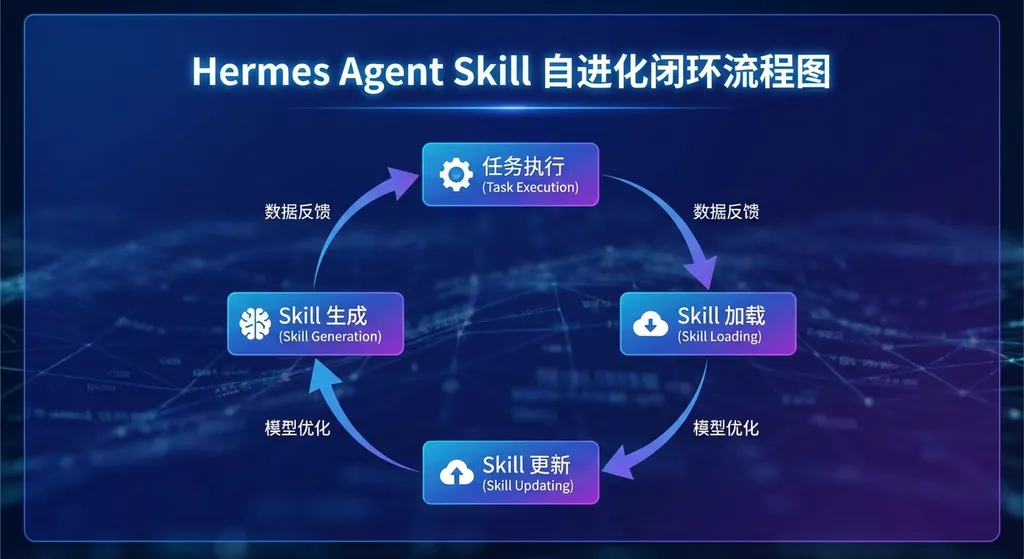
In practical tests, developers used Hermes for AI news crawling. The first time, it scraped data clumsily and generated an initial Skill. The second time, it loaded that Skill but noticed that some websites changed their structures, so it automatically adjusted its logic and updated the Skill. By the third round, the entire process ran smoothly.
It’s not magic—essentially, it structures and stores the agent’s trajectory, then retrieves and reuses it for future tasks. But Hermes makes this a first-class citizen of the framework, sparing developers from assembling it themselves.
Three-Layer Memory Model: From "Goldfish Memory" to "Veteran Employee"
The Skill system runs on Hermes’s three-layer memory architecture.
The first layer is working memory, which tracks the current conversational context—standard practice, nothing special.
The second layer is episodic memory, logging key events and preferences from past interactions. For instance, you prefer pnpm to npm, your projects use ESLint flat config, and you dislike writing any in code—these preferences are persisted and automatically loaded next time.
The third layer, as mentioned earlier, is Skill memory, which stores structured problem-solving abilities.
Together, these three layers work like this: working memory tells it what you’re doing right now, episodic memory tells it who you are and what you like, and Skill memory tells it how to solve this kind of problem.
Think of it like this: a normal agent is like grabbing a random person in a café to help you out; Hermes is like a personal assistant who’s been with you for three years—knows your habits, understands your projects, and even optimizes your workflows without being asked.
When conversations get long and approach the model’s context limit, Hermes doesn’t just truncate history—it calls the LLM to summarize and compress past messages into a few key points, preserving continuity while freeing up token space. A small detail, but it makes a huge difference for long-running tasks.
40+ Built-in Tools—But It’s Not About the Numbers
Hermes Agent comes with over 40 built-in tools covering MLOps, GitHub operations, web browsing, terminal commands, visual understanding, TTS, and more. Nothing extraordinary in quantity—the interesting part is how it manages them.
All tools use a self-registering system. Each tool file actively calls registry.register() when imported to add itself to the registry. Want to add a new tool? Just create a Python file, implement register(), drop it into the tools directory, and restart—no need to touch core code.
# Custom tool example: register a simple text summarization tool
from hermes.tools.registry import registry

@registry.register(
    name="text_summarizer",
    description="Generate a summary for input text",
    toolset="nlp"  # Toolset grouping
)
def text_summarizer(text: str, max_length: int = 200) -> str:
    # You can call any LLM API here to generate the summary
    pass
Tools also support Toolset Grouping, which enables or disables them by environment. For instance, when running in Telegram, you disable the terminal toolset—nobody wants someone executing rm -rf / through a chat window. In local CLI mode, you can enable everything.
This design feels very “operating system-like”: a lightweight core scheduler with pluggable modules and environment-based permissions.
Agent Loop: The Complete Lifecycle of a Request
Hermes’s Agent Loop is finely engineered. From input to completion, a single request goes through these stages:
User input
├── Load episodic memory + retrieve relevant Skills
├── Build API request (model, messages, tools, reasoning config)
├── Call LLM
│   ├── Plain-text response → return directly
│   └── Tool invocation request
│       ├── Execute tool
│       ├── Inject result into context
│       └── Loop back to LLM call
├── Context compression (when nearing token limit)
└── Task complete → trigger Background Review
Three mechanisms stand out:
Delegate Task (Parallel Subtasks): When subtasks can run in parallel, Hermes splits them into multiple child Agents to execute simultaneously instead of waiting sequentially—for example, fetching documentation from three APIs at once.
Background Review (Experience Extraction): After task completion, Hermes asynchronously analyzes the execution trace, distills reusable insights, and updates the Skill system without blocking the user.
Context Compression: The automatic summarization mentioned earlier is built into the Loop—no manual management required.
Seamless Cross-Platform Sessions: One Agent, Everywhere
Using the hermes gateway command, a single Hermes instance can simultaneously connect to Telegram, Discord, Slack, WhatsApp, Signal, and even Home Assistant.
You can send a deployment task via Telegram on the subway, check progress on Slack at the office, then ask for results through your voice assistant at home—all with shared memory and continuous context.
For those treating Hermes as a personal AI assistant, this is crucial. It’s no longer tied to one chat window but acts as a persistent, cross-platform service.
Open Ecosystem: agentskills.io
Hermes’s Skill system follows the agentskills.io open standard. This means:
- You can export and share the Skills you’ve trained
- Other people’s Skills can be imported into your Hermes instance
- In theory, Skills can interoperate between different agent frameworks
As one analogy puts it: it’s like Docker Hub, except instead of sharing container images, you’re exchanging structured problem-solving capabilities.
If this ecosystem succeeds, it means agents no longer start from scratch. Deploy a fresh Hermes instance, import a batch of high-quality Skills from the community, and you instantly have an “experienced employee.”
Security: B+ Rating, Still Room for Improvement
Community testing gave Hermes Agent a B+ security rating—it intercepted 6 out of 10 injection attempts and exposed 3 high-risk vulnerabilities.
Frankly, that’s not impressive. For a framework positioning itself as a “resident AI operating system,” security should be the top priority. After all, it has terminal execution rights, persistent memory, and cross-platform integration—any malicious injection could have more serious consequences than with a typical Agent.
The toolset grouping mechanism does provide some defense: you can disable risky toolsets on public channels (like Telegram groups) and enable full capabilities only in trusted environments. However, that’s more of a workaround; true security hardening at the framework level will require ongoing investment.
Where Does Hermes Stand Among Competitors?
The main players in the agent framework race have increasingly distinct positions:
- OpenClaw: Focuses on tool ecosystem breadth; rich plugin market but recently plagued by stability issues—many users are seeking alternatives.
- Claude Code: Focuses on coding depth; designed by Anthropic to pair tightly with Claude models, though its scenarios are limited.
- Hermes Agent: Prioritizes long-term companionship and self-evolution; sacrifices some out-of-the-box convenience for true personalization.
Hermes’s drawbacks are clear too: documentation is still under development, the community is smaller than the other two, and onboarding requires more technical know-how. But its Skill self-evolution mechanism is truly unique—others either haven’t built it or haven’t systematized it as well.
From a broader perspective, Hermes represents a shift: agent frameworks evolving from the “tool invocation layer” to the “system layer.” They used to focus on “how to make LLMs call tools”; now the question is “how to make agents accumulate persistent capabilities and manage themselves.” It mirrors the history of OS evolution: from batch processing to time-sharing to modern systems—moving from “run and terminate” to “persist, manage resources, and retain state.”
What This Means for Developers
Hermes Agent is fully open source under the MIT license. Its underlying model calls comply with the OpenAI API format, allowing easy switching between LLM backends.
If you want to quickly test how different models perform in Hermes, try an API aggregation service like OpenAI Hub to toggle between GPT, Claude, Gemini, DeepSeek, etc., using a single key. Configuration is simple—just change base_url:
import openai

client = openai.OpenAI(
    api_key="Your OpenAI Hub Key",
    base_url="https://api.openai-hub.net/v1"
)

# Point Hermes configuration to this client
# and seamlessly switch among GPT-4o, Claude 4 Sonnet, Gemini 2.5 Pro, etc.
response = client.chat.completions.create(
    model="gpt-4o",  # or claude-4-sonnet, gemini-2.5-pro, deepseek-r1, etc.
    messages=[{"role": "user", "content": "Analyze performance bottlenecks in this code"}]
)
Different models behave very differently in agent scenarios—those with strong reasoning excel at task decomposition; large-context models handle long tasks better; faster-response models feel smoother during multi-tool loops. Experiment to find your best-fit combination.
Final Thoughts
Hermes Agent’s achievement of 47K GitHub stars in two months proves there’s genuine demand for “self-evolving agents.” People are tired of agents that reset every conversation; they want one that learns continuously and gets more capable with use.
But stars don’t equal maturity. Hermes is still in rapid iteration—security needs strengthening, documentation needs to improve, and the Skill ecosystem needs nurturing. It suits developers who enjoy tinkering and have technical backgrounds, not production environments just yet.
Still, the direction is right. The evolution from “disposable scripts” to “self-managing operating systems” is inevitable. Hermes is simply the first to do it systematically—and impressively.
The rest of the story depends on whether Nous Research can truly build out the Skill ecosystem. If agentskills.io becomes the “Docker Hub” of the agent world, Hermes’s moat will be more than code—it’ll be network effect.
References
- Linux.do Community Discussion: “Hermes is interesting—it's like having your own operating system” — Community insights into Hermes Agent’s “AI OS” positioning
- Zhihu Column: “Hermes Agent—The Open-Source AI Agent That Evolves Itself” — Analysis of Hermes Agent’s self-evolution mechanism and Nous Research’s technical roadmap


