Chinasoft International Bets on Moonshot AI: Token-Based Revenue Sharing to Drive Enterprise Agents

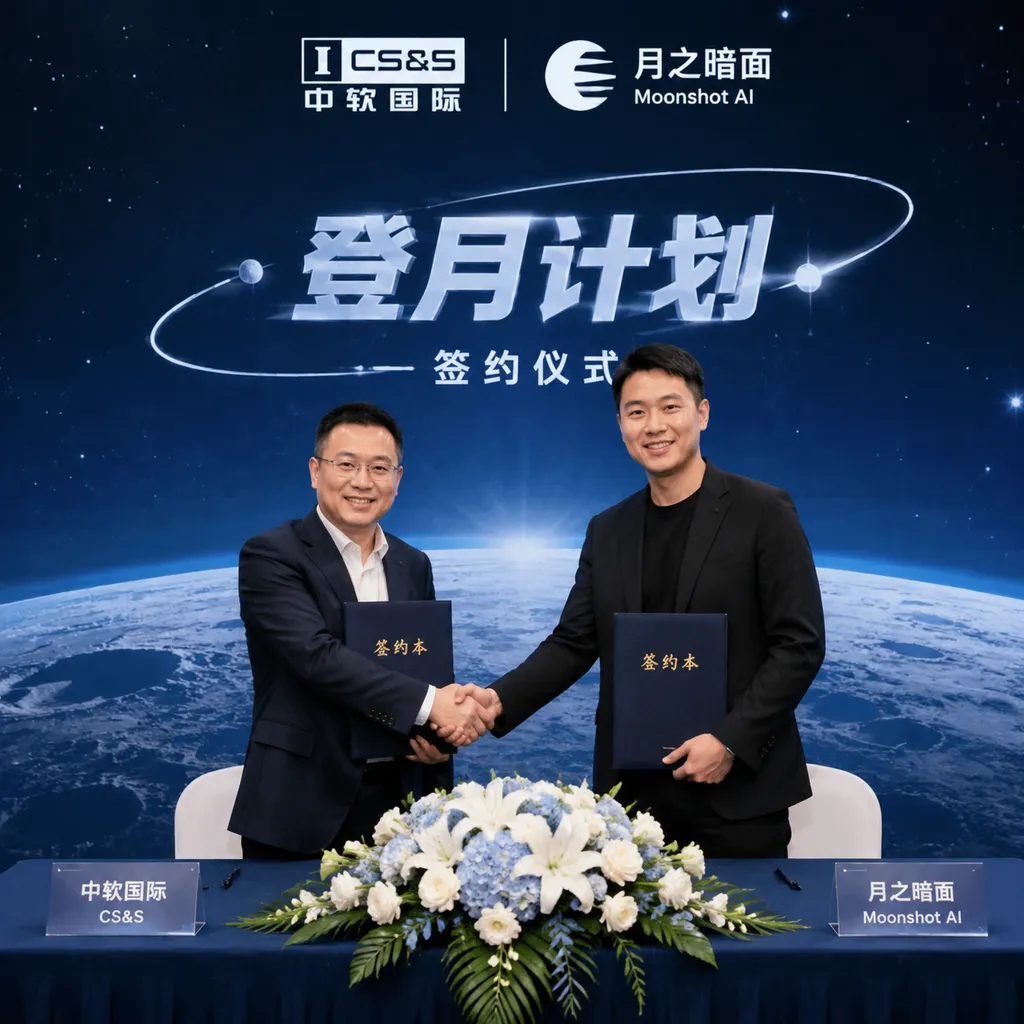
ChinaSoft International and Moonshot AI have officially signed the "Lunar Program" Token Sharing and Joint Innovation Agreement to jointly establish the FDE Laboratory. The first phase will focus on the energy and power sector, aiming to pave an enterprise-grade deployment path for Kimi K3 Agent.
Yesterday, Chinasoft International issued an announcement that it has officially signed a Token revenue‑sharing and joint innovation cooperation agreement with Moonshot AI, titled the “Moon Landing Plan.” The two companies’ agenda is quite concrete: they will jointly build an FDE Innovation Lab to define, develop, deliver, and iterate enterprise‑level Agent products, starting with a focus on the energy and power industry.
The symbolic meaning of this agreement is far greater than the short‑term revenue it may generate.
An Uncommon Partnership Structure: Token Revenue Sharing
Let’s start with the form of the agreement. In the current market, partnerships between large‑model providers and system integrators usually take one of three forms: selling API calls, selling on‑premises deployment licenses, or project‑based revenue sharing. This time, Chinasoft International chose a Token‑based revenue‑sharing model—which means that Chinasoft will embed Moonshot AI’s model capabilities into clients’ business systems. For every Token consumed by customers, the two parties will split the revenue proportionally.
This structure has been more common overseas, for example, in partnerships between Anthropic, OpenAI, and certain industry solution providers. The core logic is that model vendors are willing to give up part of their Token income in exchange for integrators taking on industry clients and scenarios they themselves cannot easily reach. For Chinasoft, this means it is no longer just a “labor outsourcing” or “project‑based contractor,” but is becoming Moonshot AI’s “distributor + joint operator” in the enterprise market.
In its announcement, Chinasoft International referred to itself as a “Token operator with high professional value.” The phrase may sound awkward, but its meaning is clear: the company aims to transform from a traditional IT service provider into an AI infrastructure partner that earns revenue based on call volume. If this transition succeeds, the business model would be lighter, offer higher gross margins, and generate more sustainable income than traditional outsourcing.
Why the Energy and Power Industry
Focusing on the energy and power sector for the first phase was not a random choice.
The industry has several characteristics that make it an ideal “test field” for Agent deployment:
First, processes are highly standardized—while business systems are complex, the rules are relatively clear.
Second, the industry invests heavily in digitalization, yields high contract values, and can afford the cost of model inference.
Third, use cases are well‑defined—from equipment inspection and fault diagnosis to dispatch optimization and customer service—all can be broken down into task chains that Agents can execute.
More importantly, Chinasoft International already has a strong position in this field. It is one of Huawei’s core ecosystem partners in major industries such as energy, finance, government, and public utilities. Its Hongmeng‑based intelligent control system for highway tunnels, co‑developed with a large state‑owned enterprise, has already been deployed in multiple projects. With existing clients, Huawei Cloud’s computing foundation, and Moonshot’s model capabilities, there is theoretical potential to form a complete “foundation + model + integration + operations” loop.
That said, implementing Agents in the energy sector is not easy. The industry demands exceptional stability, interpretability, and compliance—far higher than those of consumer‑facing chat applications. A wrong email from an Agent may be embarrassing, but a wrong load‑dispatch calculation could cause an accident. Hence, the FDE (Forward Deployed Engineer) model is crucial—this was Palantir’s formula for winning major energy and defense clients: engineers stationed onsite, refining the product while engaging in real operations. The fact that Chinasoft explicitly mentioned building an FDE lab indicates its understanding that enterprise Agents cannot simply be deployed “as is” but must be refined through close human‑in‑the‑loop engineering.
Moonshot AI: After K3, It Urgently Needs an Enterprise Play
Now, looking at Moonshot AI: on July 17 at midnight, the company released Kimi K3, a model with 2.8 trillion parameters and a 1‑million‑Token context window—the world’s first open‑weight model approaching 3 trillion parameters. According to benchmarks presented at the launch, K3 outperforms Claude Opus 4.8 and GPT‑5.5 in programming and complex tasks. Although not yet at the very top level of closed‑source models, the gap is visibly narrowing.
While its model capabilities have advanced, commercialization remains Moonshot’s bottleneck.
Compared with other members of the so‑called “Five Little Tigers,” Zhipu and MiniMax have both gone public in Hong Kong, each surpassing HK $300 billion in market value. Moonshot holds over RMB 10 billion in cash reserves and is not in a hurry to list, but in internal memos, founder Yang Zhilin has said explicitly: no matter how much capital is raised in the private market, the ultimate test is still commercial validation.
Currently, Moonshot’s revenue structure has two main sources: consumer subscriptions and API usage. The consumer side brings in roughly RMB 200 million a year. The API business surged in the first half of the year, driven by Agent products, but has since declined rapidly. After K3’s release, the problem is clear—a 2.8‑trillion‑parameter model cannot be sustained by consumer subscriptions and developer API calls alone. Breaking into the enterprise market has become a must.
But Moonshot cannot do that on its own. It lacks Chinasoft’s industry sales network and Huawei‑ecosystem relationships. Finding a distributor + system‑integration partner like Chinasoft is therefore almost inevitable. In essence, this collaboration arises from mutual need: Chinasoft requires a powerful model to offer, while Moonshot needs a channel to penetrate industry clients.
A Key Judgment: Success Depends on “Fairness of the Split”
The biggest potential failure point in Token‑sharing partnerships lies in the split ratio and the settlement granularity.
Model vendors want to retain more margin; integrators want a greater share of long‑term operational value. Yet clients’ Token consumption fluctuates—business redesigns or prompt optimizations can double or halve usage. If settlement rules lack transparency or reviews are infrequent, disputes quickly emerge.
The announcement did not disclose the specific revenue‑sharing ratio or settlement mechanism—only broad terms such as “joint construction,” “co‑development,” and “continuous iteration.” The real determinant of success will be the next three to six months: whether they can find one or two flagship clients in the energy industry and produce a repeatable business model.
If they can, Chinasoft’s story of transforming into a “Token operator” gains its first anchor, and Moonshot’s enterprise‑commercial narrative becomes credible. If not, it will be just another strategic cooperation announcement with little real outcome.
It is also worth noting that as domestic mainstream model commercialization channels expand, developers increasingly need to call multiple models (GPT, Claude, Gemini, DeepSeek, Kimi, etc.) within the same engineering framework. Aggregator platforms such as OpenAI Hub, which allow switching between major models under a single OpenAI‑compatible key, can save teams significant integration costs when designing Agent architectures or conducting A/B tests. Following the launch of Kimi K3, such aggregator platforms are already beginning to offer compatibility.
The Broader Context: Enterprise Agents Enter Their Delivery Year
Zooming out, the timing of this partnership is meaningful.
2026 is shaping up to be the “delivery year” for enterprise‑level Agents. Since the start of the year, a wave of cloud‑based Agent products—OpenClaw, MaxClaw, Kimi Claw, and others—has gone live. Model‑level tool‑calling and multi‑Agent collaboration capabilities are rapidly maturing. But what enterprise clients truly want are not “general‑purpose Agents,” but “specialized Agents” that can embed directly into business systems such as ERP, EAM, and SCADA.
Model vendors alone cannot achieve this. That is why Anthropic invests heavily in FDE teams, OpenAI assigns Solutions Engineers to larger clients, and Moonshot is willing to share Token revenue—all recognize that the enterprise AI battle requires a combination of industry know‑how, engineering capability, and model power.
Chinasoft brings the Huawei ecosystem, 20,000+ client data records, and over 6,000 partners. Moonshot brings K3. Together, could they create a Chinese version of “Palantir + Anthropic”? The next year should reveal the answer.
For the capital market, Chinasoft’s announcement marks the most tangible progress yet in its AI transformation narrative. For Moonshot, it is the first piece in its post‑K3 enterprise commercial puzzle.
For developers, it may be worth paying attention to FDE job openings in the energy sector—projects like these are where real Agent engineering capabilities are being forged today.
References
- Zhihu: How to view the Token‑sharing partnership between Chinasoft International and Moonshot AI – Zhihu discussion roundup covering both investor and practitioner perspectives
- ITHome: Moonshot AI releases Kimi K3 large model – Detailed launch‑day report including technical specs and benchmarks
- Hugging Face: Moonshot AI open‑source model repository – Open‑source weights and documentation for Moonshot AI models
- Zhihu: The real challenges of enterprise‑level Agent deployment – Practitioner discussions on the FDE model and Token‑sharing commercialization