Unitree releases the full-modal health and wellness model UnifoLM-OminiA-0.3

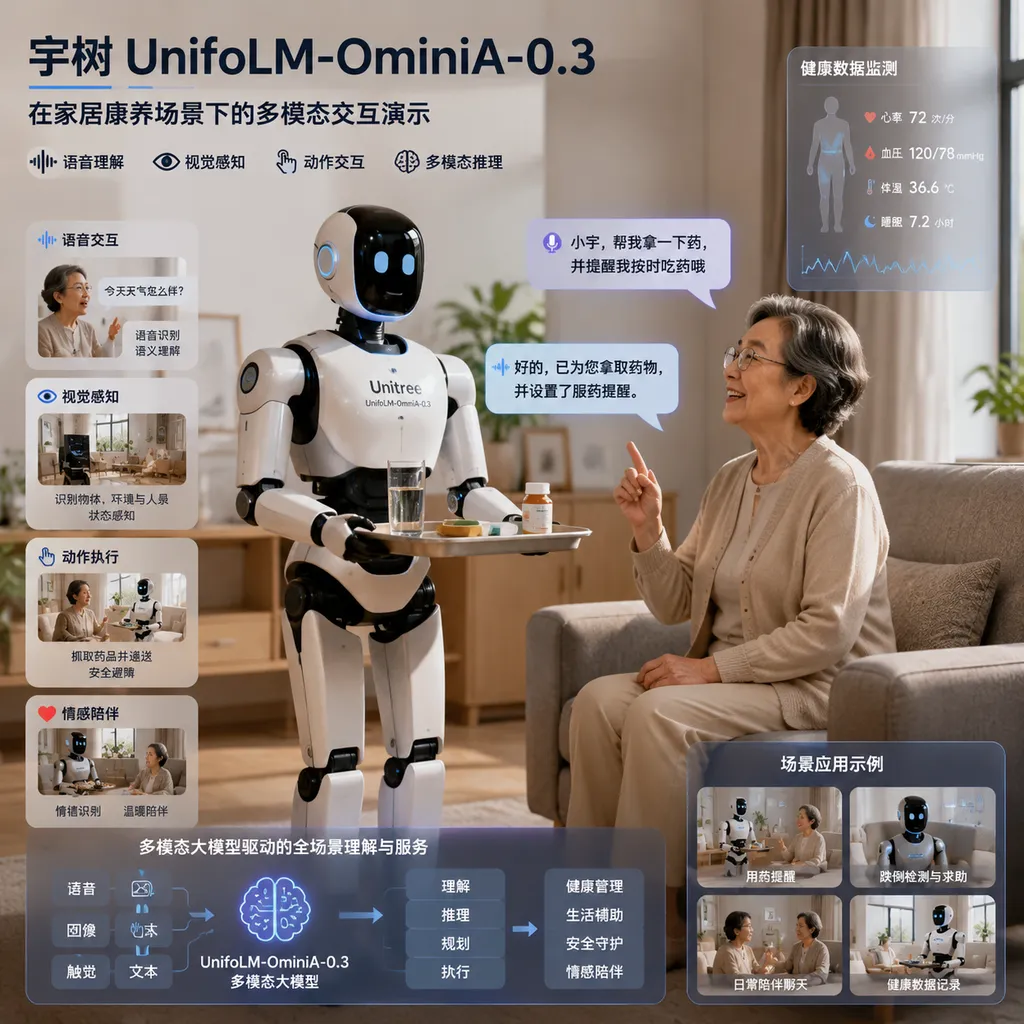
On July 20, Unitree Technology released UnifoLM-OminiA-0.3, a single model that manages multiple household and eldercare tasks. It supports full-modal interactive understanding, focuses on end-to-end autonomy and interference-resistant stable execution, and brings embodied intelligence applications from the factory floor into living rooms and bedside environments.
On July 20, Unitree Technology dropped something new on Weibo: UnifoLM-OminiA-0.3, a full-modality interactive large model designed specifically for home healthcare and wellness scenarios. The official description is quite restrained—just a few phrases: single-model multi-task coordination, full-modality interaction and understanding, fully autonomous, stable, and resistant to interference. But for those familiar with Unitree’s UnifoLM line, this is not a small signal.
This is the next iteration of the Unitree UnifoLM family, following the open-source release of UnifoLM-VLA-0 in January this year and the launch of the world model UnifoLM-WMA-0 in September last year. The biggest difference this time is that OminiA’s focus is very concrete: home healthcare. Not warehouse sorting, not factory loading and unloading—but tasks like helping elders stand up, handing them a glass of water, reminding them to take medicine.
From VLA to OminiA: Unitree is making its models “narrower”
Looking at the UnifoLM product line shows a clear roadmap for Unitree’s embodied intelligence strategy.
- UnifoLM-WMA-0 (September 2025): world model + motion architecture, the core goal being to let robots understand physical laws—predicting “if I move like this, how will the environment change.” Open-sourced, quickly gaining 100+ stars on GitHub.
- UnifoLM-VLA-0 (January 2026): a vision-language-action model continuously pre-trained on Qwen2.5-VL-7B, using around 340 hours of real robot data; on the G1 humanoid, it could complete 12 types of complex manipulation tasks under one unified policy, with solid robustness.
- UnifoLM-OminiA-0.3 (July 2026): full-modality interaction, focused on home healthcare.
Even the names tell a story. WMA gives robots a sense of “physical intuition.” VLA upgrades image-text understanding into an “embodied brain.” By the OminiA generation, Omni emphasizes modality comprehensiveness—vision, voice, language, and action, all managed by one model. The “A” suffix almost certainly continues the “Action” lineage, meaning this is still an end-to-end perception-to-execution model, not just one for multimodal understanding.
Note the version number: 0.3. Unitree clearly isn’t treating this as a full release, leaving room for iterations. Given VLA-0’s update pace, OminiA will likely see 0.5 and 1.0 versions soon.
Why home healthcare is harder than factory settings
Many assume robots working at home have it easier than in factories—after all, they don’t need to handle heavy loads. The reality is the opposite.
Factory environments are structured: materials are in fixed places, lighting is stable, and procedures are standardized. Homes are unstructured:
- The placement of objects changes daily
- Elderly users give vague commands—“Bring me that thing”—with meaning entirely dependent on context
- Too many sources of interference: TV sounds, pets wandering, slippery carpets, fluctuating light
- Home healthcare has an extremely low tolerance for safety errors—grabbing the wrong part in a factory hurts yield; misjudging pressure while helping an elderly person up could cause an accident
OminiA-0.3’s promises of “full-modality interactive understanding” and “stable, interference-resistant execution” directly target these challenges. Full-modality means the model must digest camera feeds, microphone audio, language commands—possibly even tactile data—together for joint reasoning. Interference resistance means robust handling of noise, occlusion, and ambiguous instructions.
Technically, both aspects are known problems. The hard part is making them work in one unified model, and making that model run on a humanoid robot with limited compute.
The technological bet behind “single-model multi-task coordination”
Unitree’s focus on “single-model” isn’t marketing—it’s a strategic choice.
In the healthcare robotics field, there are two main routes.
One is the task-specialist approach: one model for grasping, one for dialogue, one for navigation, coordinated by a top-level scheduler. Engineering-wise, it’s stable but complex to integrate, with poor cross-modal information flow.
The other is the general large-model approach: one end-to-end model handling all modalities and tasks, as seen with Google’s RT-2 or Figure’s Helix.
OminiA takes the second route, building on the VLA-0 approach already validated—a single-policy checkpoint handling multiple tasks. VLA-0’s success on the G1 running 12 tasks under one model proved the engineering viability of this method within Unitree.
For developers, a single model brings real benefits: no need to maintain multiple heterogeneous deployments, versions, or memory footprints; modalities can share information directly within the model’s hidden layers; and fine-tuning for new tasks requires minimal changes. The trade-offs are high training costs and very demanding data quality.
How long has Unitree been eyeing the healthcare market?
Looking over time, since the launch of the H1 general-purpose humanoid, Unitree hasn’t confined itself to industrial settings. The H1 emphasized locomotion and athletic performance, the G1 aimed to be more approachable and dexterous for complex hand tasks, and OminiA-0.3 pushes the software layer toward home healthcare—making its intent clear: to build a humanoid that can actually live in homes.
China’s need for elderly care is self-evident—the absolute number of people over 60 is enormous, and the shortage of caregivers is well known in the industry. Fourier Intelligence has worked on rehabilitation robots for years, but those are specialized hospital devices. Home-use healthcare robots are a different race—larger market, higher tech barrier—because they must be affordable, safe, and intelligent.
Unitree’s edge lies in hardware. Its M107 joint motors and G1 platform cost control are well recognized. But to truly enter the healthcare market, affordable hardware isn’t enough—it needs a capable “brain.” The OminiA series fills that gap.
A few unanswered questions
Unitree’s brief announcement leaves several key points unclear:
- Open source or not: VLA-0 and WMA-0 both released code and checkpoints. OminiA-0.3 hasn’t said so yet. Based on past patterns, the chance is high, but since “healthcare” has clear commercial value, Unitree might hold some parts back.
- Base model choice: VLA-0 used Qwen2.5-VL-7B. To handle “full-modality,” OminiA must process audio as well as vision and language. Will it stay with Qwen or switch to Qwen2.5-Omni or another multimodal foundation? Worth watching.
- Hardware deployment: The default is G1, but Unitree has also been pushing smaller R1-type models. Whether OminiA includes adaptation layers for different hardware—and can run across models—will define its ecosystem potential.
- Performance data: VLA-0 came with success rates for 12 task types and LIBERO benchmark scores. OminiA provides no benchmarks yet, suggesting version 0.3 may simply not be ready to publish results.
A note to competitors
Looking at the speed of Unitree’s UnifoLM iterations—WMA to VLA took four months, VLA to OminiA six—the pace of embodied intelligence model evolution now matches the rapid cycle that large language models saw in 2023.
Implication for the industry: hardware differentiation is losing defensive power; model capability and data are becoming the core battleground.
Unitree was already ahead on hardware. Now it’s accelerating on software. Other players’ windows of opportunity are shrinking.
Especially for teams still stuck doing “dance moves or flips” as kinematic demos—it’s time to speed up. The true watershed will be whether models can make robots perform useful tasks in real, messy, noisy environments. Whether OminiA-0.3 is that answer remains to be seen—but it’s heading in the right direction.
The rest, we’ll see when Unitree rolls out 0.5 and 1.0.