Alibaba Cloud cuts small-scale packages: minimum purchase for Intelligent Outbound Call Agent raised to 100,000 minutes
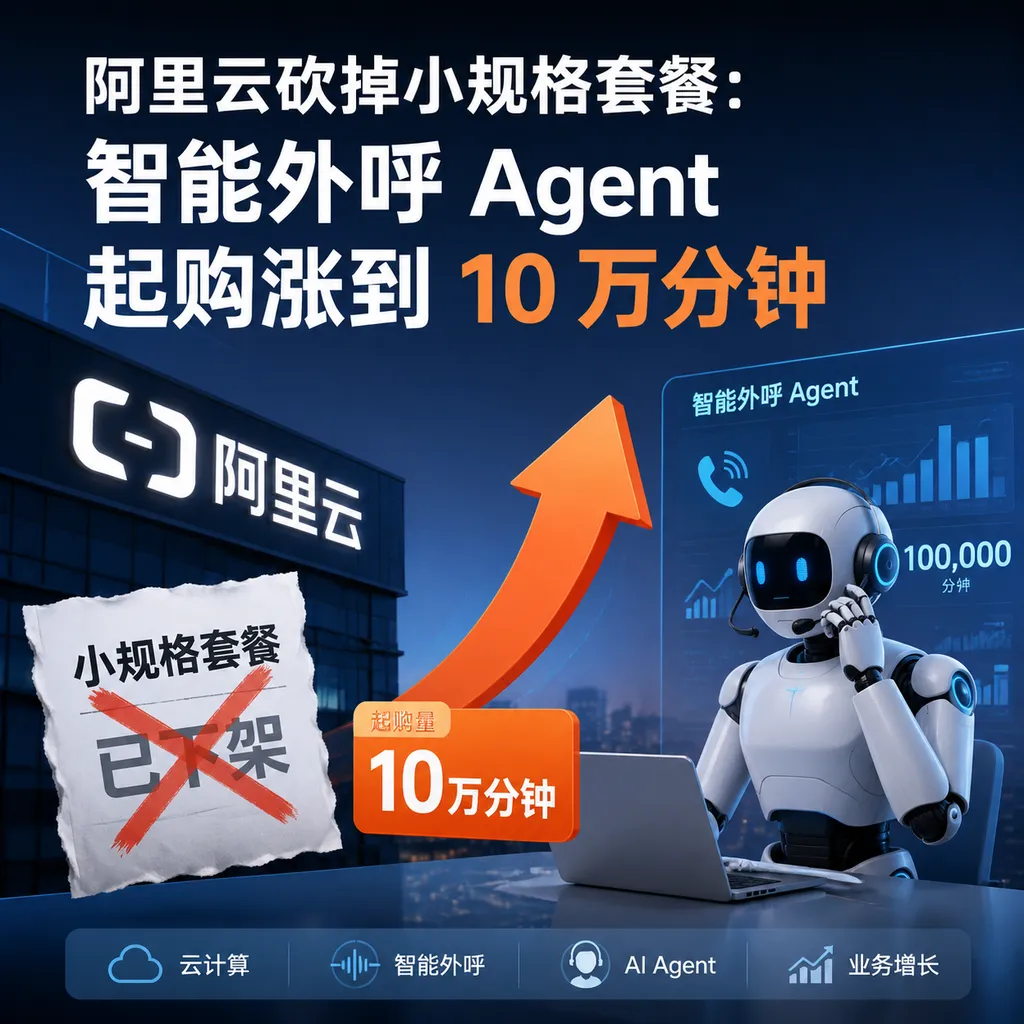
On July 20, Alibaba Cloud announced that starting July 30, the AgentOne intelligent outbound calling Agent will discontinue the 5,000-minute and 10,000-minute small-usage packages, raising the minimum threshold for new purchases and renewals to 100,000 minutes, effectively squeezing out small customers.
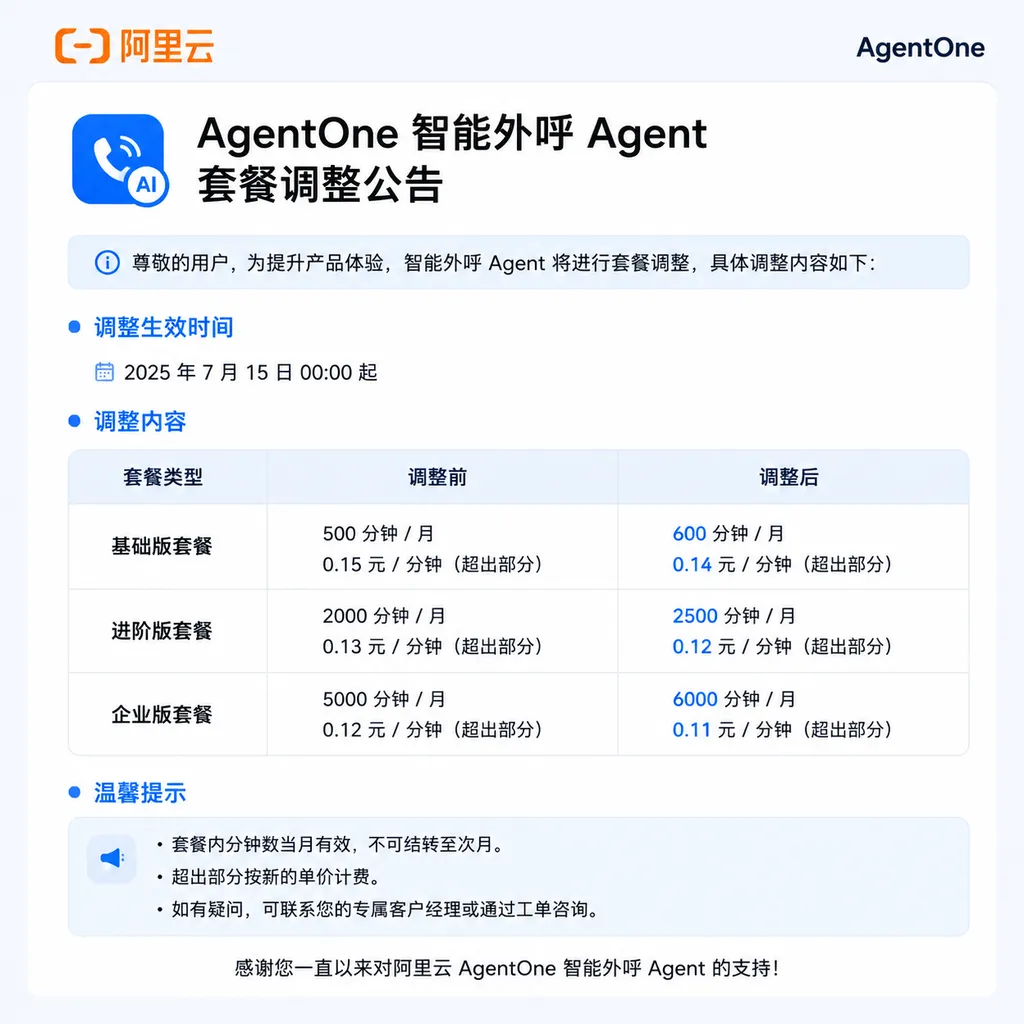
Today, Alibaba Cloud released a “Notice on Price and Specification Adjustments for Certain AgentOne Products.” It may seem like a small move, but it sends a big signal: starting July 30, 2026, the 5,000-minute and 10,000-minute packages of the Intelligent Outbound Agent will be fully discontinued. Both new purchases and renewals will now start from a minimum of 100,000 minutes. Existing users can continue using their smaller packages until expiration, but they can no longer renew under the old specifications afterward.
In plain words—Alibaba Cloud just raised the entry barrier for its intelligent outbound calling product line by 10 to 20 times.
Details of the Change
The announcement itself was concise—just three points:
- Intelligent Outbound Agent: 5,000-minute and 10,000-minute packages will no longer be offered. Minimum package size for new purchases and renewals is now unified at 100,000 minutes.
- Renewal Orders: Starting July 30, 5,000- and 10,000-minute versions will no longer be renewable; users must renew at the new 100,000-minute tier.
- Active Packages: Small packages activated before July 30 can continue being used until expiration, unaffected.
Alibaba Cloud added a line in the notice: “Users should plan renewals in advance based on actual business usage.” Translated: Existing customers, do your own math—if you miss this renewal, you’ll have to upgrade.
As a side note, the Intelligent Quality Inspection Agent also saw similar changes. It’s now limited to two packages:
– ¥100,000/year for 300,000 inspection sessions
– ¥300,000/year for 900,000 sessions.
Once again, smaller packages are cut, and only “enterprise-grade” entry options remain. The overall tone of the AgentOne pricing adjustment is consistent—moving upward, toward large enterprise clients.
What 100,000 Minutes Means
Developers will immediately sense what that number feels like. Based on past Alibaba Cloud pricing of about ¥0.11–¥0.12 per minute, a 100,000-minute package corresponds to roughly ¥11,000–¥12,000. Previously, a 5,000-minute plan cost just a few hundred yuan, and 10,000 minutes was only at the thousand-yuan level.
That’s a considerable leap:
| Spec | Minutes | Typical Usage Scenario | |---|---|---| | Former Low Tier | 5,000 | POC verification, small store follow-ups | | Former Standard | 10,000 | SME single-scenario pilot | | New Minimum | 100,000 | Full business line, continuous outbound calling |
To put it differently, 5,000 minutes equals roughly 100 calls per day at 3 minutes each—enough for about a month and a half. That tier mainly served small teams using outbound calling for POCs or limited staff replacement. Now, these teams either spend over ¥10,000 on an oversized plan or look elsewhere.
And what does 100,000 minutes feel like? Using the same math, that’s enough for a five-person outbound team to operate continuously for a full year. In other words, the new minimum threshold assumes you’re doing large-scale outbound operations, not just experimenting.
Why Alibaba Cloud Is Doing This
From a product operations perspective, eliminating small packages usually comes down to three reasons—and all three apply here:
First, the service cost for small clients isn’t sustainable. Intelligent outbound calling driven by large models involves Qwen’s ASR, TTS, and NLU full-stack calls, plus the operational costs of phone number resources, line compliance, and task scheduling. A 5,000-minute customer brings negligible revenue but occupies the same level of support, pre-sales, and account management. With such a low ticket size, Alibaba Cloud’s sales and account manager systems can’t cover the costs.
Second, shifting from “selling tools” to “selling solutions.” Since early this year, AgentOne has been moving toward positioning itself as an enterprise-grade intelligent agent platform. Official language frequently mentions “a next-generation core platform for enterprise agents.” This aligns with Microsoft’s Copilot Studio and Salesforce’s Agentforce—no longer selling API calls by usage but bundling them into annual enterprise packages. The 100,000-minute plan, combined with account management assistance, industry templates, and CRM/ERP integration, clearly follows the key account (KA) model.
Third, restructuring the customer base. In recent years, Alibaba Cloud has shifted to a profit-oriented approach, prioritizing quality over scale in its public cloud business. Intelligent outbound calling, a category with many small or gray-area clients, is being cleaned up via higher thresholds. The move toward high-price tiers also implies stricter compliance screening—outbound calling has been under increasingly tight regulation in China, and low-price users can’t easily bear compliance costs.
Impact on Small and Medium Developers
The impact is direct. Previously, developers could spend just a few thousand yuan to build a demo or close a business loop using an AI outbound agent. After July 30, that path is closed.
Alternative options for small teams include:
- Go through partner channels. Alibaba Cloud’s partner edition of its outbound agent offers a minimum monthly spend of ¥5,000 at ¥0.12/minute. It’s actually more cost-effective for small-scale scenarios, though it may not include the latest large-model capabilities.
- Switch to competitors. Tencent Cloud, Volcano Engine, and JD Cloud all have similar AI outbound products. The mid- and small-scale client segments are now up for grabs. With this adjustment, competing sales teams are likely already making their calls.
- Build your own solution. Using open-source ASR/TTS (e.g., FunASR, CosyVoice) plus a self-integrated LLM, paired with FreeSWITCH or SIP lines, is technically feasible and cost-controllable—but requires heavy engineering effort, and compliance plus telecom line resources are the biggest hurdles.
For teams that were comfortably using the 5,000/10,000-minute packages, the most rational step is to evaluate renewal strategy soon:
If annual usage exceeds 50,000 minutes, the per-minute cost of the 100,000-minute package is still reasonable.
If usage is only a few thousand minutes, it’s time to seriously plan migration paths.
A Larger Trend
Viewed in the context of 2026, this move is actually a microcosm of AI Agent commercialization.
In 2024–2025, all cloud vendors aggressively expanded the breadth of their Agent products—make it easy for developers to get onboard, attract as many users as possible, with the lowest packages and longest trials. By 2026, the focus shifts to depth and ARPU: keeping enterprise customers who can pay big, while pushing low-profit, long-tail clients toward partner or self-service options.
Alibaba Cloud’s decision to cut small packages essentially acknowledges a fact: Intelligent outbound calling is no longer a casual product anyone can use—it’s a B2B business that must be sold the B2B way.
This assessment isn’t wrong—but for China’s AI application ecosystem, it’s not necessarily good news. Previously, small developers could spend a few thousand yuan to verify an intelligent outbound use case, gather real data, and refine their SaaS products. Now, that low-cost experimentation route is closed off. As a result, there may be fewer innovative products growing from within the ecosystem.
For developers, a more practical takeaway is: don’t tie your business lifeline to a single cloud provider or SKU.
Today it’s the 5,000-minute plan that’s gone; tomorrow it could be any other discount tier you rely on.
Multi-cloud, multi-model, and backup strategies are the safest ways to hedge against such shifts.
Incidentally, that’s where platforms like OpenAI Hub find their value: a single key integrates mainstream models like GPT, Claude, Gemini, and DeepSeek in OpenAI-compatible format with domestic connectivity—giving you an instant fallback option for model use.
Alibaba Cloud’s adjustment is official—it takes effect on July 30, leaving small and mid-sized users just over a week to make new decisions.
References
- Alibaba Cloud adjusts Intelligent Outbound Agent sales policy: Minimum new purchase/renewal package increased to 100,000 minutes starting July 30 – IT Home: Explanation of the official announcement, scope of impact, and effective date.