Taotian launches four consecutive AIGX releases: the Agent recommendation system is truly here
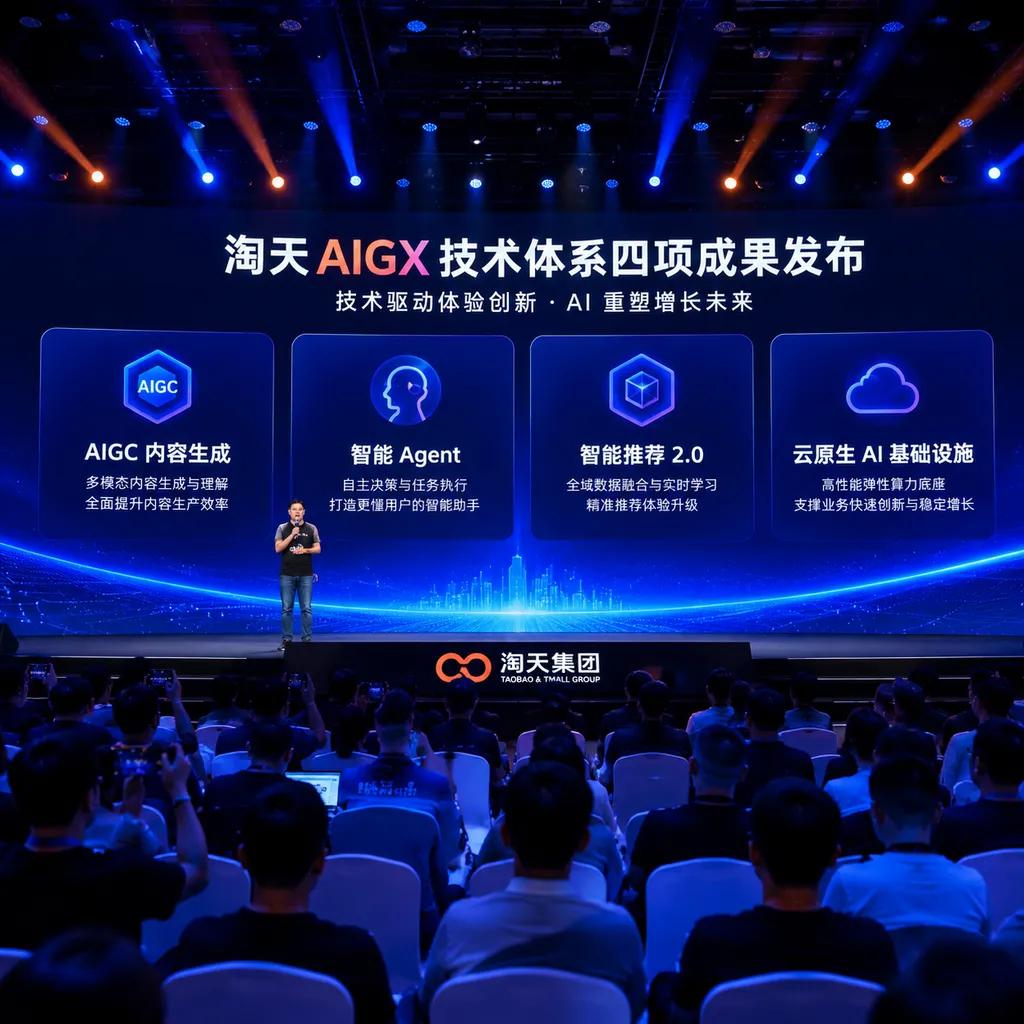
On July 20, Taotian announced four new achievements of the AIGX system: the multi-modal real-time Agent “Pai Li Tao,” if Studio, the “Coupella” intelligent benefit engine, and the Agentic recommendation system “Dream” were unveiled together, marking the official transformation of AI in the e-commerce chain from a tool into a decision-maker.
Taotian Launches Four AIGX Innovations in a Row: From “You Might Like” to “Agents Making Decisions for You”
On July 20, the Taotian Group unveiled four new results from its AIGX technology system in one go — PaiLiTao Full‑Modal Real‑Time Agent, if Studio All‑Scenario AI Creation Workbench, Coupella Intelligent Discount Engine, and the Agentic Recommendation System Dream. The release rhythm is very “Alibaba”: no single‑point muscle‑flexing, but a simultaneous push across perception, content creation, intent understanding, and discount decision‑making.
For e‑commerce algorithm engineers or developers who have integrated with the Taobao Open Platform, the signal is clear: Taotian is no longer satisfied with sprinkling large models as “seasoning” into the “Guess You Like” module. It aims to reconstruct the entire chain of recommendation, creation, and ad delivery. Several elements here are worth discussing in detail.
1. Agentic Recommendation System Dream: Rewriting “Guess You Like”
The heavyweight among the announcements is Dream.
For the past decade, recommendation in Taobao’s ecosystem has followed the “recall–coarse ranking–fine ranking–re‑ranking” pipeline. Each stage uses a separately trained model, relying on feature engineering and multi‑objective losses to balance CTR and CVR. Last year, RecGPT brought generative recommendation (AIGR) into the spotlight, but essentially it was an enhanced “post‑view/purchase‑based recommendation” — only with stronger predictive power.
Dream is different. It shifts recommendation from “predicting what you might click” to “helping you complete a shopping mission.”
Example scenario: you type “business trip to Sanya next week, plus two days of leisure” in the search box. Traditional recommendation can show you flights, sunscreen, and swimsuits, but their order and combination are based on co‑occurrence statistics. Dream, however, behaves like an Agent — it decomposes intentions: what do you need for the business trip, what for two days of fun, what is Sanya’s weather like this season, what is your usual spending level — and dynamically composes a shopping list. If you then add “I want to take nice photos,” it will adjust the recommendation stream accordingly.
In other words, Dream introduces the Agent paradigm of Planning, Memory, and Tool Use into recommendation. This is not just putting an LLM wrapper in front of recommendation for re‑ranking; it gives the system itself multi‑round decision‑making capability.
This direction has long been discussed in the industry. Meta published a paper on Generative Recommenders last year, and ByteDance’s Sora team is exploring similar ideas. But by public information, Dream may be the first Agentic architecture truly deployed at billion‑scale e‑commerce traffic. Scaling this up is ten times harder than writing a paper.
2. PaiLiTao Full‑Modal Real‑Time Agent: “See and Converse” Visual Search
PaiLiTao is one of Taobao’s oldest AI products, launched back in 2014. This upgrade completely transforms it into a full‑modal real‑time Agent.
What’s different? Previously, PaiLiTao worked as “take photo → recognize image → return similar products” — one‑shot interaction. The new Agent version enables:
- Real‑time video input: aim your camera at an item and see real‑time scanning, recognition, and recommending.
- Multimodal dialogue: you can say, “I want this bag in black, under 1500 yuan,” and the Agent adjusts the search space live.
- Scene understanding: if it detects you’re capturing “a corner of your living room” instead of a single item, it proactively suggests combinations like curtains, rugs, and decorative paintings.
The experience is somewhat similar to Google Lens + Gemini Live, but Taotian’s advantage lies in its massive catalog of billions of SKUs. This combination of “real‑time + full‑modal + e‑commerce knowledge” currently has no overseas equivalent.
3. if Studio: Outsourcing Merchants’ Design Work to AI
if Studio corresponds to the AIGC thread. Its positioning: an All‑Scenario AI Creation Workbench, covering product images, short videos, livestream materials, and full product‑page content.
Taotian previously shared data showing that personalized AI videos can increase click‑through rates by 17 percentage points. if Studio consolidates tools like “Taobao StarCluster · Image‑to‑Video 2.0,” multi‑image generated short‑videos, and AI product detail pages into one unified workbench — small and medium merchants no longer need to jump among a dozen tools.
For developers, the key point is that these capabilities are very likely to be exposed via API to the ecosystem. If you’re doing SaaS tools, managed operations, or cross‑border product sourcing, this foundational capability supply will be unavoidable next year.
A quick note on multimodal content generation: many developers struggle with the high cost of testing different models — Sora today, KeLing tomorrow, Veo the day after. Platforms like OpenAI Hub show their value here: one key to access mainstream text, image, and video models, compare their output, and decide which to use in production — no need for multiple account sign‑ups, credit‑card bindings, or KYC steps.
4. Coupella Intelligent Discount Engine: Causal Inference Behind AI‑Driven Coupons
Coupella was rolled out at scale for the 2024 Double 11 campaign, and its performance metrics are impressive:
- Covered hundreds of thousands of merchants
- Boosted AI coupon conversion rates by 81%
- Drove over 80 million yuan in conversions for top brands
Essentially, Coupella is a causal‑inference‑based intelligent discount distribution engine, answering the question:
“At what point in time, and with what coupon value, is a user most likely to complete a purchase that would not otherwise have happened?”
Note the phrase “would not otherwise have happened.” Traditional coupon systems often waste money by giving discounts to users who would have bought anyway. Causal inference tackles exactly this counterfactual problem — estimating the treatment effect rather than mere correlation.
Taotian has deep experience here; Alibaba Mama has published multiple causal‑inference papers at conferences such as CIKM and KDD in recent years. Coupella productizes these efforts. The 81% lift figure might depend on baseline choice, but the direction is correct.
5. Key Takeaways
Viewed together, the four innovations share a coherent narrative: AI evolving from “assisted generation” to “autonomous decision‑making.”
- Perception layer: PaiLiTao Agent — from single‑frame recognition to real‑time video understanding
- Production layer: if Studio — from single‑asset generation to full workflow creation
- Decision layer: Coupella — from rule‑driven to causality‑driven
- Distribution layer: Dream — from predictive recommendation to Agentic planning
This track aligns with what OpenAI and Anthropic describe as “Agent as a Product.” The difference is that while general‑purpose Agents are still figuring out whether they can work, Taotian is achieving large‑scale deployment in vertical scenarios — hundreds of millions of DAUs, hundreds of thousands of merchants, and billions of daily API calls. Running an Agentic architecture at that scale requires far more engineering depth than a demo in a paper.
Of course, some caution is warranted. Agentic recommenders like Dream may look great in offline metrics, but their long‑term online A/B results, their impact on ecosystem fairness (e.g., will small merchants be further marginalized?), and whether the cost can drop to an economically viable level — these questions won’t be answered until next year.
In the AI‑for‑e‑commerce race, JD.com, Pinduoduo, and Douyin are all competing, but Taotian still leads in technical breadth and scenario complexity. After this burst of four AIGX releases, pressure will extend to the others — especially along the Agentic recommendation line. Whoever becomes the second to scale it will be worth watching.
References
- Discussion on Taotian Group’s Full Upgrade of the AIGX Technology System – Zhihu: a full introduction on Zhihu covering the six modules of AIGI/AIGR/AIGB/AIGA/AIGC/AIGD in the AIGX system, useful as background material on Taotian’s AI tech stack.