Inertia-1 Open Source: The "Motion Brain" of Embodied Intelligence Aims to Unify the Field
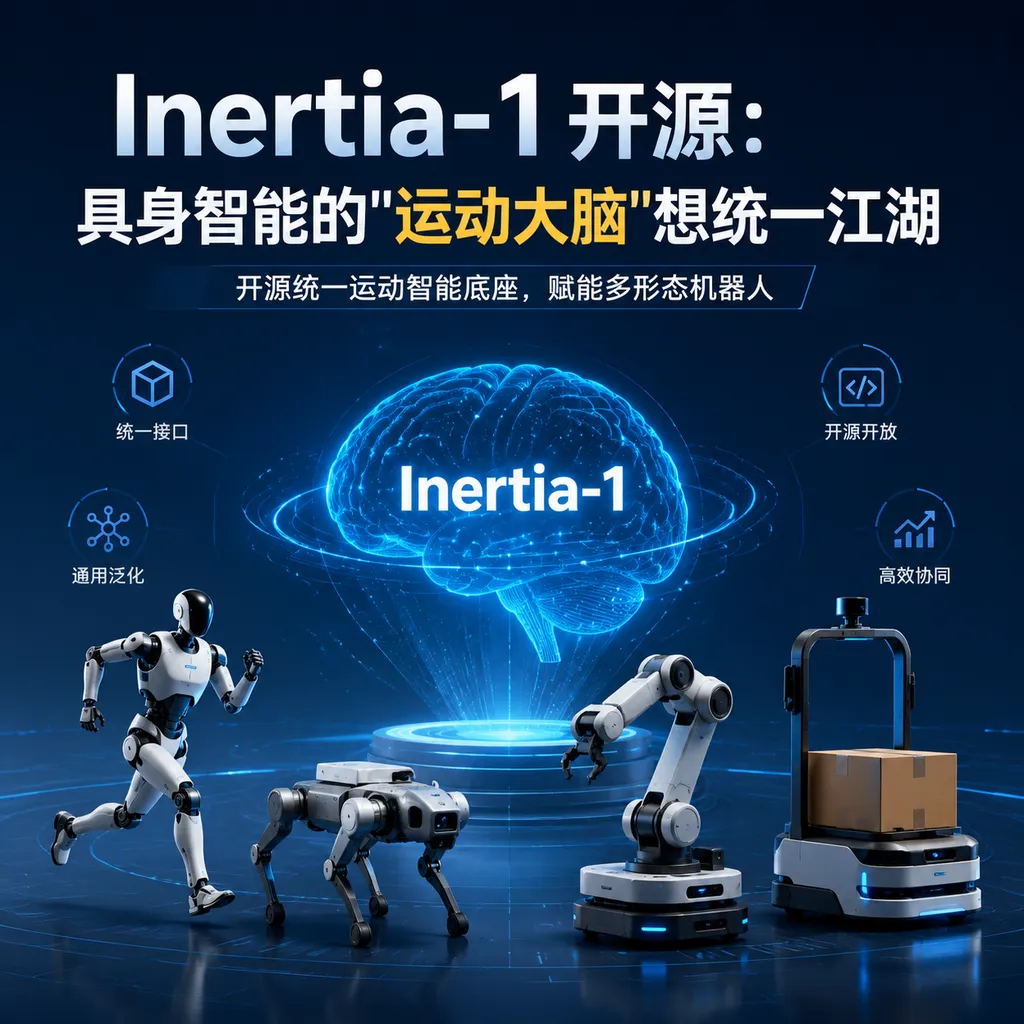
Yang AI Lab has open-sourced the embodied foundation model **Inertia-1**, aiming to unify motion understanding and generation for humanoid robots within a single model. In this field, **Horizon’s HoloMotion-1** and **BAAI’s RoboBrain 2.0** have already made their moves. By 2026, the embodied intelligence community is shifting focus from “task-specific” models toward “general-purpose foundations.”
Inertia‑1 Open Source: The “Motion Brain” of Embodied Intelligence Wants to Unify the Field
On July 19, Yang AI Lab released Inertia‑1 on its project homepage, summed up in one line: An open‑source embodied foundation model for unified motion understanding and generation. Following Horizon’s HoloMotion‑1, BAAI’s RoboBrain 2.0, and last month’s viral full‑body VLA, this marks another major move in the 2026 open‑source “arms race” of embodied AI.
Unlike past robotic models that “specialized in grasping” or “focused on navigation,” Inertia‑1 has grander ambitions: to model the entire motion of a humanoid robot—from soles to fingertips—with a single model. As the team puts it, it’s “An Open Exploration to a Unified Motion Foundation Model.” Note the word exploration, not solution—an honest stance.
What Problem Does It Actually Solve
Over the past two years, teams working on robot policies have been struggling with the same issue: the action space is absurdly fragmented.
Upper‑body manipulation uses the Diffusion Policy family; lower‑body locomotion relies on RL‑trained locomotion policies; dual‑arm coordination requires yet another VLA system. When encountering complex tasks requiring “walking while grasping,” engineers have had to forcibly glue these models together—interfaces collide, timing misaligns, and failure rates soar. The Discrete Policy paper from the National Embodied Intelligence Robotics Innovation Center at this year’s ICRA actually tackled this action‑pattern decoupling issue—using VQ‑VAE to discretize continuous actions, achieving 32.5% average improvement over Diffusion Policy across 12 tasks. But fundamentally, it was still about dividing, not unifying.
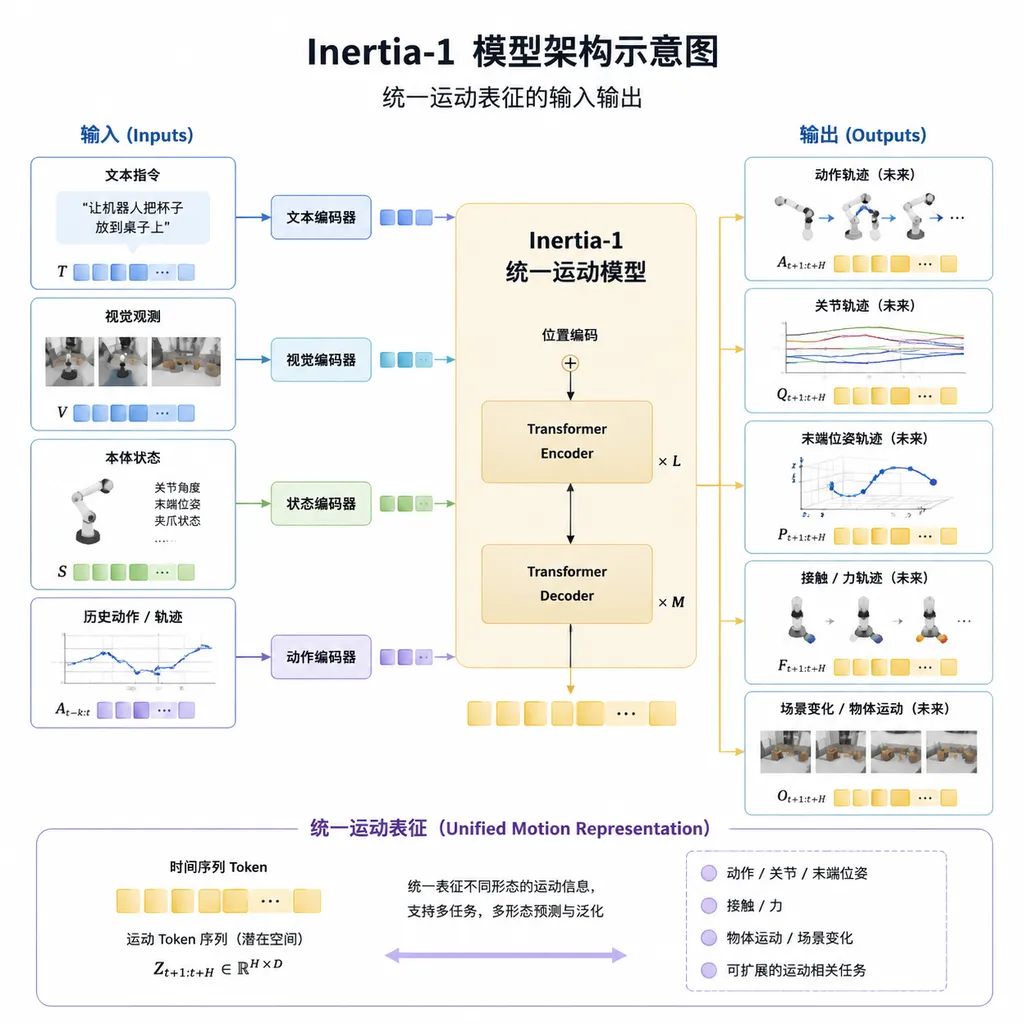
Inertia‑1 takes the opposite route. It treats motion as a single spatiotemporal signal—whether it’s a fingertip pinch, a torso twist, or an ankle cushion—and feeds all of it into one tokenizer, letting the model learn cross‑part and cross‑timescale motion priors on its own. This philosophy is closer to that of LLMs—don’t rush to split tasks; first model the modality of “motion” itself.
Technical Highlights
First is the motion tokenizer. The team didn’t adopt the mainstream VQ‑VAE that directly quantizes joint angles but instead introduced an encoder with physical constraints, embedding dynamics continuity into the codebook learning process. This detail matters because the biggest problem in prior robot motion discretization work has been that the codebook looks great on paper but makes the real robot shake uncontrollably in practice. Whether physical constraints truly solve this remains to be seen once the code is released, but the motivation is sound.
Second, multi‑scale temporal modeling. Screwing in a bolt may take 200 ms, while walking across a living room holding a cup takes 15 seconds—a two‑order‑of‑magnitude difference. Inertia‑1 uses a hierarchical Transformer to handle this: the lower layer models high‑frequency local movements, while the upper layer models low‑frequency full‑body trajectories. It sounds straightforward, but empirically, this “pyramid” structure often improves long‑horizon task success rates by tens of percentage points.
Third, cross‑morphology transfer. The project page notes that Inertia‑1 trained on data from multiple humanoid bodies, aligned via a unified skeletal semantics. This aligns with Horizon’s 400‑million‑parameter “cerebellum‑scale model,” HoloMotion‑1, whose goal is to reduce transfer barriers between different humanoid robots so developers don’t have to retrain from scratch for each new body.
How It Compares with HoloMotion‑1 and RoboBrain 2.0
Let’s line up this year’s open‑source embodied foundation models:
- HoloMotion‑1 (Horizon): 400 million parameters, focused on full‑body motor control—essentially a “cerebellum” translating high‑level commands into joint torques. Highly open‑sourced and production‑ready.
- RoboBrain 2.0 (BAAI / Unifolm): 7B and 32B versions, heterogeneous architecture, pursuing unified perception‑reasoning‑planning—more like a “brain.”
- Full‑Body VLA (Recently Open‑Sourced): VLA‑style model unifying vision‑language‑action tri‑modality across mobility, torso, arms, and hands.
- Inertia‑1 (Yang AI Lab): Positioned at the “motion understanding” layer—between HoloMotion’s execution layer and RoboBrain’s planning layer—focused on cross‑part, cross‑task, cross‑body unified motion representation.
In simple terms, each model occupies one layer of the embodied intelligence stack:
┌─────────────────────────────┐
│ Brain: RoboBrain 2.0 (planning & reasoning) │
├─────────────────────────────┤
│ Motor Cortex: Inertia‑1 (motion understanding) │
├─────────────────────────────┤
│ Cerebellum: HoloMotion‑1 (joint control) │
└─────────────────────────────┘
This layering isn’t arbitrary—read their papers or watch demo videos, and the division naturally emerges. Interestingly, none of them are truly end‑to‑end; even models branded as VLAs still rely on external planners for long, complex tasks. Inertia‑1’s ambition is to solidify that middle layer so both upstream and downstream can benefit.
My Take
Starting with the positives: Inertia‑1’s positioning is smart—it doesn’t battle VLAs at the top or compete on low‑level control, but instead focuses on the mid‑layer “motion representation,” something everyone needs but no one has perfected. The analogy in NLP would be BERT: you can attach a classification head, a generation head, or a robot‑policy head. If its motion priors truly generalize, the value extends beyond humanoid robots—to quadrupeds, robotic arms, even animation generation.
The uncertainties must also be noted. First, the team’s scale and background remain low‑profile; Yang AI Lab has little public info, so its engineering capacity and long‑term maintenance are unproven. Second, the reason a motion foundation model hasn’t yet “worked” is largely because motion data lacks the scale and diversity of text. The page mentions mixed synthetic and real data, but not its size—a critical variable for success in such work. Third, while cross‑body transfer sounds sexy, anyone who’s tried knows solving URDF differences isn’t enough—actuator dynamics, friction, and latency are the real obstacles.
When Will Embodied AI’s “GPT Moment” Arrive
At the start of 2025, the National Innovation Center dropped five top‑tier embodied‑AI papers, spanning discrete policies, model scaling, and zero‑shot navigation. At the time, the verdict was: “Technologies are flourishing, but there’s no backbone.” By 2026, that backbone is starting to emerge—multiple teams coincidentally chose “unification” as the next keyword, whether it’s RoboBrain’s perception‑planning unification, Inertia‑1’s motion unification, or VLA’s modality unification.
Unlike the LLM trajectory, however, embodied intelligence faces an unavoidable constraint: data can’t simply be scraped. There’s no “robotic Common Crawl” for you to train on. Building a true motion foundation model requires motion capture, simulation, or teleoperation—all measured in person‑years. Therefore, in the short term, I’m more optimistic about approaches like Inertia‑1 that use architecture and inductive bias to compensate for data scarcity, rather than brute‑forcing with scale.
Currently, the project page includes only model descriptions, methodological overviews, and partial qualitative results; code and weights are reportedly “coming soon.” Developers can follow the homepage and test once the weights land on Hugging Face. For humanoid‑robot teams seeking a general motion backbone, this could be one of the most worthwhile open‑source runs of the second half of the year.
OpenAI Hub will keep tracking open‑source progress in embodied intelligence. If you’re developing multimodal robotics applications and need to integrate GPT, Claude, or Gemini for high‑level planning or command generation, a single OpenAI‑format key will cover all—saving the hassle of juggling multiple domestic APIs.
References
- From Task‑Specific to General Intelligence: Foundation Models Reshaping Embodied Navigation (Zhihu) — A solid overview of architectures, memory, decision‑making, and training strategies in foundation‑model‑driven embodied navigation, providing useful context for understanding models like Inertia‑1.