NVIDIA Cosmos 3 Edge launched: a 4-billion-parameter world model packed into Jetson
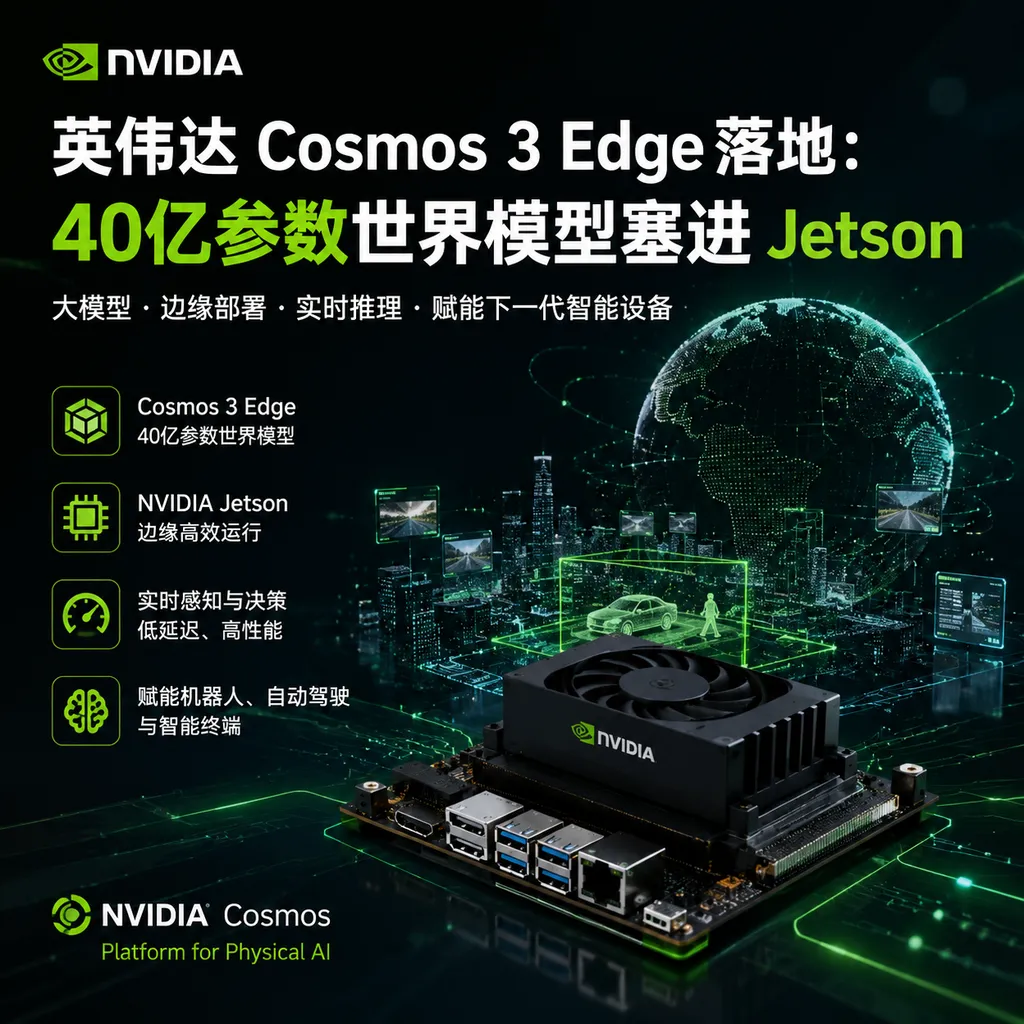
NVIDIA and Hugging Face jointly launch Cosmos 3 Edge, a 4-billion-parameter edge-side world model now officially available for download. It is designed for robotic body control and visual AI agents, and can run in real time on Jetson T2000/T3000.
NVIDIA just packed a world model into edge devices.
On July 20, during SIGGRAPH 2026, NVIDIA officially released Cosmos 3 Edge, a 4‑billion‑parameter open‑world foundation model whose weights are already available on Hugging Face. This is the final—and most crucial—piece of the Cosmos 3 family puzzle, following the June GTC Taipei launches of Cosmos 3 Super and Cosmos 3 Nano, because it directly determines whether this world model can actually run on robots and vehicles.
Unlike the heavyweight Super version that needs a DGX just to perform inference, Edge has a clear purpose: deployed on‑device, real‑time inference, adaptation to a specific embodiment within a single day. That’s also why NVIDIA simultaneously unveiled the new Jetson T2000/T3000 modules.
This world model is not just a concept
Before talking about Cosmos 3 Edge, it’s important to clarify what it’s not—it’s neither another VLM nor a miniaturized text‑to‑video model.
The entire Cosmos 3 family uses a Mixture‑of‑Transformers architecture, combining one Transformer specialized in reasoning with multiple generative “expert” Transformers. In plain terms, the model first “figures out” the physical relationships, motion trajectories, and spatiotemporal causality between objects before generating video frames or action commands. This is fundamentally different from traditional diffusion models that “guess” the next frame from noise.
Its training data scale is enormous—billions of text, image, video, audio, and action trajectory samples mixed together. According to NVIDIA, this is one of the largest multimodal physical‑AI datasets to date, with action trajectories being the key piece robots most lack for policy learning.
Cosmos 3 Edge is a distilled and pruned 4‑billion‑parameter version of Super, retaining the essential capabilities:
- Visual reasoning – Understands physical scenes from camera input and judges object interactions
- World generation – Given an action command, predicts future frames (core of closed‑loop simulation)
- Action generation – Outputs robot control sequences directly
- Multimodal input – Text + Image + Video + Audio + Trajectory, five inputs in total
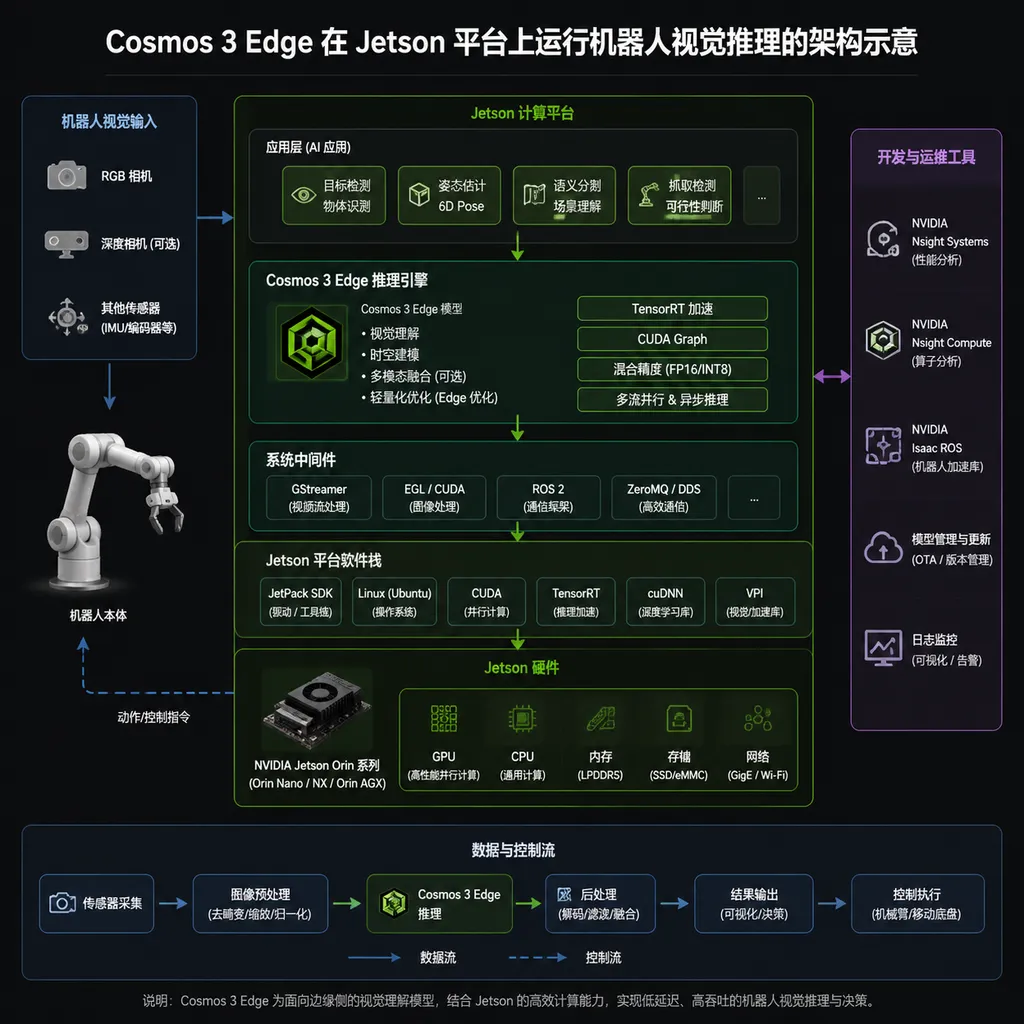
For robotics teams, the third capability is the most valuable. Previously, running VLA (Vision‑Language‑Action) models required cloud inference—latency and bandwidth nightmares. Being able to fit Cosmos 3 Edge into Jetson finally makes local inferencing viable.
The choice of 4 billion parameters is deliberate
Why 4 billion? It’s not an arbitrary figure.
Look at the specs of Jetson T3000—the new edge platform’s memory and compute capacity happen to align precisely with what’s needed for smooth inference of a quantized 4B model. Any larger would break real‑time performance; any smaller couldn’t achieve sufficient world‑model precision for closed‑loop robot control. Forty billion is NVIDIA’s calculated “sweet spot.”
The official adaptation process is spelled out clearly: a single developer, in roughly one day, can migrate Cosmos 3 Edge to a new robot embodiment, drone, sensor, or camera. That “one day” claim is rare—vendors usually hand‑wave about easy deployment—but NVIDIA daring to state it explicitly suggests the distillation and LoRA adaptation toolchains are now well‑polished.
Hardware compatibility covers:
- NVIDIA RTX consumer GPUs (local development)
- DGX systems (large‑scale training/fine‑tuning)
- Jetson T2000 / T3000 (production deployment)
- NIM microservices (cloud‑based elastic inference)
Japan’s deep strategy
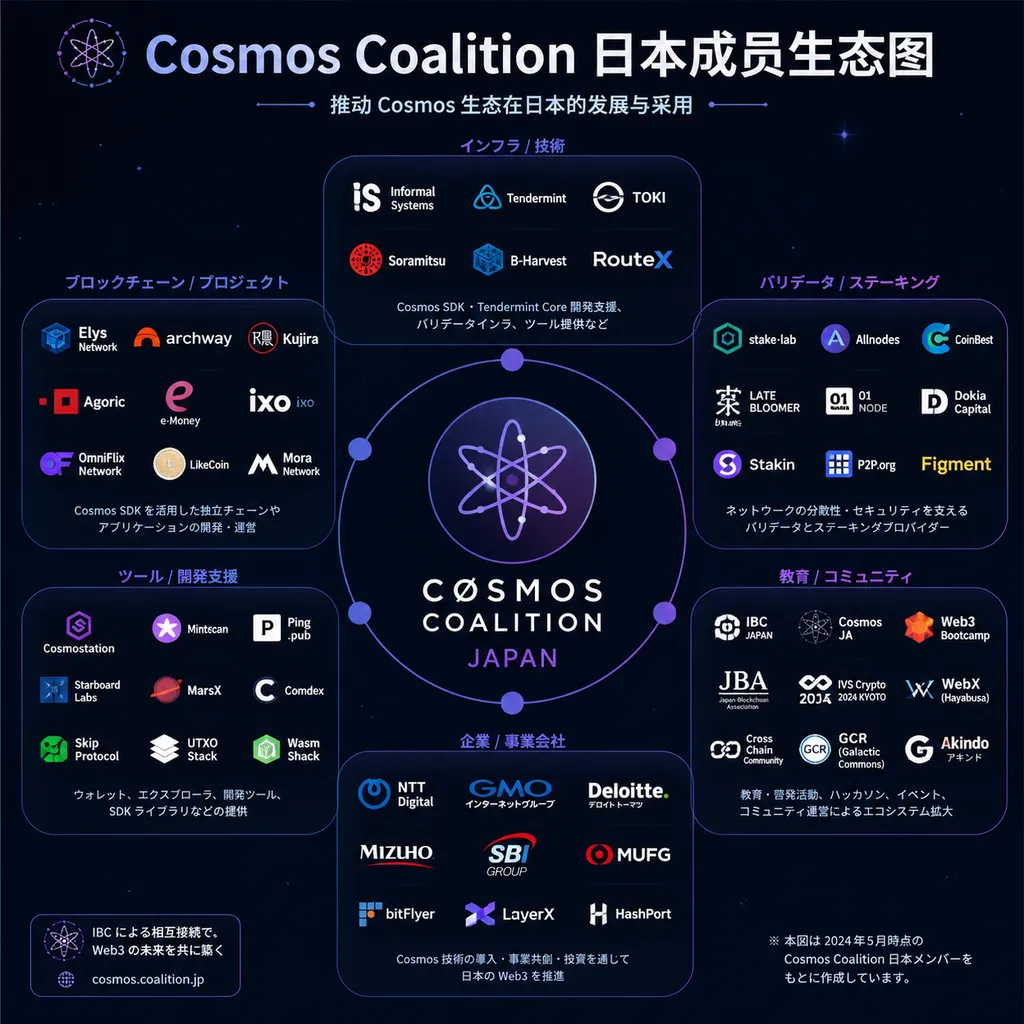
Alongside the Cosmos 3 Edge launch, NVIDIA announced with fanfare that the Cosmos Coalition now has over 20 leading Japanese enterprises onboard. The list is worth a look:
Industrial‑robotics giants: FANUC, Yaskawa Electric, Kawasaki Heavy Industries—between them they supply most of the world’s factory robot arms.
ICT heavyweights: Fujitsu, Hitachi, NEC, SoftBank, Sony—traditional ICT infrastructure combined with consumer electronics channels.
Emerging robotics players: LOVOT by Groove X (companion robots), Enactic (elder‑care robots), Telexistence (retail‑automation systems).
The collaborations are beyond PowerPoint—Fujitsu is leading a joint effort with FANUC, Yaskawa, and Kawasaki to develop a physical‑AI‑based collaborative control platform, while SoftBank is building its own physical‑AI development stack using Cosmos + Omniverse + Isaac Sim.
Why Japan? The logic is straightforward: Japan produces over 45% of the world’s industrial robots, is facing an aging population driving massive demand for service robots, and—with NVIDIA’s limitations in the China market—has become the most natural beachhead for physical‑AI rollout. This complements earlier research‑oriented coalition members like Agile Robots, Runway, and Skild AI.
The Coalition structure is interesting
A quick word on the Cosmos Coalition. It isn’t a loose “ecosystem partners” list—members must contribute models, research, and evaluation technology, and in return gain access to NVIDIA’s Cosmos 3 base models, training tools, and DGX Cloud infrastructure for large‑scale training.
It’s somewhat reminiscent of the early PyTorch Foundation, but more vertical—focused solely on physical‑AI world models. Surprisingly, founding members include Black Forest Labs (the FLUX developers) and Runway, implying NVIDIA intends to bring generative‑video expertise into the physical‑AI framework. Synthetic videos from Runway could then be fed back into robot training, closing a data loop that could cut costs by an order of magnitude.
As Jensen Huang put it at the launch: “For physical AI, compute is data.” Compute itself becomes data—because a world model can generate infinite simulation data for policy training. That’s the core commercial logic of the entire Cosmos 3 family.
What it means for developers
Several practical takeaways:
1. Weights fully open
The models are live under nvidia/cosmos3 on Hugging Face, and the Edge version will follow. They can be loaded directly via Diffusers or through NVIDIA’s official Cosmos SDK. This is genuine open‑sourcing, not “research‑only” pseudo‑open.
2. Clear deployment path
Local RTX for inference and debugging → quantized deployment on Jetson → production served via NIM microservices. All routes have official support—no need to hand‑roll inference engines.
3. Synthetic‑data generation
For teams working on robot policy learning, autonomous‑driving perception, or AR/VR content creation, Cosmos 3 Edge can generate physically accurate synthetic data at the edge—a capability previously limited to large cloud models.
4. Competition comparison
The edge‑world‑model field is still sparse. Google’s Genie series has no open‑source edge version, Meta’s V‑JEPA 2 remains research‑oriented, and Wayve’s GAIA is proprietary. Cosmos 3 Edge is the first to meet all three criteria—open‑source + edge‑deployed + fully multimodal—a clear first‑mover advantage.
There are shortcomings, of course: at 4B parameters, long‑horizon reasoning lags behind Super, requiring task‑specific fine‑tuning; and Jetson T3000 availability is still limited, so early users will likely run RTX cards instead.
A verdict
The significance of Cosmos 3 Edge lies not in dazzling model metrics but in transforming the world model from a “cloud toy” into an on‑the‑line tool. It’s a milestone for the entire physical‑AI industry—previous discussions on VLA and embodied AI were bottlenecked by inference cost and latency preventing on‑device deployment.
Now that barrier’s finally crossed. Over the next year, expect a wave of robot manufacturers launching products powered by Cosmos 3 Edge, and a surge in Jetson T‑series shipments. For developers in robotics, autonomous driving, and AR, this may be the most impactful new tech stack since ROS 2.
As for open models, while OpenAI Hub focuses on closed‑source API aggregation (GPT/Claude/Gemini/DeepSeek under one key), Cosmos 3 models are meant to run natively on robot hardware—so pulling weights from Hugging Face for local deployment via NIM or self‑hosted inference makes far more sense.
References
- nvidia/Cosmos3‑Super · Hugging Face — Model card and documentation for Cosmos 3 Super
- Introducing Cosmos 3 Edge · Hugging Face Blog — Official launch blog for Cosmos 3 Edge