
Meta created an AI version of Zuckerberg to chat with employees.
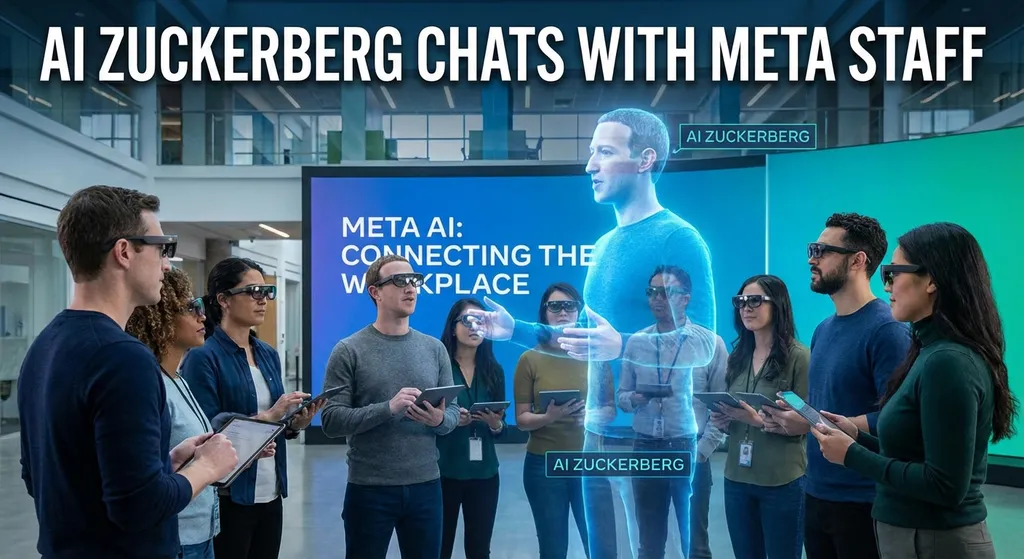
Meta internally revealed an AI version of the Zuckerberg model, capable of interacting with employees in the founder’s tone and style. This is not a toy, but a serious attempt at enterprise-grade AI character cloning.
Meta recently did something quite “Meta” — they created an internal AI version of Mark Zuckerberg that can directly communicate and interact with employees.
The news was first reported by Yicai and then sparked significant discussion within developer communities. Not because the act itself was earth‑shattering, but because it points to a direction many have considered yet few dare to pursue openly: using AI to clone a real decision‑maker and embedding that persona into daily corporate operations.
What exactly is this thing?
From the information leaked so far, this AI Zuckerberg is not just a chatbot with a familiar face. It’s more like a deeply fine‑tuned language model trained on Zuckerberg’s public speeches, internal memos, meeting transcripts, and other corpora, enabling it to respond to employee questions in a tone, mindset, and value framework close to Zuckerberg’s own.
Think of it as a virtual CEO that is always online, always patient, and never says, “I’ll get back to you later.”
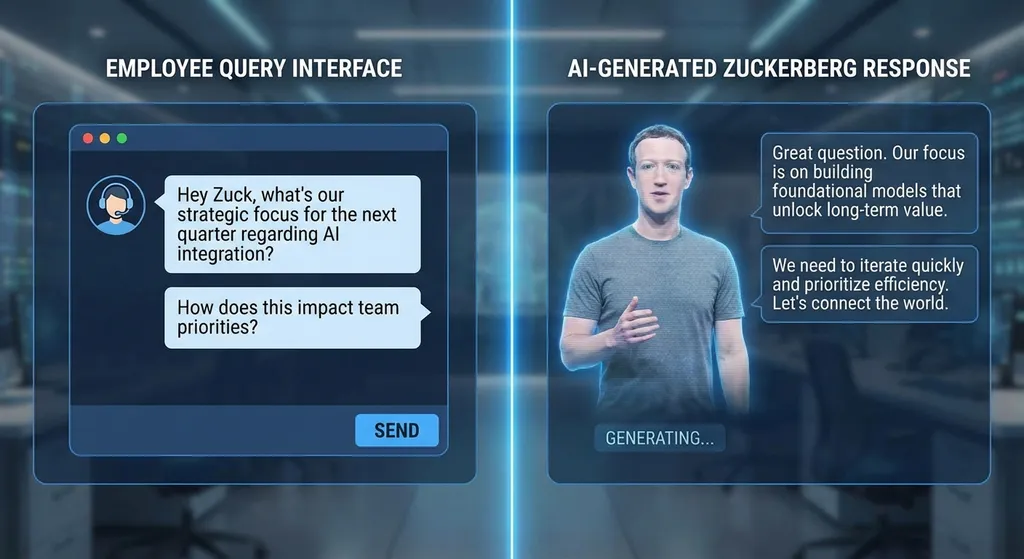
Employees might ask anything from “What’s the company’s long‑term strategy for open‑source AI?” to “How should our team prioritize next quarter’s goals?” The AI can give a “Zuckerberg‑style” response. Of course, it probably won’t make the final decisions itself, but it can “distribute” the CEO’s thinking framework and prioritization logic throughout the organization.
The significance of this experiment isn’t in the technical difficulty—it’s in Meta’s willingness to actually deploy it internally.
Why now?
In truth, the industry has been exploring AI role‑playing for quite some time.
In 2023, Character.AI turned “creating custom AI personas” into a platform‑level product, allowing users to train various virtual personalities—from historical figures to fictional characters, or even AI versions of themselves. Its core selling point is character consistency—unlike ChatGPT, which “forgets” conversation context, Character.AI’s characters remember chat history and maintain coherent personalities.
But Character.AI serves entertainment and social scenarios for consumers. Meta’s move is entirely different—it brings character cloning into the context of corporate management.
The distinction is like “chatting with an AI Shakespeare about sonnets” versus “discussing company strategy with an AI CEO.” The former can tolerate inaccuracy; the latter cannot—it could affect decisions impacting thousands of employees.
So Meta’s timing in 2026 makes sense. After two years of rapid model iteration, several key capabilities have matured to a usable level:
- Significant improvement in long‑context understanding, enabling models to digest large internal documents while keeping consistent output
- Much better persona retention—no more “breaking character” mid‑conversation
- RAG (retrieval‑augmented generation) allows real‑time access to the latest internal knowledge instead of relying solely on static training data
- Advances in safety alignment that better control what the model should or shouldn’t say
In short, in 2024 this might have backfired; by 2026, the risks are manageable.
How is it built?
Though Meta hasn’t disclosed the technical details, based on standard industry practices, this AI Zuckerberg is most likely a heavily customized build on Meta’s own Llama model family.
The architecture probably looks something like this:
Layer 1: Base model. Meta’s latest Llama models are already strong in reasoning and instruction‑following. Using in‑house models ensures data stays internal and allows the deepest customization.
Layer 2: Persona fine‑tuning. This is the core. The team gathers massive corpora from Zuckerberg—public speeches, blogs, internal memos, and possibly transcribed meeting recordings—and performs SFT (supervised fine‑tuning). The goal isn’t merely to mimic his speaking style, but to internalize his decision‑making logic and value hierarchy.
Layer 3: Knowledge injection. An AI Zuckerberg that only quotes “Move fast and break things” is useless. It must know the company’s current strategic priorities, line‑of‑business progress, the latest financial data, and even ongoing internal debates. This is likely realized via RAG—retrieving relevant internal documents before generating a contextually accurate, in‑persona response.
Layer 4: Safety guardrails. Perhaps the most critical part. AI Zuckerberg must never output unauthorized information like “We plan to ax this department” or “We’re canceling that product.” A robust content‑filtering and access‑control system ensures responses stay within safe boundaries.
For developers wanting similar persona customization in their own projects, the approach is the same: define the character via a system prompt, inject real‑time knowledge using RAG, and apply safety rules as a final safeguard. Here’s a simplified example:
import openai

client = openai.OpenAI(
    api_key="your-openai-hub-key",
    base_url="https://api.openai-hub.net/v1"
)

# Define persona system prompt
system_prompt = """
You are the AI proxy of [Company Founder’s Name].
Your responses should reflect the following traits:
- Decision style: data-driven, long-term oriented
- Communication style: direct, concise, illustrates points with concrete examples
- Core values: [fill in as appropriate]

You may reference the following internal knowledge base when answering:
{retrieved_context}

Important restrictions:
- Do not disclose unannounced business decisions
- Do not make personal comments
- If a question exceeds your knowledge scope, state this clearly and advise the employee to contact the responsible person
"""

response = client.chat.completions.create(
    model="claude-sonnet-4-20250514",  # or gpt-4o, deepseek-chat, etc.
    messages=[
        {"role": "system", "content": system_prompt},
        {"role": "user", "content": "What are the company’s investment priorities in AI infrastructure next year?"}
    ],
    temperature=0.7,
    max_tokens=1024
)

print(response.choices[0].message.content)
Using API aggregation platforms like OpenAI Hub, you can run the same code across different underlying models—try Claude for long‑context reasoning, GPT‑4o for strong instruction handling, DeepSeek for Chinese contexts—and find what best suits your business needs.
The real impact
Frankly, “AI Zuckerberg” sounds a bit sensational. But at a deeper level, it touches on a serious question: can AI become the “transmission mechanism” of corporate management?
Big companies all face a classic problem: A CEO’s ideas get distorted by mid‑management and often look unrecognizable at the operational level. It’s not out of malice—information loss and distortion are inevitable across hierarchies.
A well‑trained AI CEO agent could, in theory, let anyone in the organization directly engage with the top decision‑maker’s thought process—no need to wait for all‑hands meetings, chain‑of‑command interpretations, or guesswork about “what the boss really meant.”
That could greatly accelerate organizational flattening.
But the risks are also obvious.
First, accuracy. How faithfully do AI Zuckerberg’s words represent the real Zuckerberg? If employees act on the AI’s answer believing it’s the CEO’s directive and it isn’t, who’s accountable? Model hallucinations become exponentially more dangerous here.
Second, authority boundaries. Does AI Zuckerberg have “decision power”? If it says “I think this project should take priority,” does that count as a managerial directive? If not, its value diminishes; if yes, we’ve effectively let a statistical model partake in corporate governance.
Then there’s the subtler employee perception issue. Talking to an AI version of your boss—does that feel “efficient” or “eerie”? When you know it’s not real, yet it speaks and reasons exactly like your CEO, could this “uncanny valley” effect make people uncomfortable in a workplace context?
There are no definitive answers yet—but Meta’s willingness to experiment internally is itself noteworthy.
Will others follow?
Most likely, yes.
In fact, such needs have existed in enterprises for years. Many companies already use AI for internal Q&A, meeting summaries, and workflow automation. But few dared publicize “AI executive agents” because it’s sensitive—it implies “our CEO’s communication can be approximated by a model.”
Now that Meta has taken the lead, two trends are predictable:
- Quiet internal adoption by big tech. Without public announcements, internal pilots of “AI executive agents” for onboarding, cross‑functional coordination, or strategy Q&A. Low‑risk, high‑reward.
- Commercial SaaS products. Startups might launch “enterprise AI persona cloning” services helping mid‑ to large‑size companies deploy their own “AI CEOs” or “AI department heads.” Market potential will hinge on corporate trust in AI agents.
For developers, this means persona consistency and knowledge‑boundary control will become essential engineering capabilities. It’s more than prompt engineering—you’ll need evaluation systems: How to quantify persona fidelity? Guarantee knowledge accuracy? Test safety boundaries? These are concrete engineering challenges.
A cooler look
To be honest, information so far is limited. Meta hasn’t released technical blogs or product specs; everything comes from scattered media reports. It’s unclear whether AI Zuckerberg is a mature internal product or an early‑stage experiment.
But the direction is right. Large models have moved beyond the “general assistant” story—the next race is in deep customization and persona specialization. Whoever turns AI into not just a tool but a coherent “digital persona” with character, judgment, and memory will hold the advantage in the next phase.
Meta starting with its own CEO shows they’re serious.
As for whether the AI Zuckerberg will prove more popular among employees than the real one—that’s a question only those inside Meta can answer.
References
- Meta builds an AI version of Mark Zuckerberg — 36Kr Newsflash, report on Meta’s internal AI Zuckerberg project


