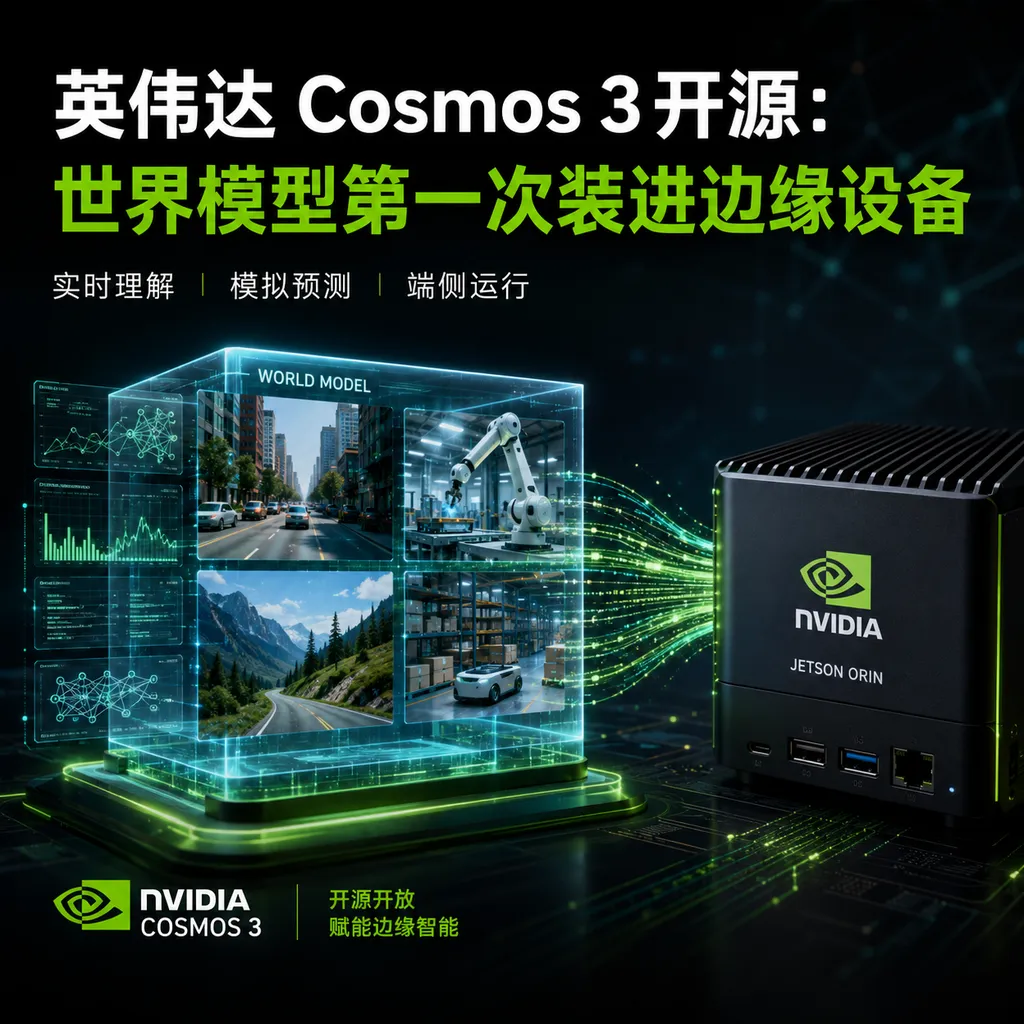
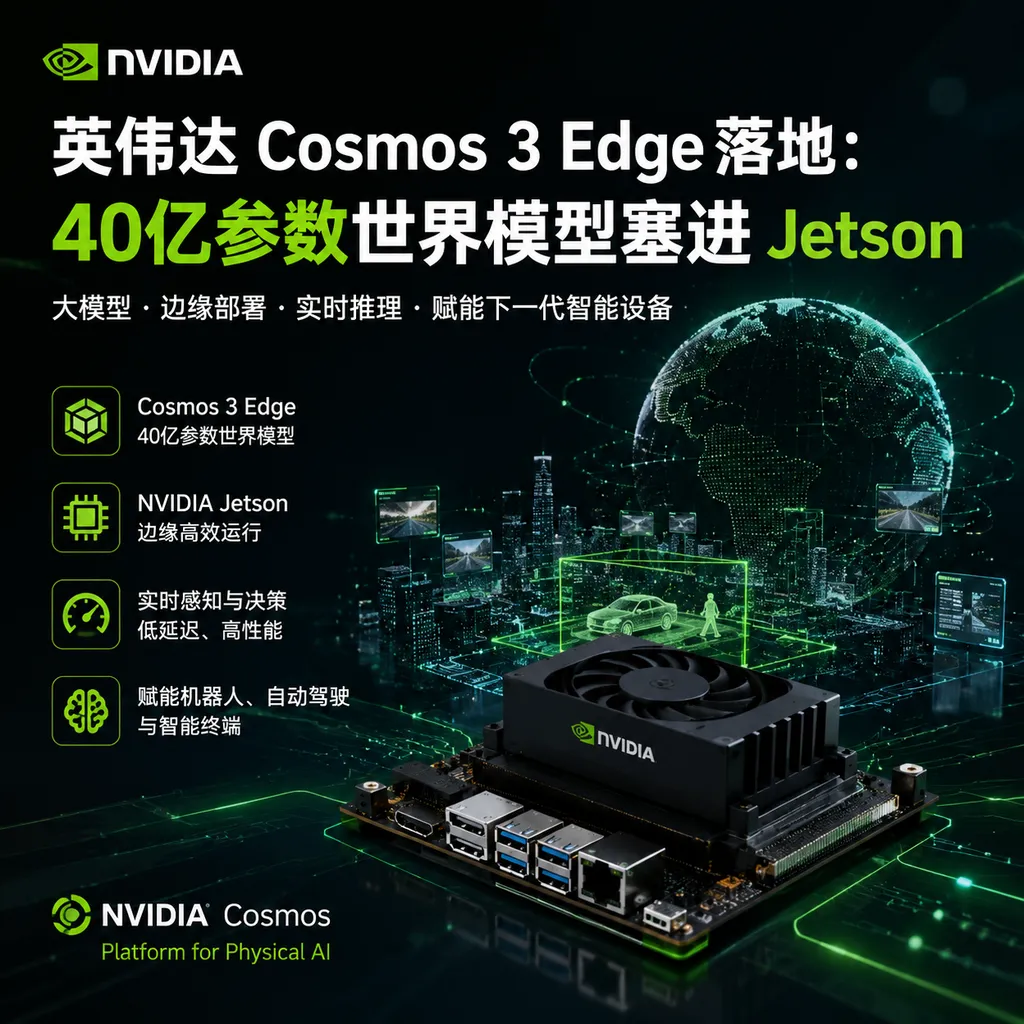
NVIDIA Cosmos 3 Edge Debuts: A 4B-Parameter On-Device World Model
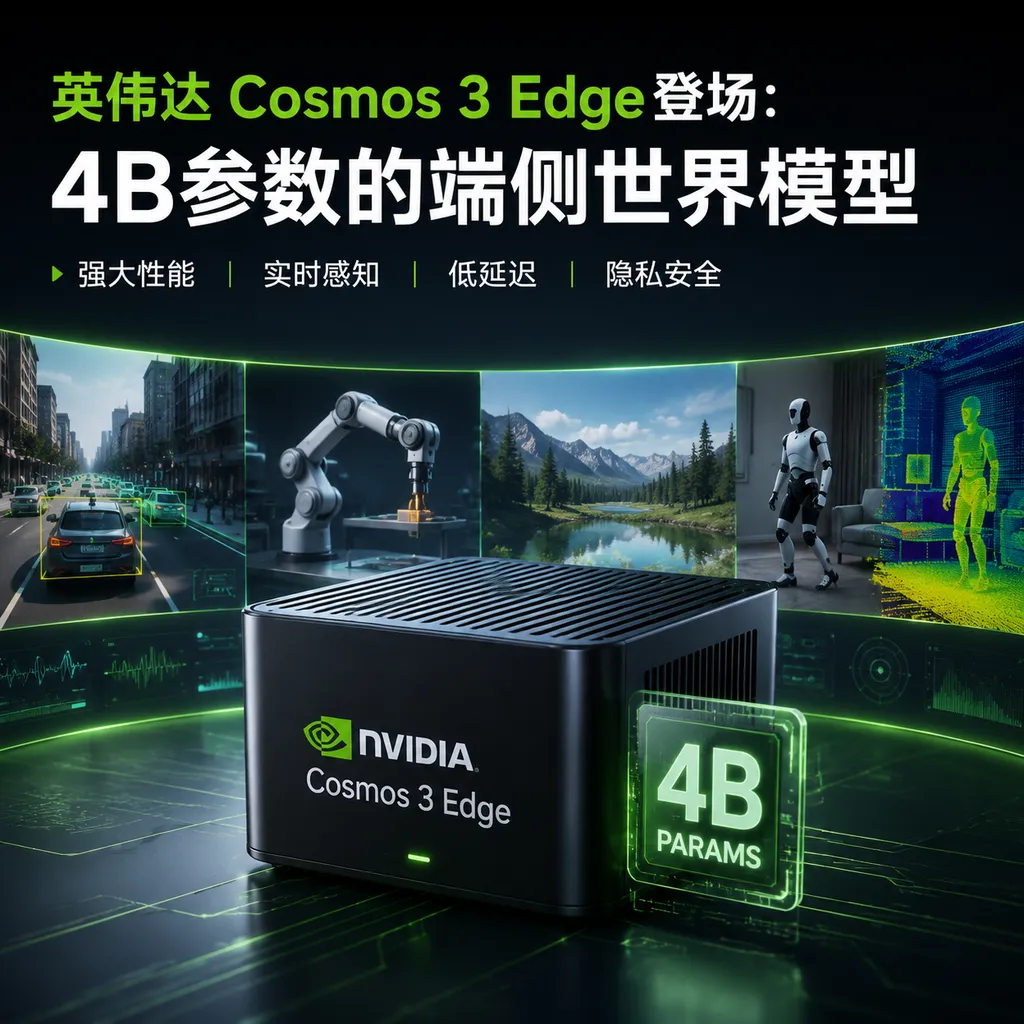
NVIDIA officially released Cosmos 3 Edge, a 4-billion-parameter on-device world model designed for robotic control and visual AI agents. It can run directly on Jetson edge devices and is being developed in collaboration with more than 20 major Japanese industry leaders to jointly build a physical AI ecosystem.
NVIDIA Releases Cosmos 3 Edge: A 4‑Billion‑Parameter On‑Device World Model, Bringing Physical AI to the Edge
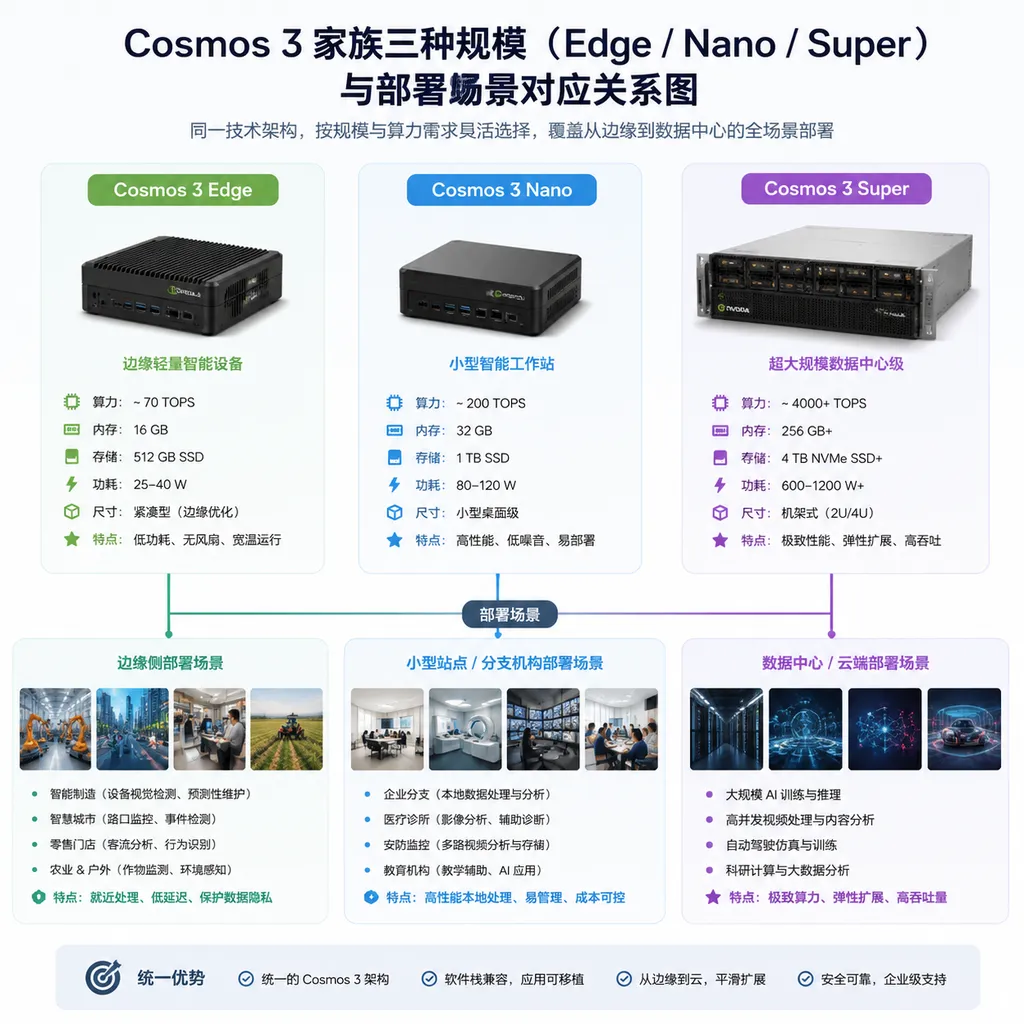
Yesterday (July 16), NVIDIA quietly posted a blog on Hugging Face announcing Cosmos 3 Edge—a 4‑billion‑parameter world model designed for robotic bodies and visual AI agents, deployable directly on edge devices such as Jetson. This officially fills the gap in the Cosmos 3 family lineup, following its initial debut on HF and GitHub in late May.
If Cosmos 3‑Super (65B) and Nano target data‑center inference and mid‑scale scenarios, then Edge is the first to truly put the concept of a world model inside a robot’s body.
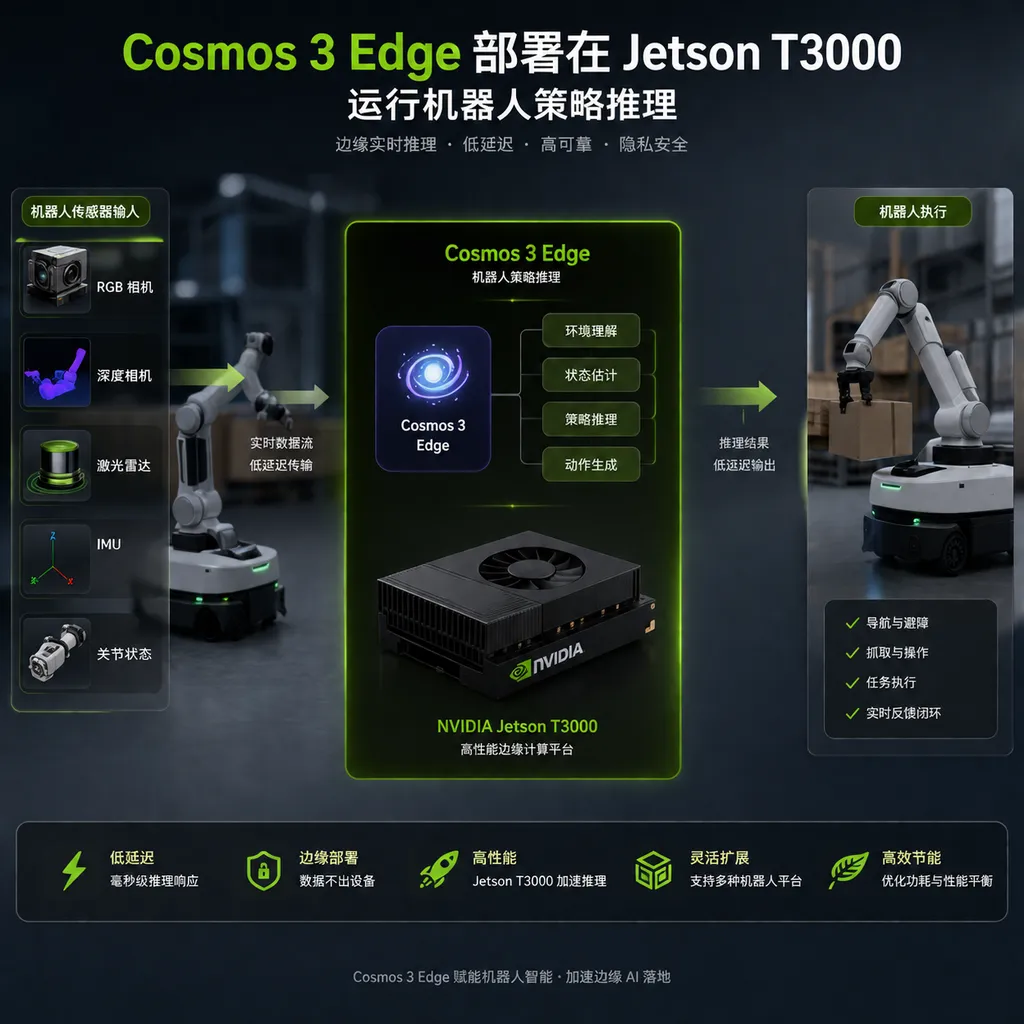
First Things First: A World Model That Fits Inside a Robot’s Body
“World model” has become a buzzword over the past year, but few truly runnable versions exist. Its core difference from traditional LLMs lies here—LLMs process token sequences, while world models handle the dynamics of the physical world: given the current observation frame and an action, they predict what happens next. That’s what robots actually need.
The Cosmos 3 family adopts an omnimodal mixture‑of‑transformers architecture—handling language, image, video, audio, and action sequences within one unified backbone. This isn’t the usual “multimodal by adapters” setup; it’s native full‑modality joint modeling from pre‑training onward. The paper’s benchmarks back it up: Artificial Analysis ranked its post‑trained version first among open‑source Text‑to‑Image and Image‑to‑Video models, and it topped RoboArena as the strongest open‑source policy model at the time.
The Edge version is the “slimmed‑down” variant of this architecture. 4B parameters may not sound large, but for real‑time inference on a robotic arm controller or autonomous vehicle, it’s already near the current engineering limit.
What 4 Billion Parameters Mean
For comparison: Google’s RT‑2 has 55B—impressive, but impossible to deploy on‑device; Physical Intelligence’s π0 has just over 3B; at around 4B, Cosmos 3 Edge clearly targets Jetson‑class hardware’s memory and power budget.
According to NVIDIA:
- It can run inference and fine‑tuning on RTX GPUs;
- It supports large‑scale post‑training on DGX systems;
- It’s fully compatible with the new Jetson T2000 and T3000 modules (released alongside it);
- Developers can port it to specific robots, autonomous vehicles, or cameras “in about a day.”
The “one‑day adaptation” claim should be taken with a grain of salt—but the Isaac Sim + Isaac GR00T toolchain does make sim‑to‑real much faster. NVIDIA has been working on this for three years; Cosmos 3 Edge is the final piece of the puzzle—what was missing before was a small, fast, and truly physics‑aware policy backbone.
Full‑Modality Backbone, Untouched Even on Edge
From the Hugging Face collection, NVIDIA released a whole series of supporting assets along with the main model:
nvidia/Cosmos3-Nano/Cosmos3-Super/Cosmos3-Super-Image2Video/Cosmos3-Super-Text2Imagenvidia/Cosmos3-Nano-Policy-DROID(policy model post‑trained on the DROID dataset)- Multiple synthetic datasets: warehouse operations, autonomous driving, embodied robotics, physical interaction, digital humans
- Adapted benchmarks for mainstream robotics:
LIBERO_LeRobot_v3,BridgeData2_LeRobot_v3,Cosmos3-DROID Cosmos-HumanEval-v1, a dedicated evaluation suite for world models
Notably, the datasets take even more effort than the models. Over recent years, NVIDIA has focused heavily on synthetic‑data pipelines: mixing real robot data with high‑fidelity physically‑correct scenes generated in Omniverse. This recipe is a key reason the Cosmos line performs so well. Other teams can easily grab the weights—but data pipelines are the true moat.
Why Japan for This Release?
Alongside the model, NVIDIA also announced the NVIDIA Cosmos Coalition—an industrial alliance for physical AI made up of more than 20 Japanese companies. The member list reads like a hall of fame of Japanese robotics and electronics:
- Industrial Robotics: FANUC, Yaskawa Electric, Kawasaki Heavy Industries
- ICT Giants: Fujitsu, Hitachi, NEC, SoftBank, Sony Group
- Service/Vertical Robotics: Groove X (LOVOT companion robot), Enactic (senior care), Telexistence (retail automation)
Concrete collaborations are already underway: Fujitsu, FANUC, Yaskawa, and Kawasaki are jointly developing a physical‑AI‑based cooperative‑control platform; SoftBank is building its own physical‑AI development platform using Cosmos + Omniverse + Isaac Sim.
It’s no surprise that NVIDIA chose Japan as the first launch ecosystem. Japan’s manufacturing base is huge—factory scenarios are where Cosmos 3 Edge fits best. Meanwhile, China’s compute and model‑export landscape is a different story; for NVIDIA, Japan is currently the most practical industrial foothold.
Comparison with Google, Meta, and π
A quick overview of recent “world models”:
| Model | Parameters | Positioning | Open Source | |--------|-------------|--------------|--------------| | Google Genie 3 | Not disclosed | Interactive video world generation | No | | Meta V‑JEPA 2 | ~1.2 B | Visual representation backbone | Yes | | DeepMind Gemini Robotics | Not disclosed | End‑to‑end VLA | No | | Physical Intelligence π0.5 | ~3 B | Policy model | Partial | | NVIDIA Cosmos 3 Edge | 4 B | Unified edge‑side generation + policy | Yes |
Cosmos 3 Edge is unique in that it’s both a generative model (predicting future frames, sim rollouts) and a policy model (outputting actions). These are usually separate modules; Cosmos 3 merges them using one mixture‑of‑transformers backbone. Theoretically, robots can “think and act simultaneously”—imagining several possible futures and choosing the optimal path to execute.
If this paradigm scales, it’s a route to embodied intelligence more promising than just “bigger VLAs.”
Should You Use It?
If you’re working on robotics, drones, AGVs, or smart cameras, Cosmos 3 Edge is the most worthwhile open‑source option right now—bar none. Reasons:
- Open weights under a commercial‑use license (see the model card for details);
- Complete benchmarks and datasets—no need to build your own;
- Clear hardware pathway—Jetson through DGX in one unified chain;
- Unified policy + perception, removing lots of glue code.
There are drawbacks:
- 4 B is still large for ultra‑low‑power use cases (e.g., drone MCUs);
- Full‑modality training means each single‑modality task isn’t SOTA—pure vision tasks may be better served by specialized small models;
- The ecosystem is tied to NVIDIA hardware; AMD / Qualcomm support will depend on the community.
Epilogue
It’s taken about two years for “world model” to go from a buzzword in papers to a 4 B checkpoint that fits inside a Jetson. Cosmos 3 Edge may not be the endpoint, but it pushes physical AI from a conceptual stage into an engineering one —an advance more significant than simply scaling to 100B parameters.
As for open‑source availability, the Cosmos 3 model weights are already on Hugging Face—grab them if you want to try. For text‑ and multimodal‑reasoning needs, the OpenAI Hub continues to host mainstream open‑source models for convenient comparison.
References
- Cosmos3 Collection – Hugging Face – Complete Cosmos 3 family on HF, with models, datasets, and evaluations
- Cosmos 3: Omnimodal World Models for Physical AI – Paper Page – Technical report with architecture & evaluations
- NVIDIA Cosmos 3: From “video generation” to embodied physical AI – Zhihu – Chinese‑community technical breakdown of the Cosmos 3 family