Qwen-Image-3.0 Release: Pushing Image Models Toward Productivity Tools
Today, Alibaba’s Qwen launched the third-generation image generation foundation model, **Qwen-Image-3.0**, supporting ultra-long 4.5k-token input, precise rendering of 10px small text, and native layout for 12 languages—pushing AI images from “good-looking” to “truly useful.”
Today (July 21), Alibaba’s Qwen team released the third generation of the Qwen-Image series — Qwen-Image-3.0.
Unlike many peers who keep chasing after “photo-realistic portraits” or “cinematic lighting,” this update focuses on one key word: practicality.
Simply put, the first-generation Qwen-Image emphasized accuracy (“准”), the second-generation expanded to accurate, diverse, beautiful, and realistic (“准多齐美真”), and by the third-generation, the team described it with three new key phrases — content-rich, detail-realistic, and knowledge-solid.
Translated for developers: this isn’t just another text-to-image model — it’s built to actually get work done.
What a 4.5k Token Input Window Means
Let’s start with the key stat: a maximum input of 4.5k tokens.
To understand how significant this is, consider that most mainstream text-to-image models (including Midjourney, SD 3.5, and the FLUX series) cap out around 512 tokens, beyond which you’d need a big encoder like T5-XXL or a custom-built one.
Back in the Qwen-Image-2.0 era, Alibaba had already pushed this to 1k tokens (snapshot from December), and now the third generation jumps more than fourfold.
This isn’t just a numbers game.
4.5k tokens means you can now feed in an entire math exam, a full research-paper layout, or a complete UI component description into one prompt and generate in a single shot.
The official example is a “knowledge nine-grid” — each grid cell is a neatly formatted math PPT with complete formulas, geometric diagrams, and coordinate labels.
At this level of structured content, what previously required assembling multiple outputs can now be done directly.
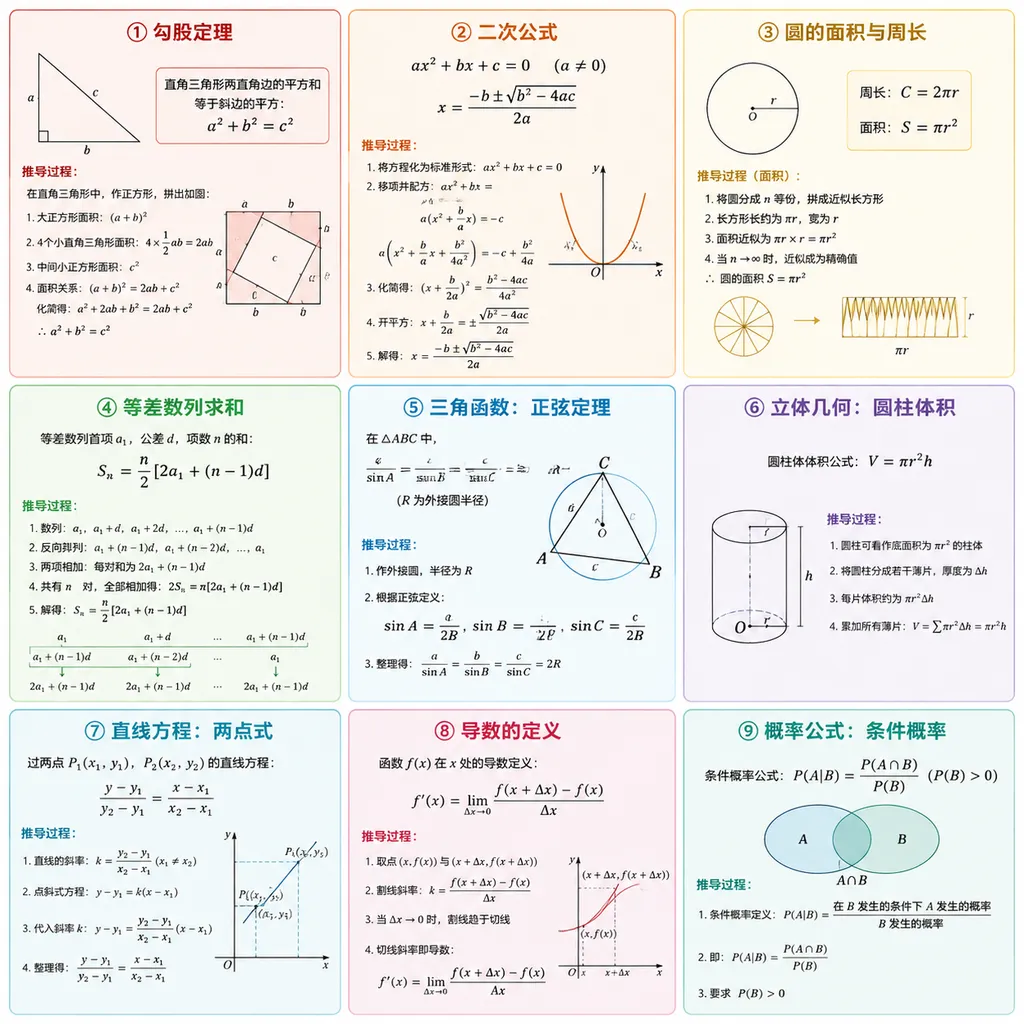
For teams in edtech or professional content tooling, this single feature alone warrants a serious budget and stack review.
Where creating an educational graphic that “looks right” used to mean combining LaTeX rendering with image synthesis — or spending time cleaning up messy AI-generated formulas — now you can just feed in your outline.
10px Fonts: Text Rendering Taken Up Another Notch
Text rendering has always been a signature feature of the Qwen-Image series.
The first open-source version (August) went viral for its ability to render long Chinese text; the December 2512 snapshot pushed things to near-commercial quality for complex Chinese.
Now, the third generation steps up again with precise rendering even at 10px font size.
What’s 10px?
Roughly the smallest readable body text on a phone screen — the size used for poster footnotes, newspaper bottom bars, or UI labels.
Below this threshold, most models blur or misplace strokes.
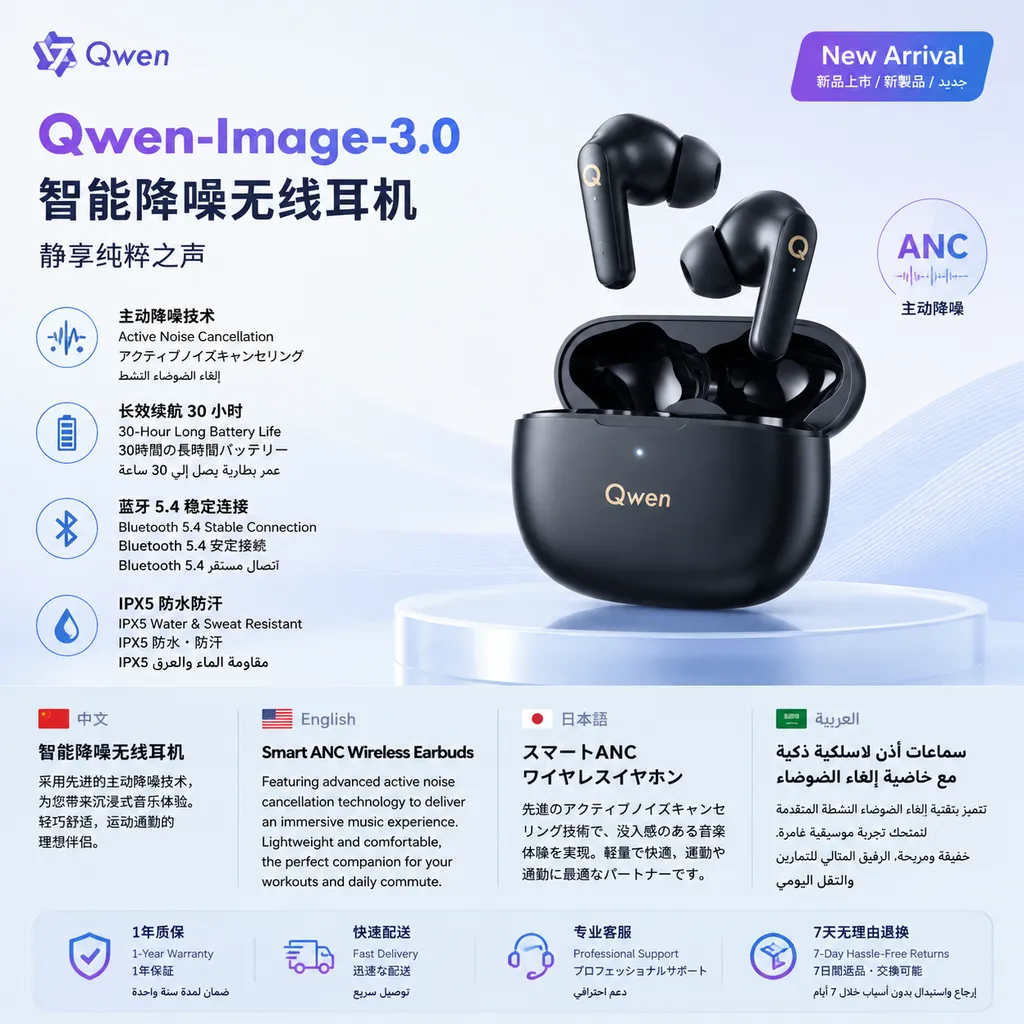
Yet Qwen-Image-3.0 remains crisp and readable — and with native support for 12 languages and 20+ fonts, it slashes the difficulty of producing multilingual posters, where human layout work used to be a must.
Developers can imagine numerous applications:
- Cross-border e-commerce posters – one prompt outputs all language versions, no need for multiple design templates
- Film/manga storyboards – speech bubbles contain readable text, no Photoshop patching
- Newspaper and magazine layouts – columns, titles, captions generated together
- Game UI mockups – buttons, tooltips, and status texts directly generated, no slicing required
Compared with overseas competitors like GPT-4o image generation, Ideogram 3.0, or FLUX.1 Pro, Qwen-Image-3.0 clearly leads in multilingual + dense text generation.
GPT-4o handles English text well but struggles with small fonts in CJK; FLUX controls font precision well but can’t take 4k-token-long prompts.
Alibaba is extending its long-standing strength even further here.
Knowledge Solidity: The Model Starts to “Understand Business”
The third dimension, knowledge solidity, is the most abstract — yet it best reflects generational jumps in foundational models.
Officially it’s described as “simulation of mainstream web, gaming, and livestream interfaces, with rich world knowledge.”
That sounds like marketing, but behind it lies a true understanding of structured visual knowledge — the model knows what an e-commerce page should look like, where floating comments appear in a livestream, or the position of traffic light buttons on a macOS window.
Previously such understanding relied on heavy fine-tuning using ControlNet or LoRA adapters.
When the base model itself has this knowledge, it means vertical scenarios no longer need custom adapters.
Want to generate a realistic Taobao product page? Just prompt it.
Need a mock-up Bilibili livestream screenshot demo? Same thing — just prompt it.
Version Evolution: Four Leaps in a Year and a Half
Looking at Qwen-Image’s timeline shows how aggressively Alibaba has iterated on this line:
- Aug 2025 – Initial Qwen-Image open-sourced, 20B MMDiT architecture, breakthrough in Chinese text rendering
- Dec 2025 – Qwen-Image-2512 update, big leaps in portrait quality and consistency
- First half of 2026 – Qwen-Image-2.0 sees rapid snapshots; 1k-token input, unified text-image modeling
- July 21, 2026 – Qwen-Image-3.0 shifts focus to “productivity tools”
This pace outstrips most domestic developers and even Stability AI’s typical six-month cycle.
Reaching a third-generation base model suggests a rising commercial expectation inside Alibaba.
API beta testing has opened on Alibaba Cloud Bailian and the Qwen AI Platform, with free access via Qwen Studio and the Qwen app coming soon.
What It Means for Developers
To judge whether a visual model is worth adopting, I usually ask three questions:
Can it replace human labor, fit existing workflows, and make financial sense?
Qwen-Image-3.0 delivers on all three.
First, it targets the least technically demanding slice of designer work — large-volume, multilingual, structured text-image materials.
This segment is huge and naturally suited to AI automation.
Second, with its 20B-parameter MMDiT model, inference costs remain manageable.
Past distilled versions of Qwen-Image already ran on consumer GPUs, so the 3.0 version will likely follow suit.
Whether deployed via enterprise API or on-premise, the economics work.
Third, on integration: the Qwen series sticks to the OpenAI-compatible format, meaning near-zero integration cost.
Teams using aggregators like OpenAI Hub (openai-hub.com) will be able to switch in the new model with a single key — allowing side-by-side runs with GPT, Claude, Gemini, or DeepSeek for effect comparison, without juggling multiple SDKs.
A Bit of Cold-Headed Judgement
Of course, promotional demos always cherry-pick results.
That slick nine-grid math PPT is a showcase; real production stability, failure rate, and controllability under complex prompts still need testing.
Another concern is copyright and compliance.
The stronger the text rendering, the easier it becomes to produce fake newspapers, forged documents, or counterfeit brand ads.
Qwen-Image-3.0’s official materials don’t highlight safety measures — presumably those will rely on platform-level filtering.
That said, stripped of marketing gloss, Qwen-Image-3.0 remains one of the most noteworthy visual foundation-model upgrades in the past half-year.
Rather than chasing “more realistic” or “more beautiful,” it focuses on “more useful.”
That’s a smart pivot — the aesthetic ceiling is already high; the next real differentiator is who can truly plug into production workflows.
Alibaba made the right bet this time.
References
- Alibaba Qwen releases Qwen-Image-3.0 foundation model: turning words into pictures with print-like precision – IT Home – Most comprehensive report on official details and capabilities
- Alibaba Cloud Summit unveils six major models including Qwen 3-VL and Wanxiang 2.5 – IT Home – Background on prior Qwen-Image iterations