Sakana AI launches Fugu Cyber: knocks GPT-5.5 off the throne in the security track
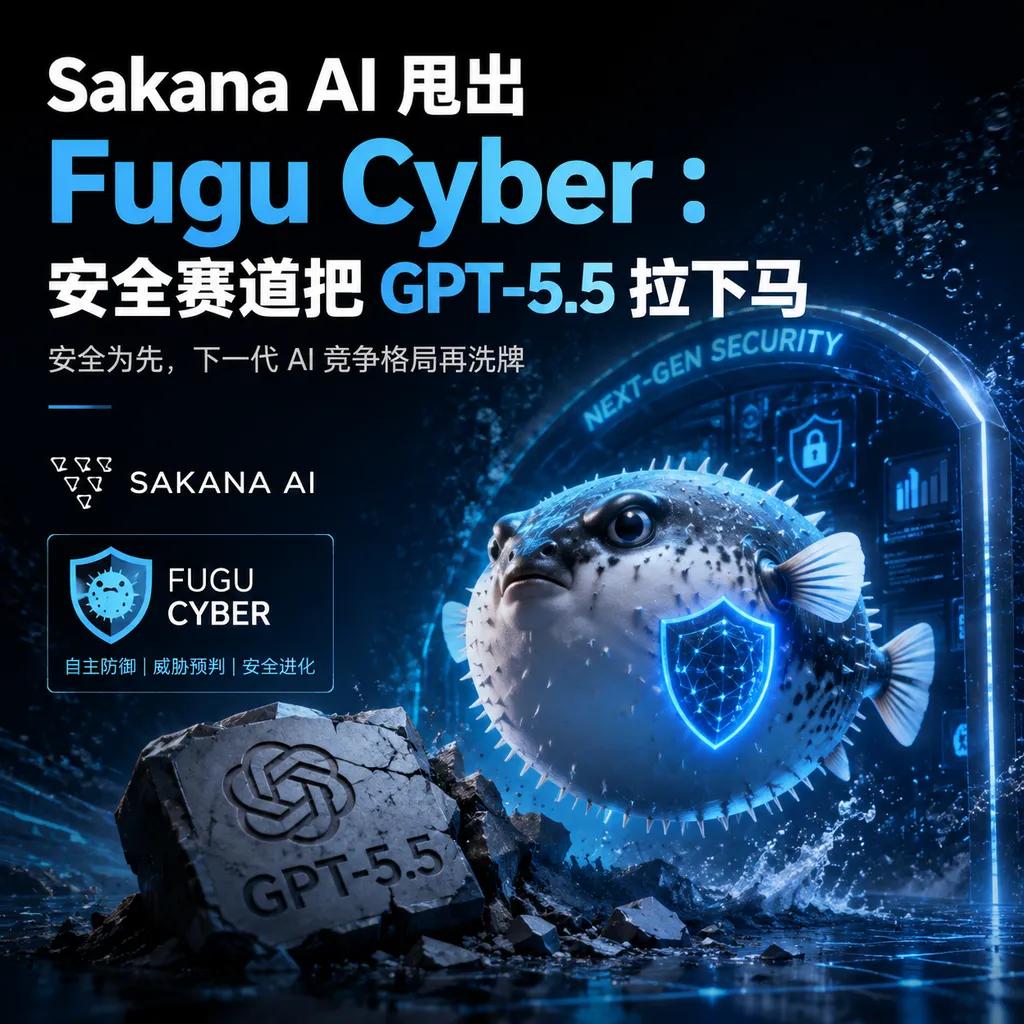
Japan’s Sakana AI has released **Fugu Cyber**, a multi-agent model dedicated to cybersecurity. It achieved an **86.9% success rate** on CyberGym and **72.1%** on CTI-REALM, outperforming both **GPT-5.5-Cyber** and **Claude Mythos-Preview** in these two core benchmarks — pushing the “multi-agent-as-model” approach further into vertical domains.
Sakana AI Launches Fugu Cyber: Pulling GPT-5.5 Down from the Throne in the Cybersecurity Track
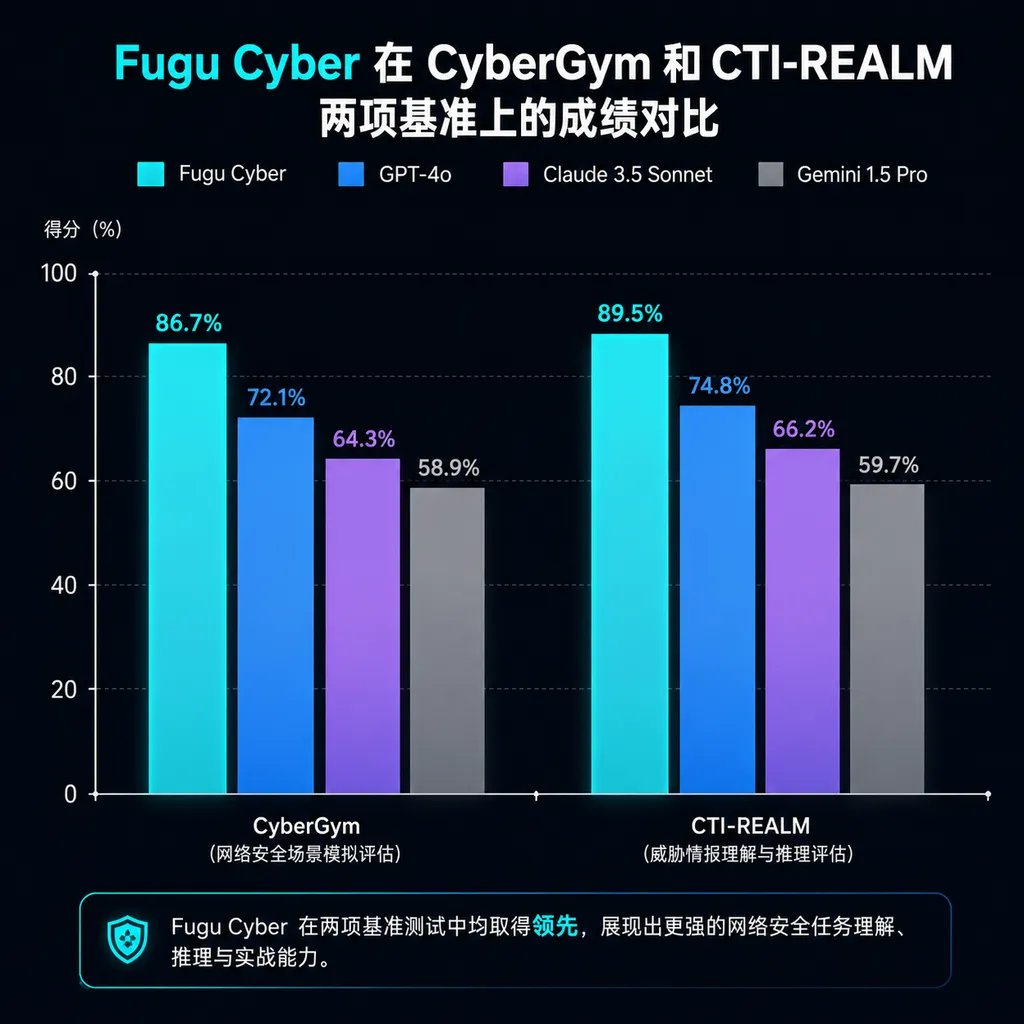
On July 21, Japanese AI startup Sakana AI released Fugu Cyber, a multi-agent model designed specifically for cybersecurity scenarios. The core numbers are straightforward: 86.9% success rate on CyberGym and 72.1% on CTI-REALM — both surpassing OpenAI’s GPT-5.5-Cyber and Anthropic’s Claude Mythos-Preview.
This marks the first time Sakana has adapted the general-purpose Fugu architecture — introduced just last month — to a vertical industry. Its debut field of choice? The red-hot security track, recently bombarded by OpenAI’s Daybreak and Anthropic’s Mythos.
Not One Model, but a Shell Housing Many
Let’s clarify what Fugu actually is — otherwise, the word “model” might mislead you.
When Sakana launched Fugu last month, it used the phrase “multi-agent system as a model.” In plain English: from the API-side, it looks like a single model, OpenAI-compatible — one request in, one response out. But internally, it dynamically orchestrates a set of specialized agents, each potentially backed by different base models, both closed and open source — Gemini 3.1 Pro, Opus 4.8, GPT-5.5 xhigh, and others are in the candidate pool.
The ambition here is clear: to move the orchestration layer from applications into infrastructure. Previously, if you wanted to build an agent system, you had to write the router, set up fallback logic, and tune prompts yourself. Sakana packages that logic into an API and sells it to you. Developers face less cognitive overhead, but the trade-off is more opacity — you won’t always know which branch the system took or how many subcalls were made.
Fugu Cyber extends this concept to the cybersecurity field. Its internal agents are specialized and security-trained — handling vulnerability analysis, reverse engineering, threat intel parsing, penetration test path planning, and CVE reasoning. When a user sends a prompt like “Analyze this suspicious traffic and provide response recommendations,” the orchestrator breaks it into steps — reconnaissance, matching, verification, and report generation — assigning each to different agents.
How Those Two Benchmark Scores Were Achieved
The 86.9% and 72.1% figures look impressive, but what do they mean?
CyberGym is among the toughest comprehensive red-team/blue-team benchmarks, covering vulnerability discovery, exploit writing, CTF-style challenges, and real CVE reproduction. It doesn’t test Q&A; it tests whether the model can actually perform tasks in a sandbox — for example, locating a flaw in a binary and producing a PoC. GPT-5.5-Cyber previously scored in the 70s range, Claude Mythos-Preview slightly higher. Fugu Cyber pushed that to 86.9%, a significant leap.
CTI-REALM, on the other hand, measures threat intelligence reasoning: piecing together fragmented IOCs, TTPs, logs, and reports to reconstruct an attack chain, attribute it to an APT group, and predict next moves. Traditionally, this work relied on human analysts and SIEM tools. A 72.1% model score implies SOC-grade readiness.
Interestingly, Fugu Cyber shows its greatest strength on multi-step tasks requiring tool invocation. This aligns perfectly with its architecture — a single large monolithic model has limits on what one forward pass can handle, while multi-agent systems are naturally suited to decomposing tasks and assigning substeps to the best-suited capabilities. That’s why GPT-5.5-Cyber, though strong on pure knowledge questions, lags behind in complex workflows.
Why Sakana, and Why Cybersecurity?
It’s actually not surprising that Sakana chose to dive into vertical security models.
On the technical side, since its founding, Sakana has focused on model fusion and evolutionary model synthesis. Its founder, David Ha, previously at Google Brain, worked on world models and neuroevolution. Fugu’s idea of “letting models search and iterate toward optimal configurations” builds directly on that lineage — AI Scientist, evolutionary optimization, and the like. The steadily improving BPB curve in CyberGym experiments shows agents performing hyperparameter search autonomously — very much in Sakana’s established style.
Commercially, it makes even more sense. Security is one of the few enterprise domains willing to pay premium prices for AI — and tolerate opacity. Sell a CISO a general-purpose model, and they’ll haggle. Offer them a tuned cybersecurity system that can replace three junior analysts, and they’ll accept higher prices and a black-box implementation. Sakana openly stated in its announcement that beyond its API, it offers on-premise deployments and on-site delivery, clearly targeting enterprise customers.
There’s also broader context. Rumors have spread on social media that Japanese AI firms are advancing faster than expected in sidestepping U.S. export controls — and Sakana often comes up. One hidden advantage of Fugu’s architecture is that it isn’t tied to any single foundation model. If a U.S. provider becomes unavailable, the orchestrator can seamlessly switch to open-source or regional alternatives. This resilience appeals to Japanese enterprise clients.
Comparing with OpenAI Daybreak and Anthropic Mythos
The cybersecurity track is getting crowded.
OpenAI expanded Daybreak in June, focusing on “patching at machine speed” — you feed it vulnerable code, and it automatically locates issues, generates patches, and runs tests. Its niche is DevSecOps, supporting “shift-left” security in development pipelines.
Anthropic’s Claude Mythos-Preview takes another approach: stronger reasoning and longer context, targeting threat intelligence and incident response workloads. It previously led the CTI-REALM leaderboard.
Fugu Cyber differs from both. Rather than excelling at a single skill, it connects multiple stages through orchestration:
- For code vulnerabilities, it may invoke a code-centric agent
- For traffic analysis, a protocol-parsing chain
- For threat attribution, a long-context reasoning pipeline
In a sense, it mirrors how roles are divided within a real security team. Users don’t decide which model or tools to call — the system does.
The trade-offs are obvious: latency and cost. Multi-agent orchestration means a single request may trigger multiple model calls internally, increasing response time and token spend. Sakana hasn’t disclosed Fugu Cyber’s pricing, but judging from the general Fugu rates, it won’t be cheap.
How Developers Can Use It
Fugu Cyber uses an OpenAI-compatible API, so integration is nearly frictionless. A typical scenario is wiring it into your existing SOC workflow or audit scripts, replacing GPT-4-style calls.
Its sweet spots include:
- Code audit pipelines: runs during CI with fewer false positives than standard SAST tools and produces readable remediation advice
- Threat intelligence aggregation: ingests multi-source IOCs for attribution and clustering, replacing some analyst triage
- Red-team assistance: generates attack path hypotheses, payload variants, and social engineering templates
- Incident response: evaluates exposure to new CVEs across assets quickly
For developers in mainland China, direct connections to Japanese APIs can be tricky. OpenAI Hub (openai-hub.com) is already working on Fugu series integration, enabling domestic access with a single key across GPT-5.5, Claude Mythos, and Fugu — handy for multi-model benchmarking.
Is It Worth Trying?
Bottom line: if you’re building security-related products or toolchains, it’s worth benchmarking.
Because Fugu Cyber pushes the “multi-agent-as-a-model” abstraction to its limit. Previously, building a security agent system meant picking base models, writing routers, tuning prompts, and managing fallbacks — a hefty engineering investment. Fugu Cyber internalizes that work, giving you a pre-orchestrated, benchmark-proven system directly via API.
But don’t expect a silver bullet. Multi-agent architectures are inherently more opaque, so debugging issues can be harder — you won’t always know which agent misunderstood which step. For production environments with strict stability needs, it’s best to run it in shadow mode first and monitor response variance and failure patterns.
A deeper question looms: as more vendors sell “multi-agent orchestration” as an API, how will general large-model providers respond? GPT-5.5-Cyber, a monolithic fine-tuned model, just lost to an orchestrated system — OpenAI will likely reconsider embedding its internal agent framework into APIs. If it does, Fugu’s differentiation window could narrow.
But for now, Sakana — with just about seventy staff — has built a vertical model that beats both American giants in their flagship security offerings. That alone should prompt the industry to rethink what exactly we mean by “a model.”
References
- ITHome: Sakana AI launches cybersecurity model Fugu Cyber, outperforming GPT-5.5-Cyber on domain benchmarks — Original Chinese report with benchmark data and product positioning