Where does Qunar connect to the national standard AIP: OTA is getting into intelligent agent interconnection too
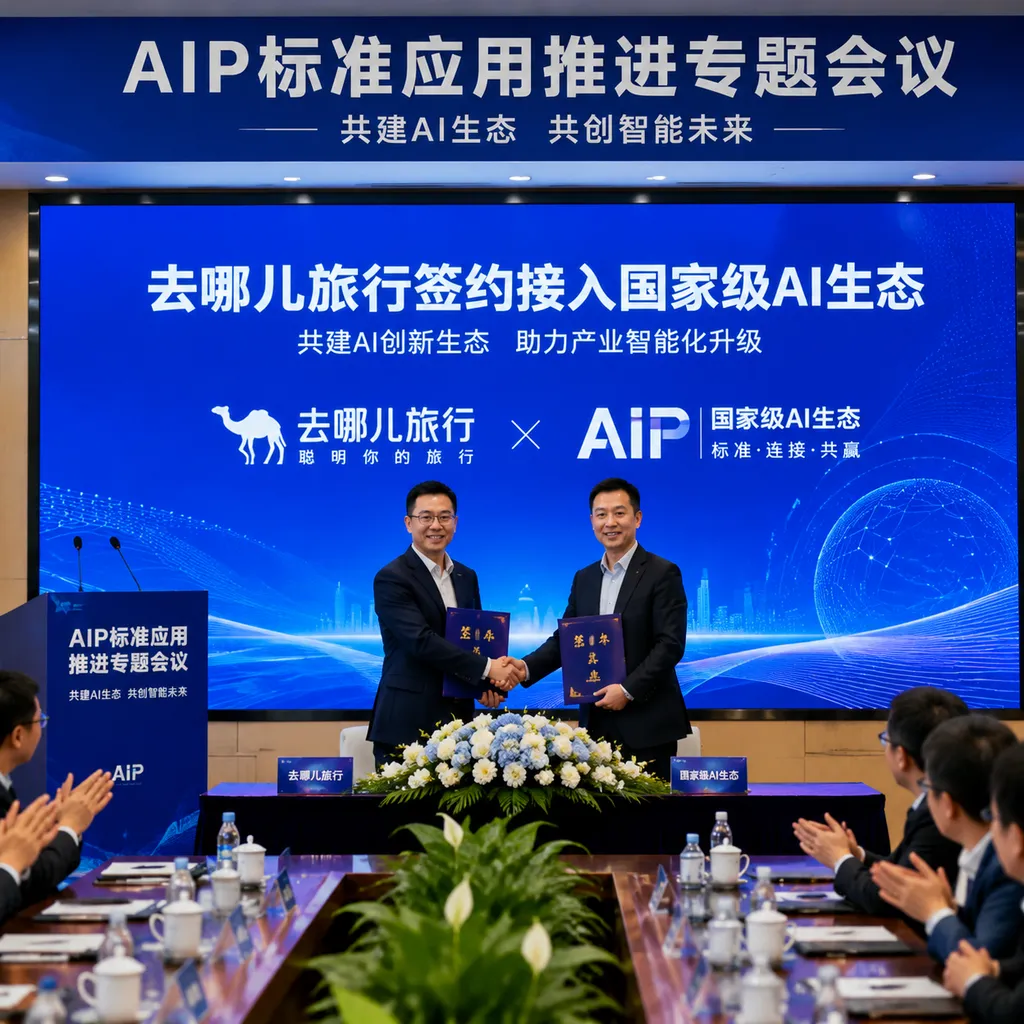
On July 21, Qunar Travel signed an agreement to join the *“Artificial Intelligence Agent Interconnection”* standards series (AIP), becoming one of the first online travel platforms to be integrated into this national-level AI ecosystem and to launch pilot applications for the national standard. This move marks the official entry of the OTA industry into the era of interconnected intelligent agents.
Where QuNar Connects to the National Standard AIP: OTA Is Also Joining the Agent Interconnection Game
On the morning of July 21, Zhongguancun Exhibition Center hosted a special session on promoting applications of the “Artificial Intelligence Agent Interconnection” (AIP) series standards, packed with industry professionals. The event itself was not highly publicized, but the signal was clear — QuNar Travel officially signed to join AIP, becoming one of the first online travel platforms to connect to the national‑level AI ecosystem, and will be among the earliest to pilot national‑standard applications.
It’s an easy‑to‑miss news item, but if you’ve spent even a day building an Agent or writing a line of MCP, you’d understand its significance: the OTA (Online Travel Agency) industry — notoriously closed and data‑siloed — has been selected as the testbed for the national‑standard Agent Interconnection protocol.
1. What Exactly Is AIP, and Why Talk About It Now?
Let’s first unpack the somewhat tongue‑twisting acronym. AIP, or Agent Interconnection Protocol, is the “Artificial Intelligence Agent Interconnection” series of standards. It’s neither a model standard nor an API specification, but rather a set of national‑level foundational protocols defining how intelligent agents discover, communicate, collaborate, and transact with each other.
Put simply: if you think of every AI Agent as a computer, then AIP aims to act like TCP/IP — you can have agents built by different vendors, running on different models (GPT, Claude, Gemini, DeepSeek, etc.); as long as they adhere to AIP, they can call, trade, and cooperate with each other.
Those familiar with overseas ecosystems will immediately recall:
- Anthropic’s MCP (Model Context Protocol) launched late last year — standardizing handshakes between models and tools;
- Google’s A2A (Agent‑to‑Agent Protocol) introduced earlier this year — enabling cross‑platform agent collaboration;
- and OpenAI’s less prominent Agents SDK conventions.
AIP’s positioning is more “upper‑layer” — and more official — than these. It’s not an open‑source spec from a single company; rather, it’s a national standard led by the China Electronics Standardization Institute, joined by ZGC Kejin, Alibaba, Baidu, QuNar, and others. That’s why the signing emphasizes a “national‑level AI ecosystem” — the term “national‑level” here is literal, not marketing hype.
In short, AIP has big ambitions: it seeks to establish a “passport system” for agent collaboration in China. Whoever connects becomes a legitimate node within this network.
2. Why QuNar First? OTA Fits Perfectly
The phrase “one of the first online travel platforms to join” deserves attention. Why QuNar? Why OTA?
If you’ve ever tried booking a flight or hotel via ChatGPT or Claude, you’d know how clunky it is. On the surface, OTA looks like an agent paradise — search, compare, book, modify, itinerary management — all seem like clear tool‑call sequences. In reality, it’s full of hidden traps:
- Interfaces don’t align — airlines, hotel chains, rail systems each have their own standards. OTA platforms already act as translators, and agents need to translate again.
- Complex states — a single ticket involves seat classes, taxes, refund/exchange policies, mileage, and connection rules.
- Transactional closure — an agent must not only “query” but also “pay,” “change,” “refund,” involving payment, ID verification, invoicing, and support.
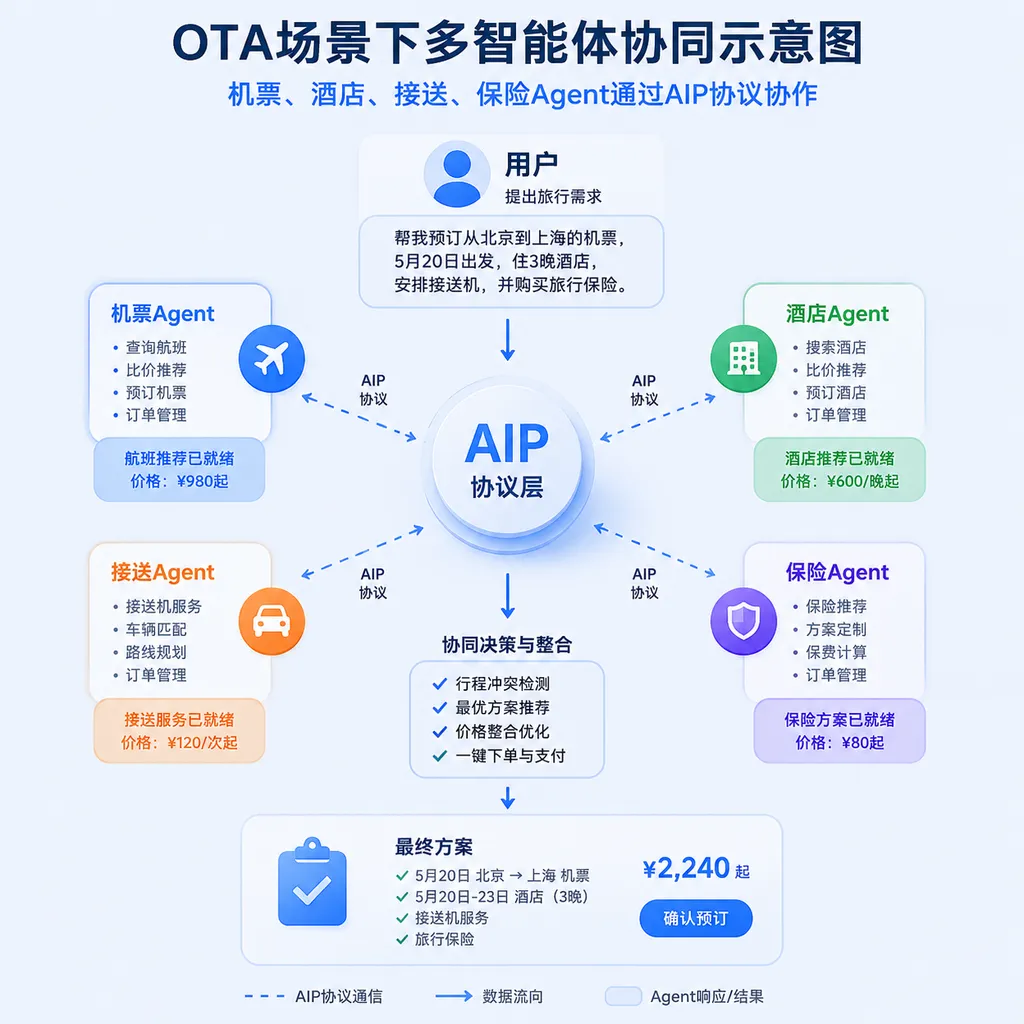
- Multi‑party coordination — one trip combines flights + hotels + transfers + insurance, often involving 3–5 different platforms’ agents.
These issues are precisely what AIP targets — enabling agents from different vendors to discover, handshake, distribute tasks, sync status, and complete settlements under one unified protocol.
So OTA isn’t a random choice of testbed; it’s one of the toughest real‑world challenges for agent interconnection. If AIP can handle this, it proves itself beyond paper.
QuNar’s motivation is also clear. Over the last two years, Trip.com, Ctrip, and Fliggy have all launched AI travel assistants, and QuNar introduced “Xiao Qu.” Yet these assistants remain private agents within walled gardens — they access only internal inventories and APIs. When users request “book me a Beijing‑to‑Dali trip with flights, hotels, transfers, and tickets,” all agents quickly hit their limits.
By joining AIP, QuNar’s agent will be able to legitimately “hire” agents from other platforms to complete subtasks, and conversely, open its own capabilities for external agents to call. To borrow an analogy — it’s like when Alipay opened its “escrow transaction” API, transforming itself from an internal tool into an infrastructure layer for the entire e‑commerce ecosystem.
3. AIP vs. MCP and A2A — What’s Different?
Developers naturally ask: compared to the MCP or A2A protocols I know, where does AIP excel or fall short?
In my view — AIP is more like an “A2A with governance.”
Let’s break it down:
Protocol Layer Design
MCP abstracts “model ↔ tool,” enabling standardized function calls from LLMs. It’s lightweight and easy to deploy but doesn’t handle agent relationships.
A2A focuses on “agent ↔ agent,” introducing Agent Cards (capability descriptions), Tasks, and Artifacts for cross‑platform collaboration. However, A2A is an open specification led by Google, lacking unified identity and transaction mechanisms.
AIP builds atop similar capability discovery (like Agent Cards) but adds two crucial layers that MCP and A2A don’t go deep into: trusted identity and service settlement. The former ensures “this agent truly belongs to QuNar and is authorized to sell tickets,” while the latter defines “how to bill and invoice.” These are essential for commercialization in regulated markets.
Governance Logic
MCP and A2A are open protocols — anyone can host a gateway. AIP is not; it includes national‑standard endorsement and registration mechanisms, requiring standardized certification. This both raises the bar and provides compliance benefits. In regulated industries like OTA, finance, and healthcare, being an “AIP‑registered node” will likely become a qualification.
Developer Overhead
This is a concern. MCP rose fast because you can build a working server in an afternoon. AIP’s public documentation is still limited. Judging from what’s been shared, it may have multiple profiles for capability descriptions, authentication, and messaging. If the implementation turns out too heavy, developers may simply walk away.
In one line: MCP solves “can models use tools,” A2A solves “can agents collaborate,” while AIP aims to solve “can agents legally do business in a regulated market.” They don’t conflict; most likely they’ll coexist in layers — AIP on top, A2A in the middle, MCP underneath.
4. What the Pilot May Look Like
The meeting mentioned that QuNar will “take the lead in national‑standard pilot applications.” Though no product details were revealed, we can infer several directions:
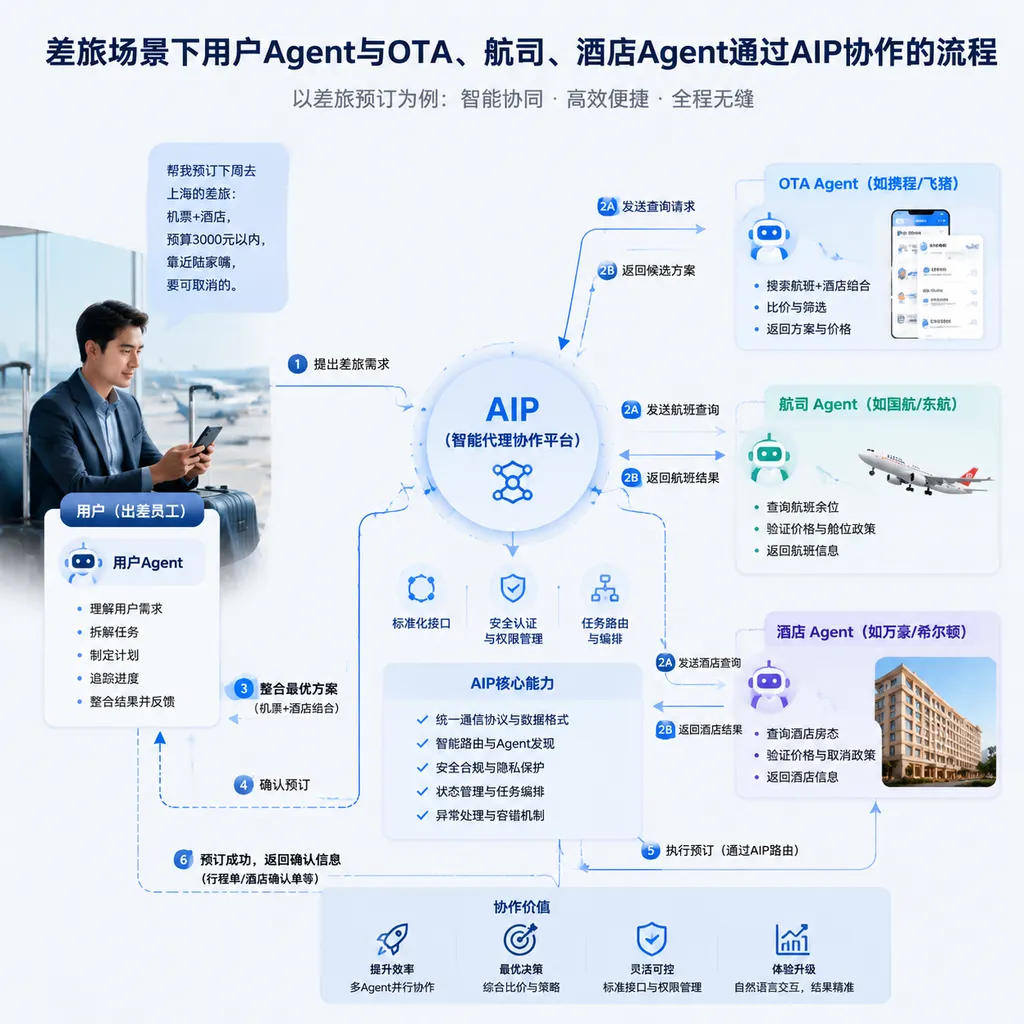
- Cross‑platform business‑travel agents — In corporate travel, one booking touches flights, hotels, transportation, and reimbursement systems. AIP allows these agents to auto‑team without humans copying data across SaaS tools.
- Real‑time itinerary replanning — In disruptions (flight delays, hotel overbooking), a user’s agent can directly negotiate through AIP with airline and hotel agents for compensation or rebooking.
- Agent monetization — QuNar could package its “price comparison” or “refund processing” capabilities as AIP services, charging other agents per call — a clear B2A (Business‑to‑Agent) revenue path.
These sound exciting, but real‑world deployment raises challenges: liability (who compensates for agent errors), privacy (how user data is shared), and competition (how QuNar and Ctrip agents split profits). These are ecosystem issues as much as technical ones — and will be AIP’s hardest steps ahead.
5. Broader Context: Agent Interconnection as the Next Battleground
Zooming out: by mid‑2026, the biggest industry shift is from “model arms race” to “agent ecosystem positioning.”
At the model layer, the leaders — Opus 4.8, Sonnet 5, OpenAI’s latest GPT, Gemini 3, DeepSeek R2 — are converging in capability. The new differentiator becomes who can turn agents into infrastructure — whoever does gains the next traffic gateway.
Globally:
- OpenAI pushes its Agents SDK and Operator;
- Anthropic shapes de‑facto standards via MCP;
- Google connects Vertex through A2A;
- even Shopify and Notion are launching their own Agent Stores.
Domestically, the long‑standing issue is protocol fragmentation — every major company has its own “agent platform,” none interoperable. AIP aims to break that through a single national standard.
From this angle, QuNar’s signing isn’t “just another OTA joining a new protocol,” but AIP securing its first top‑tier commercial participant. OTA, with its high frequency, high value, and multi‑party transactions, is the ideal proof ground.
If the pilot succeeds, the next likely entrants will be food delivery, ride‑hailing, ticketing, and finance — industries sharing cross‑entity transactions and heavy regulation.
6. Practical Takeaways for Developers
Finally, some pragmatic advice. Developers should pay attention but needn’t dive in immediately:
- Short term – no need to rebuild MCP/A2A implementations yet. AIP remains in its rollout phase; SDKs and reference code aren’t fully public, and documentation is evolving. Continue using MCP for tool calls and A2A or self‑made for agent collaboration — that’s safest.
- Mid term – watch its capability discovery and identity modules. These deepen aspects A2A only skims and meet strong domestic compliance needs. Once open‑sourced, try internal pilots.
- Long term – if you build B2B agents, especially for regulated sectors, AIP registration will likely become mandatory. Following the standard early is a defensive investment.
Industry‑wide, the key takeaway from this signing is: agent interconnection has moved from “technical experiment” to “commercial protocol.” The protocol war will last longer than the model war, but once decided, it will reshape the next decade of AI industry structure.
On multi‑model scheduling, OpenAI Hub already supports unified‑key access to GPT, Claude, Gemini, DeepSeek, etc., fully OpenAI‑compatible and stable domestically — useful for multi‑agent prototypes so you can focus on the agent‑protocol layer instead of reinventing the model wheel.
QuNar’s move isn’t aggressive but is directionally clear. Now only one question remains — who will sign next?
References
- 36Kr: QuNar Travel Signs to Join the National‑Level AI Collaboration Ecosystem — Official update on the AIP meeting, with signing details and event information