Hugging Face and NVIDIA Release Report: Physical AI Simulation Has Become a Required Course for Embodied Intelligence Training

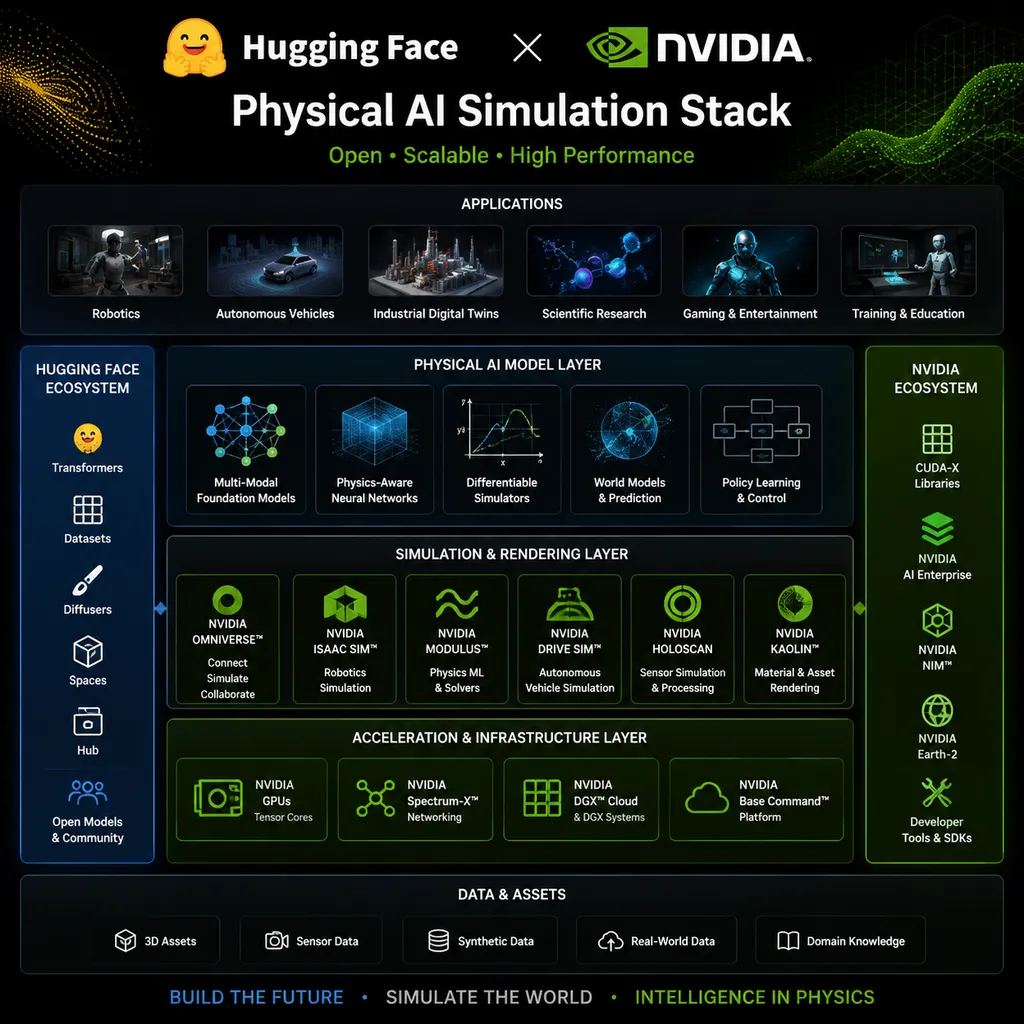
Hugging Face and NVIDIA jointly released the *Report on the State of Physical AI Simulation*, which systematically reviews the simulation technology stack underlying robot and world model training. The report points out that synthetic data and GPU-accelerated simulation are replacing real data collection, becoming the core infrastructure for embodied intelligence.
On July 21, Hugging Face published a long article co‑authored with NVIDIA on its official blog titled “The State of Simulation for Physical AI: An Overview.”
It’s not a product launch, but an industry map that sorts out the messy toolchains behind robot training, world models, and autonomous driving. For embodied‑intelligence teams, it’s worth reading line by line.
Simply put, the report boils down to one key judgment:
Real‑world data can no longer feed Physical AI—simulation is the next main battlefield for training.
Why Talk About This Now
Everyone already knows the LLM path from the past two years: crawl the web, clean data, pretrain, post‑train, RLHF. The data pipeline is so mature that almost every company can copy it. But for Physical AI—robots, drones, autonomous vehicles, humanoid robots—it’s a completely different story.
You can’t “crawl” a set of grasping actions like you crawl webpages. A real robot collecting data for one hour costs hundreds of dollars and only covers one lighting condition, one friction coefficient, one kitchen layout. Tesla’s Optimus team disclosed last year that collecting just 1,000 hours of bimanual manipulation data cost about 200 person‑days. And training a generalizable policy requires tens to hundreds of times more data.
That’s why simulation has entered the stage. In the report, Hugging Face and NVIDIA put it bluntly—“In the past, simulation was used only when there was no other choice. Now, not using it means having no choice.” Once neural networks scale up, there’s simply no way real‑world data collection can keep up.
The Report Divides the Tech Stack into Four Layers
This is what makes the report most valuable. If you search for “robot simulation,” you’ll get a jumble—Gazebo, MuJoCo, Isaac Sim, Genesis, PyBullet, Habitat… Newcomers can’t tell which is for what. The report classifies them by use and abstraction level into four categories:
1. Physics Simulators
The lowest layer handles classical physics such as rigid body, soft body, fluids, and contact forces. MuJoCo, Bullet, and PhysX are the old trio. MuJoCo remains the default choice for contact‑intensive tasks (like grasping or assembly); DeepMind and OpenAI both used it in their early robotic‑hand projects.
New challengers include Genesis and NVIDIA’s own Warp. Genesis claims 10–80× faster GPU performance than MuJoCo; when released late last year, it went viral and is now the default for many university labs.
2. Robotics Simulators
Built atop the physics engines, these add sensor models (camera, LiDAR, IMU), ROS bridging, and scene management. Gazebo is a ROS‑ecosystem veteran but has poor rendering; Isaac Sim, powered by Omniverse RTX rendering, has become the new favorite—especially for vision‑based policy training.
One new trend the report highlights: the separation of training and evaluation environments. In the past, one platform did everything, but now more teams train with Isaac Lab and evaluate with ManiSkill or RoboCasa, since evaluation demands diversity and reproducibility different from training needs.
3. World Models
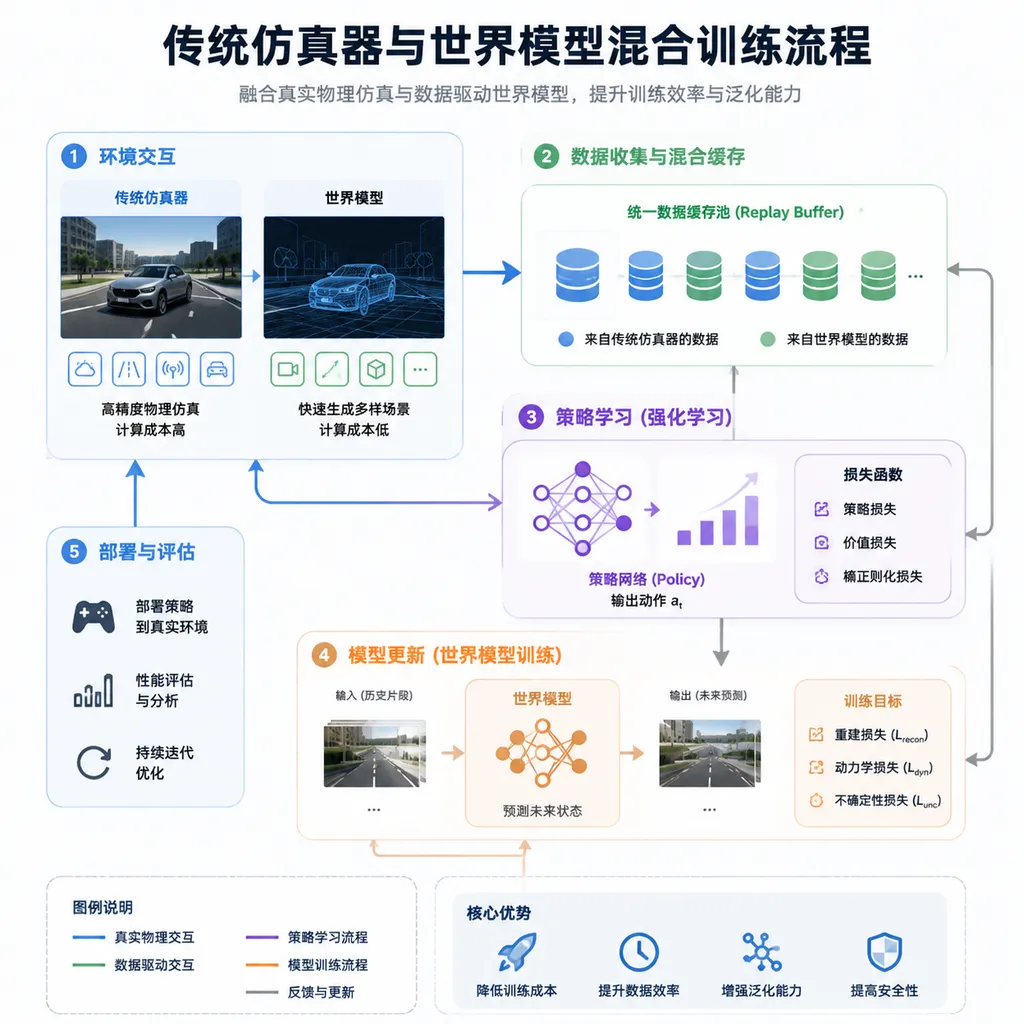
This past year’s hottest direction. Traditional simulation is “hand‑written rules + physics engine”; world models are “simulation learned by neural networks.” Feed in a video clip and an action, and it generates the next frame.
NVIDIA’s Cosmos, open‑sourced early this year, is a representative example. DeepMind’s Genie 3, Wayve’s GAIA‑2, and Tencent’s Hunyuan‑World are chasing the same goal. The report defines this category as “neural simulators”—able to generate complex scenes unattainable by classical engines (rain, crowded streets, reflectivity of transparent objects), though physics consistency is unreliable—a cup might fall through the table.
My view: world models won’t replace physics engines; they’ll coexist. Engines handle physically precise aspects such as joint torques and grasp forces; world models handle visual generalization. Some teams already use hybrid architectures—MuJoCo for physics, diffusion models for rendering, then distilling both into one unified policy.
4. Synthetic Data Pipelines
The top layer. Raw simulated data can’t be fed directly to models—it needs domain randomization, automatic labeling, and quality filtering. NVIDIA’s Omniverse Replicator and the open‑source BlenderProc belong here.
One striking figure from the report: in Waymo’s perception training, the ratio of synthetic to real data is already 10 : 1. It’s not “using synthetic data as a patch,” but rather “synthetic first, real as supplement.”
The “Data Crisis” of Embodied Intelligence—Is Simulation the Only Answer?
The report doesn’t answer directly but gives clear clues.
Some key numbers:
- Physical Intelligence’s π0 model: about 10 000 hours of training data across 10 robot manufacturers
- Google RT‑2: 130 k robot demonstrations
- Tesla Optimus: reportedly over one million demonstrations
These look large, but compared to 15 T tokens for LLMs, physical data is still tiny. And the marginal cost of real‑world data hardly decreases—you can’t “scale up human operators” the way you add GPUs.
The marginal cost of simulation is nearly zero. One H100 GPU can generate in a day as many synthetic episodes as a human operator could in a year. That’s why Hugging Face built the LeRobot project and NVIDIA made Isaac Sim free—both are betting on the same thing:
In the next decade, the decisive factor for Physical AI will be simulation infrastructure.
The Sim‑to‑Real Gap—Still the Hard Problem
No talk of simulation is complete without it. Policies trained in simulation often fail on real hardware—the sim‑to‑real gap. Causes include inaccurate physics, incorrect sensor noise models, and poor lighting realism.
The report details current solutions:
- Domain randomization: randomize friction, lighting, textures, and object mass during training to force models to learn invariants. (OpenAI’s Rubik’s‑cube robotic hand used this.)
- System identification: use real data to infer simulator parameters for closer alignment.
- Real‑to‑sim reconstruction: rebuild real scenes into simulators using NeRF or 3D Gaussian Splatting. Progress is rapid—from crude last year to photoreal this year.
- Co‑training: mix simulated and real data, adjusting ratios dynamically.
Its conclusion: pure simulation training with zero‑shot transfer to real robots is unrealistic short‑term; but simulation pretraining plus limited real‑world fine‑tuning is already a workable paradigm.
What It Means for Developers
Practically speaking, if you want to build something in Physical AI, the report serves as a procurement guide:
| Goal | Recommended stack | |---|---| | Rapid prototyping | MuJoCo + Gymnasium | | Large‑scale parallel RL training | Isaac Lab (GPU‑parallel 4096 envs) | | Vision‑based policies with photoreal rendering | Isaac Sim / Omniverse | | Running the latest world models | Cosmos (open‑source) / Genie | | Household / office‑scene tasks | RoboCasa / Habitat 3.0 | | Dataset sharing & reproducibility | LeRobot (Hugging Face) |
A note on LeRobot—it’s Hugging Face’s flagship open‑source project from last year, aiming to replicate the transformers workflow (“upload/download/fine‑tune in one line of code”) for robotics. Hundreds of datasets are already hosted there, including Stanford ALOHA and Berkeley UR5 grasping sets—almost every real‑robot data team uploads there by default.
My Take
Three points:
1. Physical AI hasn’t reached its “ImageNet moment,” but infrastructure is rapidly aligning.
Around 2015, vision took off with ImageNet + AlexNet + Caffe. Physical AI doesn’t lack model architectures (VLA, Diffusion Policy, ACT exist); it lacks data scale and evaluation standards. This report’s value lies in clarifying how to evaluate and synthesize data.
2. NVIDIA now occupies for Physical AI a position similar to CUDA’s for AI training.
From PhysX to Isaac Sim to Cosmos to Omniverse, NVIDIA has a vertically integrated stack. Hugging Face co‑signing the report is, in some sense, an acknowledgment of that.
3. World models deserve heavy investment.
The ceiling of classical simulation is predictable—no matter how fast or accurate, it can only simulate what’s modeled. The ceiling of world models is unknown. When models can generate arbitrary scenes, objects, and dynamics, Physical AI’s data problem will finally be solved.
For developers, there’s no need yet to bet on one simulator—but it’s time to start making robot‑policy learning part of your daily tech stack, no harder than learning Transformers a few years ago. Hugging Face has already lowered the barrier to a simple pip install.
For teams using large models to assist development and needing to switch quickly between models for policy generation or code assistance—for example, using Claude for control logic, Gemini for simulation‑log analysis, and DeepSeek for planning—aggregator platforms like OpenAI Hub can save the trouble of integrating each API separately: one key connects to all major models, with no VPN required in China.
In this new wave of Physical AI, simulation is the ticket to entry. After reading this report, at least you’ll know which direction to bet on.
References
- huggingface.co – The State of Simulation for Physical AI: An Overview — Original joint report by Hugging Face & NVIDIA
- github.com – Hugging Face official repositories — Entry points for open‑source projects such as LeRobot, Transformers, and Diffusers