Meta wants to build its own OpenRouter in order to cut its coding compute bill.
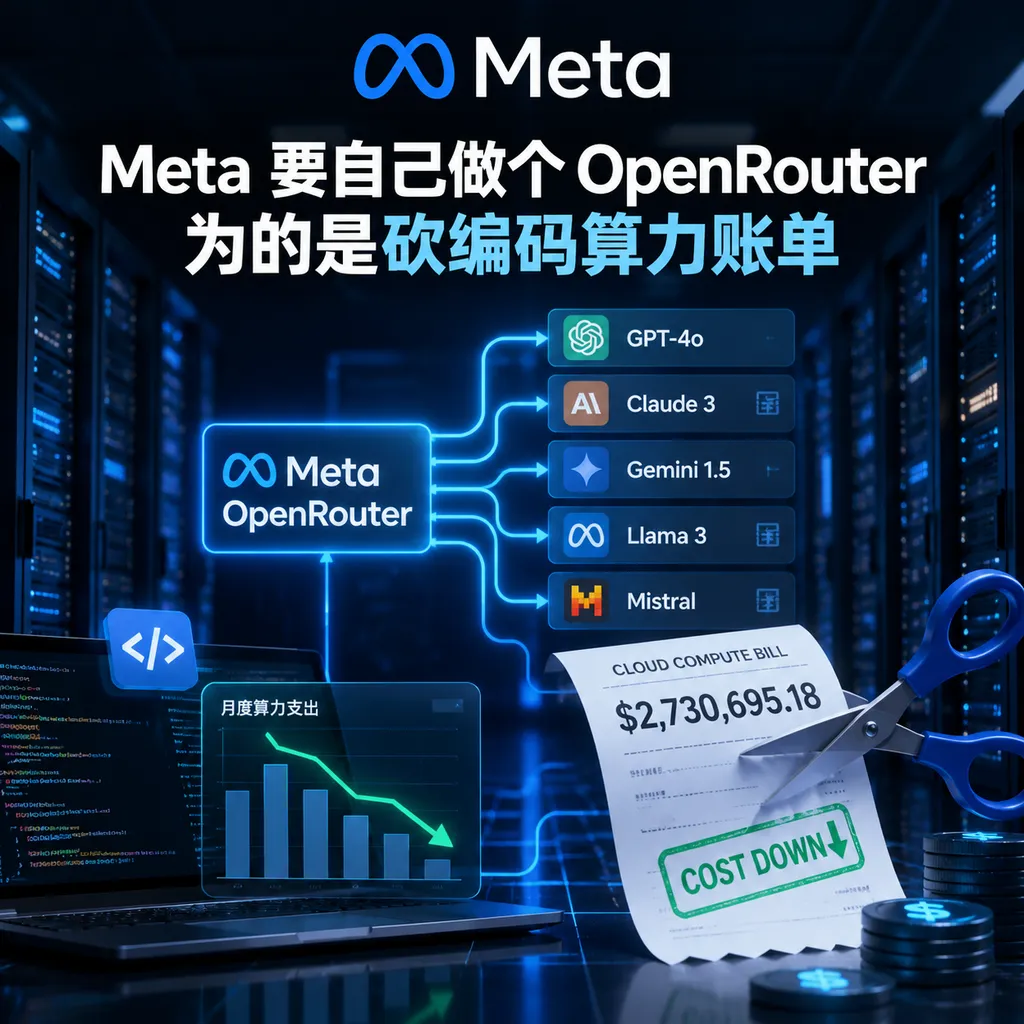
Meta’s internal incubator AAI Labs is developing a model scheduling service comparable to OpenRouter, which distributes different AI tasks to more cost-effective models. The goal is to reduce the compute expenses of its AI programming business—while also leaving open the possibility of external commercialization.
Meta Wants to Build Its Own OpenRouter — To Slash Coding Compute Bills
A new internal Meta project is underway: building a model scheduling service to compete with OpenRouter.
According to internal files obtained by The Information and follow-up reports from 36Kr and Gelonghui, AAI Labs, an incubator under Meta’s Applied AI Engineering team, is developing this service. The core logic is simple — distribute different types of AI tasks to the most cost-effective large model possible to minimize overall compute expenses. The incubator, established in March this year, allows employees to submit proposals for internal AI products and services. Once approved, a small team can be formed to build the product, with the possibility of public release if successful.
In simple terms, what Meta is doing is this: get it working internally, then spin it off for commercialization. This is a classic product decision driven by rising bills.
What Is AAI Labs, and Why Now
AAI Labs’ role is straightforward — an incubation slot within Meta’s Applied AI Engineering team. Employees can pitch their ideas; if approved, a small task force builds them out, tests internally, and later considers external release. The current OpenRouter competitor project is the first outcome from this process to draw outside attention.
Why do it now? The reasoning becomes clear when viewed in context:
First, AI coding tools have devoured a massive number of tokens. Tools such as Cursor, Claude Code, and Devin have completely reshaped developer workflows over the past year and a half. Tasks involving tens or even hundreds of thousands of tokens per context call are now normal. Meta’s engineering teams heavily use similar coding agents — once tens of thousands of engineers are running them simultaneously, bills balloon nonlinearly.
Second, OpenRouter has already proven the value of this concept. Just last month, OpenRouter closed a $113 million Series B funding round, pushing its valuation to $1.3 billion. More telling is token throughput: 25 trillion tokens per week, or around 100 trillion per month — five times what it was six months ago. The user base exceeds 8 million. This isn’t some small “API resale” business — it’s becoming the CDN of the AI era.
Meta sees the same thing: when no single model dominates, and task complexity and call frequency explode, “choosing which model to use” becomes an engineering problem. If you don’t handle it in-house, OpenRouter takes a 5% cut.
What Problem Model Routing Actually Solves
Developers already get this, but it’s worth revisiting — because what Meta wants to build is not a copy of OpenRouter, but a hardcore enterprise intranet version.
A typical AI programming scenario looks like this:
- Auto-completing a line of code — GPT‑4o mini or Haiku suffice: low latency, low cost
- Generating a React component — mid-tier models such as DeepSeek‑V3 or Qwen3‑Coder
- Refactoring a 500‑line service — call up Claude Opus or GPT‑5
- Analyzing a tricky cross‑repo bug — use the top-tier + long-context models
- Writing unit tests — run an open‑source model locally
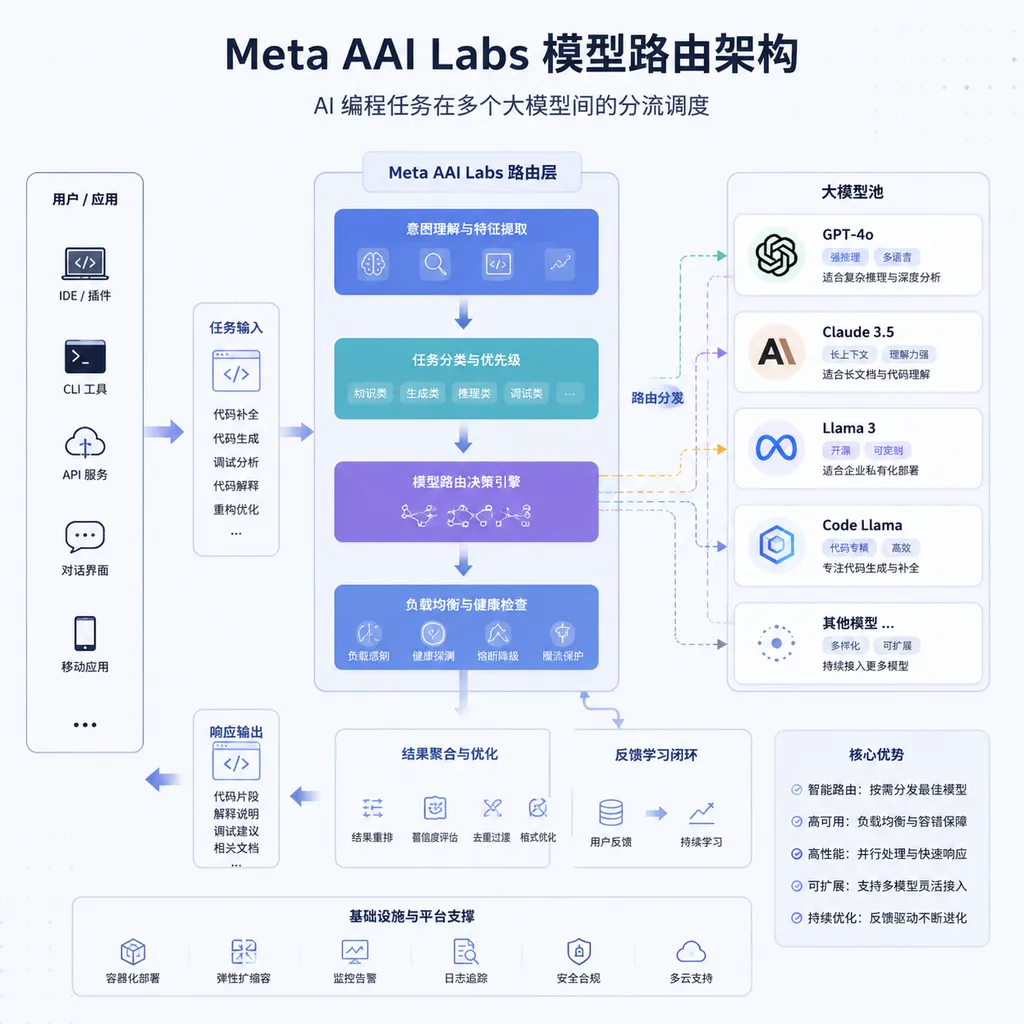
If you rely entirely on the most expensive model, costs skyrocket; go all‑in on the cheapest, and quality drops. The decision‑making scheduler in the middle is where OpenRouter‑type products add value — deciding in real time based on task type, cost budget, SLA, and model health which model each request should hit.
But this is more than “just bundling APIs.” To pull it off, the platform must maintain:
- Real‑time info on each upstream model’s pricing, rate limits, and health
- Task classifiers (to decide which tier a request belongs to)
- Fallback routing (auto‑switching if a model provider goes down)
- Streaming stability (developers’ tools must not freeze if a stream breaks)
- Billing and usage accounting
OpenRouter has turned all this into an industry‑standard interface — OpenAI‑compatible, one API key connecting most mainstream models. China’s OpenAI Hub follows the same path: one key for GPT, Claude, Gemini, DeepSeek, etc., local connectivity, OpenAI‑format compatible, handling the cross‑model integration dirty work. The products in this track are converging, and where competition heads next is worth watching.
Meta’s Two Paths: Internal Use vs. External Release
Leaked internal documents suggest two possible paths for Meta:
- Deploy internally only, to cut AI coding and agent operation costs
- Publicly release for external clients running large‑scale AI coding agents
The second path is intriguing. That would make Meta’s potential customers those mid‑ to large‑size enterprises also suffering from massive AI coding bills — companies with thousands of engineers whose daily API usage worries CFOs, yet who lack the capability to build scheduling infrastructure themselves.
Compared with OpenRouter, Meta has several unique advantages:
- Its own Llama family of open‑source models. Within the same routing framework, some traffic can go directly to self‑hosted Llama instances, cutting API costs entirely — something OpenRouter can’t do.
- Proven scale. Internal Meta engineers serve as built‑in stress tests and case studies — satisfying 30,000 engineers internally before selling externally makes a convincing story.
- Self‑developed MTIA chips. If the routing layer pairs with Meta’s AI hardware, per‑token costs could undercut public‑cloud rates further.
But there’s a hitch: Meta has near‑zero enterprise‑service experience — it’s an ad company, not an API vendor. Building a B2B routing platform means reinventing everything from billing systems and SLA contracts to enterprise permissions and after‑sales support. That’s vastly different from “internal use only.”
My take: Meta will likely pursue both paths, but internal rollout will come first, while external release enters gently as a “try our Llama‑optimized routing” offer, rather than going head‑to‑head with OpenRouter right away. That would be smarter and more in line with Meta’s usual playbook.
What This Signals to the Industry
Zooming out, Meta’s move sends several subtle signals:
First, big tech is treating the “model‑routing layer” as strategic infrastructure, not an outsourceable component. Once AI billing eats into a company’s engineering budget, owning this layer becomes inevitable. Expect to see similar moves within Google, Amazon, and Microsoft — their clouds already have some routing capabilities, but cross‑cloud, enterprise‑grade, AI‑coding‑specific routing remains an open market without a definitive leader.
Second, “coding agents” are becoming the main battlefield of large‑model consumption. On OpenRouter, Cursor and Claude Code account for a huge share of calls; Anthropic relies heavily on Claude Code revenue; now Meta targets the same space. As one use case dominates token usage, specialized routing, compression, and caching companies will find opportunities there.
Third, OpenRouter’s valuation logic will be tested. Its $1.3 billion valuation rests on being the “traffic gateway of the AI era.” But if every major company builds its own routing layer — and enterprise‑targeted routing solutions emerge — OpenRouter may depend more heavily on long‑tail developers, lowering its growth ceiling. Conversely, if it conquers the enterprise market first, the story changes entirely.
A Quick Look at the Domestic Mirror
Will something similar happen in China? In fact, it’s already happening, but with a different approach.
Cloud providers such as Alibaba Cloud’s Bailian, Volcano Ark, and Baidu Qianfan already feature model marketplaces with built‑in routing. Aggregators like Siliconflow and ThinkFlow are localizing the OpenRouter model. Cross‑border gateways handle compliant access to GPT and Claude. The domestic landscape is much more fragmented.
But China has one unique advantage: domestic developers face friction when calling overseas models. A platform supporting both domestic and foreign models with local connectivity meets a clear need. Platforms like OpenAI Hub are already doing this, turning the OpenAI‑compatible format into a cross‑vendor common interface. When Meta’s service eventually targets enterprise markets, local equivalents are likely to follow — not by copying, but by addressing the same user pain point in two mature markets.
Final Thoughts
The most interesting thing about the OpenRouter track is this: it looks low‑barrier, but is actually high‑barrier. Low because the tech stack—API gateways, routing algorithms, billing systems—isn’t mysterious. High because achieving stability, low latency, and real cost savings simultaneously requires long‑term operational expertise. Meta has the engineering capability, its own models, and massive internal usage scenarios; in theory, it could create a version of OpenRouter better suited to enterprise needs. But success depends on whether the team will endure two or three tough years on this unfamiliar B2B road.
And when the three forces—big‑tech routing services, cloud‑provider marketplaces, and independent aggregators—all collide, developers ultimately win: more choices, lower prices, unified interfaces. This is a fight worth having.
References
- Reducing “AI Costs” Is the Inevitable Trend! Meta Plans “Model Routing,” Recreating OpenRouter — Analysis of Meta’s leaked internal documents on the two potential paths: internal deployment vs. external commercialization