
Zhipu launches a no-code embodied intelligence platform, lowering the threshold for robot application development to “building with blocks.”
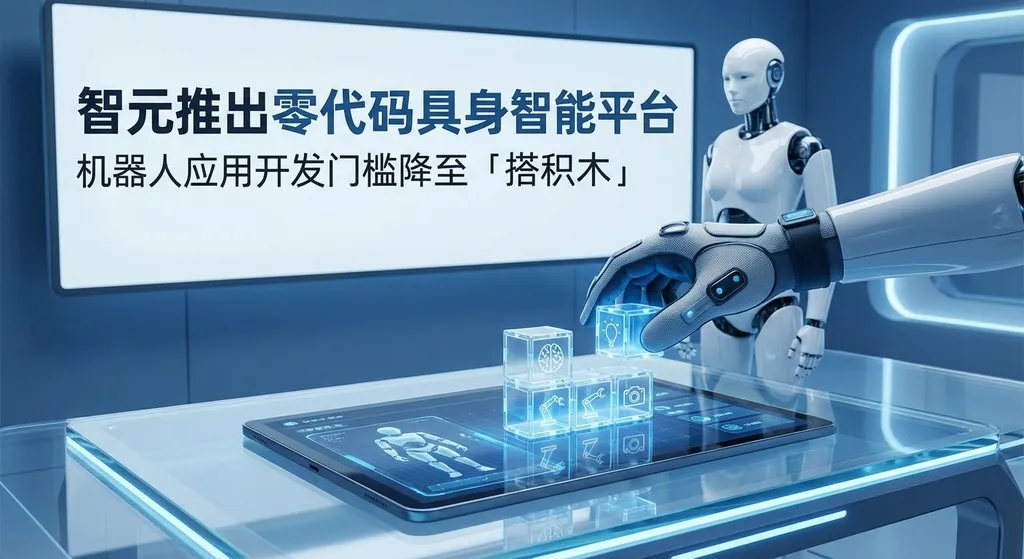
Wisdom Universe releases the Genie Studio Agent no-code application platform, completing a full-chain closed loop of embodied intelligence from datasets and simulation to models. Developers can build robotic applications without programming, achieving a daily data production capacity of 1,000 entries and directly addressing three major pain points in industry deployment.
AGIBOT Launches No-Code Embodied Intelligence Platform, Lowering the Barrier for Robot Application Development to "Building Blocks" Level
AGIBOT has launched Genie Studio Agent— a no-code application platform for embodied operation scenarios — on the fifth day of "AI Release Week". This follows their earlier releases of datasets, simulation platforms, base models, and world models, marking another product iteration and signaling the completion of a full-chain closed loop from technical capability to industrial infrastructure in embodied intelligence.
The platform’s core selling point is straightforward: enabling people who can't write code to build robot applications. In AGIBOT's words, it makes robot application deployment as simple as "building with blocks".
The Three Long-Standing Challenges in Embodied Intelligence Deployment
To understand the problems Genie Studio Agent solves, we first need to look at the difficulties developers face when deploying embodied intelligence.
High barrier to entry is the first hurdle. Traditional robot application development requires proficiency in multiple domains such as multimodal data processing, reinforcement learning, and motion planning. An application that enables a mechanical arm to perform a grasping task may involve cooperation among a dozen modules including visual perception, trajectory planning, and force control feedback. Such multidisciplinary skill requirements block many teams interested in robotics applications from even starting.
Long development cycle is the second pain point. From data collection, model training, and simulation testing to actual deployment, the process can take months. What's worse, these steps are often split across different tools and platforms — data collected in one system, models trained in another framework, and simulations run in third-party environments. Each switch entails costs in data format conversion, environment configuration, and debugging.
Low reusability is the roadblock to scaling. Even if an application runs successfully in one scenario, moving to a different environment or task often means starting from scratch. The assembly lines at Factory A and Factory B may appear similar, but differences in robot positioning, material placement, and lighting conditions can render existing models ineffective. This "one scene, one solution" model makes it hard for embodied intelligence to replicate and scale as quickly as software.
Genie Studio Agent’s Solution: Full Chain + Zero Code
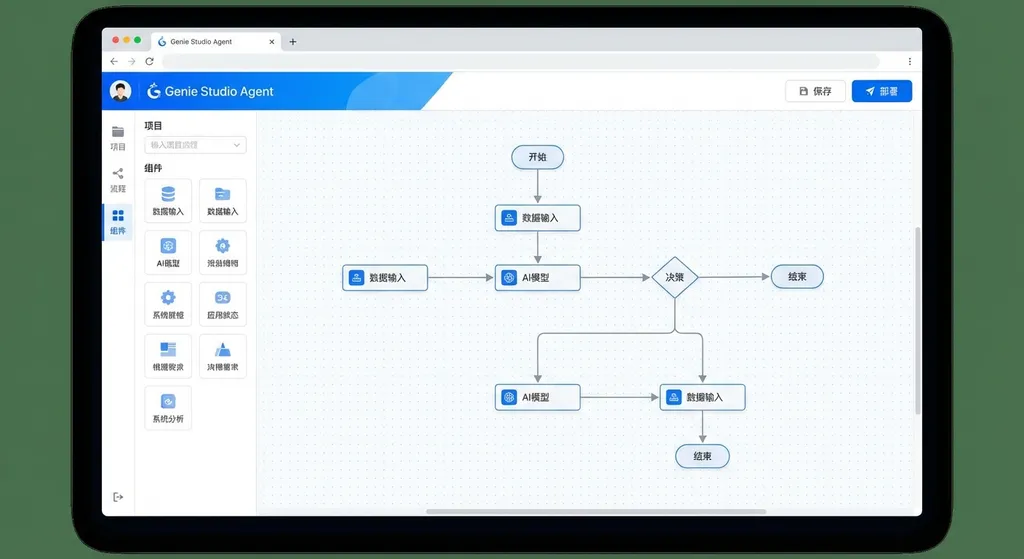
Genie Studio Agent packages the entire development process into a single platform and replaces code writing with a visual interface.
Data Collection: Million-Scale Dataset + Thousand Samples Per Day
The platform comes with a million-scale embodied intelligence dataset covering multiple scenarios including industrial assembly, logistics handling, and service interaction. These are not just simple images or videos but multimodal datasets containing robot states, environmental perception, and action sequences.
The key advantage is data collection efficiency. AGIBOT claims a single machine can produce 1,000 data entries per day. To put that in perspective: traditionally, a small team using teleoperation to collect mechanical arm grasping data would consider 50–100 entries a day an achievement. Genie Studio Agent uses automated collection tools and standardized processes to improve efficiency by an order of magnitude.
This data accumulation directly impacts model quality. Embodied intelligence models are "data-hungry" — they need to see enough scene variations to generalize to new environments. OpenAI’s robotics project was shelved due to high data collection costs, and DeepMind’s RT-2 model required 130,000 robot trajectory samples to reach usable performance.
Model Training: From "Parameter Tuning Alchemy" to "Configuration Selection"
Traditionally, robot model training is like "alchemy": selecting network architectures, tuning hyperparameters, designing loss functions, handling data imbalance — every step requires deep machine learning expertise.
Genie Studio Agent turns this process into a set of configuration options. Developers just need to:
- Select task type (grasping, navigation, assembly, etc.)
- Upload or select dataset
- Set training objectives (trade-offs between accuracy, speed, robustness)
- Click to start training
The platform automatically selects the appropriate model architecture, optimizer, and training strategy. Behind the scenes, AGIBOT has distilled its embodied intelligence expertise into "best practices". A similar approach has been proven in the AutoML domain — Google’s AutoML Vision allows people with no deep learning background to train usable image classification models.
Simulation Testing: "Trial and Error" in a Virtual Environment
Deploying untested models directly to real robots is dangerous and costly. A failed grasp may damage a workpiece; a navigation error could damage equipment.
Genie Studio Agent integrates a simulation environment so developers can test models virtually. This isn’t just basic 3D rendering — it includes a physics engine, sensor simulation, and environment randomization for high-fidelity simulation.
In simulation, developers can:
- Test performance under different lighting, occlusion, and noise conditions
- Evaluate metrics such as success rate, execution time, and collision risk
- Iterate and optimize quickly without waiting for real robot tests
This "virtual-real combined" development mode has already proven valuable in autonomous driving. Tesla’s FSD training relies heavily on simulation, and Waymo’s simulated mileage far exceeds its real-world testing mileage by thousands of times.
Model Inference: One-Click Deployment to Real Robots
Trained models ultimately need to run on real robots. Genie Studio Agent offers deployment from cloud to edge:
- Cloud inference: suitable for compute-intensive, non-real-time tasks such as task planning and scene understanding
- Edge inference: deploy models locally on robots for control tasks requiring millisecond-level response
The platform automatically handles engineering details like model compression, quantization, and hardware adaptation. Developers simply select target hardware (NVIDIA Jetson, Horizon Journey, Sophon SG2300, etc.), and the platform generates the appropriate deployment package.
Where Are the Limits of Zero Code?
"Zero code" sounds great, but it’s not a cure-all. Genie Studio Agent strikes a balance between "generality" and "usability".
What it can do:
- Standardized embodied intelligence tasks (grasping, navigation, assembly, inspection, etc.)
- Rapid prototyping based on existing datasets
- Common scenarios for model training and deployment
What it can’t do:
- Brand-new task types (unseen by the platform)
- Extreme performance optimization (requires manual tuning)
- Complex multi-robot collaboration (beyond single-agent intelligence)
This positioning is smart. About 80% of embodied intelligence application needs are in a few standard tasks. Making these 80% zero code covers most users. The remaining 20% long-tail needs can be addressed by advanced users via open APIs or plugins.
As an analogy: Webflow enables non-coders to build websites, but can’t handle complex platforms like Taobao or WeChat. For standard needs like corporate sites, personal blogs, and event pages, Webflow is already sufficient. In the embodied intelligence field, Genie Studio Agent plays a similar role.
AGIBOT’s Ambition for a Full-Chain Closed Loop
Genie Studio Agent is not a standalone product, but the final piece of AGIBOT’s embodied intelligence ecosystem.
Review AGIBOT’s release schedule this week:
- Day 1: Embodied intelligence dataset — solves "where does the data come from"
- Day 2: Simulation platform — solves "how to test"
- Day 3: Open-source base model — solves "what model to use"
- Day 4: World model — solves "how to understand the environment"
- Day 5: Genie Studio Agent — solves "how to deploy"
The blueprint is clear: from underlying data and tools, to mid-layer model capabilities, to top-layer application platforms, AGIBOT is building a vertically integrated embodied intelligence tech stack.
Such a "full-stack" strategy isn’t uncommon in AI. OpenAI has GPT models + ChatGPT apps + API services; Anthropic has Claude models + Claude.ai; Midjourney has generation models + Discord interface. But in the more complex embodied intelligence field, there are few players achieving a full-chain closed loop.
AGIBOT’s advantage is making both robot hardware and AI software. This integrated DNA allows a better understanding of the engineering needs of embodied intelligence. By contrast, pure software companies may have strong models but lack robotics know-how, while pure hardware manufacturers may have excellent mechanical engineering but insufficient AI capabilities.
What Does This Mean for Developers?
Genie Studio Agent lowers the entry barrier for embodied intelligence, but that doesn’t mean every developer should make robot applications.
Best suited for:
- Manufacturing companies with concrete application scenarios but no AI team
- Robotics startups wanting to quickly validate ideas
- System integrators needing customized solutions
- University labs for teaching and research
Not ideal for:
- Top robotics companies pursuing extreme performance (they can build full-stack in-house)
- Academic teams doing general embodied intelligence research (require lower-level control)
- Individual developers with extremely limited budgets (platform may have usage costs)
If your scenario is within the platform’s coverage, Genie Studio Agent can compress the development cycle from months to weeks. But if your needs are very unique or performance-critical, you may still need to write your own code.
How Far Are We from the "iPhone Moment" of Embodied Intelligence?
AGIBOT’s move evokes the early days of mobile internet. In 2008, when Apple launched the App Store, building an iOS app required knowing Objective-C, understanding MVC architecture, and handling memory management. Later came cross-platform frameworks and low-code tools, lowering the barrier and sparking an explosion in mobile apps.
Will embodied intelligence follow a similar path? Possibly, but there are key differences:
Hardware standardization: Phones come in a few sizes with a few types of sensors, but robots vary greatly. Industrial arms, humanoid robots, mobile bases, drones — each has different control logic. Such hardware fragmentation will slow software ecosystem maturity.
Safety requirements: A phone app crash just needs a restart; an out-of-control robot can harm people or damage property. Embodied intelligence apps will require more rigorous testing and certification, making release cycles longer.
Data loop difficulty: Mobile apps can iterate quickly with user behavior data; robot data collection is costly and slow. A food delivery app can collect millions of user interactions daily; a delivery robot might only complete a few thousand orders a month.
Nevertheless, platforms like Genie Studio Agent are a positive sign. They show that embodied intelligence is moving from "lab toys" to "engineered products". Once development barriers drop far enough, more people will experiment and application scenarios will emerge faster.
Final Thoughts
In one week, AGIBOT released five products, completing a full-chain layout from data to applications. Genie Studio Agent, as the finale, targets the last mile of embodied intelligence deployment — making the technology accessible to more people.
Zero-code platforms won’t replace professional developers, just as Webflow didn’t replace front-end engineers. But they will expand the user base of embodied intelligence, enabling more scenario validation and ultimately moving the entire industry forward.
For developers, it’s a tool worth watching. If you have a suitable scenario, try prototyping quickly with Genie Studio Agent. If you’re building embodied intelligence-related API services, consider integrating with such platforms — after all, when app development gets easier, demand for underlying capabilities will also rise.
By the way, if you’re working on multimodal model APIs for embodied intelligence, OpenAI Hub already supports mainstream Vision-Language-Action (VLA) model APIs, compatible with OpenAI’s format, with direct connections in China without VPN. From GPT-4V to Claude 3.5 Sonnet to Gemini’s multimodal capabilities, one key can handle it all.
References
- AGIBOT launches a no-code application platform Genie Studio Agent for embodied operation scenarios - 36Kr - Official AGIBOT release and product positioning
- Industry first! AGIBOT launches one-stop embodied intelligence development platform Genie Studio - Juejin - Detailed technical architecture and core functionality overview


