OpenAI Launches Presence: AI Agents Officially Enter the Enterprise Software Stack

OpenAI has launched the enterprise-level AI agent platform **Presence** (corresponding to **Frontier** overseas), taking agents from demo to production environments. This also means it will now be competing for business with its own API customers.
OpenAI Launches Presence: Agents Officially Enter the Enterprise Software Stack—and Start Competing with Their Own Customers
On July 22, OpenAI launched a new product called Presence (released overseas under the brand Frontier, though most domestic reports use the name Presence). Its positioning is straightforward—an enterprise-grade AI agent platform that helps companies move “agents” from PowerPoint slides into real customer support tickets, sales pipelines, and IT service desks.
This isn’t just another ChatGPT skin. It’s the first time OpenAI has systematically told enterprise clients: Stop building blocks with my API—I’m now selling production-ready agent runtimes directly.
What Exactly Is It
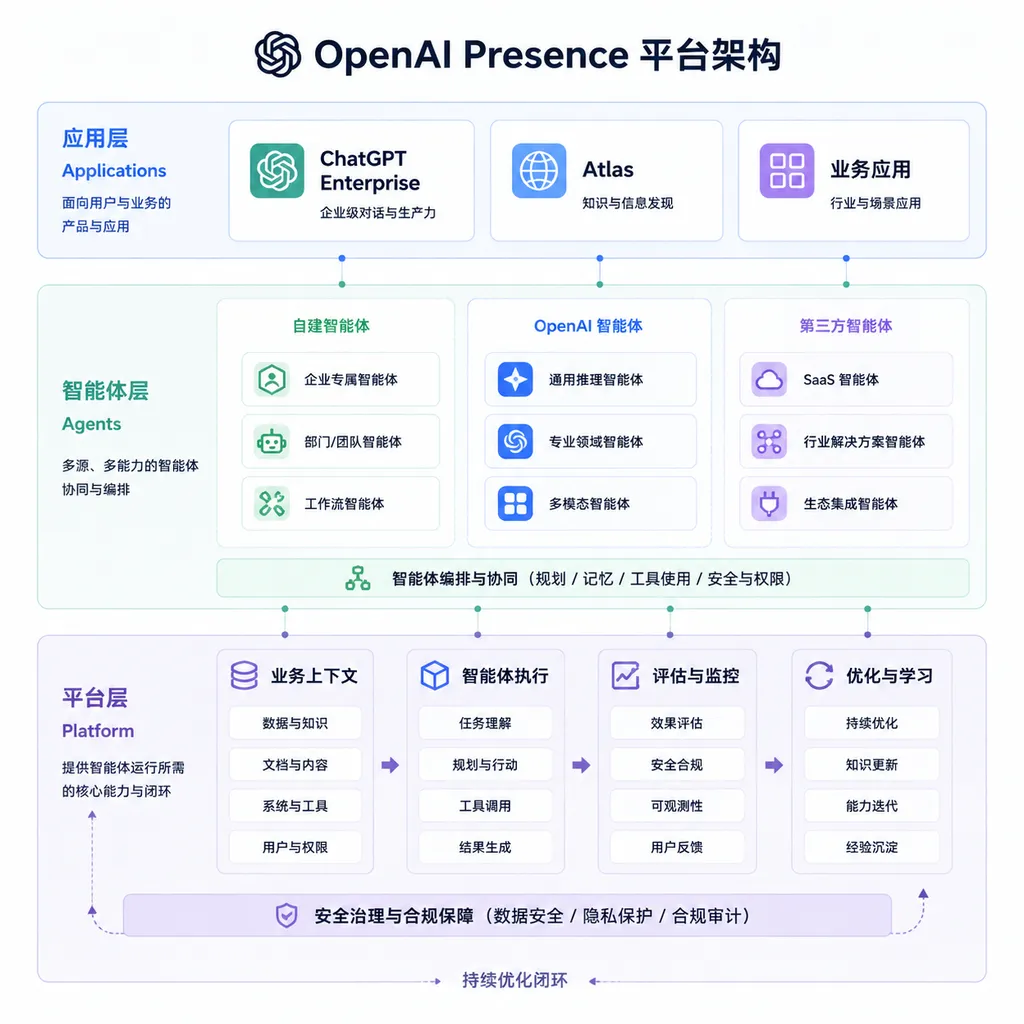
Breaking it down, Presence (Frontier) essentially stitches together a series of enterprise capabilities OpenAI has gradually released over the past two years into one unified platform:
- Business Context Layer: Connects a company’s data warehouse, CRM, ticketing system, and internal apps, giving agents access to the same information that employees see. OpenAI calls this an “enterprise semantic layer”—in plain terms, your agent is no longer the dumb customer service chatbot that only recites FAQs; it knows what the customer bought last quarter and who they complained to last week.
- Agent Execution Environment: A managed runtime where agents can process files, run code, and call tools, with support for parallel multi-agent operations. It can run locally, in a corporate cloud, or in OpenAI’s managed environment.
- Evals & Optimization Loop: Built-in guardrails, human review, and AI auto-grading. It supports simulation and testing before deployment, and if something breaks later, Codex can help trace which step of the prompt or tool call failed and suggest improvements.
- Agent Identity: Each agent has its own IAM identity with granular task-based access control. This has always been the hardest part of deploying enterprise agents—too much access is a security incident; too little and the agent can’t function.
Beyond these core layers, Presence also packages AI voice and chat capabilities. OpenAI itself revealed that its English-language phone support system is now running on Presence—eating its own dog food—a signal more convincing to enterprise customers than any benchmark.
The First Client List Reveals OpenAI’s Ambitions
The official announcement listed some heavyweight first customers: HP, Intuit, Oracle, State Farm, Thermo Fisher, and Uber. Pilot clients include BBVA, Cisco, and T-Mobile.
Not one of these is an AI-native company. They’re all traditional giants across diverse sectors—insurance (State Farm), finance (BBVA, Intuit), telecom (T-Mobile, Cisco), consumer hardware (HP), life sciences (Thermo Fisher), and mobility (Uber).
In other words, OpenAI is no longer targeting tech-savvy clients who like messing with APIs—it’s going after traditional enterprises with big budgets but limited AI-building capabilities—a territory long dominated by Salesforce, ServiceNow, and SAP.
The accompanying Enterprise Frontier Program is also key: OpenAI will assign “Frontline Deployment Engineers (FDEs)” to embed directly with client teams for architecture and production work. This approach is very “Accenture”—and very un-OpenAI. It’s an admission that enterprise clients don’t need an API doc; they need a working solution.
OpenAI Is Starting to Compete with Its Own Customers
The most interesting part is its commercial tension.
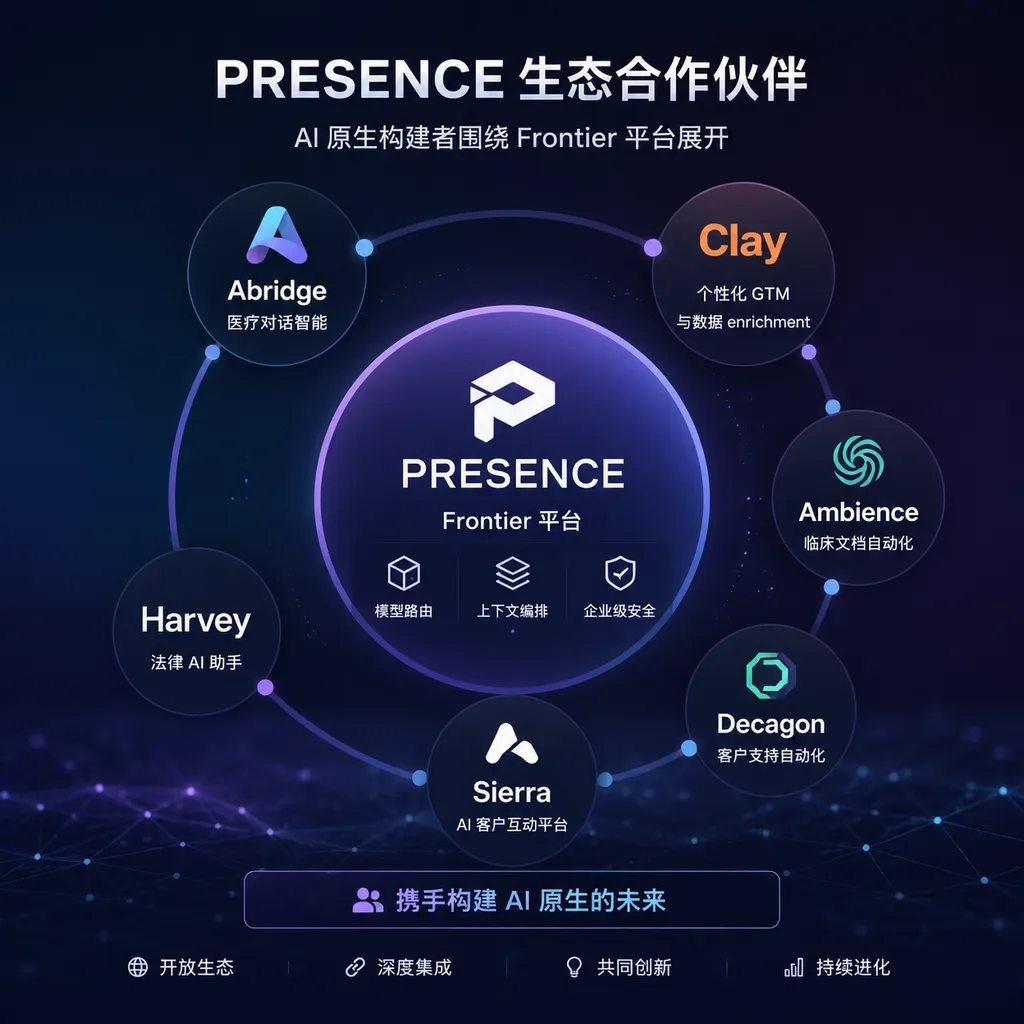
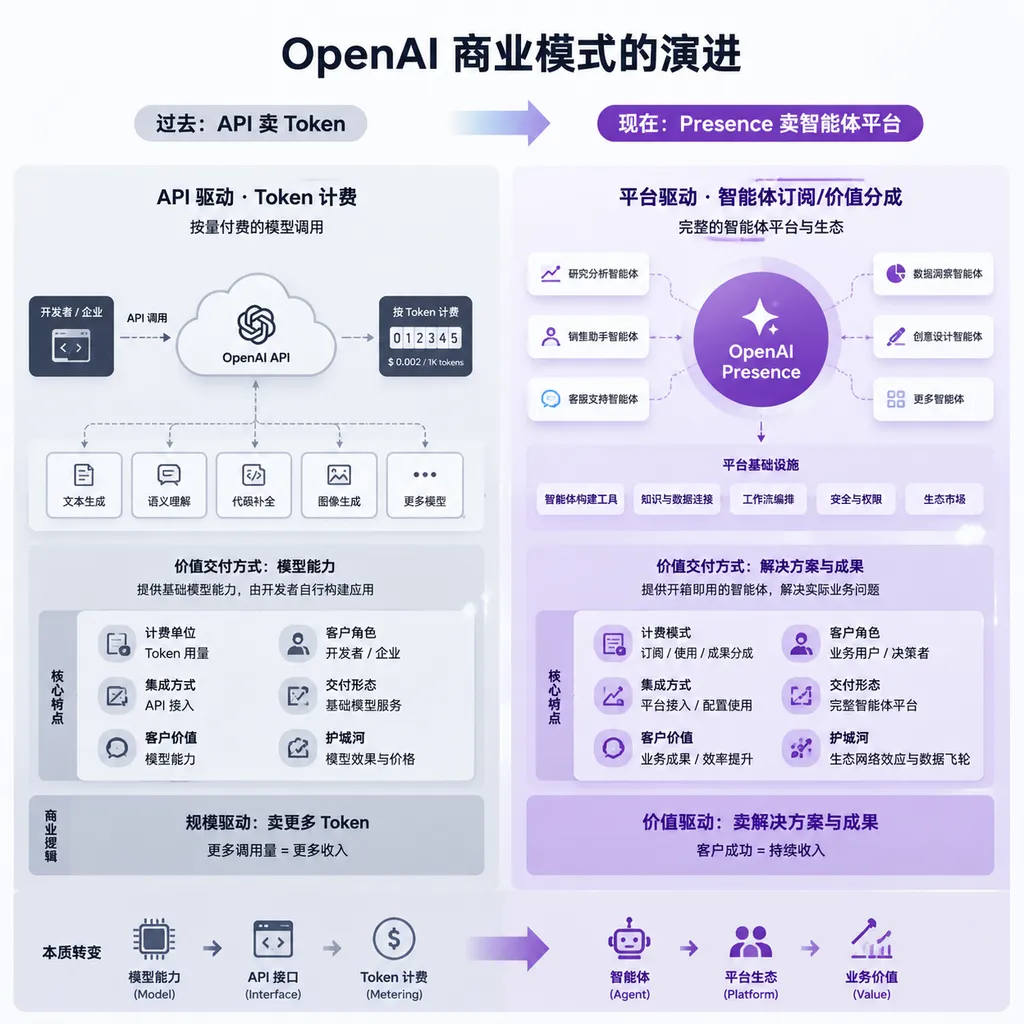
For the past two years, OpenAI’s business model was simple: sell APIs and ChatGPT subscriptions. Around these APIs grew a whole ecosystem—Decagon for customer support agents, Sierra for enterprise agents, Harvey for legal agents, Abridge for medical agents. Their pitch essentially was: “We package OpenAI models + domain know-how + enterprise integration and sell it to you.”
Now OpenAI is launching Presence, and the message gets murkier:
Customer support automation? I do it. Sales process automation? I do it. IT service desks? I do those, too.
Interestingly, Decagon, Sierra, and Harvey all appear on the Frontier “AI-native builder partners” list. OpenAI’s official line is “deep collaboration and joint delivery,” but how the industry perceives this relationship will depend on renewal rates a few quarters from now. This “platform provider turned application competitor” playbook isn’t new—AWS, Salesforce, and Snowflake have all done it—each time triggering an ecosystem reshuffle.
OpenAI doesn’t pretend otherwise; instead, it frames it as “platform openness”: Frontier adheres to open standards so that in-house, OpenAI-built, or third-party agents can all run in the same context. Technically true—but if you’re a third party who built your company atop someone else’s API, how does that feel?
Why Now? OpenAI’s Anxiety Is Showing
Viewed in isolation, the product seems like a natural evolution, but the timing reveals strong defensive motivations.
A few contextual data points:
- The performance gap among large models is rapidly narrowing. Just this month, open-weight Chinese models closed the gap further—and at much lower prices.
- Enterprise clients are increasingly switching between Anthropic, Google, xAI, Meta, Mistral, and DeepSeek. Model-level lock-in is vanishing.
- On July 9, Microsoft named GPT‑5.6 its preferred model for Microsoft 365 Copilot—but most of that channel’s profits go to Microsoft, not OpenAI.
- In June, OpenAI confidentially filed an S‑1 draft with the SEC, signaling an IPO is coming. It needs a growth story sexier than “selling tokens.”
Enterprise software is a multi-hundred-billion-dollar market, and its gross margin, retention, and NRR all crush token-based API sales. The launch of Presence marks OpenAI’s first step in moving from being an AI infrastructure provider to an AI application provider.
Technically Speaking: What Developers Should Watch
Stripping away the marketing, Presence actually tackles several real enterprise pain points:
1. Agent Identity
Previous agent frameworks sidestepped this. Under whose credentials does your agent access Jira? Salesforce? Use an admin account, and one prompt injection could nuke production. Use a regular account, and half your workflows won’t run.
Presence assigns each agent a separate IAM identity with task-level access control. This is the right direction—but it also means enterprises must rebuild their permission models, which is no small task.
2. Memory Mechanism
OpenAI says agents will “accumulate organizational memory over time.” This isn’t new—but OpenAI updated ChatGPT’s memory architecture on June 4, and enterprise clients now inherit the same foundation. For long-term agents on fixed roles (say, customer service), this is essential—you don’t want to reintroduce your product to the agent with every support ticket.
3. Debugging Agents with Codex
A clever combo. When an agent fails, you no longer have to sift through logs. Presence lets Codex analyze “why this agent chose the wrong tool in step 3” and propose fixes. This pushes agent development from manual prompt tweaking toward AI-assisted optimization.
4. Deployment Still Requires Heavy Service
Presence currently isn’t a self-serve SaaS—you must contact OpenAI’s engineering team or an authorized partner to onboard. Classic enterprise sales motion. Not ideal for individual developers, but smoother for enterprise IT procurement.
A Less Optimistic Observation
In the enterprise AI platform space, OpenAI isn’t first. Google has Agentspace, Microsoft has Copilot Studio, AWS has Bedrock Agents, Salesforce has Agentforce, and ServiceNow has Now Assist. They all tell the same story: “Use our platform to manage all your agents.”
OpenAI’s advantages are strong models, a powerful brand, and an active ecosystem. Its weaknesses are equally clear: no historical enterprise data, no native integration with business systems, and no compliance frameworks familiar to IT departments. It even lacks mature SSO, audit logging, and tenant isolation products—capabilities Microsoft and Salesforce have honed for two decades.
So whether Presence succeeds in scale isn’t a technology problem—it’s about sales, delivery, and compliance—unsexy but critical capabilities. OpenAI’s bet on the FDE frontline-engineer model essentially means burning high labor costs to win early clients. How long that lasts depends on conversion rates.
What This Means for Developers
If you’re building enterprise AI applications, you’ll need to rethink a few things in the coming months:
- Where’s your moat? If your core value is “wrapping OpenAI’s API with business logic,” Presence is now your direct competitor.
- Should you integrate with Presence? If your customer base overlaps, joining the Frontier ecosystem might be smarter than fighting it—but at the cost of ceding channel and context control to OpenAI.
- Should you diversify models? With large model performance converging, putting all your eggs in the OpenAI basket is riskier than a year ago.
And one more point: As multi-model usage becomes the default, a unified gateway that can call GPT, Claude, Gemini, or DeepSeek simultaneously is more valuable than ever. That’s what OpenAI Hub (openai-hub.com) offers—one key to connect all major models, OpenAI-compatible, with direct connections in China. Want your Presence agent to switch models for comparison—or cut costs by using open models for low-value tasks? It’s just a matter of changing the base URL.
In summary: Presence marks OpenAI’s first official pivot from selling models to selling applications—and the start of a more delicate relationship with its own API customers. The product itself is solid, but enterprise software has never been a battle won by technology alone. The next 12 months will show whether OpenAI becomes the next Salesforce—or reverts to being a model vendor who can’t sell applications and goes back to peddling tokens.
References
- OpenAI Launches Presence to Enter the Enterprise Software Track – ITHome — Detailed Chinese media coverage of Presence’s launch, covering both product capabilities and business strategy.