Shexu Technology raises over 100 million yuan in Series B funding, aims to rebuild CAD with an industrial world model.
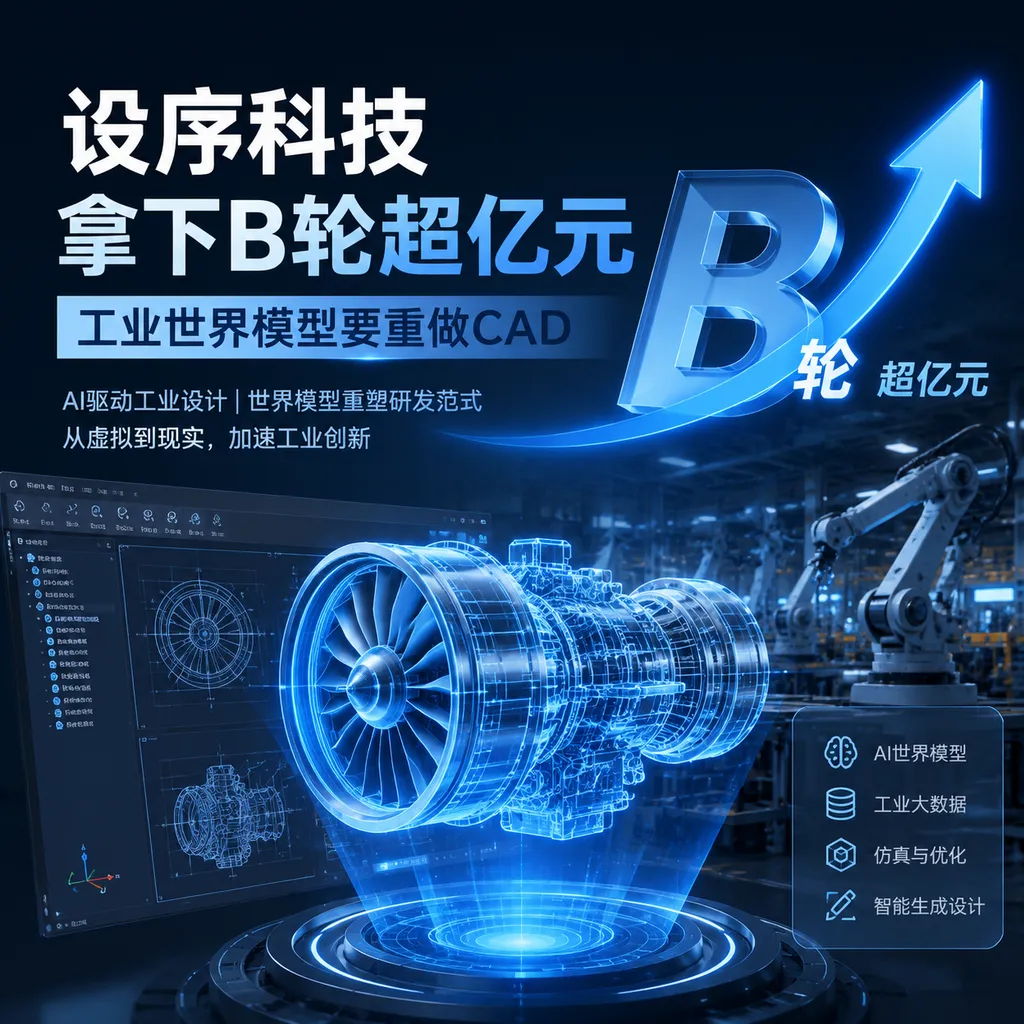
Setseq Technology, founded by Tongji University Ph.D. Wu Yongrong, has completed a Series B financing round exceeding 100 million yuan, bringing total funding to over 300 million yuan. Instead of following the path of CAD localization, the company has developed its own industrial world model combined with a multi‑agent architecture, turning 3D design, 2D drawings, and process planning all into agents. In 2026, it will officially launch its expansion into the European market.
The pond of industrial software has gone without a true disruptor for a long time. Dassault, Siemens, and Autodesk have enjoyed more than thirty years of dividends. The occasional homegrown “substitutes” that appeared in between basically just redrew the wheel along the same lines.
But Sheshu Technology is taking a different path.
In late July, this industrial AI company founded in 2020 completed a Series B financing round exceeding 100 million RMB, with investors including Shenzhen Capital Industry Development Fund, Hedinge Capital, and existing shareholder Yonghua Investment. Counting previous rounds, Sheshu’s total funding has surpassed 300 million RMB—a rare feat amid the current tight capital environment, and particularly among AI application companies that are not only still raising funds but raising ever larger amounts. The use of proceeds is clear: market expansion (including overseas) and core model R&D.
Even more noteworthy are the business results. In the first half of this year, contract value rose about 70 % year‑on‑year, with full‑year revenue expected to reach nearly 200 million RMB—almost double last year’s figure. Roughly one‑third of that comes from a relatively new delivery model: RaaS (Result as a Service).
Not a Domestic CAD Clone, but an AI‑Native Industrial Software
Sheshu’s founder Wu Yongrong holds a PhD in advanced manufacturing from Tongji University. He previously worked as a researcher at the General Advanced Manufacturing Lab and later as an intelligent‑manufacturing specialist at NIO. In his own words, he “had many arguments on the shop floor”—about out‑of‑spec parts and inconsistent processes—only to find that the root cause often lay in design.
That observation was the starting point of Sheshu’s technical roadmap. While most of the industry discusses how AI can help on the manufacturing floor—vision inspection, picking, maintenance—Wu aimed further upstream: design and R&D.
“From day one, we never wanted to build a localized CAD replacement; rather, we chose an AI‑Native route to define, from 0 to 1, a completely new modality and an industrial world model.”
This isn’t mere rhetoric. Many traditional CAD vendors also claim to use AI, but most just wrap a natural‑language large model around their existing tool as an “AI assistant,” enabling basic text‑to‑model operations. Sheshu judged that an LLM alone cannot grasp how a geometric model is actually manufactured or what the production requirements are.
So they built their own industrial world model.
Dual‑Layer Nested Graph Neural Network: The Shape of an Industrial World Model
Sheshu’s industrial world model is based on a dual‑layer nested graph‑neural‑network architecture. The key idea is that it encodes the existence of assembly, feature, and constraint relationships in industrial data—relationships that general LLMs cannot fully understand.
Each network layer has its role:
- First nested network: represents multiple parts in an assembly and their assembly relationships
- Second nested network: represents a single part’s geometric features, such as fillets, slots, and holes
Within this modality, an industrial assembly is expressed in three dimensions:
- Part dimension: the type and material of each component
- Downward dimension: the geometric features each part has
- Upward dimension: where the part is assembled and with which other parts
“Based on information from these three dimensions,” Wu says, “you can understand an assembly’s positioning and intended function.”
The model has about one billion parameters and is trained entirely on proprietary data. The data come from two sources: nearly 20 years of industrial experience accumulated by Sheshu’s industry‑shareholder partners, and the data generated by Sheshu’s own SaaS customers and delivery teams. On the public cloud alone, Sheshu’s platform now produces no fewer than 50 000 drawings or parts per day—over 20 million per year.
This is a moat many general‑model developers underestimate. Industrial data cannot be crawled from the web; every drawing embodies decades of engineering know‑how.
From “FlashDesign” to “Zexing AI”: A Three‑Step Agentization
Sheshu’s product line was originally branded “FlashDesign” but was recently upgraded to “Zexing AI.”
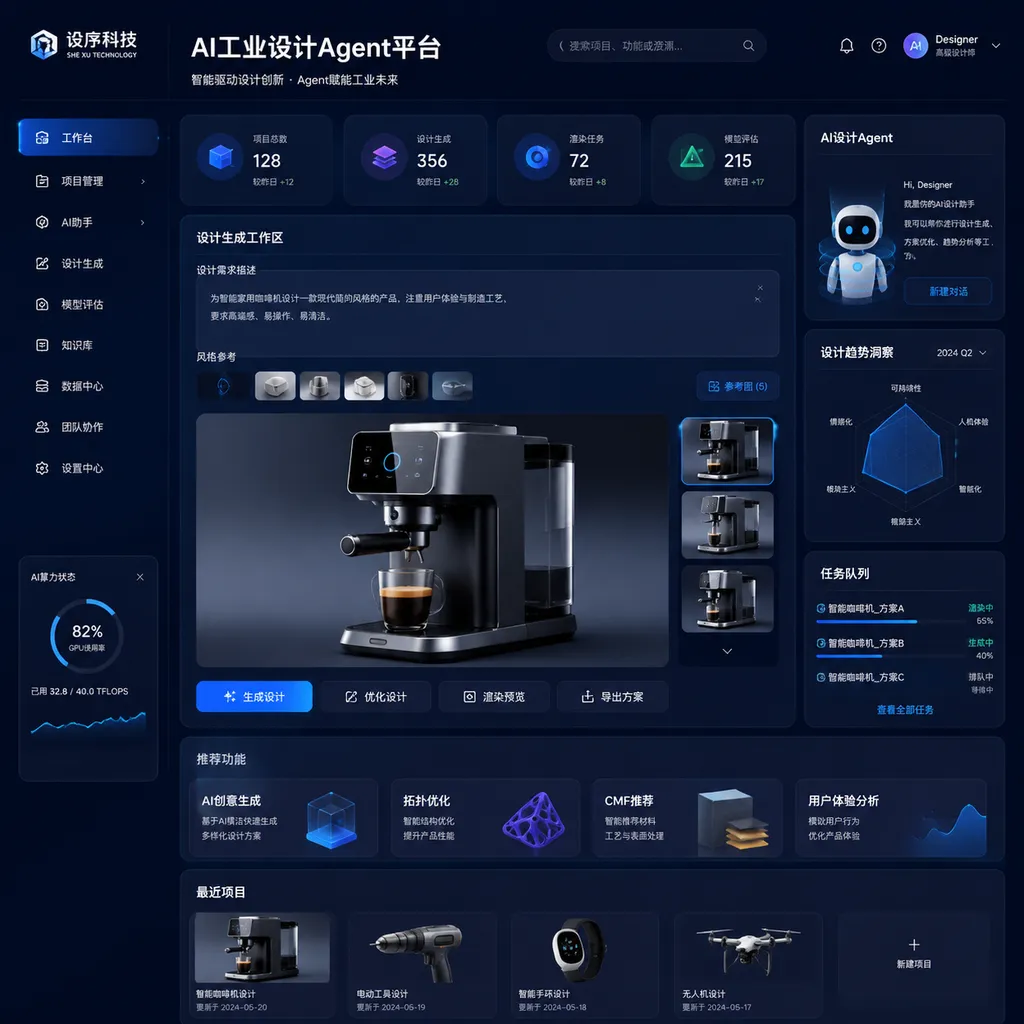
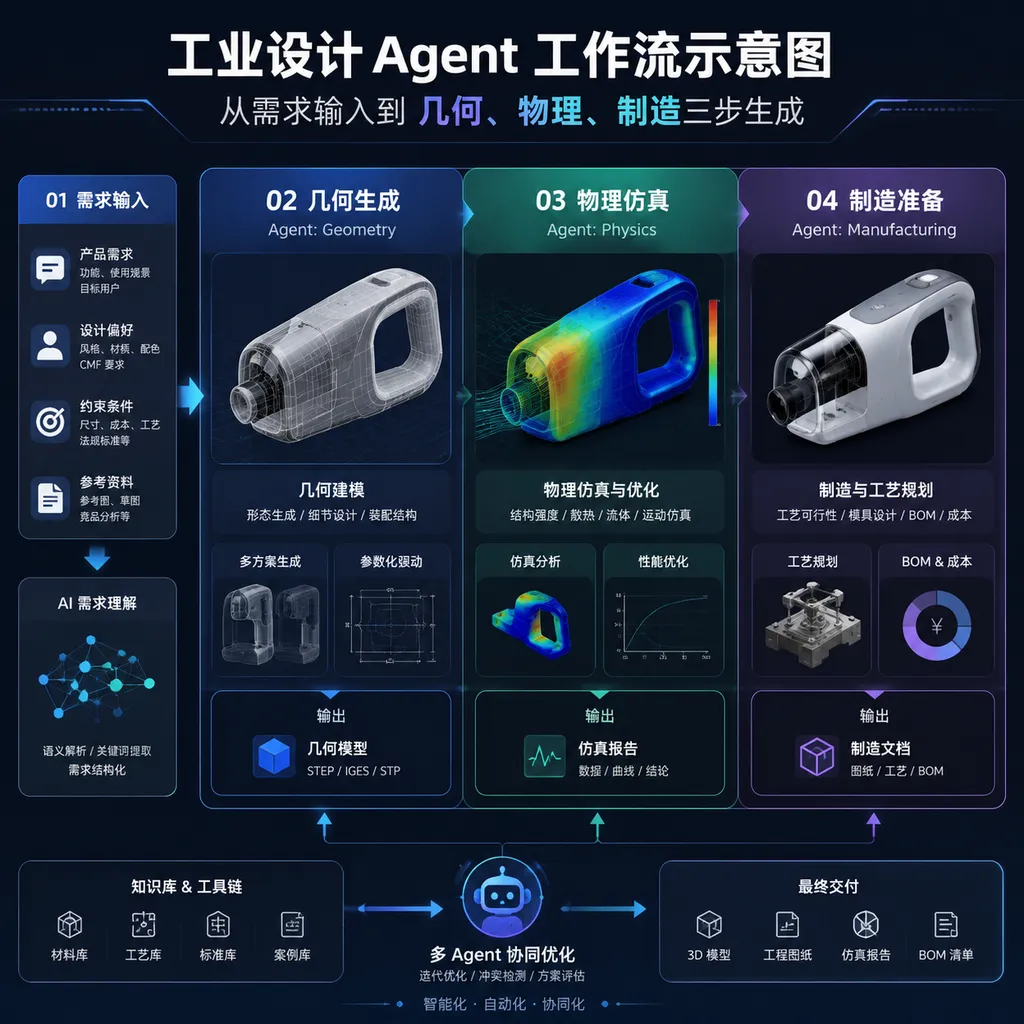
Compared with a year ago, the two original product lines—3D generation and 2D generation—have both undergone deep agentization. The current product matrix looks like this:
| Agent | Role | |-------|------| | 3D Agent | Uses geometric AI to generate 3D designs containing process and assembly info directly from user requirements | | 2D Agent | Uses manufacturing AI to automatically produce fully detailed machining drawings | | Review Agent | Checks dimensions, process steps, and standard compliance | | Process‑Planning Agent | Outputs executable process plans bridging design and production |
The Physical AI connecting geometric AI and manufacturing AI is now in R&D and POC testing. Note that “Physical AI” here is not limited to embodied AI; Sheshu uses the term to mean industrial‑grade precise solutions of physical fields (strength, stiffness, flow, magnetic, etc.) based on combined physical mechanisms.
Wu explains the logic clearly: “The user states a need; AI executes in three steps—geometric AI designs the exact geometry, physical AI solves its mechanical or flow‑field properties, and manufacturing AI assesses manufacturability.”
For engineers, this mainly means efficiency—Sheshu claims design‑cycle times shortened by more than 10×. But Wu emphasizes another aspect: consistency.
“When under high workload, designers make low‑level mistakes that lead to material waste and rework on the shop floor. AI rarely makes low‑level errors, so it greatly improves consistency.”
That’s a more honest statement than “10× faster.” A designer mis‑types a dimension at 3 a.m. and downstream tens of thousands of dollars’ materials are scrapped—something traditional CAD assistants can’t prevent.
RaaS: Selling Results, Not Software—a Forced Innovation in Business Model
Perhaps Sheshu’s most interesting move is its business model.
Early in the year, North American AI circles began discussing how direct delivery of AI results might surpass software subscriptions—RaaS (Result as a Service). Sheshu took the idea and became the first in China to make it work.
By 2025, RaaS will contribute one‑quarter of annual revenue; by the first half of 2026, it has grown to one‑third, becoming the main growth engine.
Why is RaaS such a good fit for Sheshu?
Because industrial design is inherently result‑oriented. Clients don’t care what software or model you use—they just want ready‑to‑produce drawings. Sheshu has built an ecosystem with multiple industrial‑design firms to deliver AI‑generated design results directly to end customers. One manufacturer in Wuxi approached Sheshu proactively for AI‑based automatic pricing—the platform generates process plans, computes machining costs, and handles outsourcing end to end.
Wu’s vision goes further: “Imagine if most drawings in an industry were delivered through your platform—then your platform would become the new industry definition. Dassault, an earlier industrial‑software giant, started by building fighter jets. In the AI era, whoever establishes the best AI‑enabled practice can become the new industry definer.”
A bold statement—but logically sound. The CAD giants didn’t win by selling software per se; they won by turning their workflows into industry standards.
Customer List and Scenarios: From Automotive, 3C, and Energy to L’Oréal Packaging
Zexing AI’s deployments are already quite diverse:
- Core industries: automotive (Honda, Dongfeng, Yutong, CAERP), 3C (Bozhon), energy, rail (CRRC)
- Emerging fields: commercial space, embodied intelligence
- Cross‑sector clients: L’Oréal’s global innovation team adopted the product for packaging and display‑material design
It now serves more than 100 major clients. Crucially, it’s not dependent on a few big accounts—the platform works across industries, showing that the industrial‑world model generalizes well rather than being over‑tuned to one vertical.
Wu notes a shift: once‑conservative customers have become even “aggressive.” Where they once said “AI can’t handle this use case,” they now initiate POCs before the scene fully matures. This mindset change across the industrial AI customer base is a key reason contract values have doubled.
2026 as the Year of Going Global—First Stop: Germany
Sheshu has designated 2026 as its first year of overseas expansion, focusing on Europe.
The roadmap:
- 1H 2026: complete EU data‑compliance prep; win the first German seed customer
- 2H 2026: land the first ≈10 customers
- 2027: scale up across Europe and open Japan, Korea, and Southeast Asia
Germany is a logical starting point—it sits in one of the world’s densest manufacturing clusters, especially in automotive and machinery, and has strong willingness to pay for industrial software. A well‑known German heavy‑industry company has already approached them.
Going overseas isn’t just about revenue growth—it’s about data growth. Much of Sheshu’s moat lies in its proprietary datasets; globalization means diversified data sources and therefore a more universal model.
A Longer Bet: Design‑Side Data as Fuel for Embodied Intelligence
At the end of the interview, Wu shared a longer‑term view: as embodied intelligence and robotics evolve, design‑side data accumulated by Sheshu will become highly valuable for factory‑floor training and deployment.
“Every physical object on the shop floor has complete corresponding data from the design stage—essentially a one‑to‑one digital twin.”
That’s a smart positioning. While many talk about how embodied AI will land in factories, Sheshu is already at the data source—the design phase, where every drawing, parameter, and assembly constraint naturally forms the highest‑quality digital‑twin dataset.
From this standpoint, Sheshu isn’t building an “AI design tool” or “next‑gen CAD,” but accumulating training data for future physical‑world intelligent agents.
For decades, industrial‑software has been criticized for lacking breakout Chinese players. The opportunity now lies not in recreating the legacy giants’ software, but in an AI‑native architectural shift. The combination of Sheshu’s fresh funding, rapid revenue growth, agent‑based product rhythm, and innovative RaaS model together outline a clear answer—China’s industrial‑software breakthrough may truly come via AI, not by imitation.
For AI developers and enterprise tech teams, Sheshu offers a case study worth dissecting: a vertical‑industry world model + multi‑agent collaboration + RaaS delivery could be a replicable path to deeply embedding AI in industry.
References
Current public reports mainly come from outlets such as 36Kr. As of now, there are no in‑depth technical materials hosted on domestic whitelist domains (github.com, juejin.cn, ithome.com, zhihu.com, linux.do, stackoverflow.com, reddit.com, huggingface.co). Interested developers can obtain additional product information and white papers through Sheshu Technology’s official channels.