AWE 3.5 Embodied Brain Debuts at WAIC, Marking a Breakthrough in Multi-Tasking for Industrial Robots
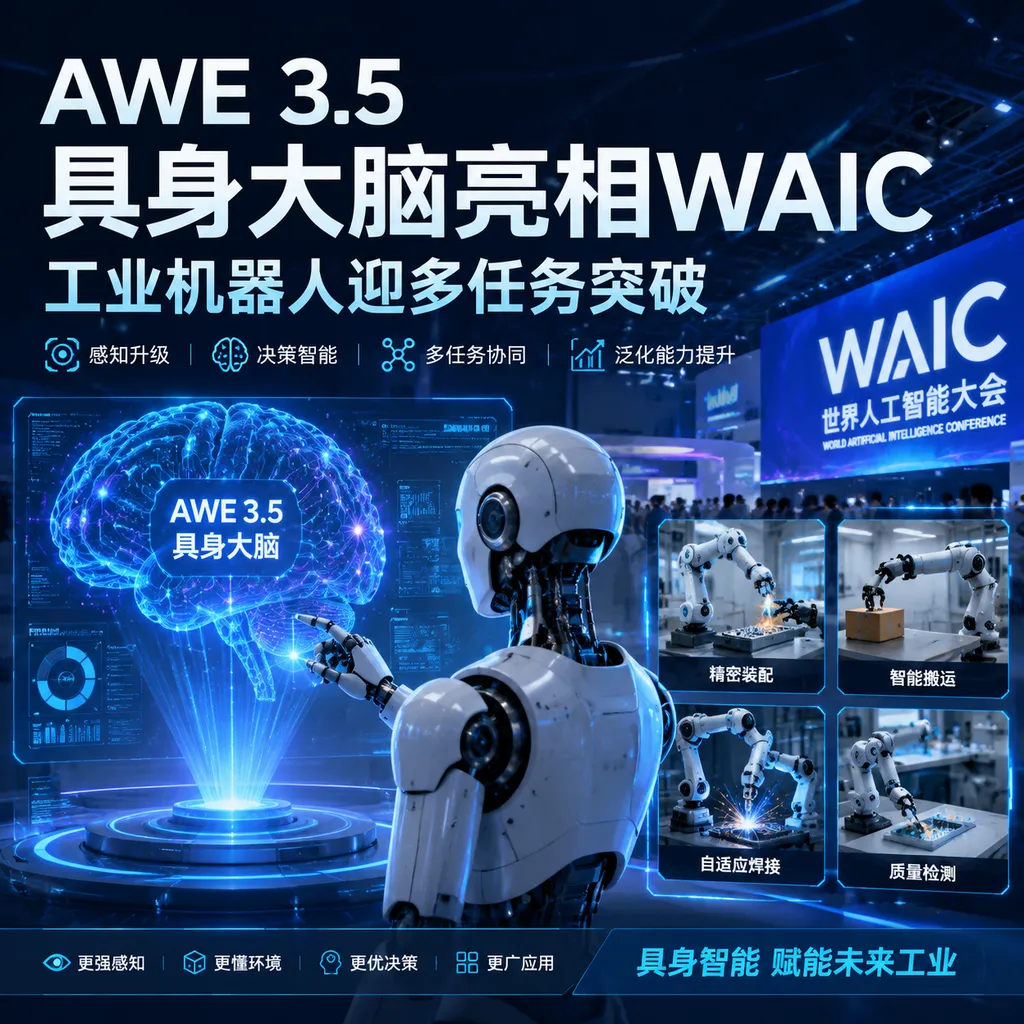
Its Zhihang unveiled the embodied native brain AWE 3.5 at WAIC 2026, using an end-to-end multi-task architecture to penetrate deeply into the industrial domain. The on-site demonstration showcased real machines continuously performing complex operations such as welding, assembly, and sorting, marking the full release of the Scaling Law for embodied intelligence.
AWE 3.5 Embodied Native Brain Debuts at WAIC: Another Breakthrough for Industrial Robot Multi-Task Models
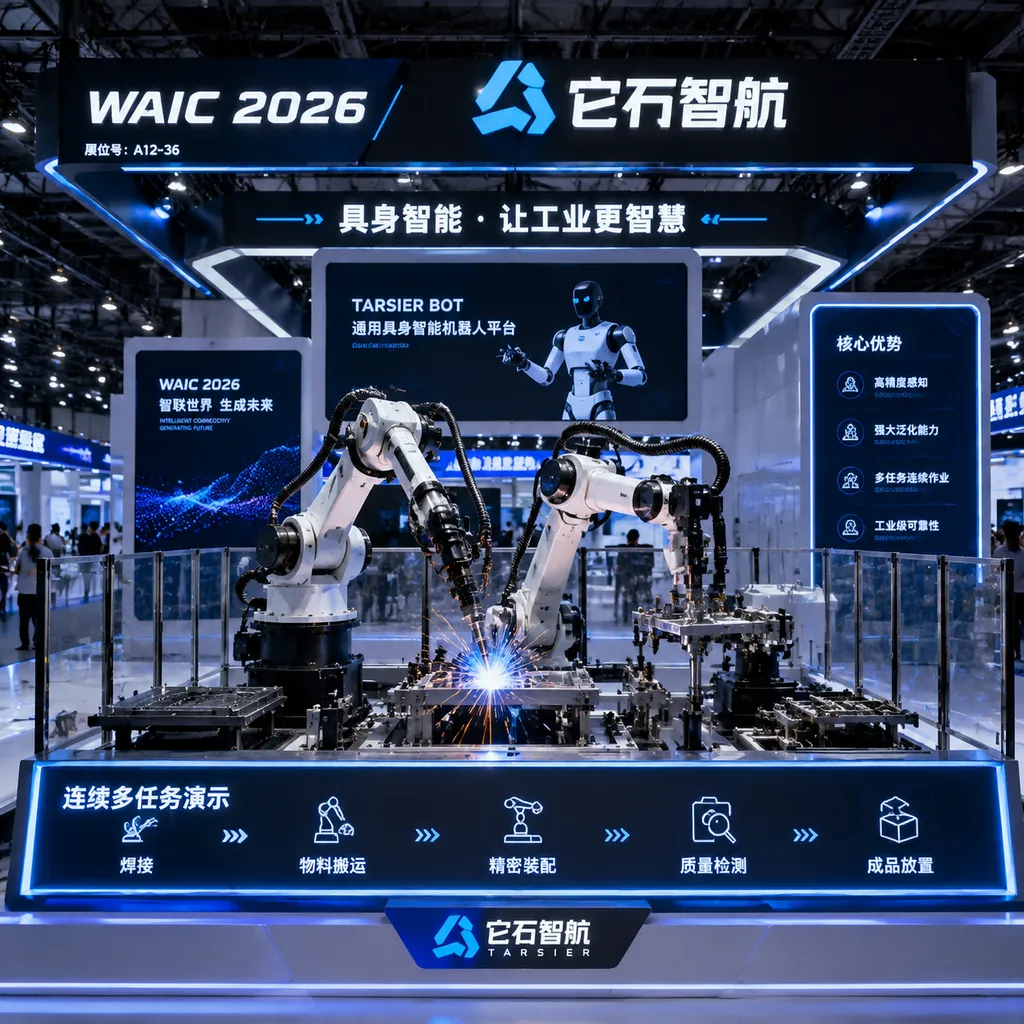
On July 23, 2026, the third day of the 2026 World Artificial Intelligence Conference (WAIC) took place at the Shanghai World Expo Exhibition Center. The Itstone Robotics booth in Hall H2 remained packed with visitors. The company, which rose to fame over the past two years with the concept of an "Embodied Native Brain," officially launched its flagship model AWE 3.5 (Autonomous World Engine 3.5) on the opening day. Using an industrial robotic arm that continuously completed 12 industrial tasks — including welding, precision assembly, flexible gripping, and irregular part sorting — the company moved “multi-task models” from demo videos to a true production-level demonstration. Industry insiders widely regard it as one of the most hardcore embodied intelligence releases at this year’s WAIC, and, following GR00T N2 and RT-3 earlier in the year, another highly impactful new model for industrial applications.
I. Launch Background: The "Multi-Task Dilemma" of Industrial Deep Waters
Over the past two years, the public discussion around embodied intelligence has focused mainly on home and service scenarios — folding clothes, pouring coffee, opening drawers. These tasks demand high generalization but have relatively modest requirements for precision, cycle time, or consistency compared to industrial production lines. The real challenge in the industrial domain is not "can it be done," but rather "can one robot do many kinds of work without retraining every time a workstation changes."
The traditional industrial robot deployment pipeline works as follows:
- Write kinematic scripts or use teach programming for a single workstation
- Retrain whenever the workpiece changes — often taking several days
- Vision, force control, and planning systems belong to separate stacks with no shared semantics
- Switching production lines nearly means redoing the entire integration
Itstone Robotics CEO Chen Yilun stated at the press conference: “It’s not that industry doesn’t need large models — it’s that large models so far haven’t been able to enter industry. A VLA (Vision-Language-Action) model that scores 70 points may be usable for household tasks, but even 99 points in weld seam tracking could produce scrap.” The goal of AWE 3.5 is to raise the lower bound of embodied large models to a level acceptable for industrial use — while extending the upper bound to true “one robot, many tasks” generalization.
II. Technical Architecture of AWE 3.5: From VLA to “Native Embodiment”
Since version 2.0, the AWE series abandoned the "vision large model + action policy head" concatenation paradigm. Instead, it adopted a single Transformer backbone that directly consumes multi-modal observations and outputs continuous action tokens. Version 3.5 builds on this with three key upgrades.
1. Parameters and Data Scale
According to the technical white paper released onsite:
- Backbone parameters: 42B (8.7B active parameters, MoE architecture)
- Training data: 180 million real robot trajectories + 920 million simulated trajectories
- Covered embodiments: single-arm, dual-arm, wheeled, quadruped, and humanoid — 27 configurations in total
- Training compute: about 3800 GPU-months on an H800 cluster
Compared with AWE 3.0, model parameters expanded about 3.5×, and the share of industrial data rose from 18% to 41% — with welding, gluing, and lithium battery assembly data appearing at scale for the first time.
2. Hierarchical Action Tokenization
AWE 3.5 decomposes the action space into three token levels:
- Coarse-grained: task-level intent (“move the workpiece to station B”)
- Mid-grained: trajectory segments (Bezier curve control points)
- Fine-grained: 50 Hz joint increments + end-effector forces/torques
This hierarchical scheme allows the model to perform long-range planning and high-frequency servo control within the same forward pass, avoiding the usual mismatch where “the high-level planner looks good, but the low-level controller can’t keep up.” In onsite welding demos, the robotic arm’s arc stability was visibly superior to traditional setups at neighboring booths — a direct outcome of this design.
3. World Model Joint Training
AWE 3.5 embeds a differentiable world-model branch, jointly optimized with the action policy during training. Engineers revealed that this branch enables the model to perform an “inner rollout” for a few steps when facing unseen workpieces before deciding on an action, greatly reducing trial-and-error costs. During the demo, when the robotic arm first encountered an irregular aluminum part, it completed pose planning after only about 1.2 seconds of “gazing,” without any manual teaching.
III. Live Demo: One Robot’s “Multi-Task Combat”
The most striking part of the launch was how Itstone Robotics turned its booth into a “mini flexible production line.” The same six-axis robotic arm sequentially completed the following before the audience:
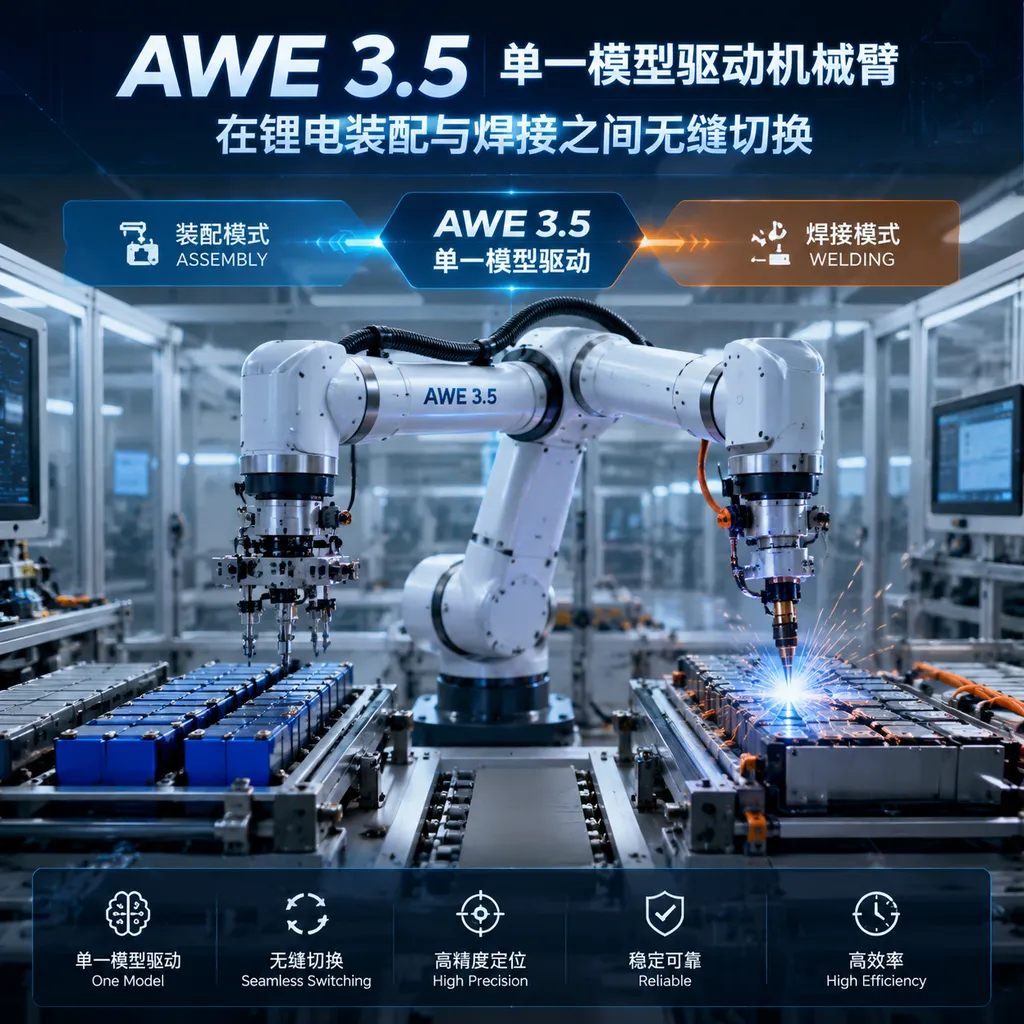
- Thin-plate MIG welding: 0.8 mm cold-rolled plate, 8 cm straight seam, uniform weld with no undercut
- Lithium battery module assembly: pressing 21700 cells into brackets, with < 3% press-fit force error
- Flexible harness arrangement: gripping loose cable bundles and inserting by color into sockets
- Glass screen lamination: 0.1 mm alignment accuracy, no bubbles
- Irregular part sorting: bin-picking target parts from a disordered tray
- Screw tightening: M3 screws with closed-loop torque control
- Glue application: maintaining constant speed along a curved edge
- Quality inspection: visually checking welds and giving vocal feedback
- Tooling change: robot autonomously swapping its end effector
- Collaborative handling: loading/unloading jointly with a nearby AGV
- Human–robot collaboration: slowing down automatically when a spectator reaches in
- Voice task editing: when the host said, “Tighten that screw another half turn,” the robot complied immediately
The entire sequence lasted 18 minutes, with no engineer intervention or program switching between tasks. All twelve tasks shared the same model weights, switching purely through language commands — the most impactful highlight of the release.
IV. Verifying the Scaling Law in Embodied Intelligence
During the technical session, Itstone Robotics’ Chief Scientist Wang He presented a key curve: the log-linear relationship among model parameter count, real data volume, and task success rate.
Key data points:
- Parameters from 1.2 B → 42 B: average industrial task success rate from 62.3% → 94.7%
- Real data from 2 million → 180 million trajectories: zero-shot success on unseen parts from 11% → 68%
- Simulation-to-real gap reduced from 23% → 4.1%
Wang concluded: “A scaling law does exist for embodied intelligence, but its slope is steeper than for language models — the marginal gain from data is still accelerating.” He also cautioned that this curve heavily depends on data quality, especially real trajectories with force feedback and failure labels, whose collection cost remains 2–3 orders of magnitude higher than that of language data.
V. Deployment Form: From Model to “Brain Box”
Alongside the model, Itstone Robotics also introduced a hardware product — the AWE Brain Box, a 2U inference unit equipped with dual NVIDIA Thor chips, capable of running a distilled local version of AWE 3.5 (8.7 B active parameters). Recommended deployment configurations:
- Production-line level: runs locally on Brain Box with end-to-end latency < 35 ms
- Multi-agent collaboration: connects via private 5G network to the cloud 42 B model for long-horizon planning
- OTA updates: model weights roll out monthly; supports factory-specific fine-tuning
For industrial clients, this means they can buy the “brain” like a PLC — without building a GPU cluster. Booth staff said the first batch of 500 Brain Boxes has already been pre-ordered by Sany Heavy Industry, CATL, and Luxshare Precision.
VI. Ecosystem and Open Strategy
Itstone Robotics also announced AWE 3.5’s open approach:
- Embodiment adaptation SDK: open-source, compatible with major industrial robot brands (FANUC, ABB, KUKA, Estun, STEP Robotics, etc.)
- Data collection toolchain: open-source teleoperation suite and simulation environments
- Model weights: 42 B main model closed for now; 8.7 B distilled version to be released to academia in Q4
- Fine-tuning service: for enterprises, combined LoRA + RLHF fine-tuning to onboard new workstations within 72 hours
Notably, the company stated it will not pursue a “fully open-source” route, citing the stronger security and liability control required by industrial data. This aligns with global peers such as Physical Intelligence and 1X, reflecting how embodied models are forming a business paradigm distinct from that of language models.
VII. Industry Impact and Sober Reflections
The release of AWE 3.5 once again intensified debate over when “industrial embodied intelligence” can scale up. Optimists argue that, with the scaling law validated, 2026–2027 will bring the first landmark “Brain-as-a-Service” cases in industry. Cautious voices, however, highlight several unsolved issues:
- 99.99% reliability for long-tail tasks: raising from 94.7% to six-nines may require 2–3 orders of magnitude more data
- Safety certification: current ISO 10218 and ISO/TS 15066 standards don’t yet cover large-model-driven robots
- Liability attribution: if a model misoperation causes a production accident, who is responsible — the integrator or the model provider?
- Energy and cost: even distilled, the 42 B model’s annual power cost per deployment still exceeds that of traditional setups
A visitor from a German automaker told a Qbit reporter at the booth: “The demo is stunning, but I’m more concerned about drift rates after three continuous eight-hour shifts.” This might be exactly the question AWE 3.5 must answer to move from showcase to shop floor.
VIII. Conclusion
The significance of AWE 3.5 lies not in yet another leap in parameter scale, but in turning “multi-task generalization” from a slogan into a visible sequence of continuous actions onstage. For industrial clients, it’s a demonstration of a new paradigm where “brains can be bought, models rented, and tasks switched.” For the broader embodied intelligence field, it marks a loud annotation of the scaling law crossing from language and vision into the physical world. With two days left of WAIC 2026, it’s foreseeable that the next underground race — for “who can push 94.7% to 99.99%” — will dominate embodied AI in the coming months.
References
The technical details and live data cited here are drawn from onsite records and public reports of the WAIC 2026 Itstone Robotics launch. Readers can learn more from the following China-accessible sources:
- Zhihu topic: How to evaluate AWE 3.5 and industrial embodied intelligence — features technical breakdowns and critiques by frontline robotics engineers
- GitHub: Embodied Intelligence open-source embodiment adaptation SDK collection — search keywords such as embodied-ai, VLA, robot-foundation-model to follow community progress on AWE series SDK adaptation