Claude Voice Mode Receives Major Upgrade: Opus and Sonnet Now Selectable, Thought Layer Open for Adjustment

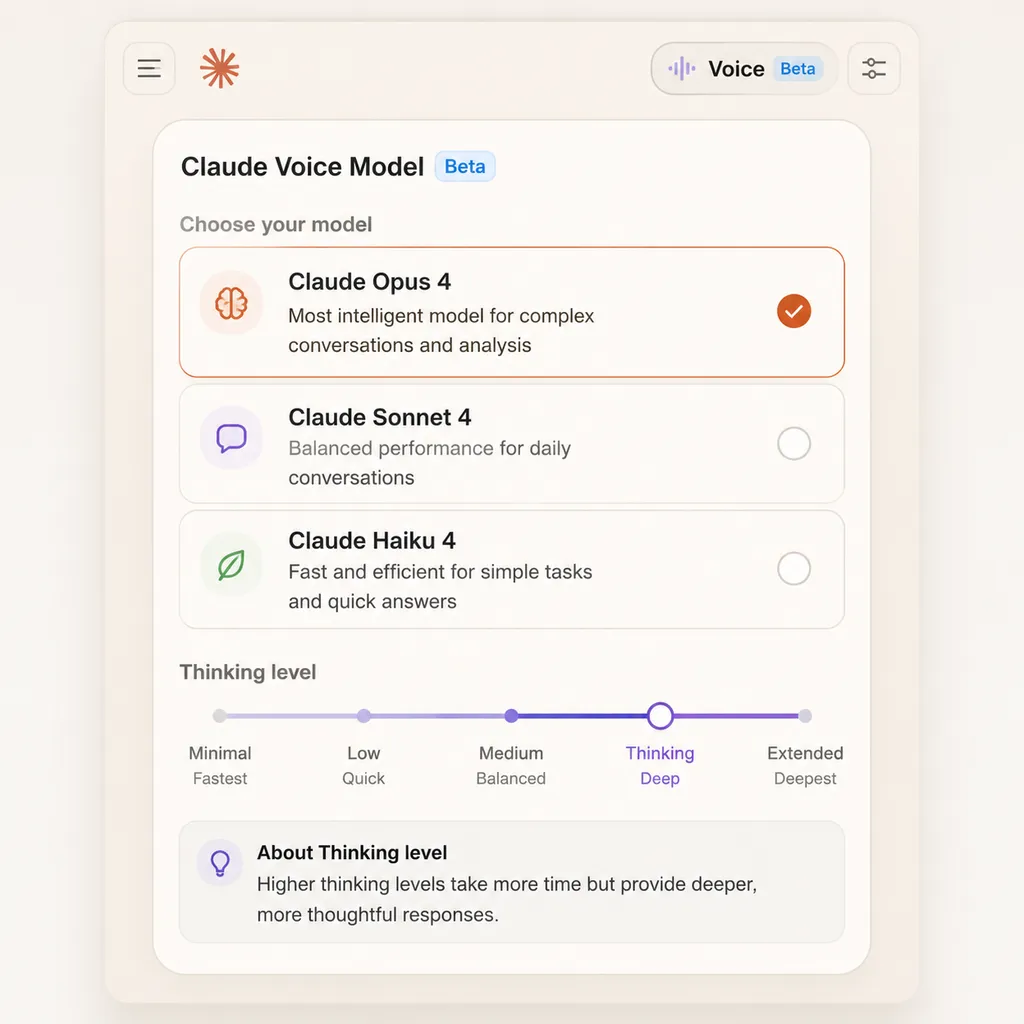
Anthropic is expected to introduce the Opus and Sonnet model selectors for Claude’s voice mode this week, while simultaneously releasing control over the "thinking" level. Previously, voice mode uniformly used Haiku 4.5; this upgrade means that users will now be able to directly access flagship-level reasoning capabilities during calls.
Major Upgrade to Claude’s Voice Mode: Opus and Sonnet Now Selectable, Thinking Level Control Enabled
July 23, 2026 News Flash · Product Update
According to IT Home on July 23, technology media site testingcatalog published a blog post on July 22 reporting that Anthropic is expected to roll out a major upgrade to Claude’s Voice Mode this week. The update will add a model selector, allowing users to freely switch between Opus, Sonnet, and Haiku, and also introduce a “Thinking” level control. Previously, Voice Mode always used the Claude Haiku 4.5 model — widely seen as an “entry‑level” option that users often criticized for falling short of the intellectual performance seen in text chats. This adjustment means the capability gap between Claude’s text and voice interactions is about to disappear.
Notably, Anthropic’s latest Mythos‑class model, Claude Fable, does not yet appear in the voice options, and for now remains on a “separate track.”
I. From "Can Talk" to "Can Think": The Evolution of Voice Mode
Claude’s Voice Mode was originally designed with a very straightforward goal — to let users have a complete conversation with the AI without typing or reading. When the user presses the voice button, they can speak as if on a phone call or using a voice assistant, and the AI replies in natural speech. For use while commuting, cooking, exercising, or providing accessibility for people with visual impairments, this has been a critical capability.
However, the voice mode previously could only use the Claude Haiku 4.5 model. The Haiku series has always been characterized as “lightweight, fast, low‑cost” — excellent for quick Q&A and short chats, but noticeably weaker than Opus or Sonnet in multi‑step reasoning, code analysis, long‑text comprehension, or complex decision making. This created a split experience:
- In text chats, Pro/Max users could call the latest Opus and Sonnet flagship models for deep reasoning.
- In voice chats, users were “downgraded” to Haiku — the same Claude, but with a lower “IQ” in voice mode.
The new upgrade addresses this gap. The screenshots from testingcatalog show a new dropdown menu in voice mode that lets users directly choose Opus 4.5, Sonnet 4.5, or Haiku 4.5 for that session’s base model. Next to it sits a “Thinking”‑level control, allowing users to balance between instant responses and deep reasoning.

II. What Does “Thinking Level” Control Mean?
If the model selector decides who answers, the Thinking level decides how long they think.
Users familiar with Anthropic’s developer platform may recall that when Opus 4.5 launched in November 2025, Anthropic introduced a new “effort parameter” to the Claude API. This lets developers choose between minimal time/cost and maximum performance, allowing the model to adaptively decide “whether to think a few steps further.” The official data released then was striking:
- With medium effort, Opus 4.5 achieved Sonnet 4.5’s best score on SWE‑bench Verified while using 76% fewer tokens.
- At maximum effort, performance improved another 4.3 points while token usage dropped another 48%.
This shows that “Thinking level” isn’t a simple “slow / fast” toggle, but a genuine reasoning‑budget scheduler. Extending this control to Voice Mode lets ordinary users specify in conversation: “Take your time and think deeply on this one,” or “Just answer that greeting quickly.”
Expected common use cases include:
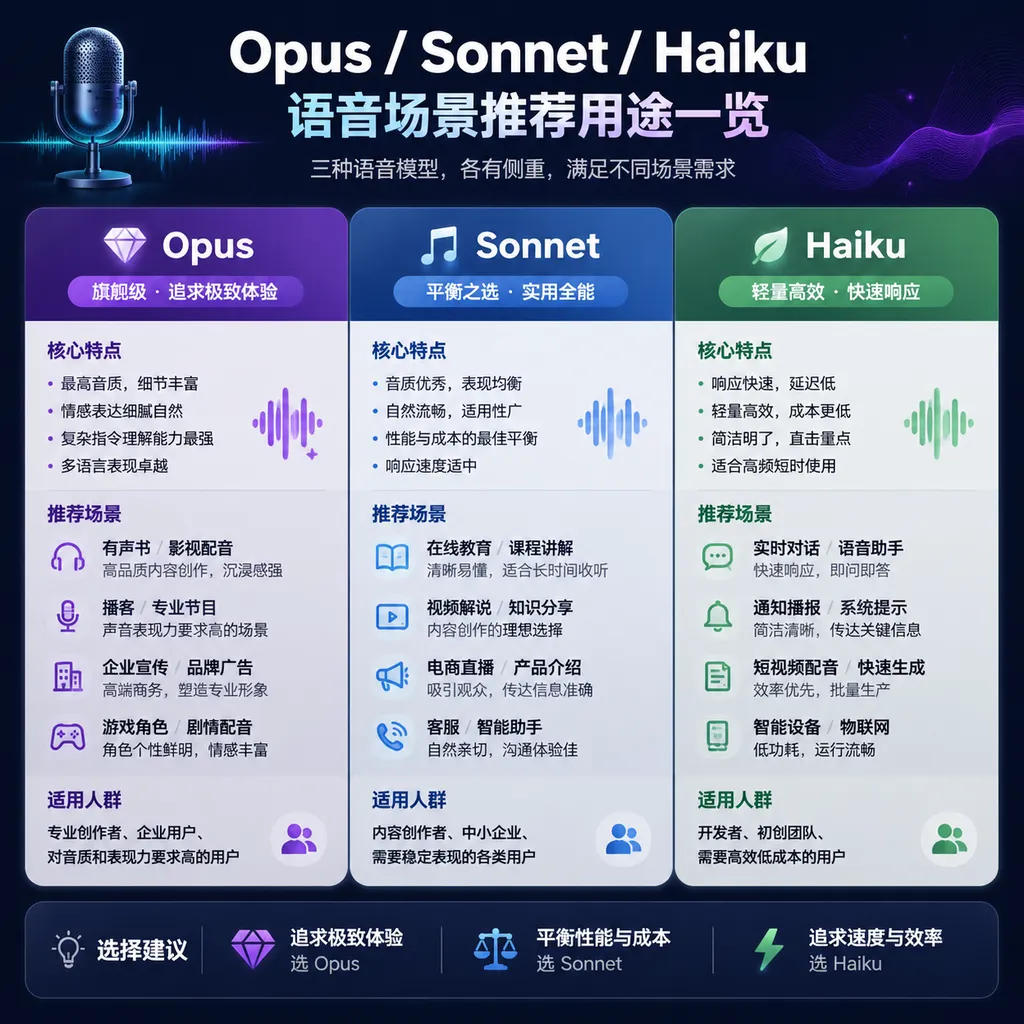
- Dictating a weekly report while commuting — Sonnet + medium thinking for a balance of quality and latency.
- Discussing architecture plans on a walk — Opus + maximum thinking for deep reasoning exchange.
- Asking for recipes, weather, or setting alarms while cooking — Haiku + minimal thinking for millisecond‑level response.
- Accessibility / Visual‑impairment scenarios — flexible switching as needed, no single‑model limitation.
III. How Differences Between Opus 4.5 and Sonnet 4.5 Affect Voice Experience
To gauge whether this upgrade is “worth the excitement,” it’s key to understand the gap between Opus and Sonnet within voice interaction.
Claude Opus 4.5
Released in November 2025, Opus 4.5 is Anthropic’s flagship model specializing in coding, agents, and computer‑use capabilities. In a widely recognized home‑engineer benchmark test, its two‑hour score surpassed all human candidates. In the SWE‑bench multilingual test, it ranked first in 7 out of 8 languages. It excels at multi‑file bug fixing, coordinating sub‑agents, and maintaining coherence in long tasks.
Bringing Opus 4.5 to voice means:
- Deep technical consulting in spoken form — talk with Claude about cross‑module bugs while walking.
- Continuous companion for long projects — voice chats benefit from flagship‑level context memory.
- Verbal‑to‑plan workflows — describe a requirement; Opus drafts the plan.md skeleton as it listens.
Claude Sonnet 4.5
Sonnet 4.5 strikes an excellent balance between performance and efficiency and has been the “default daily option.” In voice scenarios, Sonnet will likely become the mainstream choice — capable of most complex Q&A without Opus’s “overthinking.”
Claude Haiku 4.5
Haiku remains in the selector because “instant response” always has value — e.g., for quick smart‑speaker‑style commands.
IV. Why Is Fable “Absent” from Voice Mode?
A notable detail: Anthropic’s Mythos‑class Claude Fable is not among the leaked voice‑model options.
The Mythos line is Anthropic’s experimental branch outside the flagship series, focused on creativity and character‑driven interaction. Fable currently appears in Claude’s web and desktop apps as a standalone entry, officially positioned for “narrative/creative” tasks. Its absence from Voice Mode may stem from several factors:
- Priority on conversational stability: voice requires low latency and consistent tone; Fable emphasizes creative divergence, possibly mismatched with voice pacing.
- Audio‑pipeline adaptation unfinished: switching from Opus/Sonnet/Haiku to Mythos requires realignment of voice rendering layers.
- Product‑line positioning: Anthropic may want Fable to stay text/creation‑centric while Voice Mode focuses on “general assistant + coding + agent” use.
Whatever the reason, Fable’s omission merits watching — if the Mythos line gains voice support later, Claude could evolve from a “high‑IQ assistant” into a “storytelling, role‑playing” voice companion.
V. Signals for Developers and Enterprise Users
Although this upgrade directly targets Claude web/app users, it sends clear signals to the developer ecosystem:
1. “Reasoning‑budget scheduling” is now core
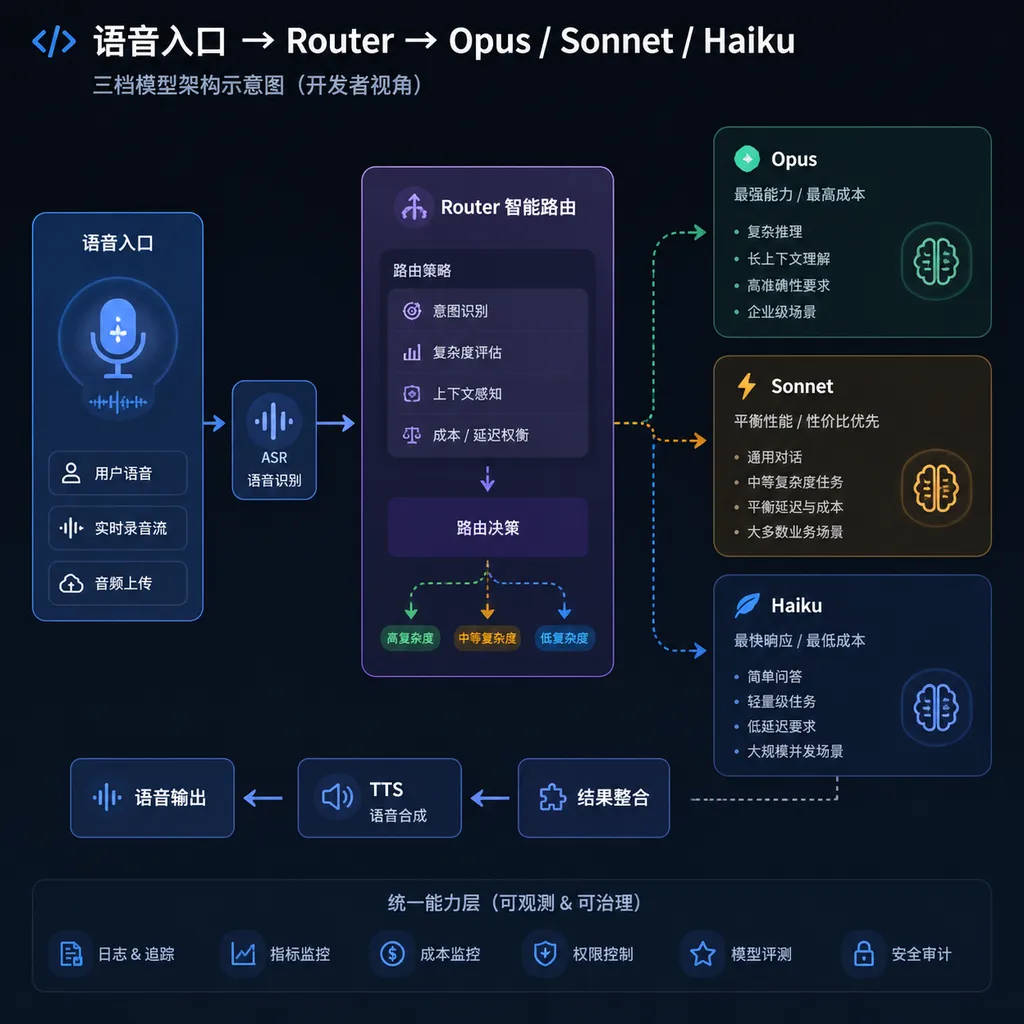
From the API’s effort parameter to Voice Mode’s Thinking‑level control, Anthropic is elevating explicit control over how much thought the model spends to a first‑class capability. Developers may want to include a “depth ↔ speed” toggle in nearly all Claude‑based UIs.
2. Voice is becoming the new agent interface
Combined with Opus 4.5’s sub‑agent‑coordination skill, once voice access reaches flagship models it can act as a “voice‑driven agent” gateway: you speak the goal, AI delegates multiple sub‑agents, and reports progress — a real step from “voice assistant” to “voice agent.”
3. Unified cross‑platform experience
Claude Code is now on desktop, Claude App supports automatic context compression for “infinite continuity,” and Voice Mode now ties into flagship models — together driving the ecosystem toward “multi‑entry, single‑capability” consistency.
4. How to call the equivalent API features
For developers building “voice + deep thinking” experiences, Claude offers Opus/Sonnet access via the Messages API and effort parameter.
Example (Python):
import anthropic

client = anthropic.Anthropic()

# Call Claude Opus 4.5 with high thinking effort
response = client.messages.create(
    model="claude-opus-4-5-20251101",
    max_tokens=1024,
    # effort controls reasoning budget: "minimal" / "medium" / "maximum"
    extra_body={"effort": "maximum"},
    messages=[
        {
            "role": "user",
            "content": "I’m building a voice assistant where users may ask cross‑system, multi‑step questions. Please design a routing strategy that can automatically switch between Opus / Sonnet / Haiku."
        }
    ],
)

print(response.content[0].text)
To minimize latency in voice scenarios, switch model to claude-haiku-4-5-20251001 and set effort = "minimal" for an ultra‑fast “answer instantly” reaction.
Note: The Voice‑Mode model selector and Thinking‑level slider are currently for Claude web/app users. Developers aiming to replicate the “three levels + thinking control” experience must orchestrate model + effort parameters via the API.
VI. Preview: Rollout This Week
According to testingcatalog, Anthropic is expected to begin limited rollout of the new Voice Mode this week (as of the July 23, 2026 IT Home report). Based on Anthropic’s usual gradual‑release pattern:
- First wave: Claude Max, Team, and Enterprise subscribers
- Next: Pro users
- Free users: likely keep Haiku as default; Opus/Sonnet availability depends on quota policies.
For users long accustomed to “Opus for typing, Haiku for voice,” the key significance isn’t just “two more options,” but that voice is no longer Claude’s weak spot. When you can chat in your earbuds with a Claude as smart as the web version, the AI assistant truly starts to feel like science‑fiction — not a text box on‑screen, but a deep‑thinking companion by your side.
VII. Summary
Although this Voice‑Mode upgrade mainly opens UI options, it reflects Anthropic’s clear design philosophy:
Letting users explicitly choose who answers and how long they think is more important than letting the model guess.
The model selector enables on‑demand control of intelligence tiers; the Thinking‑level slider makes reasoning budgets visible and adjustable. With Opus 4.5’s flagship abilities in coding, agents, and computer use, and Sonnet 4.5’s balanced everyday performance, Claude Voice Mode will no longer be just a “talking Haiku.”
Whether the Mythos‑class Fable will join next and whether enterprise/team editions gain “voice‑agent orchestration” remain topics to watch. Domestic media such as IT Home will continue tracking rollout progress.
References
- Report: Claude Voice Mode to Support Opus and Sonnet AI Models — IT Home: IT Home, July 23, citing testingcatalog on upcoming Opus/Sonnet switching and Thinking‑level control.
- LLM (18) | Anthropic Releases Its Most Powerful Coding Model: Claude 4 — Zhihu: Zhihu column analyzing the technical differences between the Claude 4 series (Opus 4 and Sonnet 4), providing context for this Voice‑Mode capability upgrade.