Feishu aily upgrade: from an assistant to a team Agent that can work autonomously
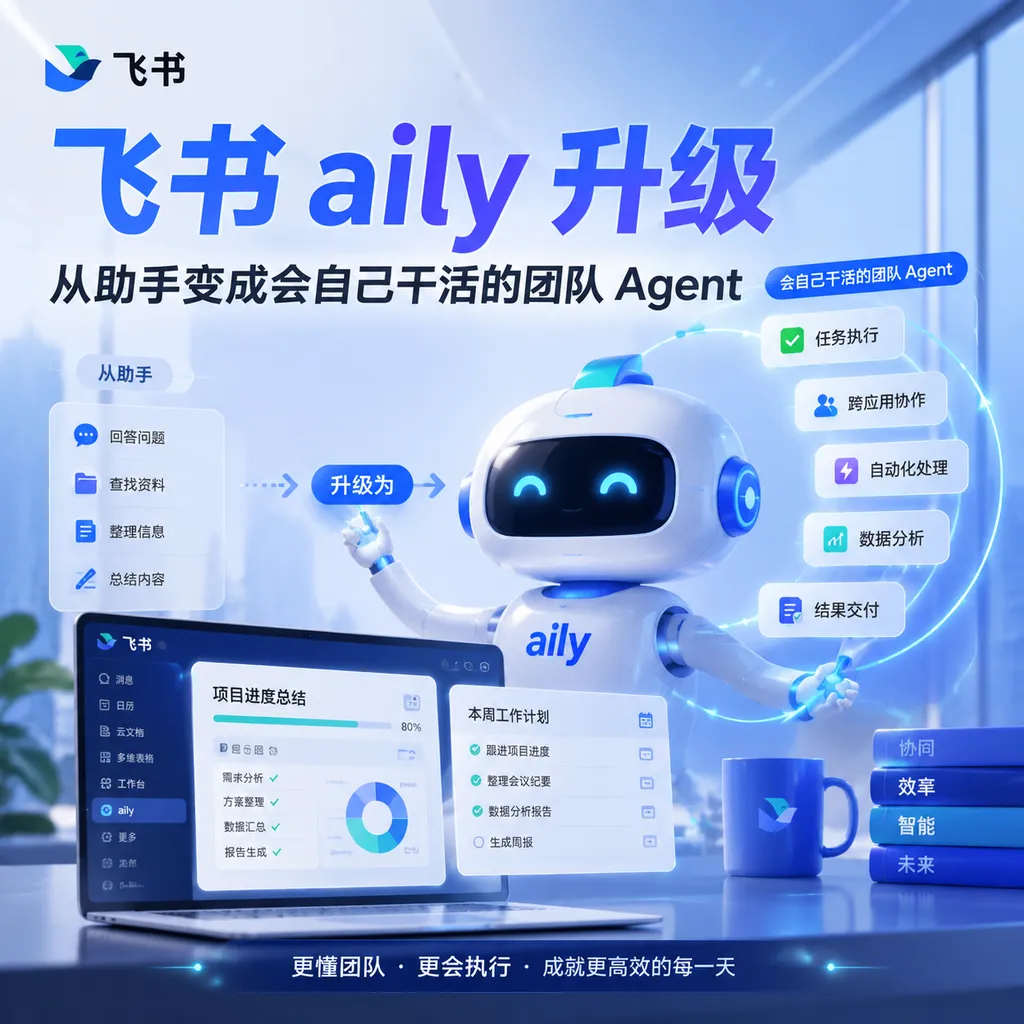
On July 23, Feishu aily completed a fundamental upgrade, evolving from a single assistant to a team-level Agent platform capable of autonomously breaking down tasks across messages, documents, calendars, and multi-dimensional spreadsheets, while supporting collaborative work among multiple intelligent agents.
On July 23, Feishu rolled out another major upgrade to its built-in Agent product aily. This time, it’s not as simple as adding a few templates or refreshing the interface—according to the official announcement, the new aily can now, within a user’s authorization scope, operate across Feishu messages, documents, calendars, meetings, tasks, and databases, proactively follow up on tasks, and collaborate with team members or other intelligent agents.
In short: aily has evolved from a chat bot sitting in your contacts waiting for questions, into something that can break down tasks on its own, find the right context, progress autonomously, and even pull in another Agent when needed. This has been the direction most domestic collaboration platforms have been chasing over the past six months, but Feishu’s latest leap forward is clearly larger.
From “Q&A Assistant” to “Colleague Who Gets Things Done on Their Own”
A quick look at the timeline helps illustrate the weight of this upgrade.
At the March 19 launch event, Feishu simultaneously released upgrades to the aily Agent platform, Feishu Miaoda (its natural language–powered business system builder), AI-enhanced databases, and the official OpenClaw plugin. At that time, aily was positioned as an “intelligent companion”—always available in your contacts to help track work progress and deliver results proactively. CEO Xie Xin’s exact words were: “This year, we want everyone to have their own intelligent work partner.”
At that stage, aily mainly followed a “personal version” logic—understanding your context and helping boost your individual productivity. It could already handle weekly reports, research lookups, and approval follow‑ups quite easily.
The July 23 upgrade shifts focus from “individual” to “team.”
That’s not just a marketing trick: between a personal agent and a team agent stands a tall wall. The former only needs to deal with one person’s context and permissions, while the latter must handle multi‑person collaboration—information flow, access boundaries, task handoffs, and scheduling among multiple agents.
Agentic Loop + Multi‑Agent Architecture: True “Autonomy” This Time
From the official capability description, several keywords stand out:
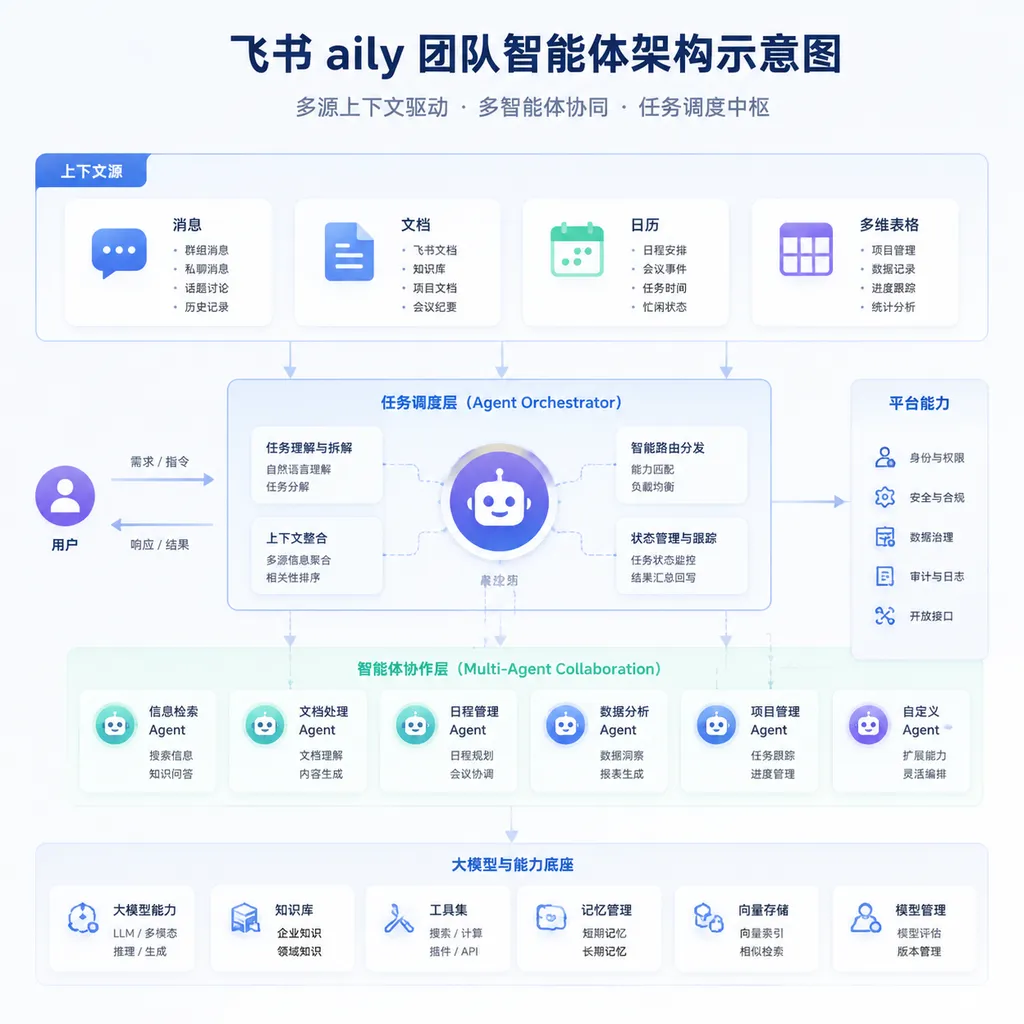
- Agentic Loop + Task Planning + Multi‑Agent Architecture: autonomously decomposes and executes complex, long‑running tasks.
- Out‑of‑the‑box Multi‑Agent Framework: comes with deeply optimized built‑in tools and sub‑agents for high‑frequency office scenarios.
- Virtual Computer Runtime Environment: a cloud sandbox providing browser, terminal, file system, and internet access for multi‑step execution.
- Complete Task Deliverables: outputs reports, executable scripts, spreadsheets, webpages, and more.
For developers familiar with agent engineering, these align closely with today’s mainstream best practices.
One especially notable piece is the “virtual computer runtime”—previous versions of aily were confined to Feishu’s internal APIs. If you needed it to perform non‑standard actions (like scraping data from a third‑party site or running a Python analysis), you had to use MCP or workflow integrations. Now, with a cloud sandbox, those long‑tail needs can be handled directly in code; the Agent is no longer bound by “available tools.”
Single‑session runtime has also increased: previously, aily dialogues were capped at 15 minutes; the new task mode can run for several hours. This signals a philosophical shift—from synchronous dialogue to asynchronous tasks. You no longer have to watch the screen for answers; you can simply issue “Do my weekly competitor research,” and it’ll break down, execute, and iterate in the background—then notify you when done.
Feishu highlights several typical long‑running asynchronous scenarios:
- Asynchronous exploratory tasks: competitor research, strategic analysis, exploratory data analysis (EDA);
- Recurring executions: scheduled document batch processing, market monitoring, weekly/monthly report generation;
- Task notifications: completion updates via messages, email, or to‑dos;
- Environment‑aware triggers (coming soon): automatically launch tasks upon signals like ticket status changes, meeting endings, or spreadsheet updates.
That last environment‑aware trigger is especially interesting—it means the Agent isn’t merely reactive but can act like a real coworker who notices business events and starts working automatically. At the extreme, that heads toward a “persistent employee” concept—but only if permission, audit, and controllability frameworks keep up.
Team Collaboration: Dividing Work Between Agents Is a New Challenge
“Collaborating with team members or other agents” sounds simple, but implementation is tough. Human collaboration relies on explicit communication and implicit organizational understanding; for Agents, both must be formalized and structured.
Feishu’s approach is to capture and persist as much context as possible within the platform:
- Unified enterprise knowledge assets: personal and corporate knowledge spaces connected, agents’ knowledge and outputs stored within departments or organizations;
- Low‑threshold customization and reuse: through command templates and customizable sub‑agents, departmental know‑how can be shared efficiently;
- Run‑to‑learn: every agent run logs execution details into an Agents.md repository—building an enterprise “intelligent agent knowledge archive”;
- Unified workspace with precise governance: a centralized agent console with permission and audit controls.
That Agents.md reference is telling. It borrows from the open‑source community convention on GitHub—describing an agent’s capabilities, boundaries, and experience in a readable, editable Markdown file so both humans and agents can understand. The benefit is transparency and portability; the drawback is needing people inside the company to maintain those docs. But given Feishu’s user base, that bar shouldn’t be too high.
Comparing Against Itself—and Others
Horizontally, Feishu isn’t alone in the enterprise Agent race.
DingTalk’s AI assistant, WeCom’s smart bot, Alibaba’s Wukong, Accio Work, and even pure agent‑platform players like Kouzi are all pushing in this direction. Feishu’s biggest moat remains the same as ever: context density.
If over 80% of a company’s daily collaboration—chats, documents, schedules, approvals, data tables—lives in Feishu, then aily naturally has the richest working context. That’s decisive for an Agent’s performance. You can build a more powerful general platform, but once it leaves an enterprise’s private context, its outputs become “smart‑looking but unaware of what I’m actually doing.”
Vertically, compared with earlier versions, aily’s most substantial upgrades are:
- From synchronous to asynchronous: runtime extended from 15 minutes to several hours; deliverables shift from dialogue outputs to reports, scripts, or web artifacts.
- From personal to team: agents, knowledge, and insights now sharable at department or organizational scope.
- From reactive to proactive: environment‑aware triggers are paving the way; Agents can now initiate action.
There’s another upgrade that developers may quietly appreciate: earlier this year, aily elevated knowledge to a platform‑level resource. Multiple assistants under one tenant can now share it, and multiple knowledge spaces can be called simultaneously. Previously, every change required an app release, and app knowledge remained siloed; that architectural bottleneck is gone—a big win for teams developing in‑house Agents.
Worth Watching—But Don’t Get Carried Away Yet
Objectively, Feishu’s direction and timing look solid—perfecting the personal assistant first, then expanding to team‑level, multi‑agent, long‑task autonomy. From an engineering view, key pieces (sandbox execution, multi‑agent scheduling, run‑log persistence) are all on point.
But enterprise Agent adoption has never ended at the press conference. Real hurdles remain:
- Permission and audit granularity: multi‑agent workflows mean one agent may invoke another; the longer the chain, the tougher traceability becomes. Feishu says aily strictly inherits the user’s permissions—but for cross‑departmental sub‑agent collaboration, implementation details will matter.
- Long‑task reliability: what if a multi‑hour job crashes, yields wrong results, or burns too many tokens? These are real‑world pain points.
- Protocols between agents: how do they coordinate—natural language or structured messages? Natural language introduces errors; structured requires an enterprise‑grade A2A spec. Public info here is still vague.
For developers, the most practical step now: if your team already lives inside Feishu, pick one or two time‑consuming async scenarios (like weekly competitor reports or market monitoring) and try the new aily. If you’re building internal enterprise Agents, examine aily’s MCP marketplace and Agents.md knowledge‑logging approach—they could save a lot of wheel‑reinvention.
The OpenAI Hub team, meanwhile, continues tracking the model‑integration needs of both domestic and global Agent platforms—whether GPT, Claude, Gemini, or DeepSeek—a single API key can access them, with direct China connectivity and OpenAI‑compatible formatting, making model switching and A/B testing much easier.
In short: this isn’t just a feature update—Feishu aily has redefined itself from an “AI assistant” into an “AI employee.”
Whether that employee proves reliable will depend on the real feedback from enterprise users in the coming months.
References
(This article is based primarily on sources from 36Kr News, Feishu’s official site, and Xinhua Net, and contains no external links outside China’s accessible domain list.)