Bailing’s 5.1B Active Parameters Challenge Trillion-Parameter Flagships

Ant Ling has released Ling-3.0-Flash, with 124B total parameters and 5.1B activated parameters, matching its previous-generation 1T flagship. What truly deserves attention is the system-level synergy among hybrid linear attention, sparse MoE, and long-context caching.
Bailing Challenges a Trillion-Parameter Flagship With Just 5.1B Active Parameters
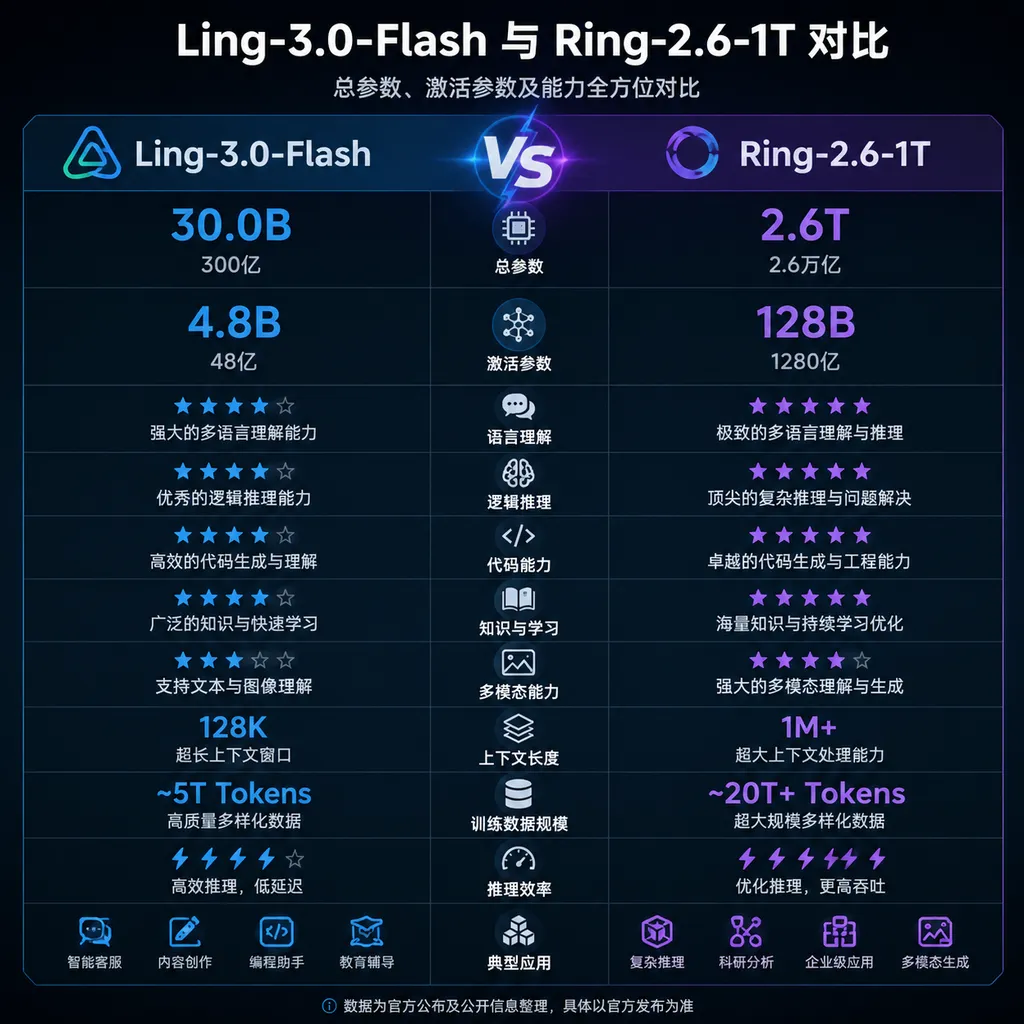
Ant Group’s Bailing large-model team today (July 24) released Ling-3.0-Flash, a new-generation native hybrid-reasoning model. The most striking aspect is not another increase in parameter count, but a clear downsizing: the model has 124B total parameters and activates only 5.1B parameters per token, yet it is positioned directly against the previous-generation 1T-class flagship reasoning model, Ring-2.6-1T.
According to data published by Ant Group, Ling-3.0-Flash has only about 12.4% of the total parameters of the previous flagship and approximately 8.1% of its active parameters. Nevertheless, it matches the earlier model in conventional reasoning, instruction following, long-context processing, and agent tasks, even surpassing it on some metrics.
If these results can be reproduced under real-world production workloads, the significance of Ling-3.0-Flash is not merely that another benchmark-topping model has arrived. Rather, it suggests that model competition is shifting from “who has more parameters” to “how much compute is actually invoked for each inference, and how much useful work it can accomplish.”
124B Is Not Small; 5.1B Is the Key Number
Ling-3.0-Flash uses a sparse MoE architecture with 124B total parameters, but activates only 5.1B parameters per token, for an activation ratio of approximately 4.1%. One way to understand this is to think of the model as a company with many specialized teams: 124B represents the company’s entire workforce, while 5.1B represents the employees actually mobilized to handle a particular task.
In a traditional dense model, most parameters participate in the computation required to generate every token. An MoE model, by contrast, uses a router to direct different tokens to a small number of experts. Coding, solving math problems, and understanding natural language can each be routed to different combinations of experts. This preserves substantial capacity for knowledge and capabilities without requiring the full computational cost of all 124B parameters for every token.
This time, Bailing uses a 1/64 sparse MoE design. However, the actual activation size cannot be estimated simply by dividing 124B by 64, because models typically also include shared layers, attention modules, routers, and experts that may be invoked jointly. The officially stated 5.1B is therefore a more meaningful measure of the model’s actual active parameter count.
This is also the most reasonable interpretation of “Flash” in the Ling-3.0-Flash name: it is not a small model with only 5.1B parameters, but a large model that retains 124B of capacity while using only a small portion of its compute units at each step.
There is, however, an important caveat. Fewer active parameters do not mean that deployment requires storage for only 5.1B parameters. The full 124B weights generally still need to reside in system memory or GPU memory. Counting only the raw weights and excluding the KV cache, runtime buffers, and framework overhead, a 124B model requires approximately 248 GB in BF16, 124 GB in INT8, and nearly 62 GB even when quantized to INT4.
In other words, it is more compute-efficient, but not inherently compact in memory. For cloud inference providers, this offers a highly valuable throughput advantage. For developers planning local deployment on a single machine, however, 124B is still far too large to ignore the hardware requirements.
Linear Attention Handles the Long Haul, While MLA Retrieves the Details
The more noteworthy technical change in Ling-3.0-Flash is its native hybrid linear-attention architecture, adopted from the pretraining stage onward, with KDA and MLA layers alternately stacked at a 5:1 ratio.
As context length increases, the computational and storage costs of standard Transformer self-attention rise rapidly. Linear attention attempts to compress historical information into a continuously updated state, avoiding the need to rescan the entire context whenever a new token is generated. This is well suited to long conversations and agent trajectories, but compression can also lead to lost details: the model may remember the gist while failing to retrieve a specific line of code or tool output from much earlier in the context.
Mechanisms such as MLA are better at preserving and retrieving fine-grained contextual information, but they generally come at a higher cost. Ling-3.0-Flash does not choose one over the other. Instead, it assigns them different roles: most layers use KDA to control long-context costs, while MLA layers are inserted periodically to provide precise information exchange.
Bailing has also added finer-grained diagonal gating to KDA. Gating can be understood as a valve for state updates: it determines which old information should be retained, which should decay, and which new information should be written, without relying on a single coarse-grained rule for everything. This is particularly important across dozens of tool calls, because an agent does not operate on a static long document. It works through a dynamic trajectory that continuously accumulates new observations, execution results, and error feedback.
The fact that this design is “native from pretraining” is also significant. Some previous models added reasoning modes or expanded context windows late in training, or assembled fast and slow modes through external routing, giving them the feel of aftermarket upgrades. Ling-3.0-Flash instead attempts to make hybrid attention and hybrid reasoning foundational to how the model develops its capabilities, rather than adding them as patches just before deployment.
The challenge with this type of architecture is finding the right balance. If the proportion of linear attention is too high, the model may lose information when precise recall is required. If the proportion of conventional attention is too high, it sacrifices long-context efficiency. It is too early to conclude from official benchmarks alone whether 5:1 is the optimal ratio, but the direction is clear: use a small number of expensive layers to preserve the upper bound of model capability, while using many lower-cost layers to reduce average inference cost.
Accelerating Agents Takes More Than a Model Architecture Diagram
Bailing has explicitly positioned Ling-3.0-Flash as a model for production-grade agents, stating that its training covered more than 10,000 interactive environments, with a particular focus on Coding Agents, general-purpose Agents, and Deep Research Agents.
This is fundamentally different from ordinary instruction fine-tuning. A chat model usually completes a single question-and-answer exchange, while an agent must repeatedly:
- Understand the objective and break down the task;
- Select and invoke tools;
- Read the results returned by those tools;
- Determine whether the results are valid;
- Revise its plan and continue execution;
- Deliver a verifiable result after multiple rounds.
Strong single-step performance does not guarantee success on long-horizon tasks. Suppose a model has a 95% chance of getting each step right. After 20 critical steps, the theoretical probability of completing the entire trajectory without error is only about 36%. Real-world agents also encounter changing webpages, API failures, code execution errors, and context contamination, so error accumulation is often more severe than single-turn benchmarks suggest.
The value of 10,000 interactive training environments therefore lies not only in increasing the amount of data, but also in teaching the model a closed loop of “act—observe—correct.” For a Coding Agent, the key is not how much code it can generate in one pass, but whether it can understand a repository, run tests, locate errors, and keep fixing them. For Deep Research, the key is not producing a fluent answer, but planning searches, cross-checking sources, and changing direction when the evidence is insufficient.
Of course, the number of training environments is merely an input metric, not a guarantee of results. Final generalization depends on whether the environments are sufficiently diverse, whether tool feedback is realistic, how task difficulty is distributed, and whether the reward system encourages shortcut-seeking behavior. What developers truly need to evaluate is whether the model can reliably complete dozens of steps inside their own codebases, browsers, and internal systems—not whether it succeeds once in a demonstration video.
A 60%–80% Reduction in TTFT Depends on the Cache System Working in Concert
Another cost of long-horizon agents comes from repeated computation. After every tool call, the model often has to send another request containing the previous system prompt, user objective, execution history, and tool results. If the same prefix is recomputed from scratch on every round, time to first token will continue to rise even if the model generates each individual token quickly.
Ling-3.0-Flash now integrates the SGLang HiCache and Mooncake hierarchical caching architecture, using two physically separate cache pools and a cluster-wide shared L3 cache. According to official claims, time to first token (TTFT) for long-input scenarios can be reduced by 60% to more than 80%.
This design addresses system-level issues outside the model itself:
- Frequently used context states are placed in faster cache tiers;
- Larger cache tiers hold colder data;
- Reusable prefixes or states are shared among cluster nodes;
- When an agent enters the next round, computation resumes from cache wherever possible instead of replaying the entire input history.
This is similar to using incremental builds when compiling a large project: if only one part of the code has changed, there is no need to recompile every unchanged module. For agent services with fixed system prompts, tool definitions, and long histories, the gains from cache hits may be more noticeable than shaving a few percentage points off the model’s own computation.
However, a 60%–80% improvement is not a fixed benefit available to every request. Actual performance depends on prefix reuse rates, cache capacity, request scheduling, inter-node networking, session length, and concurrency patterns. Large numbers of unrelated short requests may gain little from shared caching, while agents with stable system prompts and persistent multi-turn trajectories are much better suited to this architecture.
Matching a 1T Flagship Still Requires Validation Under Real Workloads
According to Ant Group’s published comparison, Ling-3.0-Flash can match or even surpass Ring-2.6-1T with roughly one-eighth of its total parameter count and around one-twelfth of its active parameter count. This result suggests that small-active-parameter MoE models combined with hybrid attention are rapidly approaching the capability frontier of the previous generation of ultra-large models.
However, “matching 1T” should not be interpreted as complete equivalence across every dimension. Benchmarks can readily cover mathematics, coding, knowledge-based question answering, and instruction following, but they may not fully reflect the following issues:
- Actual output tokens per second under high concurrency;
- Additional latency caused by cross-device communication among MoE experts;
- Detailed recall and state drift in extremely long sessions;
- Recovery from failed tool calls;
- Capability degradation at different quantization precisions;
- Hallucination rates and result verifiability in real-world applications.
For MoE models in particular, low theoretical FLOPs are only the first step. If experts are unevenly distributed, routing creates hotspots, or cross-device All-to-All communication is inefficient, hardware utilization may still be poor. Final inference pricing and latency must be evaluated together with the serving framework, parallelization strategy, batch size, and cache hit rate.
Ling-3.0-Flash’s most credible selling point, therefore, is not the slogan that “124B comprehensively beats 1T.” Rather, it is that the model architecture, agent training, and inference caching were all designed around the same efficiency objective. This comes closer to what production environments need than merely reducing parameter count or applying distillation.
Free Through August 3, With Open Weights to Follow
Ling-3.0-Flash is now available for limited-time free API access through Bailing’s official platform and OpenRouter. The free period ends at 11:00 p.m. Beijing Time on August 3, 2026. Ant Group plans to officially release the model weights after the free period ends.
For developers, this free-access window is better suited to targeted stress testing than merely asking a few math questions. Recommended areas to evaluate include:
- The success rate of running the same agent task continuously for 20 to 50 steps;
- Precise recall of early tool results within long contexts;
- Differences in latency and token consumption between reasoning and non-reasoning scenarios;
- The ability to complete a closed loop of running tests and fixing errors in coding tasks;
- Whether TTFT drops noticeably with cache hits during multi-turn calls that share a fixed long prefix;
- Stability on complex Chinese instructions, structured outputs, and function calls.
If integrating through an OpenAI-compatible aggregation platform, developers should first confirm whether the platform has listed the model, mapped its model name, and adapted its parameters for reasoning mode. Aggregation services, including OpenAI Hub, can reduce the engineering effort required to switch models. However, when a new model is first released, availability by region, context limits, and pricing may not be synchronized across platforms, so its model ID should not be inferred from promotional names alone.
Once the weights are released, Ling-3.0-Flash will enter a more meaningful phase of evaluation. The community will then be able to examine quantization quality, the requirements for single-machine and multi-machine deployment, compatibility with inference frameworks such as SGLang, and whether the official results can be reproduced in independent environments. The specific license will also need scrutiny: open weights do not automatically mean unrestricted commercial use, nor do they eliminate the deployment costs of a 124B model.
Bailing Is Betting on “Intelligence Density”
Over the past two years, competition among flagship models has largely been an arms race in parameter counts, training compute, and context length. Ling-3.0-Flash represents another path that is becoming increasingly important: instead of activating the model’s full capabilities for every request, it uses sparse routing, hybrid attention, interactive-environment training, and hierarchical caching to accomplish more useful work with limited compute.
This approach is particularly well suited to agents. Agents are not one-shot question-answering systems; their costs accumulate with trajectory length, the number of tool calls, and context size. A model that is slightly better on a single response but expensive and slow at every step may offer less production value than a model with similar capabilities that can reliably execute dozens of rounds.
The answer offered by Ling-3.0-Flash is compelling: 124B parameters provide capacity, 5.1B active parameters control per-step computation, hybrid attention handles long contexts, and the caching system reduces repeated computation. But whether it truly delivers “1T capability at Flash cost” will remain uncertain until the weights are released and independent evaluations and real-world agent workloads provide the evidence.
At the very least, the direction is right. The next stage of efficiency competition among large models will not be judged solely by parameter count or per-token pricing. It will be judged by how much time and compute are required to complete a verifiable task—and how often a human must take over.
References
- ITHome: Ant Group Releases Bailing’s Native Hybrid-Reasoning Model Ling-3.0-Flash — Release details, model architecture, parameter scale, caching solution, and the schedule for free access and open-sourcing.