Opus 5 Released: Flagship Models Start Competing on Cost

On July 23, Anthropic released Claude Opus 5, emphasizing complex coding capabilities and targeting production deployments with lower costs and fewer restrictions than Fable 5. It may not be the most capable Claude model, but it could be the flagship developers are more likely to deploy in practice.
Anthropic Brings Its Flagship Model Back to Production
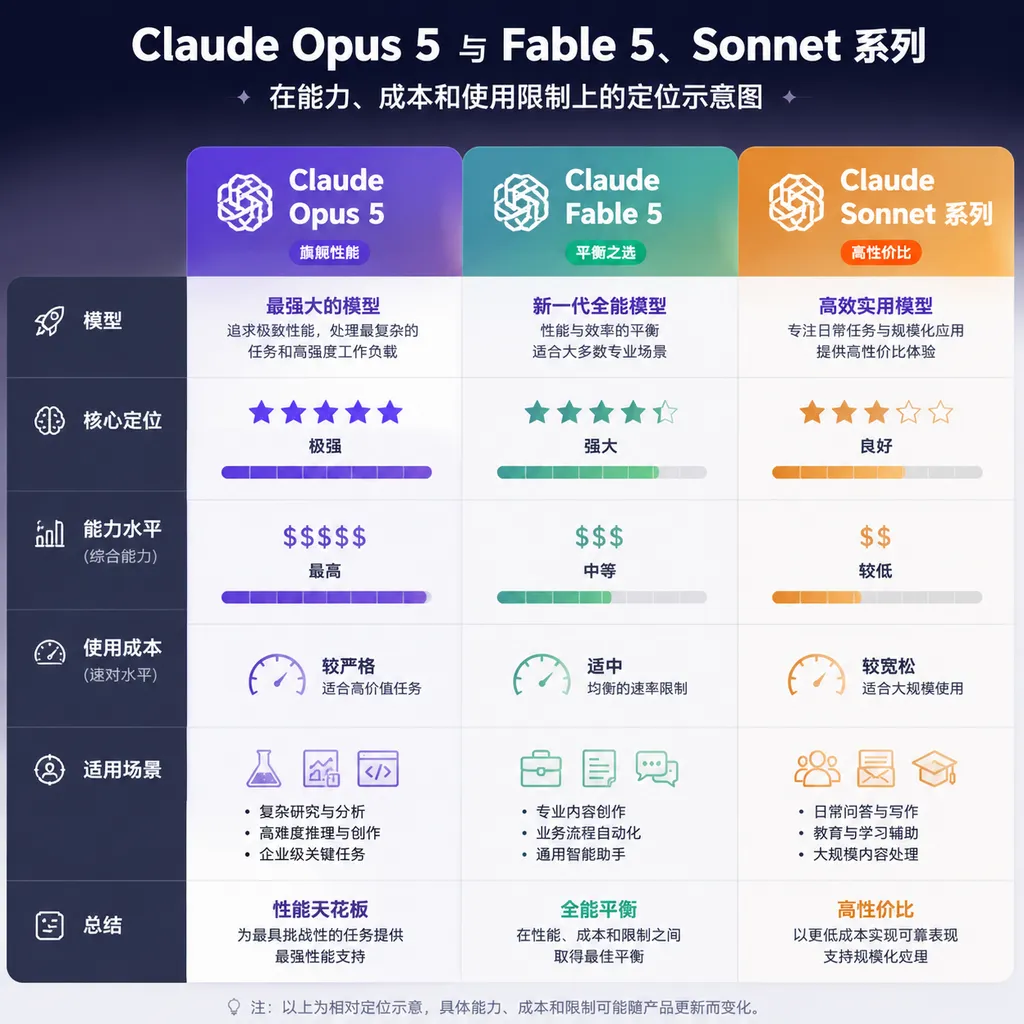
Anthropic released Claude Opus 5 on July 23 local time. According to the company’s positioning, this new flagship is already “close” to Claude Fable 5 in multiple areas, with significant improvements in complex coding capabilities. At the same time, it is cheaper than Fable 5 and subject to fewer usage restrictions.
Taken together, these claims matter more than any individual benchmark result.
Opus 5 is not Anthropic’s most capable or aggressive frontier model. Fable 5 still holds that position. But for the vast majority of development teams, whether a model can enter production has never depended solely on “how many questions it can answer correctly at best.” What matters is whether capability, price, latency, stability, and safety restrictions can all clear the required threshold at the same time.
From this perspective, Opus 5 looks more like the flagship Anthropic genuinely intends to sell at scale: it may not push the laboratory frontier as far as possible, but it aims to be a model developers can call continuously rather than use only occasionally for demos and high-risk tasks.
Close to Fable 5, but Not a Drop-in Replacement
Anthropic says Opus 5 is close to Fable 5 in “many areas,” with particular emphasis on complex coding tasks. However, as of July 24, public reports have not provided a fully reproducible set of benchmark results, nor have they disclosed all API pricing, context-window, maximum-output-length, and latency data.
The word “close” should therefore be interpreted cautiously.
It may mean that the gap between Opus 5 and Fable 5 in routine reasoning, code generation, question answering, and agent tasks has narrowed to the point where most users will struggle to notice it, while Fable 5 retains an advantage in advanced cybersecurity, extremely long reasoning chains, or other edge-case tasks. It could also mean only that the two models achieve similar average scores on several public tests, not that they have the same capability ceiling.
Fable 5 is a higher-capability public model in the Mythos tier. It was previously taken offline for several weeks alongside Mythos 5 amid safety and government-regulation controversies, then returned with stronger cybersecurity safeguards. In other words, it plays not only a product role but also bears the policy risks associated with making frontier capabilities publicly available.
Opus 5 takes a more pragmatic approach: placing some near-frontier capabilities into a product tier with fewer restrictions and more manageable costs. For developers, that is more valuable than “building another stronger but harder-to-use Fable.”
Fewer restrictions, however, does not mean no restrictions. This likely refers to lower refusal rates for ordinary development, code analysis, and tool use, as well as a broader range of supported use cases—not to Anthropic abandoning its safety policies. Requests involving vulnerability exploitation, malicious code, credential theft, and automated attacks are still expected to be tightly controlled in Opus 5.
Complex Coding Is the Upgrade That Matters Most
Anthropic’s clearest capability claim for Opus 5 is that it is better at complex coding tasks.
This should not be interpreted as “faster function completion.” Today’s flagship models differ little in simple code generation. The real difference in user experience comes from engineering tasks that span multiple files and tools and run for extended periods, such as:
- Reading a repository with hundreds of thousands of lines of code to locate race conditions or memory leaks;
- Modifying multiple modules in response to an issue while updating tests, type definitions, and documentation;
- Continuously invoking tools across terminals, editors, browsers, and CI logs;
- Detecting new problems introduced by the first change, proactively rolling it back, and switching approaches;
- Completing refactoring, migrations, and dependency upgrades with less human intervention.
A conventional coding model is more like a pair programmer who writes code quickly: you give it a localized task, and it returns a localized answer. A complex coding agent is more like an engineer who can take ownership of a ticket. It must understand the repository, formulate a plan, execute commands, inspect the results, and continue correcting its work after failures.
The latter places much greater demands on the model. Even a difference of only a few percentage points in single-step accuracy can, after dozens of tool calls, become the difference between “completing the task” and “breaking the repository.”
Opus 5’s coding capabilities therefore cannot be evaluated solely with short coding tests such as HumanEval. A more meaningful validation method is to have it process complete issues in real repositories and record:
- Whether the first generated patch passes the tests;
- Whether it can recover after tool-call failures;
- Whether it modifies unrelated files;
- Whether it forgets the original constraints during long-running tasks;
- The total token cost per successful task;
- How much content humans ultimately need to review and rework.
If Opus 5 merely posts higher benchmark scores, its value is limited. If it can substantially reduce mid-task failure rates during long-running agent workflows, that would be a meaningful upgrade.
“Cheaper” Should Be Measured by Cost per Successful Task, Not Price per Token
Cost is another key selling point of this release. Public information indicates that Opus 5 is cheaper than Fable 5, but it is not yet possible to determine whether it is also cheaper across the board than the previous generation of Opus, or how much less it costs for input, output, caching, and batch processing respectively.
Developers also need to avoid a common misconception: comparing only the price per million tokens.
That comparison is generally valid for simple summarization and classification tasks. For coding agents, data analysis, and multi-tool workflows, what should actually be calculated is the “cost per successful task.” A rough formula would be:
Cost per successful task = Cost per call × Average number of calls ÷ Task success rate
Suppose a cheaper model requires 30 calls per task and often fails on the 25th, while another model costs twice as much per call but can reliably finish in 12 calls. The latter is actually less expensive. Tokens consumed by failed tasks, sandbox runtime, and engineering review time are all costs as well.
This is precisely where Opus 5 has an opportunity. It does not need to be cheaper than the Sonnet series. It only needs to offset the price difference through a higher success rate on high-value, long-horizon tasks to become a rational choice.
Our assessment is that there is still no need to use Opus by default for simple customer service, content processing, or bulk extraction. Opus 5 is better suited to large-codebase maintenance, complex research, mission-critical business agents, and high-quality code reviews.
Anthropic Is Redefining Its Product Tiers
The release of Opus 5 also reveals a shift in Anthropic’s product strategy.
In the past, model providers tended to define their “flagship” as the most capable publicly available model. But as frontier models begin to reach more sensitive cybersecurity and automation capabilities, the model with the highest capability ceiling may no longer be the same model that serves as the company’s primary commercial offering.
Anthropic is now establishing a clearer tier structure:
- Fable / Mythos tier: Explores the capability frontier while facing greater safety and regulatory pressure;
- Opus tier: Targets high-value production tasks, balancing capability, cost, and usability;
- Sonnet tier: Handles greater call volumes for day-to-day development and general-purpose agents;
- Lighter-weight models: Handle routing, classification, extraction, and low-latency tasks.
This closely resembles the cloud computing market. Providers can keep releasing larger instances, but the configurations that generate steady revenue are often not the ones with the most extreme specifications. Instead, they are the ones enterprises can run over the long term and finance departments are willing to pay for.
The most notable aspect of Opus 5, therefore, is not that it “falls just short of Fable,” but that Anthropic is beginning to deliberately separate its strongest model from its most commercially viable one.
What Developers Should Validate Now
Until Anthropic provides a more complete model card and API information, production models should not be replaced solely on the basis of launch claims. At a minimum, the following data is still needed:
- Exact pricing for input, output, and prompt caching;
- Context-window size and maximum output length;
- Time to first token, sustained output speed, and concurrency limits;
- Reliability of Tool Use and structured outputs;
- Context retention across multi-turn tasks;
- Cost for the same tasks compared with the previous-generation Opus, Sonnet 5, and Fable 5;
- The specific request types covered by “fewer restrictions”;
- Data retention, regional availability, and enterprise compliance terms.
Teams planning to integrate Opus 5 into coding agents should, in particular, build a test set from their own historical issues rather than simply reusing vendor benchmarks. Internal frameworks, outdated dependencies, and implicit conventions in real codebases are where models are most likely to fail.
Calling It Through an OpenAI-Compatible API
Claude Opus 5 is a newly released closed-source model. Once the corresponding model route becomes available on OpenAI Hub, it can be called using the OpenAI-compatible format. The exact model ID and Base URL should match what is shown in the console on the day of use; do not hard-code the default name from this example into production.
import os
from openai import OpenAI

client = OpenAI(
    api_key=os.environ["OPENAI_HUB_API_KEY"],
    base_url=os.environ["OPENAI_HUB_BASE_URL"]
)

response = client.chat.completions.create(
    model=os.getenv("CLAUDE_MODEL", "claude-opus-5"),
    messages=[
        {
            "role": "system",
            "content": "You are a senior code review engineer. Identify the risks first, then propose the smallest possible changes."
        },
        {
            "role": "user",
            "content": "Analyze the potential race conditions in this concurrent task-scheduling code and propose a testing strategy."
        }
    ],
    temperature=0.2
)

print(response.choices[0].message.content)
For complex coding tasks, it is advisable to save the model version, prompts, tool-call traces, and final test results together. Otherwise, after updates to model routing or server-side versions, it will be difficult to determine what caused any change in the success rate.
Opus 5 May Not Be the Strongest, but It May Be the Right Flagship
Over the past year, competition among flagship models has often been reduced to a leaderboard: whoever has the highest reasoning score is temporarily in the lead. But in the agent era, developers are not buying a single answer. They are buying a continuously executable workflow.
The positioning of Opus 5 reflects this shift. Rather than trying to replace Fable 5 in its marketing, Anthropic emphasizes that Opus 5 approaches its capabilities, improves complex coding, and lowers both costs and barriers to use. This is a combination clearly oriented toward commercial deployment.
If subsequent data shows that Opus 5 can reliably complete most real-world engineering tasks at a substantially lower cost than Fable 5, it will have more market significance than being “the strongest Claude.” Conversely, if its supposedly stronger coding performance appears only in short benchmark tests while tool use, error recovery, and context retention in long-running tasks remain unimproved, it will still amount to little more than a routine generational update.
It is still too early to draw conclusions, but the direction is already clear: the frontier-model race is shifting from “who can build the strongest model” to “who can put near-frontier capabilities into developers’ hands at a lower cost.” Opus 5 is Anthropic’s latest answer to that question.
References
- Reddit: Search for Claude Opus 5 discussions — Used to track hands-on feedback and rollout status within the developer community. Community content should not be treated as official conclusions, and key parameters still require cross-verification.
Note: Due to restrictions on the permitted domains for reference links, this article does not include links to original media reports hosted on domains outside the allowlist.