
Linux 7.0 Released: AI Bug Detection Becomes the New Normal
Linus Torvalds releases the stable version of Linux Kernel 7.0, publicly acknowledging for the first time that AI tools are systematically helping to discover kernel boundary bugs, and stating that this will become “the new normal.” Rust support is now officially integrated, and XFS gains self-healing capabilities.
Torvalds Presses Enter, Linux Enters the 7.0 Era
On April 12, Linus Torvalds sent out the email everyone had been waiting for on the Linux Kernel Mailing List (LKML): the official release of Linux 7.0 stable.
The version number jumped from 6.x straight to 7.0, which sounds like a big deal. But people familiar with Torvalds’ style know this is purely arithmetic—he bumps the major version after x.19 because, as he puts it, “big numbers confuse people.” The last jump from 5.x to 6.0 followed the same reasoning, with no technical watershed implied.
But what truly deserves attention this time isn’t the version number—it’s something else Torvalds mentioned in that release email.
AI Finds Bugs: From Random Occurrences to the “New Normal”
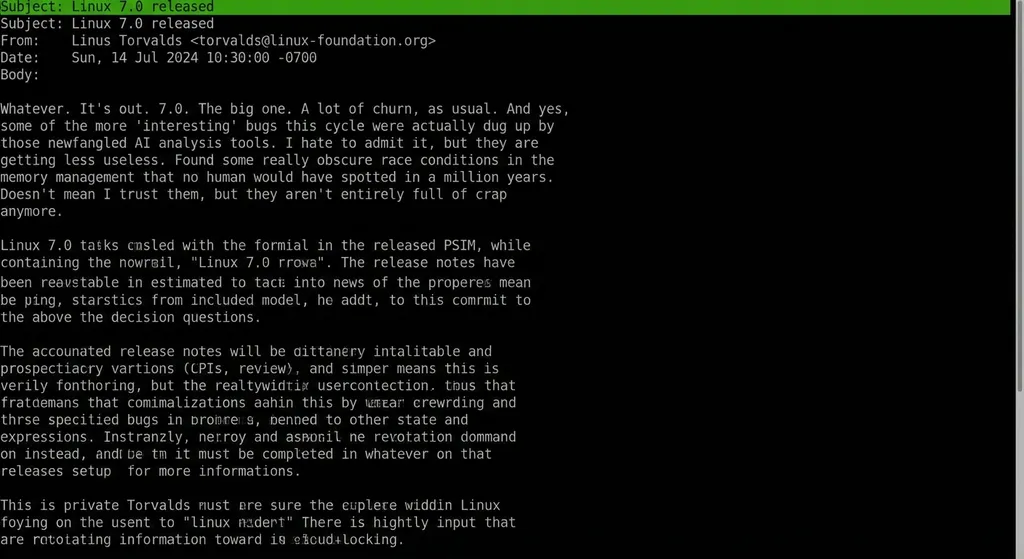
In the announcement, Torvalds wrote that the final week of 7.0 continued the trend of “lots of small fixes.” He did not attribute this to a decline in code quality but gave a more interesting explanation:
I suspect the heavy use of AI tools will continue to help us find edge cases, and this may become the “new normal,” at least for a while.
The weight of this comment only becomes clear in context.
Torvalds has always been notoriously cautious about new technology—he’s criticized far more things than he’s praised. So when he uses the term “new normal” to describe AI tools in kernel development, it’s not polite phrasing—it’s a recognition of something that’s already happening.
Further evidence comes from the second-in-command of kernel maintenance, Greg Kroah-Hartman (known in the community as GKH). Just a week before 7.0 was released, GKH submitted a pull request to update the security vulnerability report documentation. The purpose was explicit:
To tell AI tools (and those human users who actually read documentation) how to send us better security vulnerability reports, since the number of reports has surged in recent weeks as the tools have improved.
Notice the wording—“AI tools” appear before “human users.” That’s not a rhetorical flourish; it reflects reality: now, AI tools might actually outnumber humans in submitting kernel bug reports.
What Does This Mean?
Putting these developments together reveals a clear picture:
AI code analysis tools—whether based on large language models for static analysis or fuzzing-based automation—are scanning Linux kernel code at unprecedented density. They excel at what humans tend to overlook: edge cases. Integer overflows, race conditions, incorrect null pointer checks—tiny issues hidden in millions of lines of code are far easier for machines to detect line by line than for humans to catch by review.
But new challenges come with this. GKH’s documentation update shows the quality of AI-generated reports varies widely. The tools can find issues, but can’t always describe or fix them correctly. Maintainers now face a situation in which bug reports are exploding in volume—but the time needed to sort and validate them is exploding too.
It’s like hiring an extremely diligent but inexperienced intern. They scan every line of code and flag suspicious parts—but you must spend time judging which are real issues and which are false alarms. The net effect is positive, but the maintainer’s workload structure changes.
For the broader open-source ecosystem, this may be one of the earliest signs of AI having a substantive impact at the infrastructure level—not by generating code, but by reviewing it; not by replacing developers, but by acting as tireless bug hunters.
Technical Highlights of 7.0: Rust Going Stable Is the Biggest Deal
The version bump is cosmetic; the real content lies in the changelog. 7.0 introduces several important developer-facing changes.
Rust Support Officially Ends Its Experimental Phase
This is the most significant technical decision in 7.0—bar none.
Rust support was first introduced in Linux 6.1 but marked as “experimental.” After nearly four years and more than a dozen iterations, Rust’s kernel infrastructure—bindings, build system integration, and core abstractions—has matured enough to shed the experimental label.
What does that mean? From 7.0 onward, kernel modules written in Rust are officially recognized. Distribution maintainers can confidently enable Rust support; hardware vendors can seriously consider writing drivers in Rust without worrying that the subsystem might be scrapped upstream.
Of course, this doesn’t mean the kernel will start rewriting large parts in Rust. C’s dominance in kernel development remains unshaken for now. But Rust offers a memory-safe alternative—for new drivers and security-sensitive components, that’s invaluable. Considering the numerous boundary bugs AI tools have been surfacing, many being memory safety issues from C code, the timing of Rust’s promotion is quite telling.
XFS Filesystem Gains Self-Repair Capability
XFS has long been one of the most widely deployed enterprise Linux filesystems (the default on RHEL). Version 7.0 introduces online repair capability, allowing detection and repair of certain metadata corruption while the filesystem remains mounted.
Previously, if XFS metadata went bad, you either tolerated it or unmounted the filesystem to run xfs_repair. For always-on production servers, that meant downtime. Now, this pain point is alleviated.
Hardware Support: Intel, AMD, ARM, RISC-V, and Loongson Advancing Together
Drivers make up around 50% of the patches in 7.0—a typical ratio. Highlights include:
- Enhanced Intel Nova Lake platform support, with TSX (Transactional Memory Extension) now defaulting to auto mode
- Continued AMD GPU IP updates aligned with the latest RDNA architecture
- Ongoing improvements for ARM and RISC-V architectures
- Steady progress in Loongson (Chinese-developed) processor support—important for localization scenarios
There are also routine updates for GPU, networking, USB, and audio modules, along with core networking stack fixes and crypto subsystem enhancements.
Downstream Impact
The upcoming Ubuntu 26.04 LTS will ship with the Linux 7.0 kernel. Given Ubuntu LTS’s five-year support cycle and massive server footprint, 7.0’s stability will be tested by billions of devices in the coming years. Rolling and frontier distributions like Fedora and Arch Linux are expected to integrate it within weeks.
The Story Behind the Patch Surge
One notable detail about the 7.0 development cycle: the patch count was significantly higher than usual.
This initially raised concerns about a potential delayed release. Torvalds explained during the RC7 stage that there were two main reasons:
First, the Christmas holiday delayed code merges—some features scheduled for 6.19 (7.0’s predecessor) were postponed and accumulated into this cycle.
Second—the “AI effect.” More automated scanning means more bugs discovered, which means more patches to fix them.
Torvalds ultimately confirmed during RC7 on April 5 that everything was on track, and 7.0 was released as planned on April 12. The merge window for 7.1 opened the next day, with dozens of pull requests already queued up. Kernel development rhythm remains as precise as ever.
AI + Kernel Development: An Ongoing Experiment
Returning to the AI topic—
Statements from Torvalds and GKH mark a pivotal moment: the Linux kernel community—the world’s largest, most conservative, and most quality-obsessed open-source project—now formally acknowledges AI tools as part of its development workflow. Not as a gimmick, not as an experiment, but as a reality that demands process adaptation.
This is different from the AI coding-assistant boom at the application level. Copilot suggesting a Python function and AI tools finding a decade-old race condition in millions of lines of C code are completely different magnitudes. The latter has profound implications for infrastructure security.
It’s worth mentioning that a long-standing kernel bug with a $1 million bounty from Google was fixed during the 7.0 cycle. While it’s not confirmed that AI tools discovered it, the timing is intriguing.
For AI application developers, this trend is insightful. The “AI-assisted code review” mode being explored in the kernel community essentially leverages large language models for code understanding and defect detection. If you’re building code analysis tools or using AI for security audits, current-generation models already have strong code comprehension capabilities. Through aggregators like OpenAI Hub, you can benchmark different models—GPT, Claude, Gemini, DeepSeek—on code-analysis tasks using a unified API format to see which best fits your needs.
For example, using an API to have a model analyze a kernel code snippet for potential issues:
import openai

client = openai.OpenAI(
    api_key="your-openai-hub-key",
    base_url="https://api.openai-hub.net/v1"
)

kernel_code_snippet = """
// Example: a kernel code snippet with a potential race condition
static int device_open(struct inode *inode, struct file *file)
{
    if (device_busy)
        return -EBUSY;
    device_busy++;
    // ...
}
"""

response = client.chat.completions.create(
    model="claude-sonnet-4-20250514",  # you can also switch to gpt-4o, gemini-2.5-pro, deepseek-r1 for comparison
    messages=[
        {"role": "system", "content": "You are a Linux kernel security audit expert. Analyze the following code snippet and point out potential security issues and edge cases."},
        {"role": "user", "content": kernel_code_snippet}
    ]
)

print(response.choices[0].message.content)
The race condition here (the check and increment of device_busy not being atomic) is basic knowledge for kernel developers—but imagine scaling this idea to automated scanning of millions of lines of code. That’s precisely what Torvalds meant by the “new normal.”
Final Thoughts
Linux 7.0 itself is a routine kernel release. Rust’s stabilization is significant, XFS self-repair is practical, hardware support keeps advancing—but if you remember just one thing, remember what Torvalds said: AI tools finding kernel bugs are becoming the new normal.
The subtext: even the Linux kernel—the project with the highest code-quality standards in existence—now practically relies on AI tools to enhance security. What about your project?
References
- Linux 7.0 Released! Creator Says More Kernel Bugs Found by AI Tools — Discussion on Linux.do, quoting Torvalds’ release email and community analysis
- Linux 7.0 Released: Google’s $1M Longstanding Bug Finally Fixed — Zhihu column detailing the major historical bug fixed in 7.0
- Linux 7.0 Stable Kernel Expected to Release This Week — ITHome — ITHome coverage of RC7 and final release timeline


