AutoDev Studio Goes Open Source, Cutting Repository Repair Costs by 75%
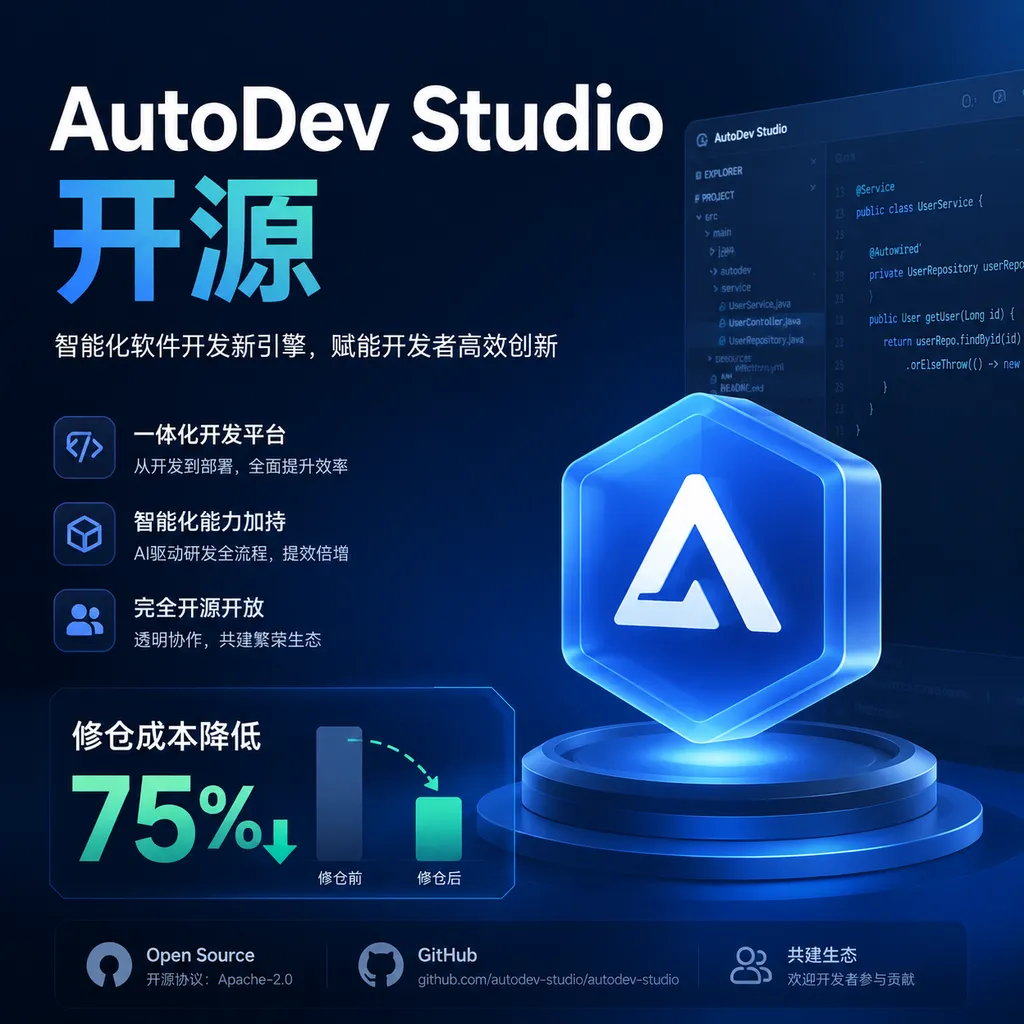
AutoDev Studio was recently open-sourced. It uses static analysis and local vector indexing to build a persistent knowledge base for codebases. According to its own tests, it can reduce costs by 7% to 75% compared with a cold-start Claude Code across six clearly scoped tasks, though the gains depend heavily on the task type and how often the knowledge base is reused.
AutoDev Studio Goes Open Source, Cutting Repository Repair Costs by Up to 75%
AutoDev Studio recently open-sourced a multi-agent harness covering the entire software development lifecycle. According to benchmark results published by the project’s author, it reduced costs by 7% to 75% across six code repair tasks compared with a cold-start run of claude -p. In the task with the largest gap, Claude Code cost $6.83 and took 207 interaction rounds, while AutoDev Studio completed the same fix for approximately $1.70.
The figure is striking, but the scope of the comparison needs to be clarified first: AutoDev Studio has not demonstrated that it comprehensively outperforms Claude Code. What it beat was a “cold-start run” that enters an unfamiliar repository and searches for context from scratch each time, and the benchmark covered only six tasks with relatively well-defined locations. More precisely, it is not trying to solve whether a model can write code, but how much repeated “navigation cost” the model must pay to understand the same repository before it can begin working.
As of July 24, these results still come primarily from benchmarks published by the project’s author and have not yet been independently evaluated by a third party. Therefore, “up to 75% lower costs” should be viewed as a noteworthy engineering signal, not as evidence that every repository and every task can cut costs by three-quarters.
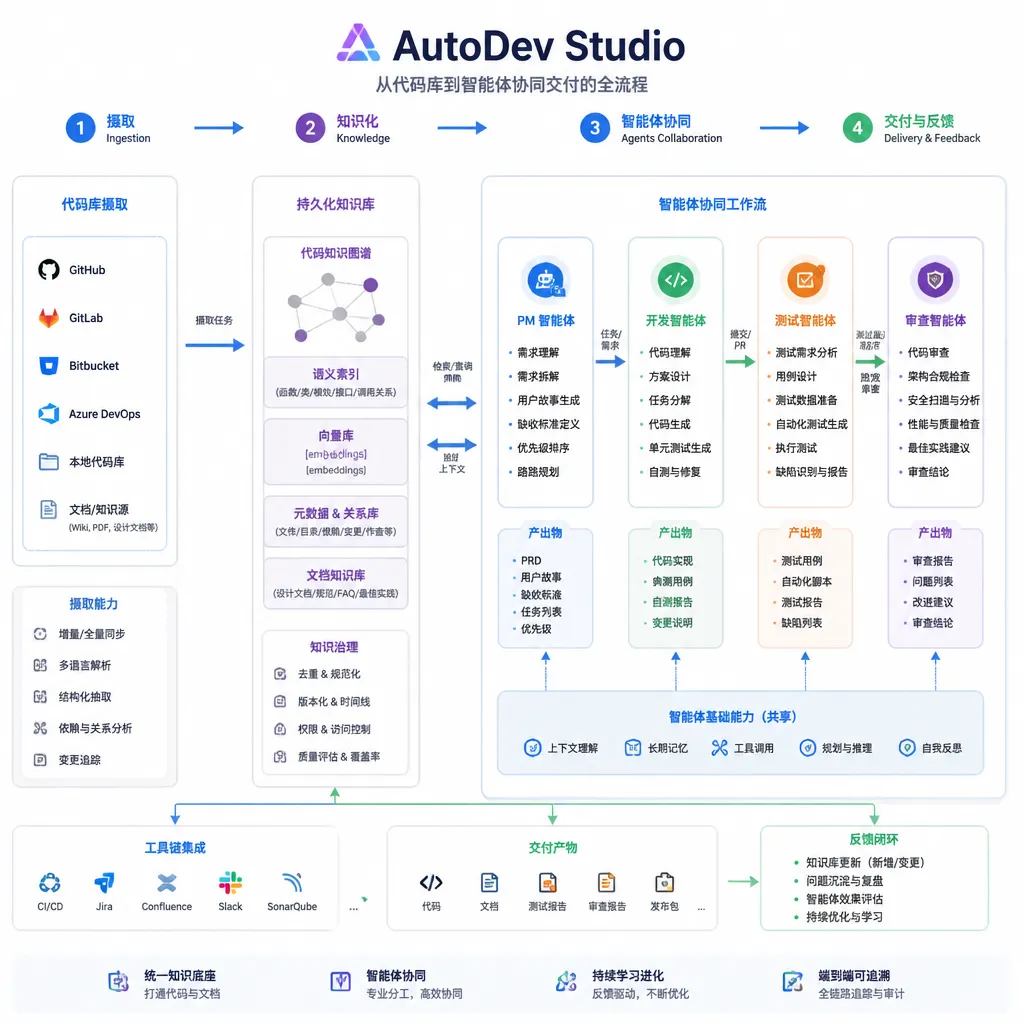
What It Eliminates Is the Cost of Repeatedly Understanding the Repository
Most coding agents today follow a similar process when handling a new task: read the directory tree, search for keywords, open entry-point files, trace the call chain, and then inspect tests, configuration, and related types. The larger the codebase, the more expensive this process of “first finding where to make the change” becomes.
Larger model context windows have not completely solved the problem. Putting an entire repository into the context is usually neither practical nor economical. Even when it fits, large amounts of irrelevant code can dilute the model’s attention. Agents therefore need to repeatedly invoke search, file-reading, and terminal tools, gradually piecing together a local map through multiple rounds of exploration.
The problem is that when the team next asks the agent to modify the same repository, this map is usually not fully retained. The agent starts again from the directory tree and follows a similar path all over again.
AutoDev Studio takes a different approach: when first connected to a codebase, it uses static analysis and a local embedding index to build a persistent knowledge base that can be reused for subsequent tasks. Its basic approach can be summarized as follows:
Traditional cold start:
Task -> Browse directories -> Search symbols -> Read files -> Trace dependencies -> Locate modification point -> Code

AutoDev Studio:
Initial onboarding -> Static analysis + local embedding index -> Persistent knowledge base
Subsequent tasks -> Query knowledge base -> Identify candidate modules -> Verify context -> Code
This is similar to assigning an engineer to maintain a service over the long term instead of hiring a temporary contractor for every ticket. Both may use the same model, but the former knows where the authentication logic lives, how the tests are organized, and which modules have implicit dependencies, while the latter must first learn the terrain.
The project’s author summarizes the difference as turning localization from a new search into a query.
Multiple Agents Are Not the Point; Separation of Responsibilities Is
AutoDev Studio divides the development process among several roles:
- PM Agent: asks users follow-up questions about requirements, organizes constraints, and generates tickets;
- Dev Agent: modifies code in an isolated branch;
- QA Agent: runs tests and checks whether the changes meet expectations;
- Reviewer Agent: reviews code diffs and uses a different model family from the code author;
- Revision stage: enters a bounded modification loop when the review fails;
- Git stage: ultimately applies the result to a real Git workflow instead of merely outputting a patch as text.
On the surface, this is a familiar “virtual software team” design. What is genuinely valuable, however, is not the number of agents but several engineering constraints.
First, development and review are separated. Asking the same model to write code and then “check its own work” can easily produce a confirmatory review: the model carries forward the assumptions it made while generating the code and repeatedly overlooks the same issues. AutoDev Studio goes a step further by requiring the author and reviewer to come from different model families, with the aim of reducing correlated bias.
This does not mean a different model is guaranteed to find the flaws, but it is generally more credible than self-congratulation within the same context. One model may excel at rapid implementation, while another may be more sensitive to edge cases, type constraints, or missing tests. Heterogeneous models are not used here because “more models means more sophistication,” but to prevent their failure modes from overlapping completely.
Second, changes are made in an isolated branch. Once coding agents enter real production workflows, the greatest danger is not that they write one incorrect line of code, but that their tool permissions are too broad, the scope of their changes gets out of control, and failures become difficult to roll back. Branch isolation at least provides a clear boundary: the agent can operate on the repository, but its changes can still be inspected through diffs, tests, and the merge process.
Third, the revision loop has a limit. Many agent demos show only successful outcomes without discussing what happens when they fail. “Keep fixing until the tests pass” without a budget limit opens the door to erroneous loops: the model may continue consuming tokens while cycling among failing tests, incorrect interpretations, and repeated rewrites. Limiting the number of rounds may be less glamorous, but it is closer to a deployable software system.
Where the 75% Comes From—and What It Does Not Prove
The benchmark disclosed by the author contains six clearly localized tasks involving repositories of up to approximately 82,000 lines of code. AutoDev Studio was cheaper than a cold-start claude -p run on all six tasks, with savings ranging from 7% to 75%. The largest gap was:
| Approach | Cost per Task | Interactions | | --- | ---: | --- | | Cold-start Claude Code | $6.83 | 207 rounds | | AutoDev Studio | Approximately $1.70 | Comparable round count not disclosed | | Nominal savings | Approximately 75% | Primarily from reducing repeated localization |
The calculation is straightforward: (6.83 - 1.70) / 6.83 ≈ 75.1%.
However, this result has at least four limitations.
1. “Clearly Localized” Is Itself a Favorable Condition
If a bug can already be traced to a particular module, a persistent knowledge base can quickly narrow the search scope. Difficult real-world tasks, however, may involve cross-service performance regressions, intermittent concurrency errors, or incorrect requirements. The main cost of these tasks is not finding files, but forming hypotheses, collecting runtime evidence, and ruling out incorrect directions.
Static analysis can tell an agent “who calls whom,” but not necessarily why a race condition occurs only under high load.
2. Knowledge Base Construction Costs Must Be Amortized
“Learning the repository once” is not free. Static analysis consumes compute resources, the embedding index requires model calls or local computing power, and code changes require incremental updates. If a team only needs to fix one small issue, a cold-start tool may be more economical. The upfront cost can be amortized quickly only if the same repository receives dozens of tickets each week.
Therefore, tools of this kind should not be evaluated solely by the model bill for a single task. The calculation should also include:
Total cost = Initial indexing cost
           + Index maintenance cost
           + Inference cost for each task
           + Testing and execution costs
           + Cost of human takeover after failures
What the project most needs to provide now is a break-even analysis at different levels of reuse: after how many tasks does the persistent knowledge base approach become cheaper than repeated cold starts?
3. Repository Knowledge Becomes Stale
A codebase is not a static document. Refactoring, dependency upgrades, branch switching, and generated code can all invalidate relationships in the index. A stale knowledge base is more dangerous than no knowledge base because it can direct an agent to the wrong place with high confidence.
What will truly determine whether AutoDev Studio can enter team workflows is not only the quality of its initial index, but also incremental indexing, branch awareness, commit-level invalidation policies, and the ability to trace each piece of knowledge back to the commit it came from.
4. Lower Cost Does Not Mean the Fix Is Correct
A lower API bill is a good thing, but correctness remains the ultimate metric in software development. A $1.70 patch that introduces a regression may ultimately cost far more than $6.83. A rigorous comparison would also need to disclose test pass rates, patch acceptance rates, human modification time, the number of incorrectly changed files, and variance across repeated runs.
The project’s author explicitly states that the README also includes “cases where it loses.” This is actually more valuable than showing only the win rate. Agent benchmarks are highly sensitive to model versions, prompts, caching, task order, and price changes. A willingness to present failure cases at least suggests that the project is not packaging a one-off demo as a universal rule.
Well Suited to Large Repositories, but Bigger Does Not Always Mean Better
AutoDev Studio is most likely to deliver value first in medium-to-large codebases that are maintained over the long term, receive frequent tasks, and have relatively stable structures—for example, internal enterprise platforms, mature SaaS backends, and legacy system modernization projects.
These projects usually share several characteristics:
- Many new tickets involve existing modules rather than creating projects from scratch every day;
- The repository structure is complex, requiring both humans and agents to spend time locating relevant code;
- Testing, branching, and code review processes are relatively complete;
- The team is willing to maintain the repository index continuously rather than discard it after one use;
- The code cannot be uploaded freely to external services, making local indexing valuable for compliance.
By contrast, for small utilities with only a few thousand lines of code, one-off migration scripts, or rapidly changing prototypes, building a knowledge base in advance may be overengineering. Letting Claude Code, Codex-like tools, or other coding agents start cold may actually be faster.
“82,000 lines of code” is also not representative of a genuinely massive monolithic repository. Monorepos containing millions or tens of millions of lines introduce more complex issues involving multiple languages, build graphs, permission boundaries, and generated files. AutoDev Studio’s approach has the potential to scale, but the current six tests are insufficient to prove that it has solved the software engineering challenges of extremely large repositories.
The Real Competition Is Shifting from Models to Context Infrastructure
Over the past year, competition among coding products has often focused on model leaderboards: who scores higher on SWE-bench and who can generate more code in one attempt. AutoDev Studio represents another increasingly clear direction—once model capabilities become comparable, engineering efficiency depends on who can manage context better.
Persistent indexing, code graphs, historical task memory, branch isolation, and heterogeneous review are all infrastructure outside the model itself. They will not suddenly enable a model to understand a business rule it has never seen, but they can reduce repetitive work and turn one successful exploration into a reusable asset for future tasks.
This is also why “harness” is more accurate than “agent.” It does not train yet another new model that can write code; instead, it wraps existing models in a framework of processes, memory, and permissions. The underlying model can be replaced. The assets that remain with the team are repository knowledge, execution traces, and quality gates.
This architecture is also suitable for combining multiple models: a lower-cost model can organize requirements and retrieve candidate files, a stronger coding model can implement the changes, and a model from another family can review them. For teams that have already adopted a unified model interface, model routing is more flexible than binding every stage to a single vendor. When heterogeneous orchestration is needed across models such as GPT, Claude, Gemini, and DeepSeek, OpenAI-compatible aggregation interfaces such as OpenAI Hub can also reduce integration work. However, whether the tool can reliably pass context and control permissions remains more important than “how many models it supports.”
Our Assessment: The Direction Is Sound, but the Numbers Need Replication
The most convincing aspect of AutoDev Studio is not that multiple agents play the roles of PM, developer, and QA. It is that the project addresses a real and costly weakness in today’s coding agents: they lack persistent memory of the same repository.
As long as a team repeatedly maintains the same codebase, the economics will likely work if the cost of understanding the repository shifts from “paid on every task” to “paid once and reused afterward.” The minimum savings of 7% suggest that persistent localization can still deliver benefits even when the difference between tasks is modest. The maximum savings of 75% show just how wasteful cold starts can become in large repositories.
However, six self-run tests are far from enough to support a universal claim of “75% lower costs.” The next stage should focus not on more impressive examples, but on three categories of data: how the initial indexing cost is amortized, how the knowledge base remains accurate as the repository continues to change, and whether the system can preserve both cost efficiency and repair quality on open-ended, complex tasks.
If these questions are answered, AutoDev Studio may become more than another wrapper around a coding agent—it could become an internal codebase cognition layer for teams. Conversely, if the index frequently becomes stale and complex tasks still require repository-wide searches from scratch, its advantages will shrink to a subset of clearly localized, highly repetitive tickets.
For now, the conclusion should remain measured: this is an open-source engineering solution worth trying, but “up to 75% savings” should currently be understood as the upper bound under a specific benchmark, not a discount rate that can be entered directly into a procurement budget.
References
- Reddit: Project author announces AutoDev Studio and its cost benchmark: Includes an overview of the six-task benchmark, the persistent knowledge base design, and scenarios in which the project is at a disadvantage.
- Zhihu: Introduction to AutoDev 2.0: Used to understand the open-source background of a Chinese project with the same AutoDev name. Note that the AutoDev project discussed there should not be assumed to be the same project as the AutoDev Studio discussed in this article based on the name alone.