AI Entered the Company, but Not the Workflow

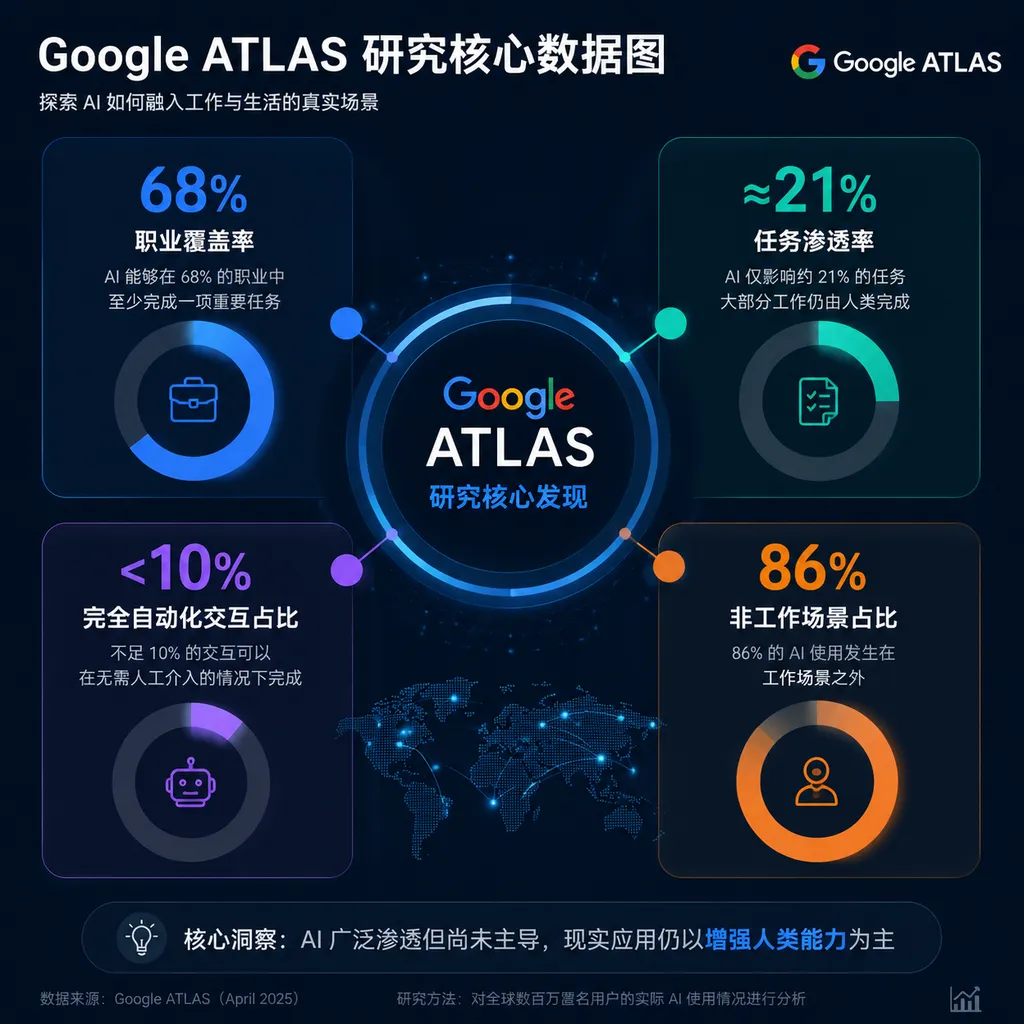
Google’s analysis of nearly 15 million AI interactions found that AI has reached 68% of occupational categories, but touches only about 20% of tasks within any given occupation. Adoption is no longer the primary challenge; the real bottlenecks are workflows, access permissions, and boundaries of responsibility.
Google Pours Some Not-Quite-Cold Water on the AI Hype
On July 23, Google Chief Economist Fabien Curto Millet published the first edition of the ATLAS study. After analyzing nearly 15 million de-identified AI interactions, Google reached a strikingly contrasting conclusion: AI has entered a wide range of occupations, but it has yet to penetrate most people’s end-to-end workflows.
The data shows that 68% of granular occupations worldwide have seen AI usage reach the statistical threshold. Within those occupations, however, AI typically touches only about 20% to 21% of common tasks. In just 3% of occupations is AI used for more than three-quarters of tasks.
In other words, AI is spreading rapidly across occupations, but its depth of penetration remains limited.
It is like a company giving nearly every department an AI account: marketing uses it to revise copy, R&D uses it to explain code, legal uses it to summarize clauses, and administration uses it to organize notices. It may look as though everyone is using AI, but relatively little of it has truly entered core processes such as approvals, procurement, delivery, and auditing.
15 Million Interactions Offer a Truer Picture of Actual Use Than Surveys
ATLAS stands for the Activities, Tasks, Locales, and Adoption Study. The first edition analyzed 14,653,926 de-identified interactions recorded between April 6 and 19, 2026, from:
- the Gemini app;
- AI Mode in Google Search;
- Gemini API calls.
The study covered more than 150 countries and regions, 140 languages, over 800 occupations, 4,000 work tasks, and approximately 300 categories of household activities. Google aggregated the interaction data and mapped it to specific occupations and tasks to determine where people were using AI and whether they wanted AI to collaborate with them or complete tasks directly.
Compared with conventional user surveys, this approach has the advantage of reducing self-reporting bias. Someone may say in a survey that they use AI every day, but that does not mean AI has changed their core work. Actual interactions reveal more directly whether someone is merely asking a model to write an email or handing over an entire business process.
But an easily misinterpreted concept must first be clarified: 68% occupational coverage does not mean that 68% of workers use AI every day, much less that 68% of the work in those occupations has already been automated.
To protect privacy, Google only included a task in its statistics once it reached a minimum number of users. An occupation being “covered” therefore means only that Gemini usage has reached a sufficient scale within that occupation. Task penetration answers a different question: Of all the typical tasks associated with an occupation, how many show meaningful AI usage?
The former measures breadth; the latter measures depth. Conflating the two can easily produce the false conclusion that “AI has already taken over most jobs.”
What AI Does Best Is Still Only a Small Part of the Job
ATLAS shows that workplace AI usage is concentrated primarily in collaborative scenarios such as ideation, research, drafting, learning, reviewing, and rewriting. Interactions in which users ask models to complete non-routine cognitive tasks end to end account for less than 10% of the total.
This aligns with the actual capabilities of today’s large models.
A model can quickly generate a draft proposal, but it struggles to independently determine whether that proposal fits a company’s real budget. It can analyze a section of logs, but it may not understand the organizational constraints behind a particular release. It can draft a contract, but it cannot assume legal responsibility for what happens after the contract is signed. Work is not a continuous block of text; it is a state machine composed of data, permissions, tools, people, and accountability.
When a user asks a model to “write a customer follow-up email,” both the input and output fit inside a chat box, and the result is easy to check. Asking a model to “complete a customer renewal” requires it to access the CRM, assess customer risk, call the quoting system, request a discount, update the contract, send an email, and leave an audit trail. An error at any step could generate real costs.
For now, therefore, AI is more like an exceptionally responsive copilot than a driver capable of taking over the vehicle independently.
This state of being “useful in parts but difficult to put in charge of the whole” also explains why model capability rankings continue to rise while companies have not experienced a corresponding order-of-magnitude increase in productivity. Benchmarks measure a model’s upper limit on relatively closed tasks, while enterprise workflows test a system’s lower bound of reliability in open environments.
Non-Routine Cognitive Tasks Actually Attract the Most AI Use
The report includes another noteworthy finding: “non-routine cognitive” tasks such as analysis and creative design account for approximately 35% of all economic tasks, yet generate 65% of workplace AI interactions.
This shows that generative AI is not simply spreading along the path followed by traditional automation.
In the past, software automation typically prioritized tasks with clear rules and high repetition, such as spreadsheet data entry, inventory calculations, and standardized reports. Large models, by contrast, have first entered areas where the rules are not entirely clear and where language understanding and open-ended generation are required, such as:
- fleshing out ideas from a vague requirement;
- extracting information from multiple documents;
- suggesting troubleshooting paths for code failures;
- generating design concepts or initial copy drafts;
- rewriting specialized content for non-specialist users;
- providing an immediate learning path in an unfamiliar field.
The reason is straightforward. Traditional software requires developers to define the rules in advance, while large models can process ambiguous input and provide candidate answers in natural language. This makes them particularly well suited to tasks that “have no single correct answer, but whose quality humans can quickly assess.”
However, non-routine tasks are usually both more valuable and riskier. The more a job requires judgment, coordination, and creativity, the harder it is to establish standardized acceptance criteria. AI can contribute an intermediate result, but it has difficulty proving that the result is sufficient to support a final decision.
Thus, the fact that 65% of interactions are concentrated in non-routine cognitive work does not mean those jobs are the easiest to replace. A more reasonable interpretation is: They can most easily obtain localized gains from AI, but are the hardest to run without human supervision.
More Than 86% of Interactions Occur Outside the Office
Another ATLAS finding may be even more important than its workplace data: More than 86% of conversational AI interactions occur outside formal work.
These uses include learning, leisure and social activities, household matters, shopping research, and access to government services involving matters such as taxes and licenses. In the published data, leisure and social activities account for approximately 26.4%, education for approximately 20.7%, and household activities for approximately 11%.
This means that AI currently resembles a general-purpose information interface more than merely a new feature in office software.
Search engines excel at returning links, while generative AI attempts to compress fragmented information into an actionable path. For example, instead of separately searching for appliance specifications, installation instructions, and after-sales policies, users can ask a model to compare options directly. Nor do they need to first decipher a body of administrative terminology and then search page by page for the required documents; they can ask a model to produce a checklist tailored to their circumstances.
These scenarios may not be included in corporate productivity statistics, but they can substantially reduce the information-processing burden on ordinary people. The first wave of AI’s economic value may not be fully reflected in “how many fewer people were hired.” Instead, it may be dispersed across countless instances of opening one fewer webpage, making one fewer phone call, or avoiding one unnecessary detour.
Of course, this also creates new problems. Shopping, taxation, and public services often depend on highly time-sensitive information. If a model is not connected to reliable data sources or does not clearly indicate uncertainty, a seemingly comprehensive answer may be more misleading than conventional search results.
AI Use in Repair Jobs Reveals the True Value of Multimodality
The study also found that automotive technicians, industrial machinery repair workers, and people in similar occupations use multimodal tools to interpret test results, inspect equipment wear, or troubleshoot electrical problems. When workers in these occupations use AI, they are about twice as likely as workers in other occupations to invoke image or video capabilities.
Such cases demonstrate the value of multimodal models more clearly than “AI generating a weekly report.”
What repair workers truly need is not an encyclopedic answer, but a way to combine on-site photographs, instrument readings, equipment manuals, and historical fault records to narrow the scope of troubleshooting. A model will not replace disassembly, measurement, or repair work, but it can serve as a portable knowledge base that reduces the number of trial-and-error steps less experienced workers must take through a fault tree.
Yet this also exposes the boundaries of current AI applications. If a model can only view a single image but cannot access the equipment model, maintenance records, real-time sensor data, or parts inventory, it remains merely an advisory system. To move from recommendations to execution, developers usually need to solve problems involving data access, tool use, permission controls, and result verification—not simply write another version of the prompt.
What Enterprises Lack Is Not Accounts, but Verifiable Closed Loops
The most important industry implication of ATLAS is not that AI is insufficiently powerful, but that it breaks down the overly broad metric of “adoption.”
When measuring AI deployment, many companies still count account activation rates, weekly active users, conversation volumes, and token consumption. These metrics can indicate whether people are using a tool, but they cannot answer three more important questions:
- Which specific tasks has AI entered?
- How much has it shortened the task cycle?
- When the output is wrong, who detects the error and assumes responsibility?
If employees use AI to produce more drafts but review time increases accordingly, the organization may see no net benefit. If a customer service bot reduces the number of interactions handled by human agents but increases complaints and escalation rates, greater token consumption may actually indicate a more serious problem.
What enterprises truly need to track are task-level metrics, such as first-contact resolution, average handling time, manual rework rates, factual error rates, tool-call success rates, and cost per task. Only when these metrics form a closed loop can AI evolve from “a tool employees found and started using on their own” into “a production system the organization can rely on.”
For developers, this also means that the focus of competition in the next phase is shifting from model wrappers to systems engineering:
- Can tasks be broken down into verifiable steps?
- Can the model be given only the minimum necessary permissions?
- Can the system roll back or degrade gracefully when tool calls fail?
- Can it record the versions of models, prompts, data sources, and tool calls?
- Can it be continuously evaluated using real business samples?
- Can it be forced to stop at points where human judgment is required?
Multi-model access and unified APIs can lower the barriers to trials, switching, and cost comparisons, but they primarily address the supply of models. What ultimately determines task penetration remains the context, permissions, evaluation, and organizational workflows surrounding the model.
This Report Should Not Be Treated as a Comprehensive Map of Global AI Use
ATLAS has a very large sample, but its boundaries are equally clear.
First, the data covers only two weeks in early April. The time window is short and may have been affected by seasonal factors such as tax season. Second, the sample comes from Google’s own products. It cannot represent users of models such as GPT, Claude, and DeepSeek, nor can it capture the many internal enterprise deployments and offline workflows.
Some granular analyses did not include content from paid Gemini API usage, while Google Workspace, AI Overviews, Google Translate, and the enterprise Gemini platform were not fully included either. For developers and enterprise users, this may understate back-end calls embedded in business systems while overstating the share of consumer-facing conversational scenarios.
More importantly, the study can determine what users want AI to do, but it cannot confirm whether the task was ultimately completed successfully, how much time was saved, or how much economic value was generated. A “request for full automation” does not mean “successful automation,” and the presence of an AI interaction does not mean productivity has improved.
Therefore, the approximately 21% task coverage rate cannot be described as “AI has already automated one-fifth of work,” and the less-than-10% share of end-to-end automation intent is not an automation success rate.
The Next Stage of AI Adoption Is Moving from the Chat Box into the State Machine
The picture presented by Google’s study is not pessimistic. Quite the opposite: 68% occupational coverage indicates that AI distribution has already been highly successful, and users no longer need to be taught “why they should use AI.”
The question has become: Why does it remain limited to only a small number of tasks?
The answer may lie not in the next generation of models scoring a few percentage points higher on benchmarks, but in more mundane and expensive engineering work—connecting internal systems, maintaining context, configuring permissions, establishing evaluations, handling exceptions, and redesigning the boundaries of responsibility between humans and machines.
Over the past three years, the industry has addressed the question, “Can AI answer?” The next question is, “Can AI act reliably under the right conditions—and stop when it should not act?”
ATLAS’s 68% and 21% figures precisely mark the distance between these two stages: AI has entered the company, but it has not truly entered the workflow. Whoever closes that gap may capture the more tangible value of the next phase of generative AI.
References
- ITHome: Insights from 15 Million AI Interactions—Google Says AI Adoption Is Broad but Lacks Depth — Reports on the sample scope of Google’s ATLAS study, its occupational and task coverage rates, and its main findings regarding work and non-work scenarios.