
Kimi K2.6 is here: Moonshot AI’s multimodal ambitions take another step forward

DarkSide of the Moon confirms that the new model **Kimi K2.6** is about to be released. This is another iteration following K2.5, and for the first time, the official communication explicitly states the adoption of a *"native multimodal"* technical approach—an announcement with strong signaling implications.
From K2 to K2.6: The Dark Side of the Moon Is Iterating Faster and Faster
Moonshot AI recently confirmed via an official email to selected developers that a new model, codenamed K2.6, is about to be released. This marks the third major version upgrade in less than a year since the trillion-parameter K2 model debuted in July of last year.
The news first appeared in a post on the developer community Linux.do, and multiple sources have since corroborated it. Notably, the email explicitly mentions the keyword “native multimodal” for the first time—indicating that this is not a mere performance refresh but a statement about the model’s technical direction.
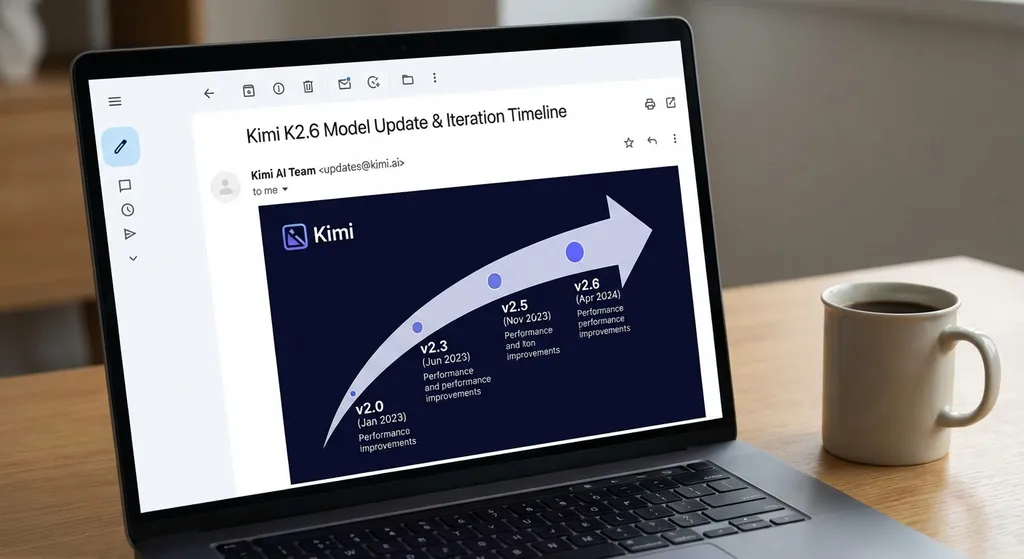
Let’s Review: How the K2 Line Has Evolved
To understand the significance of K2.6, we need to take a clear look at the entire evolution path.
When Kimi K2 was released in July 2025, its positioning was crystal clear: a base large model built on an MoE (Mixture of Experts) architecture with a total of 1 trillion parameters but only 32 billion active parameters. This design philosophy aligned with models like Mixtral and DeepSeek-V2—using sparse activation to improve inference efficiency, ensuring that trillion-level models didn’t overburden GPUs during deployment.
K2 focused on two main things: code generation and general Agent capabilities. To be fair, it performed quite well, especially in coding scenarios—competitive against GPT‑4o and Claude 3.5 Sonnet at the time. But multimodality? That barely made the conversation.
In September 2025, K2 received a major update: its context window expanded from 128K to 256K, and it introduced the Thinking model, supporting a "think-while-calling-tools" collaborative mode. This was meaningful—it marked Kimi’s transition from a "powerful model" to a "functional intelligent agent."
Then on January 27, 2026, K2.5 was officially released—a real turning point.
K2.5: A Silent Launch That Spoke Volumes
The launch of K2.5 was very much in Moonshot AI’s style—no press conference, no teaser posters, just a quiet rollout on the website. When users opened the Kimi chat interface, they simply found that the model had changed.
But behind that “silent” update was a noisy leap forward. K2.5 was the first to adopt a native multimodal architecture, supporting mixed visual and textual inputs, incorporating visual understanding, reasoning, coding, and agent capabilities into one unified model.
Let’s pause to clarify the difference between “native multimodal” and “stitched multimodal”, as this is critical to understanding K2.6’s technical direction.
Many early “multimodal” models simply wrapped a language model with a visual encoder (e.g., CLIP or SigLIP). The image was encoded into tokens first, then fed to the language model—functional, but with limited upper bounds. Visual information was already compressed and abstracted before reaching the LLM, losing many fine-grained visual cues.
The native multimodal approach is different: it treats vision and language as first-class citizens at the architectural level, co-learning multimodal representations during pretraining. Models like GPT‑4o and Gemini follow this path. K2.5 joined them, signaling that Moonshot AI sees this as the correct technical course.
In practice, K2.5 showed a qualitative improvement in chart comprehension, document parsing, and UI screenshot analysis. However, it still had some weaknesses—unstable performance in complex visual reasoning, weaker multi-image comparison than GPT‑4o, and no audio modality support.
K2.6: Catching Up or Overtaking?
Now let’s get back to K2.6.
Based on current information, K2.6 will likely focus on several areas:
-
Further strengthening visual reasoning. K2.5 laid the foundation for native multimodal architecture. K2.6 aims to push precision and complex reasoning further upward. Simply put, if K2.5 can understand a single image, K2.6 should understand the logical relationship among multiple images.
-
Deepening Agent capabilities. From K2’s Thinking model to K2.5’s multimodal Agent, Moonshot AI has consistently pursued the “model-as-agent” path. K2.6 is expected to improve tool use accuracy and multi-step planning, enhancing workflow automation reliability for developers.
-
Potential introduction of audio modality. This has not been officially confirmed, but given current industry trends and K2.5’s absence in this area, adding audio understanding would be a reasonable expectation. GPT‑4o and Gemini 2.0 already support audio input, while domestic models largely trail behind here.
Frankly, K2.6 faces a tougher competitive environment than K2 did upon its release.
By 2026, the multimodal field has become crowded. OpenAI’s GPT‑4o keeps iterating, Google’s Gemini 2.0 leads on multimodal benchmarks, and Anthropic’s Claude is rapidly catching up in visual understanding. Domestically, DeepSeek, Zhipu, and MiniMax all have multimodal strategies in motion.
Moonshot AI’s advantage lies in iteration speed and engineering strength. From K2 to K2.6, completing three major version upgrades in under a year makes it one of the fastest among Chinese AI companies. The mention of a “10 billion RMB cash reserve” by CEO Yang Zhilin in an internal letter indicates they are financially prepared for a long game.
However, advantages aside, the challenges are real: training native multimodal models is costly, requiring massive data, and evaluating multimodal capability is far more complex than text-only. Whether K2.6 merely “catches up” or manages to overtake in certain dimensions remains to be seen once it’s released.
What This Means for Developers
If you’re already building with the Kimi API, there are a few points worth noting when K2.6 launches.
First, the API interface will likely remain compatible. From K2 to K2.5, Moonshot AI maintained OpenAI-compatible formats, and K2.6 should be no exception—meaning model migration costs are low.
Second, multimodal API calls may expand. If K2.6 truly adds audio, the API input format will need to change. Based on K2.5’s approach, it will probably still follow the OpenAI-style messages format, adding new content types.
For developers eager to try the new model, using an API aggregation platform like OpenAI Hub can be convenient—one key gives access to multiple models without managing separate API keys. Here’s an example request for the Kimi multimodal model including an image:
from openai import OpenAI

client = OpenAI(
    api_key="your-openai-hub-key",
    base_url="https://openai-hub.com/v1"
)

response = client.chat.completions.create(
    model="kimi-k2.5",  # Switch to the K2.6 model name after release
    messages=[
        {
            "role": "user",
            "content": [
                {
                    "type": "text",
                    "text": "Analyze the data flow in this architecture diagram and identify potential performance bottlenecks."
                },
                {
                    "type": "image_url",
                    "image_url": {
                        "url": "https://example.com/architecture-diagram.png"
                    }
                }
            ]
        }
    ],
    max_tokens=2048
)

print(response.choices[0].message.content)
If K2.6 supports audio input, the call format may expand like this:
# Expected audio input format (to be confirmed after K2.6 release)
messages = [
    {
        "role": "user",
        "content": [
            {
                "type": "text",
                "text": "Summarize the key decisions from this meeting recording."
            },
            {
                "type": "input_audio",
                "input_audio": {
                    "data": "<base64-encoded audio data>",
                    "format": "mp3"
                }
            }
        ]
    }
]
Third, watch for context window changes. K2 increased from 128K to 256K, and K2.5 maintained 256K. Will K2.6 expand further? If your application handles long documents or multi-turn complex conversations, this parameter is worth watching.
The Bigger Picture: The Domestic Multimodal Race
Zooming out, the release of K2.6 symbolizes how China’s LLM industry is collectively pivoting toward multimodal capabilities.
2025 was the year of “textual capability catch-up,” where domestic models aggressively improved in coding, reasoning, and long-context performance—rapidly narrowing the gap with GPT‑4 and Claude. By 2026, however, the battlefield clearly shifted to multimodality.
The reason is simple: the ceiling for pure-text LLMs is already visible, while real-world applications—document processing, visual analysis, embodied AI—all require models to understand multiple forms of information simultaneously. Whoever first achieves “usable and useful,” not just “technically possible,” multimodality will lead the next phase.
Moonshot AI’s decision to rapidly iterate multimodal capabilities at this juncture is strategically sound, but execution challenges abound:
-
Data barriers. High-quality multimodal data (especially well-aligned image‑text or video comprehension datasets) are much harder to obtain than pure text. OpenAI and Google have a first‑mover advantage and data flywheel effects.
-
Evaluation difficulty. There’s still no universally accepted benchmark for multimodal performance. Existing tests like MMMU and MMBench cover only partial scenarios, and real‑world performance often diverges from benchmark scores.
-
Compute pressure. Native multimodal training costs several times more than text‑only training. Even with a 10 billion RMB reserve, Moonshot AI must allocate compute resources wisely.
-
Commercialization pace. Capability gains must eventually translate to revenue. Kimi’s consumer product already has solid traction, but keeping B2B and API revenue in sync with R&D spending will be an ongoing test.
In Conclusion
From K2 to K2.5 and now the upcoming K2.6, Moonshot AI has completed the transition from “text‑first” to “native multimodal” in under a year—a remarkable testament to its engineering agility.
We’ll have to wait for the official release to see K2.6’s true performance, backed by data and firsthand experience. But one thing is certain: in the 2026 LLM race, multimodality is the main battlefield, and Moonshot AI has already placed its bet firmly on the table.
References
- Kimi K2.6 to Launch Soon: Official Email Confirms New Model Codename — Linux.do developer thread that first leaked the K2.6 email information
- Kimi K2.5 Officially Released: Fully Open‑Source Native Multimodal AI Enters the Era of Cluster Intelligence — Zhihu column detailing K2.5’s architecture and capability upgrades


