Large Models Run on an $8 Chip

The open-source project esp32-ai packs a 28.9M-parameter language model into a low-cost microcontroller. It is not yet “offline ChatGPT,” but it demonstrates that on-device generative AI is moving beyond smartphones and PCs and continuing its descent to MCUs.
A 28.9M-Parameter Model Running on $8 Hardware
Developer slvDev recently open-sourced esp32-ai, a project featuring a language model with approximately 28.9 million parameters that can perform local inference on microcontroller-class hardware costing around $8.
The key point is not how intelligent the model is, but where it runs.
Over the past two years, on-device AI has typically centered on smartphones and AI PCs equipped with NPUs delivering tens of TOPS, or Raspberry Pis and high-end development boards with several gigabytes of memory. esp32-ai pushes the boundary down another level: the target is no longer a “miniaturized computer,” but an MCU platform with resources measured in megabytes and highly constrained clock speeds and power consumption.
Such devices were originally responsible for reading sensors, driving motors, connecting to Wi-Fi, and executing state machines written in advance by developers. Now, language models are beginning to make their way onto the same chips.
Judged solely by output quality, the project could easily be dismissed as a “toy.” But from an engineering perspective, it deserves more attention than yet another 7B model running on a consumer GPU: on-device inference is moving beyond end-user devices and into the controllers embedded inside them.
First, Do the Memory Math
A 28.9M-parameter model is tiny by today’s large-model industry standards. A 7B model has roughly 240 times as many parameters, to say nothing of cloud models with tens or hundreds of billions of parameters.
But inside a microcontroller, 28.9 million parameters is anything but small.
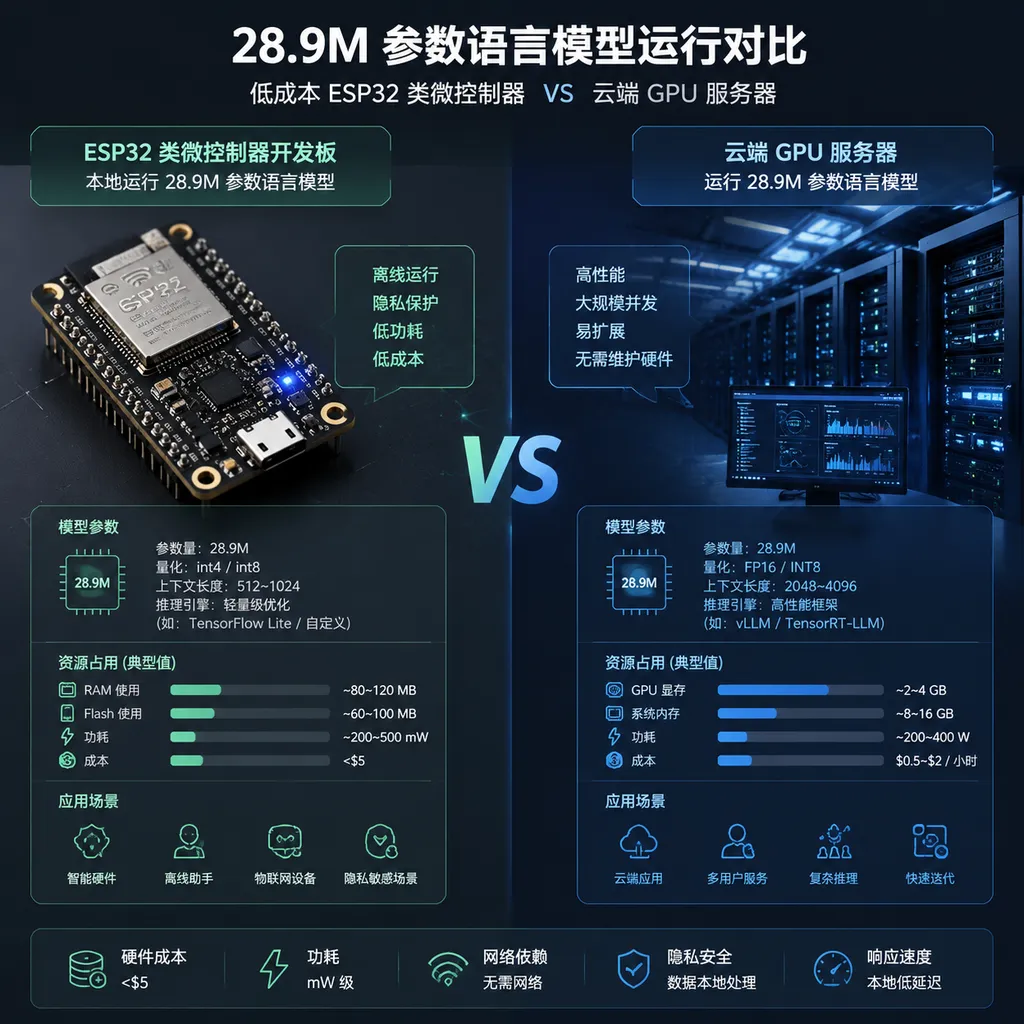
Assuming FP32 weights, the parameters alone require about 115.6 MB. With FP16, they still require about 57.8 MB. Even when compressed to INT8, they take up around 28.9 MB. At 4-bit precision, the theoretical weight size remains close to 14.5 MB—and that does not include:
- Model architecture and quantization metadata;
- The tokenizer and vocabulary;
- Intermediate activations;
- The KV cache;
- Memory occupied by the inference program itself;
- Runtime space for the system network stack, drivers, and other tasks.
This is the fundamental difference between running a language model on an MCU and deploying one on a PC. On a GPU, optimization often means “using a few gigabytes less VRAM and generating a few more tokens per second.” On a microcontroller, the question is whether the model fits at all—and whether peak memory usage will cause the system to reboot outright.
The technical substance of projects like this therefore usually lies not in the Transformer architecture itself, but in a complete set of trade-offs under extreme resource constraints: low-bit quantization, on-demand loading, memory reuse, operator pruning, and avoiding large dynamic memory allocations wherever possible.
In other words, this is not simply a matter of recompiling desktop inference code. The model must be treated as embedded firmware.
“It Runs” Does Not Mean “It Can Chat”
This result needs to be put into perspective.
A 28.9M-parameter language model is not in the same capability class as cloud models such as GPT, Claude, or Gemini. It is more like a lightweight pattern processor with a natural-language interface than a general-purpose assistant capable of answering complex questions or building complete applications.
Its parameter count makes it difficult to accommodate extensive world knowledge, sophisticated reasoning, and long contexts all at once. Low-bit quantization further reduces representational precision. Developers should not expect high-quality open-domain question answering on an MCU, much less market it as an “$8 version of ChatGPT.”
The genuinely practical use cases are instead narrow scenarios with relatively fixed forms of expression, such as:
- Mapping “The living room is too dark” to turning on a specified group of lights;
- Parsing short natural-language instructions into device-control intents and parameters;
- Generating one or two sentences of local explanation for sensor alerts;
- Performing limited command classification without a network connection;
- Providing simple conversations for toys, wearables, or educational hardware;
- Performing a first layer of semantic filtering before data is uploaded to the cloud.
These tasks were previously handled with keyword rules, classification models, or finite-state machines. The value of a small language model is that it trades some computational cost for a more flexible input interface. Users do not have to speak exact predefined commands, and devices do not need a separate rule for every possible phrasing.
However, in devices with strict determinism requirements, a language model must not directly take over the execution chain. A safer architecture is for the model to interpret intent while conventional code validates parameters, permissions, and safety boundaries, with the final action still executed by deterministic logic.
Otherwise, a hallucination might do more than produce a wrong answer—it could activate the wrong relay.
On-Device AI Is Beginning to Move Below the Operating System
On-device models running on smartphones and PCs still have complete operating systems, virtual memory, file systems, and mature inference frameworks underneath them. The MCU environment is entirely different: it may lack a general-purpose operating system, memory cannot be expanded freely, and compute tasks must compete with sensor sampling, network connectivity, and real-time control for resources.
esp32-ai therefore represents more than “model miniaturization” in the conventional sense. It signals that generative AI is beginning to move below the operating-system layer and into firmware and controllers.
This brings several immediate changes.
1. Latency Becomes Predictable
Cloud APIs can have very low average latency, but network jitter, weak connectivity, and server-side queuing are unavoidable. Local MCU inference is not necessarily faster, but it reduces network-related uncertainty. For a device that only needs to recognize short commands, consistency is often more important than peak speed.
2. The Privacy Boundary Moves Closer to the Device
Microphone transcripts, home-device status, and industrial sensor data can be processed inside the device first. Only when the model cannot make a determination—or genuinely needs stronger capabilities—does the device send the necessary information to a cloud model.
This kind of tiered architecture is better suited to homes, healthcare, and industrial environments than an “everything goes to the cloud” approach. However, local inference does not automatically mean security: firmware updates, model-file integrity, debug interfaces, and flash read protection can all remain attack surfaces.
3. Individual Inferences No Longer Incur API Fees
Cloud API costs are usually not a concern for a small number of devices. But when hardware shipments reach hundreds of thousands or even millions of units, even a few requests per device per day can result in substantial cumulative costs and concurrency-management overhead.
Simple tasks that can be completed locally do not need to be sent to the cloud. A more sensible approach is to let the small model on the MCU handle frequent, low-complexity requests while sending infrequent, complex tasks to more capable models such as GPT, Claude, Gemini, or DeepSeek.
This is not about on-device models replacing the cloud. It is about turning the cloud from a mandatory stop for every interaction into a capability layer invoked only when needed.
Parameter Count Is Not the Only Real Bottleneck
Fitting the model into storage solves only the first problem. MCU inference faces at least four more practical constraints.
The first is memory bandwidth. Transformer inference requires weights to be read repeatedly. Even if compute units still have spare capacity, access speeds for external storage or expanded memory can leave the processor waiting for long periods. Ultra-low-bit quantization reduces not only storage requirements, but also the amount of weight data that must be moved.
The second is time to first token and generation speed. For chat applications, even several—or more than ten—tokens per second may feel slow. For control instructions, outputs are very short and lower throughput can still be usable. The use case determines whether a given speed metric is meaningful.
The third is context cost. Longer inputs increase both computational and memory pressure. Small MCU-based models are better suited to short prompts, fixed templates, and limited history than to extended conversations lasting dozens of turns.
The last is energy consumption and thermal management. Local inference eliminates wireless transmission and cloud API calls, but sustained operation under heavy load still consumes power. For battery-powered devices, whether the model remains resident, when it wakes up, and whether requests are first filtered by a lighter-weight classifier matter more than a single benchmark result.
Therefore, “running on an $8 microcontroller” demonstrates technical feasibility more than it proves that any $8 device can deploy the model at no additional cost. The price of a development board also cannot be equated directly with a production bill of materials: external storage, power design, microphones, speakers, certification, and engineering maintenance all contribute to the final cost.
The Demonstration Matters More Than the Capability
Historically, TinyML has primarily handled discriminative tasks such as keyword spotting, image classification, and anomaly detection. Their inputs and outputs are relatively fixed: the model answers “yes or no,” “which category,” or “what value.”
Small language models change this by enabling MCUs to attempt generative tasks. Instead of merely selecting a category, a device can generate short text, structured commands, or the next action to take.
The difference can be compared to a menu and a waiter: a traditional classification model asks users to select an item from a menu, while a language model attempts to understand requests expressed in different ways. Of course, a 28.9M-parameter “waiter” has limited knowledge, responds slowly, and must operate within a strictly defined scope.
Our assessment is that esp32-ai is currently more of a clear signpost than a standard solution ready to be copied directly into commercial products.
It demonstrates three things:
- Transformer inference can continue moving down to MCU-class devices;
- Quantization and memory engineering are becoming as important as model architecture;
- Edge-cloud collaboration may evolve from a mobile-app architecture into the default architecture for IoT devices.
But it also reminds developers not to conflate “runs successfully” with “ready for production.” Real-world deployment still requires evaluating task accuracy, worst-case latency, peak memory usage, recovery from power loss, model-update mechanisms, and fallback logic for uncontrolled model outputs.
The Next Thing to Watch Is Not a Bigger Number
The next phase of competition among MCU models should not be limited to increasing 28.9M parameters to 50M or 100M. More meaningful metrics will include:
- Whether structured-instruction accuracy can improve at the same power consumption;
- Whether the model can reliably output validatable JSON or function parameters;
- Whether it supports incremental loading and secure OTA updates;
- Whether the toolchain can automate quantization, operator conversion, and memory planning;
- How many core functions it can perform without a network connection;
- Whether it can seamlessly escalate complex requests to cloud models when connected.
If these issues are resolved, future language models inside devices may not appear as chat boxes. They may be hidden inside door locks, air conditioners, dashboards, industrial controllers, and children’s toys, responsible only for translating ambiguous human expressions into intents that machines can validate and execute.
From this perspective, running a 28.9M-parameter model on an $8 microcontroller is not simply a matter of “making a large model smaller.” A more accurate description is: natural language is becoming an input protocol for embedded systems.
There is still a long way to go before this approach matures, but the continued migration of on-device inference into lower-level hardware is no longer merely an idea confined to research papers.
References
- slvDev/esp32-ai: The open-source project, code, and documentation for running this 28.9M-parameter language model on a low-cost microcontroller.