
OpenAI Partners with Cloudflare to Launch Agent Cloud, Boosting Edge Deployment of Agents by 100×
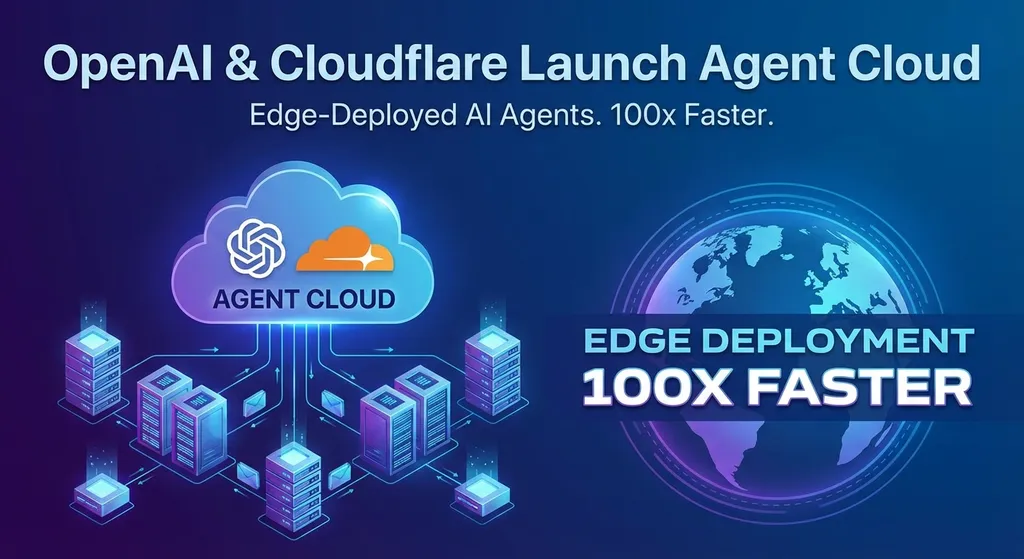
OpenAI and Cloudflare jointly launched Agent Cloud, which leverages V8 isolation technology to achieve millisecond-level startup — 100 times faster and 100 times more memory-efficient than traditional containers — addressing the infrastructure bottleneck of large-scale agent deployment.
OpenAI Partners with Cloudflare to Launch Agent Cloud: 100× Faster Edge Deployment for AI Agents
OpenAI and Cloudflare jointly announced yesterday (April 12) the launch of Agent Cloud, an edge computing platform designed specifically for AI agents. Its core selling point is deploying agents across Cloudflare’s global network, enabling startup speeds 100× faster and memory efficiency 100× higher than traditional containers.
This isn’t just another “AI on the cloud” story. Agent Cloud targets the real pain point of large-scale agent deployment: existing cloud architectures simply can’t handle agents’ concurrency demands.
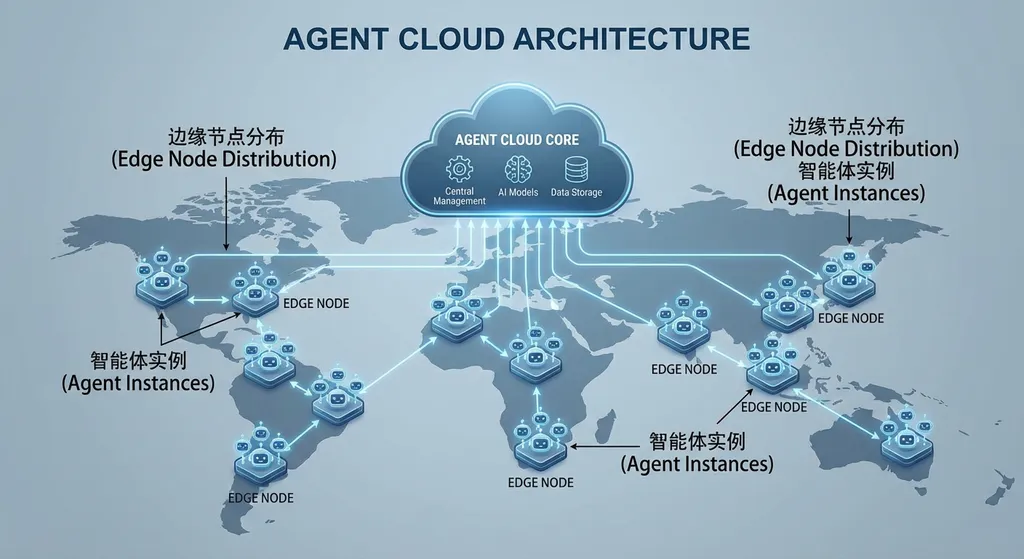
Why Current Cloud Architectures Fall Short
Traditional cloud computing is a product of the smartphone era, built around a “one-to-many” model—one application serving thousands or millions of users. Agents are fundamentally different: they operate on a “one-to-one” model—each agent is an independent instance serving a single user, executing specific tasks, requiring its own runtime environment.
Cloudflare’s Agents Week blog breaks down the numbers: suppose 15% of the 100 million knowledge workers in the U.S. use agents at the same time—that’s roughly 24 million concurrent sessions, requiring computational power equivalent to 500,000–1 million server CPUs. Global demand from one billion knowledge workers? The scale increases exponentially.
Container technology is too inefficient for such scenarios. Docker containers take hundreds of milliseconds to seconds to start and typically consume tens of megabytes of memory. Agents, which are frequently created, short-lived, and quickly terminated, are severely bottlenecked by container startup overhead.
V8 Isolation: The Secret Behind 100× Faster Performance
At the heart of Agent Cloud is Cloudflare Workers’ V8 Isolation technology. It’s not new—Cloudflare has used it for eight years—but now it perfectly fits the agent deployment use case.
V8 Isolation is the sandbox mechanism used by the Chrome browser. It doesn’t require full OS-level virtualization; instead, it isolates environments at the JavaScript engine level. The result? Startup time drops from hundreds of milliseconds to mere milliseconds, and memory usage from tens of MB to hundreds of KB.
Specific numbers:
- Startup speed: milliseconds vs. containers’ hundreds of milliseconds
- Memory efficiency: a few hundred KB per isolated environment vs. tens of MB per container
- Density: thousands of isolated instances per server vs. dozens of containers
Cloudflare’s new Dynamic Worker open beta goes further—it supports on-demand creation of execution environments. When an agent calls a tool or executes a task, resources are allocated in real time and reclaimed immediately afterward. This elasticity is essential for agent workloads.
From “Horseless Carriage” to True Agent Infrastructure
Cloudflare’s blog offers an apt analogy: today’s agent applications are still in the “horseless carriage” phase—adapting new concepts with old models. Many developers still run agents on traditional containers or VMs, just like early cars retained carriage-like designs.
Agent Cloud takes a pragmatic dual approach:
- For code agents needing full file systems or Git operations, containers are supported.
- For lightweight, high-concurrency agents, V8 isolation is used.
Developers can choose according to their needs.
This pragmatic approach matters. The agent ecosystem is still in its infancy, and forcing new tech can alienate developers. Cloudflare’s strategy is to lay the groundwork first and enable smooth migration.
Security and Open Standards
Agent security is more complex than traditional applications—prompt injection, data leaks, and privilege misuse are real threats. Agent Cloud integrates Cloudflare’s Zero Trust Platform for execution-level security control.
More importantly, Cloudflare is helping push open standards. They support the MCP (Model Context Protocol) championed by Anthropic for agent communication, and the x402 payment standard for micropayment settlements between agents.
These standardization efforts might sound dull but are crucial for a healthy agent ecosystem. Without unified protocols, every company would build closed systems, and agents couldn’t interoperate. As an infrastructure provider, Cloudflare has more credibility pushing standards than any individual AI company.
How Developers Can Use It
Cloudflare has open-sourced the Agents project (cloudflare/agents) on GitHub, offering a full development toolchain. The core is a TypeScript SDK supporting agent definition, deployment, and monitoring.
A typical deployment workflow:
- Define the agent: write logic in TypeScript, specifying required tools and permissions
- Local testing: use the Wrangler CLI to run locally and debug tool calls and state management
- One-click deployment: push to Cloudflare’s network, automatically distributed to edge nodes worldwide
- Monitor performance: view call volume, latency, and error rates via the Dashboard
If your agent needs to call an LLM, you can directly use the OpenAI Hub API. Agent Cloud is compatible with the OpenAI format, making the switch virtually cost-free:
import { OpenAI } from 'openai';

const client = new OpenAI({
  baseURL: 'https://api.openai-hub.net/v1',
  apiKey: process.env.OPENAI_HUB_KEY,
});

export default {
  async fetch(request: Request, env: Env) {
    const completion = await client.chat.completions.create({
      model: 'gpt-4',
      messages: [
        { role: 'system', content: 'You are a helpful assistant.' },
        { role: 'user', content: 'Analyze this data...' }
      ],
    });

    return new Response(completion.choices[0].message.content);
  },
};
This script runs on a Cloudflare Worker, calling GPT-4 on OpenAI Hub. Because Workers are deployed at edge nodes, latency is far lower than routing requests to a centralized cloud.
How It Compares to Competitors
The agent deployment race is already crowded. Vercel offers an AI SDK supporting Edge Runtime for agents; AWS has Bedrock Agents integrated into its cloud stack; and several startups are building agent orchestration platforms.
Agent Cloud’s biggest advantage lies in Cloudflare’s global network. With over 300 data centers worldwide, user requests are processed at the nearest node—meaning lower latency and better experience for agents.
Another differentiator is the pricing model. Cloudflare Workers charge by request count and CPU time, with no idle cost. Since agent usage patterns are often bursty, pay-per-use is more economical than monthly subscriptions.
But Agent Cloud has limitations. V8 isolation only supports JavaScript/TypeScript, with limited Python compatibility. While Python can run via WASM, performance and ecosystem completeness suffer. Considering most AI tools and libraries are built in Python, this is a practical concern.
The Competition for Agent Infrastructure Has Just Begun
The launch of Agent Cloud marks a shift for agents—from experimental to engineered systems. Over the past year, discussions focused on what agents could do, how to design prompts, and how to plan or reason. Now the questions are: how to run agents reliably, handle millions of concurrent sessions, and manage cost.
Cloudflare’s answer is edge computing plus lightweight isolation instead of containers. It’s the right direction—but not the only one. AWS, Google, and Azure are all preparing their own solutions, each with unique technical stacks and ecosystems.
For developers, this is a great moment. Infrastructure players are competing, tools are iterating rapidly, and development costs are falling. But beware of over-reliance on a single platform. The core logic of agents should remain platform-agnostic; infrastructure is just the runtime.
It’s also notable that OpenAI chose to partner with Cloudflare instead of building its own infrastructure. Clearly, OpenAI doesn’t want to replicate AWS’s path and prefers to focus on models and APIs. That’s good for the ecosystem—clear division of labor, each focusing on their strengths.
How Close Is Production Readiness?
Agent Cloud is currently in open beta, and production-level deployment still requires observation. Key challenges include:
Cost: Although pay-as-you-go sounds economical, agent invocation frequency may be higher than expected. A complex task could trigger dozens of tool calls—each spinning up a Worker, calling an LLM, processing results. The cost model must be carefully calculated.
Debugging: Debugging distributed environments is notoriously hard. With agents running across hundreds of nodes globally, locating issues is tricky. Cloudflare provides logs and tracing tools, but the experience still lags behind local debugging.
State management: Agents must remember context and maintain session state. Edge computing is inherently stateless—state must be stored in KV or sent back to a database, adding latency and complexity.
Ecosystem maturity: Standards like MCP and tool invocation protocols are still early-stage. Whether agents from different vendors can truly interoperate remains to be seen.
The direction, however, is clear. Agents will proliferate, infrastructure demands will rise sharply, and whoever offers faster, cheaper, easier deployment will reap the rewards.
The Cloudflare–OpenAI partnership is essentially a move to capture the agent-era infrastructure frontier. Just as AWS seized the IaaS opportunity in early cloud computing, the window for agent infrastructure won’t stay open for long. Expect intense activity in the coming months.
References
- GitHub - cloudflare/agents – Cloudflare’s open-source agent development toolchain
- OpenAI Agent Cloud with Cloudflare - Linux.do Discussion – Community technical discussion on Agent Cloud


