Token Reselling Is More Than Just Reselling APIs
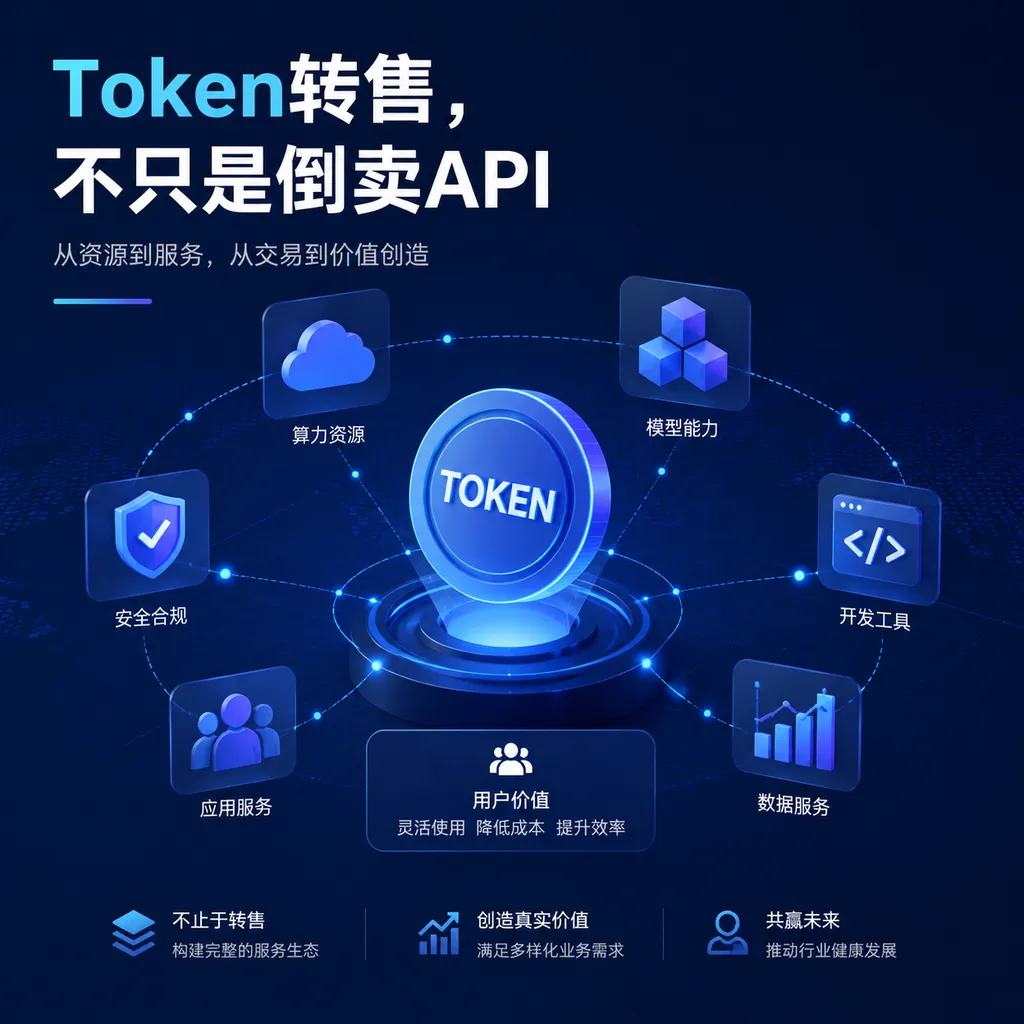
A recent market survey has uncovered the model token resale chain: behind low-cost APIs may lie layers of cloud providers, quota resellers, routing services, and aggregation platforms. What developers truly need to audit is no longer just the price, but exactly who their requests pass through.
Recently, AI infrastructure provider Vectoral published an investigation into the token resale market, describing a rapidly expanding model API supply chain that has long lacked transparency: developers may think they are simply sending requests to an intermediary platform, when in reality a single API call may pass through an aggregation gateway, routing provider, quota supplier, and cloud platform before finally reaching the model provider.
This is not simply a matter of “more middlemen.”
As of July 26, 2026, large-model API aggregation has evolved from basic protocol forwarding into a complex system encompassing quota procurement, cross-region settlement, account-pool scheduling, protocol conversion, caching, failover, and revenue allocation. What the industry should truly be concerned about is not the markup charged by intermediaries, but the fact that as these chains grow more complex, model provenance, data boundaries, billing accuracy, and responsibility for failures all become increasingly ambiguous.
In other words, what customers purchase today is not necessarily “tokens from a particular model provider,” but potentially a supply chain’s promise to deliver model inference capacity.
Tokens Are Not a Transferable Commodity
First, let us correct a common but imprecise industry expression: tokens themselves generally cannot be resold and delivered like servers or GPUs.
Model providers bill for APIs in tokens, but what is actually traded on the market is usually one of the following:
- API credits in prepaid accounts;
- Contractual discounts offered by cloud or model providers;
- Startup support credits, cloud credits, and promotional quotas;
- RPM and TPM quotas tied to a particular account, project, or region;
- Inference capacity that an agent promises to deliver;
- Unified API services provided after protocol conversion and routing.
“Token resale,” therefore, is more like bandwidth resale and compute distribution in cloud computing than the resale of a sequence of numbers.
A platform offering models below the official list price is not necessarily doing anything wrong. Large customers commonly obtain discounts through prepayment, minimum-spend commitments, cloud marketplace procurement, and bulk settlement, then subdivide and resell that capacity. This is a well-established model in mature cloud service markets. Aggregation platforms can also further reduce average costs through caching, traffic shaping, and cross-model routing.
The problem is that two offerings that are both 20% cheaper may derive their savings from entirely different sources.
One may come from a legitimate enterprise discount. Another may rely on short-term promotional credits, account balances of unknown origin, or even shared accounts that violate upstream terms. To the API consumer, these channels look almost identical at the interface level, but their risks are not remotely comparable.
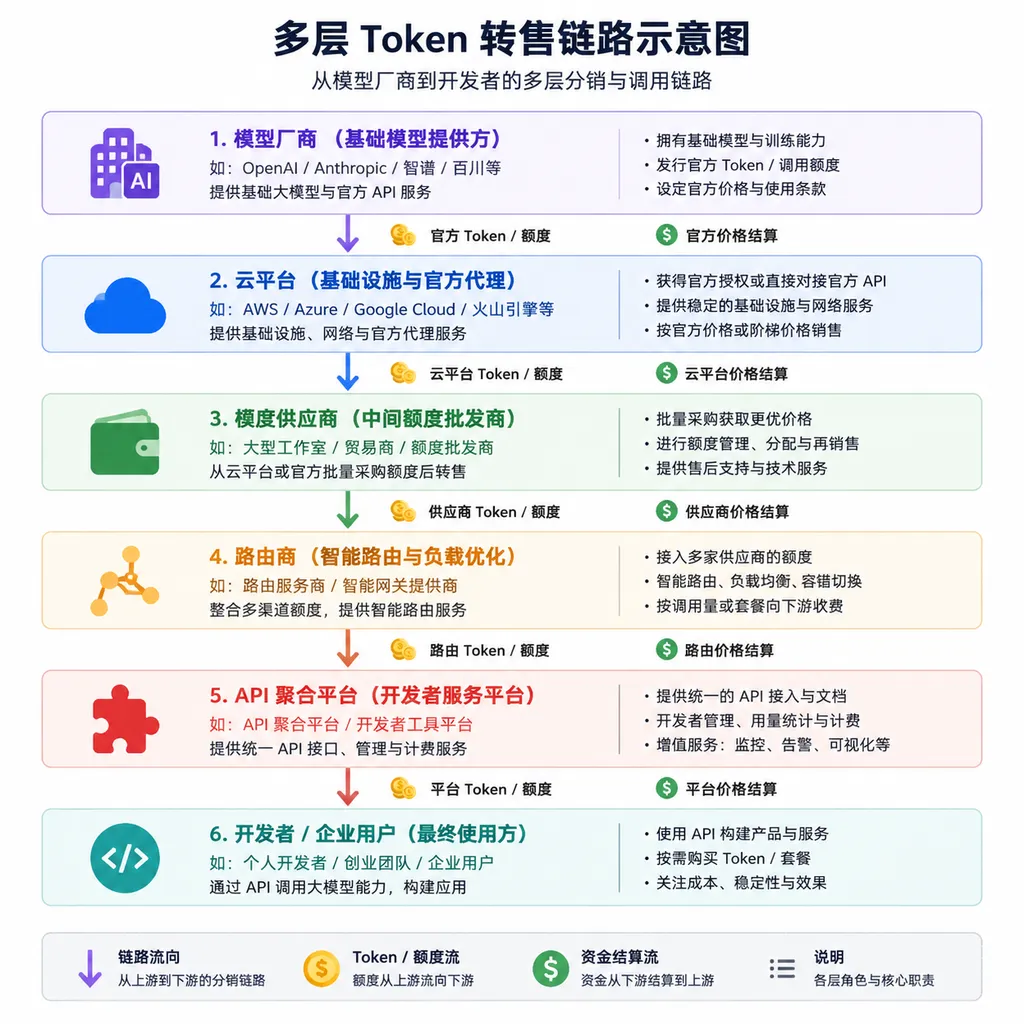
A Single API Call May Pass Through Five Layers of Providers
The simplest aggregation chain has only three parties: the developer, the aggregation platform, and the model provider. In today’s market, however, five or more layers of participants may be involved.
Layer One: Model Providers and Authorized Cloud Platforms
This is where inference is actually performed, including APIs operated directly by model providers and public cloud platforms authorized to host or distribute their models.
This layer determines the model weights, inference clusters, original rate-limiting policies, and underlying content-safety mechanisms. In theory, the closer a service is to this layer, the easier it is to verify model identity and data-processing boundaries.
Layer Two: Quota and Capacity Suppliers
These participants obtain lower procurement costs through annual contracts, cloud credits, regional pricing differences, or enterprise spending commitments, then wholesale API capacity to other service providers.
They may not serve developers directly or provide a fully featured console. Their core product is not an SDK, but capacity: how many requests and tokens can be processed per minute, and whether that capacity can be delivered consistently during peak periods.
Layer Three: Routing Providers or Relays
Routing providers typically maintain multiple upstream accounts or channels and allocate requests based on price, remaining quota, concurrency limits, and availability.
This layer resembles the ticketing systems behind airline booking agencies. Users see the same flight number, but the system may switch between different ticketing channels depending on inventory. For model APIs, this means the same model name may be routed to different regions, cloud platforms, or even providers.
When implemented well, this improves availability. When implemented poorly, users may encounter latency fluctuations, changes in caching behavior, inconsistent error codes, or unnoticed drift in model capabilities.
Layer Four: Protocol Aggregation and Developer Platforms
This is the layer developers know best. It unifies the APIs of Anthropic, Google, OpenAI, and other providers into a single invocation format while offering key management, usage statistics, balance top-ups, subaccounts, and model catalogs.
Platforms such as OpenAI Hub primarily operate at this layer: one key can access models from multiple providers, while an OpenAI-compatible format reduces migration costs. For developers in China, the practical value of a unified entry point is clear. However, a unified protocol does not imply unified semantics, nor does it automatically mean there is only one underlying upstream provider.
Layer Five: Secondary Wrappers and Application Tools
Cursor-like coding tools, AI agent platforms, chat clients, and internal enterprise gateways may further wrap aggregation APIs. By the time a request reaches the end user, it is often impossible to determine from the interface how many hops it has traversed.
The longer the chain, the harder it is to assign responsibility. A 429 returned by the model provider may be rewritten as a 500 at the routing layer. If an upstream streaming response is interrupted, the aggregation layer may automatically retry it and generate duplicate charges. Tool-call fields lost during protocol conversion may also make it appear that “the model suddenly became less capable.”
Where Low Prices Come From: Legitimate Optimization and Risky Arbitrage Are Separated by a Fine Line
Aggregation platforms usually derive their cost advantages from four sources.
The first is procurement discounts. Platforms obtain settlement prices below the public list price through prepayment, spending commitments, or large-volume purchasing. This is the healthiest and most sustainable source.
The second is caching. For fixed system prompts, repeated context, and code repository indexes, upstream prompt caching can significantly reduce input costs. However, whether the cache was actually hit and what price was charged must be demonstrated through detailed billing records. A platform that attributes every discount to “cache optimization” without providing cached-token data is not highly credible.
The third is traffic mixing. Capacity utilization varies among models, regions, and time periods. Routing platforms can direct low-priority tasks to cheaper channels while reserving stable channels for real-time workloads. This is similar to spot instances in cloud computing, but only if users explicitly accept the differences in service levels.
The fourth is quota arbitrage, including regional price differences, promotional balances, cloud credits, and pooled account resources. These methods are not inherently noncompliant, but they are the least sustainable and the most likely to violate terms of service. When a platform offers extremely low prices one day and suddenly disappears the next, the cause is often not a technical system failure, but the loss of its upstream quota source.
Therefore, determining whether a platform is reliable requires more than calculating “how much cheaper it is per million tokens.” A more meaningful question is whether the price remains viable after promotions end, official prices change, and peak-time rate limits take effect.
If a price is substantially lower than the official rate without being explained by large-scale procurement, caching, batch processing, or differences in service level, developers should treat it as a warning sign rather than a bargain.
The Real Challenge Is Model Identity
In a multilayer resale market, the hardest thing to verify is not whether a request returns a response, but which model actually generated that response.
A model name in an API is merely a string. An aggregation platform can map that name to a designated upstream provider, or switch to a compatible model during an outage. The latter is valuable as an explicit disaster-recovery feature, but if users are not informed, it becomes an unauthorized model downgrade.
Simply asking a model “Who are you?” cannot verify its identity, because the answer may be influenced by the system prompt or guessed from training data. Output-style tests and benchmark questions can reveal obvious anomalies, but they cannot provide cryptographic proof.
Enterprise customers should at minimum require platforms to clarify:
- Whether a model name is permanently mapped to the same provider and version;
- Whether the platform automatically switches models during failures;
- Whether user authorization is required before switching;
- Whether responses can include the actual routing channel and request identifier;
- Whether aliases silently point to new versions after upstream model updates;
- Whether different service tiers exist for speed, batch processing, or low-priority workloads.
In our view, the core competitive advantage of future aggregation platforms will not merely be the number of models they offer, but “verifiable routing.” The platforms that can clearly explain which model handled each request, which channel it traversed, and why a particular charge was incurred will be the ones that most closely resemble enterprise-grade infrastructure.
The Chain Also Extends the Data-Security Boundary
When using an official API, developers mainly assess the model provider’s data policies. When requests pass through an aggregation chain, the entire supply chain must be evaluated.
Every layer through which a request passes can theoretically access prompts, uploaded files, tool parameters, and model outputs. Even if a platform claims that it “does not store content,” further verification is still needed: whether request bodies are recorded in logs, whether error samples contain original content, whether monitoring systems capture responses, and whether upstream suppliers follow the same data-retention policies.
This is especially important in agent use cases, where requests may contain database schemas, internal code, access tokens, and customer information. In such cases, “HTTPS encryption” protects only data in transit; it does not prevent nodes in the chain from reading the content after decryption.
Enterprise buyers should ask at least four questions:
- Which countries, regions, and infrastructure providers will requests pass through?
- Which nodes can view plaintext, and how long are logs retained?
- Will data be used for training, evaluation, or human review?
- If a leak occurs or an upstream account is suspended, who is responsible for notification and remediation?
If a platform cannot disclose all of its upstream providers, its need to protect commercially sensitive information is understandable. However, it should at least disclose channel types, data regions, and compliance boundaries. Simply describing a service as an “official channel” is not an adequate substitute for technical and contractual details.
OpenAI Compatibility Solves Only the Shape of the Interface
The engineering benefits of a unified API remain clear. Teams do not need to maintain multiple authentication systems, SDKs, and basic retry mechanisms, nor do they need to rewrite an entire application when switching models.
However, OpenAI compatibility usually means only that requests and responses “look similar”; it does not guarantee complete functional equivalence. Practical differences include:
- Different tool-call parameters and parallel-call behavior;
- Different ordering of streaming response events;
- Different levels of enforcement for structured JSON output;
- Different formats for image, audio, and file uploads;
- Differences in whether reasoning tokens are visible and billable;
- Different rules for creating and hitting context caches;
- Different semantics for 429 responses, timeouts, and content-moderation errors.
If an aggregation platform merely renames fields, problems will quickly emerge in complex requests. A technically sophisticated gateway must maintain capability matrices, parameter validation, error normalization, and model-level regression tests rather than blindly converting every request into the same JSON format.
This is also where the token resale market is beginning to diverge: low-end platforms sell interfaces, while high-end platforms sell orchestration, governance, and predictability.
How Developers Should Audit Aggregation Platforms
For personal experiments, low prices and convenience may be sufficient. But once a service enters production, its aggregation API should be evaluated as a cloud infrastructure provider.
Start With Small, Repeatable Technical Tests
Do not deposit a large amount of money at the outset. Select a test suite that includes long contexts, tool calls, structured output, and streaming responses, and continuously record time to first token, total response time, error rates, and usage data.
The focus should not be average speed, but P95 and P99 latency and performance during peak periods. Many channels perform quickly under normal conditions but expose inadequate account pools or upstream rate limits as soon as concurrency rises.
Reconcile Usage, Not Just Account Balances
Cross-check client-estimated token counts, platform invoices, and the usage fields in responses. The three may not match exactly, but any persistent discrepancy must be explainable.
Also examine how failed requests, retries after interrupted streams, and cache hits are billed. The greatest danger is not high prices, but charges that cannot be independently recalculated.
Require Configurable Failover
Automatic model switching should not be a black box. Production systems need at least three policies: “no degradation,” “switch channels only while retaining the same model,” and “allow switching to specified backup models.”
For code generation and data extraction, silently changing models may alter output formats, causing business losses far greater than those from a single failed API request.
Do Not Send All Traffic Through a Single Entry Point
Aggregation platforms are intended to reduce vendor lock-in, but an enterprise that integrates with only one aggregation platform simply creates a new form of lock-in. A safer approach is to retain at least one official channel or a second aggregation provider, while maintaining basic circuit-breaking capabilities at the application layer.
A unified protocol reduces the cost of integrating multiple providers, which means teams have no reason to abandon their fallback channels entirely.
Aggregation Platforms Will Not Disappear, but Source Transparency Will Become a Prerequisite
The growing complexity of the token resale market is a natural consequence of model APIs evolving from developer tools into enterprise infrastructure. As long as providers continue to differ in protocols, prices, regions, and quotas, there will be businesses that procure, subdivide, route, and consolidate billing for model capacity.
This provides real value. Without an aggregation layer, developers would have to manage multiple sets of keys, bills, rate limits, and failover mechanisms themselves. Teams in China must also deal with additional challenges involving payments, network connectivity, and invoicing.
However, the market’s next stage should no longer be defined by “the most models” or “the lowest prices.” Model catalogs can be copied, and compatible interfaces are not difficult to implement. What is truly difficult to replicate is stable upstream access, sustained procurement capacity, accurate billing, protocol regression testing, and auditable data governance.
For developers, the most important shift in mindset is to stop treating an API aggregator as a transparent network cable. It is more like a combination of a cloud provider, CDN, and payment gateway: it can greatly simplify systems, but it also controls the entry point for requests, the billing gateway, and the authority to handle failures.
Token resale is not inherently wrong. Black-box resale is.
When a single model call may cross five layers of providers, saving a few percentage points is no longer the most important metric. What determines whether the chain is suitable for production is whether you can know where the request went, whether the model was replaced, who processed the data, and whether the charges can be independently reconciled.
References
- Aggregation/relay platforms all sell tokens, so why do their prices and user experiences differ so much? — An analysis of the differences among API aggregation platforms from the perspectives of upstream-provider selection, dynamic scheduling, failover, disaster recovery, and cost structures.