WMO Wants Small Models to Take Over Frontier Capabilities

World Model Optimizer was recently released, aiming to distill the capabilities of teacher models into smaller, self-deployable models while maintaining quality through dynamic fallback. Halving costs is not guaranteed, but it is worth considering for teams with stable workloads and high call volumes.
WMO Wants Small Models to Take Over Frontier Capabilities
World Model Optimizer (hereinafter “WMO”) was recently released to the developer community. It is not trying to build yet another general-purpose foundation model. Instead, it targets something closer to real-world production and easier to quantify: distilling the capabilities of expensive frontier models for specific business tasks into smaller models, then deploying those models in an organization’s own inference environment, with the goal of maintaining near-frontier performance while cutting costs by roughly half.
As of July 27, the project’s code is available on GitHub. One point should be emphasized at the outset: “frontier quality at half the cost” is currently better understood as an engineering objective than as a conclusion that has been broadly reproduced by third parties. Whether it holds depends on the task distribution, request volume, teacher-model costs, GPU utilization, and the percentage of failed requests that must fall back to a frontier model.
But the direction is sound.
Over the past two years, developers have commonly optimized LLM costs by switching to cheaper models, shortening prompts, implementing semantic caches, or routing requests among multiple APIs. WMO goes one step further: if a business handles similar problems repeatedly every day, why not turn those request traces into training material and let a smaller, cheaper model gradually take over the work?
“World Model” Here Does Not Mean a Robotics World Model
The project’s name can easily cause confusion.
In AI research, a world model usually refers to a model’s internal representation of environmental states, actions, and future outcomes, commonly used in robotics, autonomous driving, and reinforcement learning. WMO focuses more on language-model engineering: constructing a learnable business environment from real tasks and feedback, then enabling a small model to absorb how a teacher model makes decisions within that environment.
In other words, it is more like a “business capability compressor.”
General-purpose frontier models know a great deal, but companies often pay to use only a small subset of those capabilities. For example:
- Extracting fields from contracts according to a fixed specification;
- Classifying customer-support tickets based on an internal knowledge base;
- Attributing logs to a limited set of failure types;
- Generating unit tests according to a team’s coding standards;
- Producing structured judgments for review materials;
- Selecting the next action from a fixed set of tools.
Tasks like these do not require activating the model’s full general-purpose capabilities every time. A purpose-distilled 7B, 14B, or similarly sized model may not beat a frontier model on open-world question answering, but it may perform closely enough on one specific production workflow within a company.
That is the kind of “local equivalence” WMO is betting on: the goal is not for a small model to become a frontier model across the board, but only for it to behave like one within the target request distribution.
Distillation Transfers More Than Just Answers
The simplest form of distillation has a teacher model generate answers for a batch of inputs, then uses those input-output pairs to fine-tune a student model. But production-grade distillation cannot stop there.
The same final answer may reflect entirely different capabilities underneath: formatting constraints, tool selection, refusal boundaries, evidence citation, locating information in long documents, and handling anomalous inputs. If only the final text is copied, the student model may learn to produce something that “looks right” without learning why the answer is right.
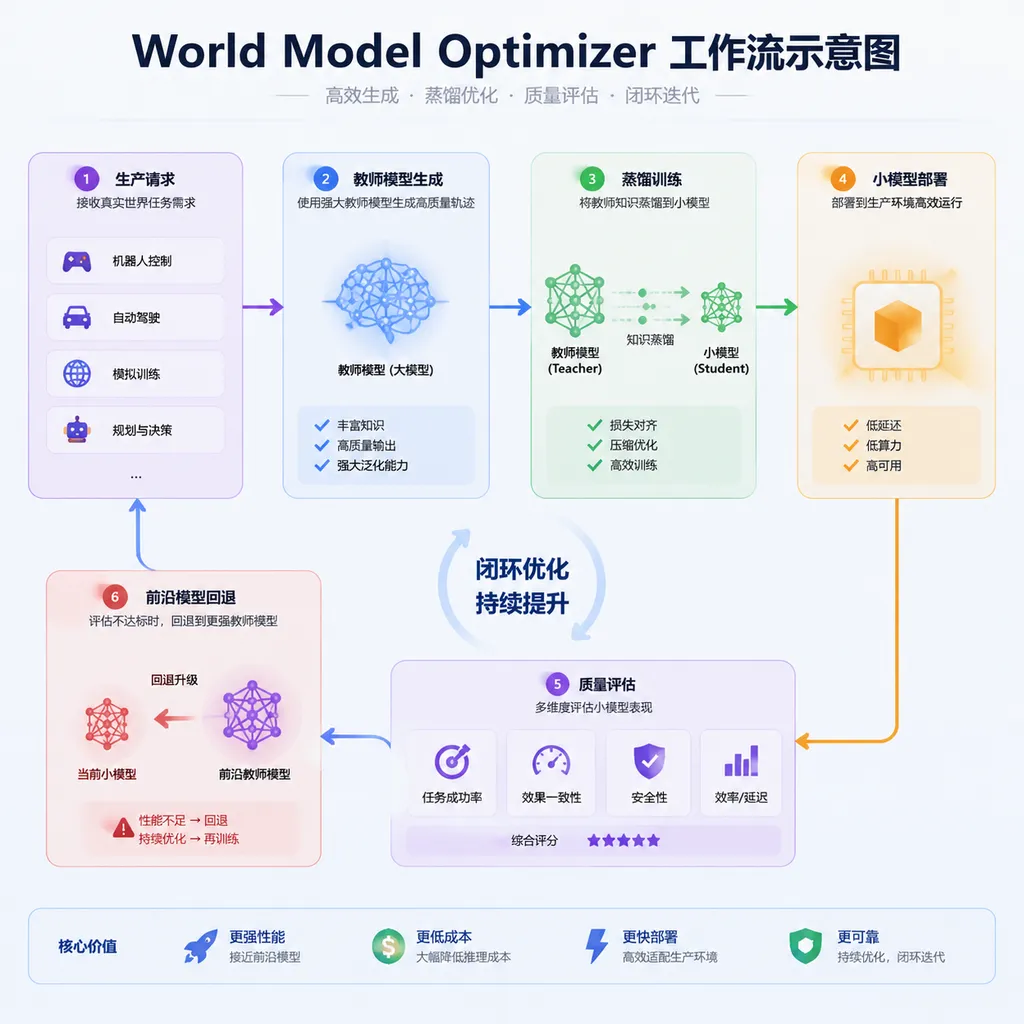
Breaking down WMO’s objective, an effective closed loop must address at least five stages:
- Collect the task distribution: Training samples should resemble real traffic rather than consist only of polished, manually written examples.
- Generate teacher signals: A highly capable model provides answers, classification labels, structured steps, or preference rankings.
- Filter and balance the data: Remove incorrect, duplicate, and privacy-leaking samples while adding coverage for rare, difficult categories.
- Train and evaluate the student model: Do not look only at average scores; examine how the model fails in critical scenarios.
- Continuously feed production data back into training: Route failed requests to the teacher model while turning them into data for the next training round.
The final step is especially important. One-time fine-tuning is more like taking a snapshot, while real businesses change every day. Product catalogs are updated, customer-support policies change, code repositories migrate, and attackers alter their prompt-injection techniques. Without a feedback mechanism, a small model may perform well when launched but begin to drift a month later.
WMO’s most noteworthy feature, therefore, is not that it is “yet another distillation script,” but that it attempts to put training and serving into the same optimization loop. The process does not end when the model is trained. Instead, the model serves requests, identifies weaknesses, and accumulates data for the next training round at the same time.
Cutting Costs in Half: How Should the Math Work?
There is no dispute that small models are cheaper to use. But a claim of “reducing total costs by 50%” cannot be based solely on comparing listed prices per million tokens.
The primary cost of the old approach can be approximated as:
Old cost = Request volume × (Input token cost + Output token cost)
After introducing distillation and self-hosting, the bill becomes:
New cost = Teacher-data generation
         + Training and repeated experimentation
         + Small-model inference
         + Fallback rate × Frontier-model calls
         + GPU, storage, monitoring, and operations
To achieve a genuine 50% reduction, the following condition must hold:
Teacher-data generation + Training + Self-hosted inference + Fallback calls + Operations
< 0.5 × Original frontier-model API cost
This formula reveals several issues that marketing materials often omit.
First, request volume must be high enough. If a team handles only a few thousand requests per day, the fixed costs of purchasing GPUs, maintaining inference services, and preparing training data may exceed the cost of calling an API directly. Distillation is not the default answer for low-traffic workloads.
Second, the task distribution must be relatively stable. For agents whose requirements change weekly and whose inputs are highly open-ended, the business may already have moved on to the next version of a workflow by the time the student model learns the previous one. Frequent iteration can consume all the savings through training costs.
Third, the fallback rate determines the economics. If 40% of requests handled by the small model still need to be passed to a frontier model, the team is effectively paying for two inference stacks at once. Conversely, if the small model can handle 80% to 90% of routine requests and only long-tail requests fall back, the economics become much easier to justify.
Fourth, savings on output tokens are usually more pronounced than savings on input tokens. If the workload depends on very long contexts, retrieved results, or enormous system prompts, the compute cost and latency of the prefill stage remain even after switching to a self-hosted small model. Distillation can compress capabilities, but it does not automatically eliminate context.
A 50% reduction is therefore more likely in scenarios that are high-frequency, repetitive, well-bounded, and stable in output format, and that have already relied on expensive models for a long time. For low-frequency, open-ended, and constantly changing tasks, it may not be more economical than mature API routing.
A Production-Ready Architecture Should Not Leave the Small Model on Its Own
The most dangerous production-deployment strategy is to see that a student model approaches teacher-model performance on an offline benchmark and then switch all requests to it at once.
A safer approach is tiered routing: simple tasks go to the small model, while low-confidence, out-of-distribution, or high-risk tasks fall back to a frontier model. The logic can be abstracted as follows:
Receive request
  → Check whether it belongs to the known task distribution
  → Small model generates a candidate result
  → Validate formatting, constraints, citations, or tool calls
  → Pass: Return directly
  → Fail: Escalate to frontier model
  → Add failed sample to the next distillation dataset
The hardest part is not deploying the model, but deciding when not to trust it.
A language model’s self-reported confidence is often unreliable. Even when it is wrong, the model may assign high probability to its output. More practical signals include:
- Whether JSON Schema or business-rule validation passes;
- Whether retrieved citations actually exist;
- Whether repeated samples produce consistent results;
- Whether the input’s vector distance from the training data is too large;
- Whether an independent classifier judges the answer to meet requirements;
- Whether tool-call parameters pass static validation;
- Whether the task falls into a high-risk category such as finance, healthcare, or access-control changes.
This means tools like WMO will ultimately compete not only on fine-tuning performance, but also on evaluation, routing, monitoring, and data governance. Training the model weights is only the first half of the job. Knowing when to fall back is the second.
“Frontier Quality” Must Be Limited to the Target Distribution
Few phrases in distillation are more likely to create misunderstanding than “approaching frontier-model quality.”
If the test set contains only template questions previously generated by the teacher model, the student model can naturally achieve impressive results. A genuinely useful evaluation should include at least four layers:
1. In-Distribution Holdout Set
Reserve data from real traffic that was not used for training to determine whether the student model has learned the task rather than memorized the samples.
2. Out-of-Time Test Set
Evaluate the model using new requests generated after training is complete to observe how well it adapts to business drift.
3. Adversarial and Boundary Samples
Deliberately include malformed formats, prompt injection, missing fields, conflicting evidence, and extremely long inputs. Average accuracy cannot expose these problems.
4. Online Shadow Traffic
Have the student model process real requests in parallel without returning its results to users, then compare its quality, latency, and cost against the current production model.
In addition, agreement with the teacher model should not be the only metric. Teachers make mistakes too. If the student model merely reproduces the teacher’s errors with high fidelity, the distillation metrics may look excellent while the actual product does not improve.
For verifiable tasks such as coding, mathematics, and structured extraction, compilers, test cases, and rule engines should be incorporated whenever possible. Open-ended text tasks should combine blinded human evaluation, pairwise preference evaluation, and business-outcome metrics. A customer-support summary that resembles the teacher’s output more closely does not necessarily resolve the user’s issue faster.
It Does Not Replace Caching, Prompt Optimization, or Model Routing
The distillation approach represented by WMO should not be understood as the only way to optimize costs.
Semantic caching addresses the problem of avoiding repeated computation for similar questions. Prompt optimization reduces the number of unnecessary tokens provided to the model. Model routing assigns models at different price points to tasks of different difficulty. Quantization enables the same model to run with less VRAM. Distillation, by contrast, changes the model itself, compressing general-purpose capabilities into business-specific ones.
In real-world systems, these methods are often combined:
- First, use caching to absorb completely repetitive requests;
- Then use rules or lightweight classifiers to filter simple tasks;
- Have the distilled small model handle most of the traffic;
- Fall back to a frontier model for difficult requests;
- Further optimize the small model itself through quantization and batching.
This combination is generally more reliable than “replacing every request with one cheaper model.” Cost optimization is fundamentally not about finding a single model with the lowest price. It is about ensuring that each type of request pays only for the compute it genuinely requires.
Data and Licensing May Be More Troublesome Than Training
Any distillation system based on production traces must confront data-related issues.
Enterprise logs may contain personal information, customer code, commercial contracts, access tokens, and internal decision records. Before requests are sent to a teacher model or added to a training set, organizations must implement anonymization, access isolation, retention-period controls, and deletion mechanisms. Deleting raw logs only after training is not enough, because sensitive information may already have entered the model weights.
Teams must also review the teacher-model provider’s terms of service and the license of the selected open-source student model. The technical ability to generate training data does not necessarily mean that legal and commercial terms permit using that data to train a competing model or offer services to external customers.
This is also why a mature distillation platform cannot consist of only a train button. At a minimum, it needs sample-provenance tracking, data versions, model versions, evaluation records, and rollback-capable deployments. Otherwise, if a batch of training data is later found to be problematic, the team may not even be able to determine which models were affected.
Assessment: The Direction Is Sound, but Do Not Confuse Target Numbers With Results
WMO is worth watching because it addresses a genuine tension in today’s model applications: frontier models are becoming increasingly capable, but many production requests do not need to keep paying for the full breadth of general intelligence. Using a powerful model to generate experience and then letting a small model take over stable tasks is a reasonable engineering path. Distillation efforts involving models such as DeepSeek-R1 have also shown that reasoning capabilities are not completely tied to parameter count.
However, both keywords in the project’s headline need qualification.
“Frontier quality” should mean approaching frontier performance under a specific task, a specific distribution, and specific evaluation criteria. “Cutting costs in half” should mean a 50% reduction in total lifecycle costs after accounting for training, fallback, GPU utilization, and operations. Without these conditions, the numbers mean little.
For development teams, the most practical adoption path is not to train a model immediately, but to do three things first:
- Analyze real requests from the past month and confirm whether stable task clusters account for most of the traffic;
- Build an automatically verifiable evaluation set and define what “good enough” means;
- Calculate the break-even point at different fallback rates before deciding whether to invest in distillation and self-hosting.
If all three steps produce clear answers, a toolchain like WMO can be valuable. It may allow teams to move from “buying frontier capabilities with every call” to “buying capabilities first, then turning them into proprietary model assets.”
If tasks remain highly open-ended, request volume is low, or the team does not even have a stable evaluation set, continuing to use mature APIs together with caching and routing will often save both money and labor.
Ultimately, a small model is not a free frontier model. It is an internal asset that depreciates, incurs maintenance costs, and becomes outdated as the business changes. WMO’s value lies in its attempt to connect the production, deployment, and updating of that asset into a closed loop. Whether it can truly cut the bill in half must ultimately be answered by live production traffic, not by a launch headline.
References
- World Model Optimizer GitHub Repository: Project code, objectives, and currently available documentation, proposing the distillation and serving of small models to reduce the cost of using frontier capabilities.
- Overview of DeepSeek Distillation and the Evolution of Reasoning Capabilities: Not included as an external reference; the relevant observations are used only to understand the industry context of transferring reasoning capabilities to smaller models.
- AI Frontier Recommendations by Aike AI: Discusses the trade-offs among reasoning-model production costs, output tokens, and prompt costs.