Meituan CatPaw Moves Beyond the IDE
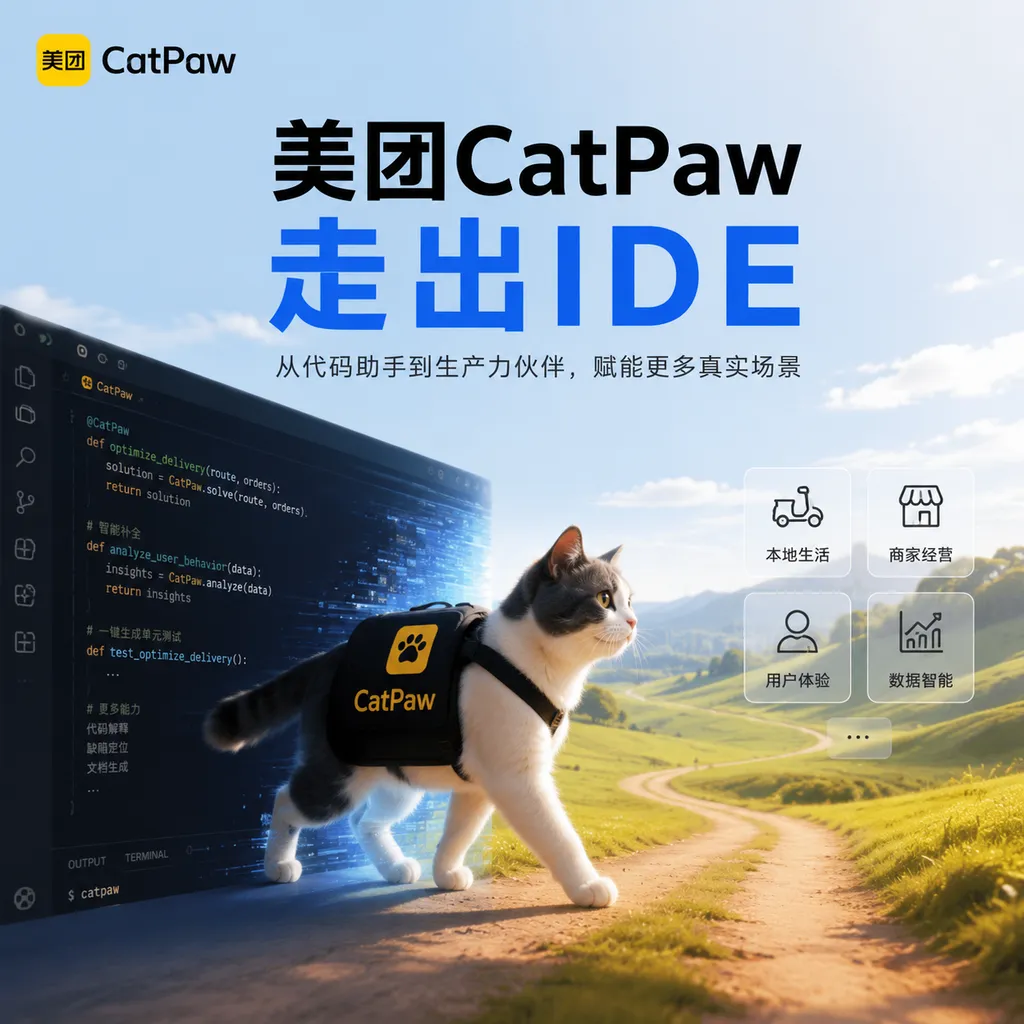
Meituan today launched CatPaw, an all-scenario AI agent platform. Internally, it already serves 90,000 employees and has enabled the creation of more than 30,000 agents. What truly deserves attention is not the numbers, but that Meituan has begun packaging its internal agent engineering capabilities as enterprise-grade infrastructure.
Meituan Expands CatPaw From a Programming Tool Into an Enterprise Agent Platform
On July 27, Meituan officially launched CatPaw, an AI Agent platform for all scenarios. According to official figures, the platform now covers 90,000 Meituan employees, has been used to build more than 30,000 Agents, and has been validated in real-world business scenarios including food service, beauty services, and veterinary hospitals.
The focus of this release is not another AI assistant that can chat and write copy. Instead, it offers two layers of capabilities: an AI-powered workspace that employees can use directly, and an enterprise platform for Agent development, hosting, and management.
In other words, Meituan aims to deliver not just “an intelligent agent,” but an assembly line for producing, running, and managing Agents at scale.
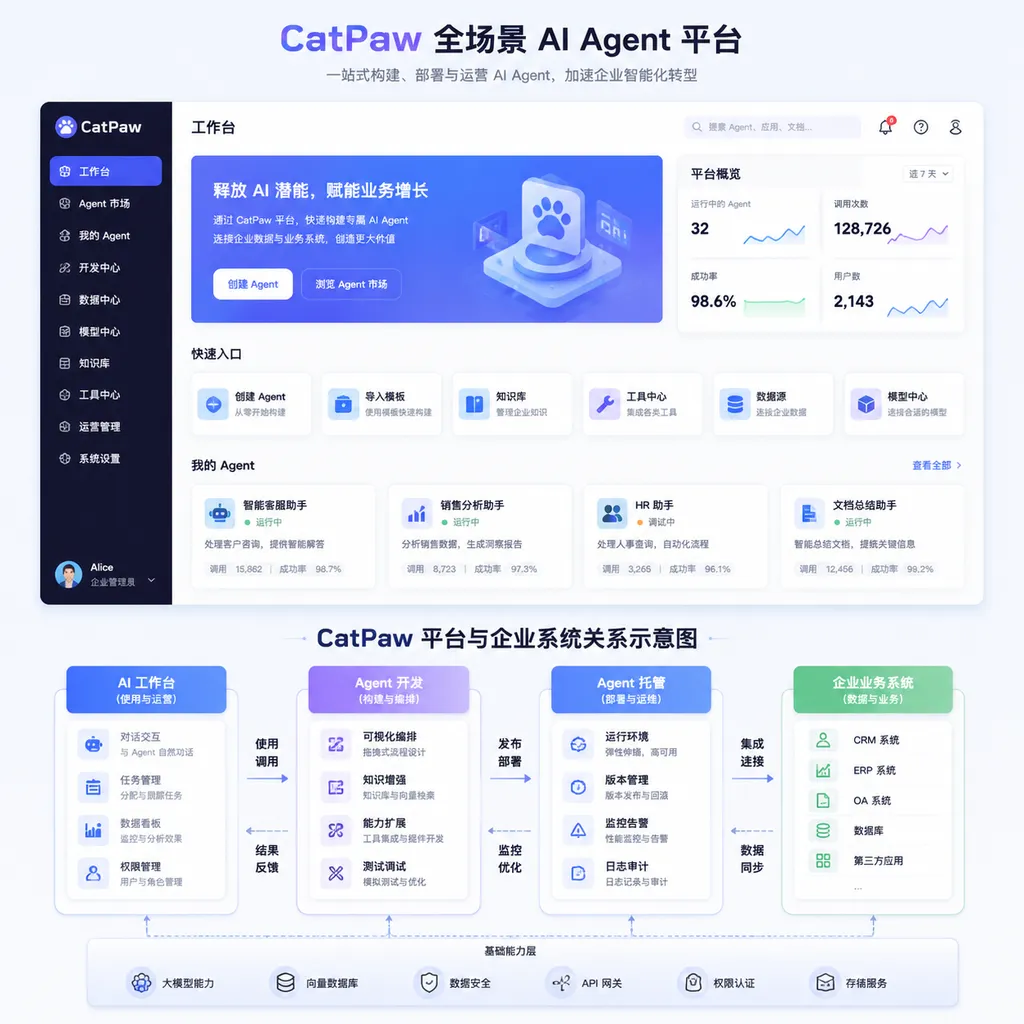
This also means that CatPaw is moving beyond its previously better-known positioning as an AI IDE and Coding Agent. In public information released in 2025, CatPaw was primarily described as an Agentic IDE for professional developers, integrating Meituan’s proprietary LongCat model, which was trained for programming scenarios, while also supporting hybrid calls to multiple models. Today, Meituan has added two new keywords to its positioning: “all-scenario” and “enterprise-grade.”
The product’s scope has clearly expanded.
30,000 Agents Show, First and Foremost, That Meituan Has Solved the Management Problem
The figure of 30,000 Agents is the most eye-catching number in this release, but it first needs to be put into context.
The official wording is that “more than 30,000 Agents have been built.” This does not mean that 30,000 Agents are always online, nor that they execute tasks simultaneously, and it certainly cannot be directly equated with 30,000 independent production systems. The total likely includes frequently used business Agents as well as internal team tools, personal workflows, and Agents still undergoing testing.
Even so, the scale remains significant.
A rough calculation based on 90,000 employees and 30,000 Agents works out to one Agent for every three employees. For enterprise software, this is no longer a proof of concept conducted by a small number of technical teams. It has entered the stage of organization-wide adoption. The platform must therefore address not only whether its models provide good answers, but also a series of more difficult questions:
- Who can create, modify, and publish Agents?
- Which databases, documents, and business APIs can an Agent access?
- How should permissions and data be isolated across departments?
- How should versioning be handled after Prompts, knowledge bases, or toolchains are updated?
- When a task fails, can the issue be traced to the model, the tools, or the data?
- When multiple Agents collaborate, how can recursive calls and runaway costs be prevented?
- How should permissions be revoked when employees leave or change roles?
- When an Agent makes an incorrect decision, can the process be audited, replayed, and assigned accountability?
Building a demo Agent is not difficult. Connect a model, configure a Prompt, and add search, a database, and several business tools, and it can be up and running in a day or two. The difficult part is keeping tens of thousands of Agents in production over the long term while ensuring they do not collectively spiral out of control because of model upgrades, API changes, or permission misconfigurations.
The most noteworthy aspect of CatPaw, therefore, is not that “there is yet another Agent platform,” but that it has already undergone at least one large-scale organizational validation within Meituan. The 30,000 Agents are better understood as an achievement in platform engineering than merely an application count.
What Enterprises Really Need Is Not More Chat Windows
Over the past two years, enterprise Agent products have often fallen into a common trap: renaming a chat interface, adding a knowledge base and workflows, and calling the result a “digital employee.”
But enterprises do not lack chat windows.
An Agent for a restaurant operator might need to read store performance data, identify sales anomalies, and provide inventory recommendations based on stock levels, weather, holidays, and platform promotions. It might then generate a marketing plan and, after receiving approval from the person in charge, call business systems to execute it. An Agent for a veterinary hospital could face entirely different data structures, domain knowledge, and compliance boundaries. It would need to handle appointments and follow-ups while avoiding the direct use of model-generated content as a clinical diagnosis.
What these tasks have in common is that none can be completed with a single model call.
A usable enterprise Agent generally cycles through the following stages: understanding the task, retrieving context, selecting tools, executing operations, checking results, and requesting human confirmation. The industry commonly uses approaches such as ReAct to describe this architecture of alternating reasoning and action. In engineering terms, however, it is more like a large-model-driven workflow engine with inherent uncertainty.
Each node in a conventional workflow is relatively deterministic: if the input meets condition A, execute action B. An Agent, by contrast, may decide on the fly which tool to call, what additional information to gather, or even how to adjust its execution steps based on the context. It is more flexible, but also more difficult to control.
This is precisely why enterprise Agent platforms exist. They need to wrap a layer of determinism around the open-ended nature of models:
- Identity and access control: Agents should only be able to access the data necessary to complete their tasks;
- Tool registration and invocation governance: The inputs, outputs, timeouts, and failure-handling policies of every API must be clearly defined;
- Context engineering: Enterprise documents, historical tasks, and real-time business data must be accurately delivered to the model rather than simply piled into the context window;
- Evaluation and observability: Task success rates, tool calls, Token consumption, latency, and human takeover rates must be continuously recorded;
- Human approval checkpoints: Humans must be able to intervene in high-risk actions involving refunds, procurement, publishing, clinical recommendations, and similar activities;
- Version and cost management: Changes to models, Prompts, and tools should support staged rollouts, while costs per task and departmental budgets must remain under control.
CatPaw’s currently available public information does not fully disclose how extensively each of these capabilities has been implemented. However, its positioning around “development and hosting” already indicates that Meituan is targeting the entire Agent lifecycle rather than just the creation stage.
Meituan’s Advantage Is Its Abundance of Complex, Real-World Tasks
Enterprise Agent platforms are nothing new. Cloud providers, office software companies, low-code platforms, and large-model startups are all competing for this market. In China alone, Tencent Cloud upgraded its enterprise Agent product portfolio in June, launching the enterprise edition of WorkBuddy and the Agent Suite for workplace Agents. Other major technology companies are likewise combining models, knowledge bases, workflows, and workplace entry points into platforms.
CatPaw’s differentiation may not come from its models.
Today, it is difficult for an Agent platform to build a moat solely by tying itself to a particular model. Model capabilities are changing too quickly, and enterprises are increasingly inclined to choose different models for different tasks: high-performance models for complex reasoning, inexpensive small models for bulk classification and summarization, and potentially privately deployed models for sensitive business operations. What truly retains customers is a platform’s ability to connect with business systems, its engineering reliability, and its industry templates.
Meituan happens to possess a dense array of highly time-sensitive offline business scenarios.
Food service, beauty services, and veterinary hospitals are not purely online content-production businesses. They involve physical stores, inventory, fulfillment, customer communication, transactions, and after-sales service, with many tasks spanning online systems and offline operations. Whether an Agent’s recommendations are effective can ultimately be measured through orders, conversion rates, response times, and operating costs—not merely whether users think the answers “sound human.”
This gives Meituan two advantages:
- A sufficiently large internal testing ground: Its 90,000 employees can quickly expose problems involving permissions, collaboration, and stability;
- Sufficiently deep business closed loops: The platform can validate Agents across real operational processes rather than stopping at document-based question answering.
But the flip side of these advantages is also a challenge. Meituan’s internal systems, data, and organizational processes are highly mature. Just because CatPaw works internally does not mean it can be seamlessly replicated for external merchants. Data at small and midsize merchants is often scattered across spreadsheets, point-of-sale systems, instant messaging platforms, and multiple SaaS tools, while data quality is also inconsistent. The platform must first solve the problems of connectivity and data cleansing before Agents can access reliable context.
If a store does not even use consistent product codes and inventory records, even the most capable model can only produce more fluent wrong answers based on bad data.
Expanding From a Coding Agent to All Scenarios Makes Technical Sense
CatPaw’s previous investment in Coding Agents has provided a reusable underlying architecture for this expansion.
Programming itself is one of the most complex Agent use cases—and one of the easiest to validate. A model must understand a codebase, retrieve files, modify code, invoke terminal and testing tools, and continue iterating based on the results. This process is highly similar to how enterprise Agents handle business tasks: both require context, tool invocation, multi-step planning, sandbox environments, and result validation.
Meituan representatives previously noted that CatPaw’s Agent architecture involved stronger ReAct capabilities, proprietary models, complex execution chains, and customizable context engineering, tool processes, Prompts, and Rules. These capabilities are not inherently limited to coding. Replace the code repository with an enterprise knowledge base and the terminal tools with order, inventory, and customer systems, and the underlying approach still holds.
Expanding from an AI IDE into an all-scenario Agent platform is therefore not an unrelated pivot. It is more like opening up an Agent runtime already validated in programming scenarios for use in business operations.
However, there remains one crucial difference between writing code and executing business operations: code can be tested in a sandbox, while business actions may be irreversible. If a model writes incorrect code, it can be rolled back. If a model incorrectly issues a refund, changes inventory, or publishes marketing content, the cost immediately affects real-world operations.
For CatPaw to become a reliable enterprise platform, the key is not making Agents “more autonomous,” but finding the right boundary between autonomous execution and human control. Enterprise customers generally do not seek completely unattended operation. They care more about predictability, auditability, and the ability to contain losses promptly when something goes wrong.
30,000 Agents Alone Are Not Yet Enough to Judge CatPaw’s Commercial Viability
Judging from its product signals, CatPaw has taken a critical step from an internal tool toward an external enterprise platform. However, the information Meituan has disclosed so far remains relatively general, and several questions that will directly determine its market competitiveness have yet to be fully addressed:
- How can external enterprises gain access, and will the platform be open to all merchants?
- Which models are supported, and can the platform automatically route tasks between different models?
- Does it support private deployment or dedicated cloud environments?
- How are Agent runtime environments, data residency, and permission auditing implemented?
- Does it provide standardized industry templates and a marketplace for third-party tools?
- Is pricing based on seats, usage volume, Tokens, or the number of tasks executed?
- What SLA and service-credit mechanisms are provided for production tasks?
- How much efficiency improvement has been achieved in validated scenarios, and what are the human takeover and task success rates?
In particular, “validation completed” remains a broad statement. For developers and enterprise technology leaders, more important metrics than the number of Agents include the end-to-end task success rate, P95 latency, cost per task, permission incident rate, and the actual number of manual steps eliminated after deployment.
Without public disclosure of these metrics, the 30,000 Agents demonstrate the platform’s internal penetration more than they prove its external commercial value.
CatPaw Is Competing to Become the Control Plane for Enterprise Agents
Looking at broader industry trends, Agents are evolving from individual product features into a new software runtime layer. In the future, enterprises may not deploy a single general-purpose Agent, but rather a collection of specialized Agents: some for data analysis, some for customer service, some for generating operational plans, and others for calling internal systems to execute tasks.
As the number of Agents increases, the platform’s value will shift from “helping users create Agents” to “centrally managing all Agents.” This is similar to the evolution of cloud computing: enterprises initially cared about whether they could provision a server, but as deployments scaled, scheduling, monitoring, permissions, costs, and security became more important.
This is precisely the control plane CatPaw is targeting.
Meituan’s 30,000 internal Agents show that this need is no longer theoretical. What the platform must demonstrate next is whether capabilities developed through Meituan’s complex business operations can be reused by external enterprises at a sufficiently low integration cost.
Our assessment is that CatPaw’s launch is substantial, but the real test has only just begun. Its scale of internal adoption makes it more credible than most Agent platforms still stuck in the demonstration stage. Vertical scenarios such as food service, beauty services, and veterinary hospitals are also more likely to form complete business closed loops than generic workplace question-answering. However, without standard connectors, transparent pricing, observable metrics, and an industry implementation framework, it could still become a heavyweight platform that “works extremely well within Meituan but is difficult for external customers to integrate.”
Competition in enterprise Agents is no longer about who can build a bot the fastest. It is about who can enable tens of thousands of Agents to work safely, reliably, and at predictable costs. CatPaw has earned its entry ticket with 30,000 internal Agents. Its next step is to prove itself through the business results of external customers.
References
- Zhihu: Meituan Releases the Public Beta of Its AI IDE Product CatPaw: Used to understand CatPaw’s previous positioning as an AI IDE, as well as the background of the LongCat model and multi-model invocation.
Note: The launch date, scale of internal adoption, and business validation details for this release of CatPaw are based on information publicly disclosed by Meituan on July 27.