Gemini 4 Starts Training, Google Plays Catch-Up on Agents

Google has confirmed that Gemini 4 is now in training and, in a rare admission, acknowledged that its coding and agent capabilities still lag behind. In the next round of frontier-model competition, the focus is shifting from chat and leaderboards to real-world task execution.
Google Confirms Gemini 4 Is Already in Training
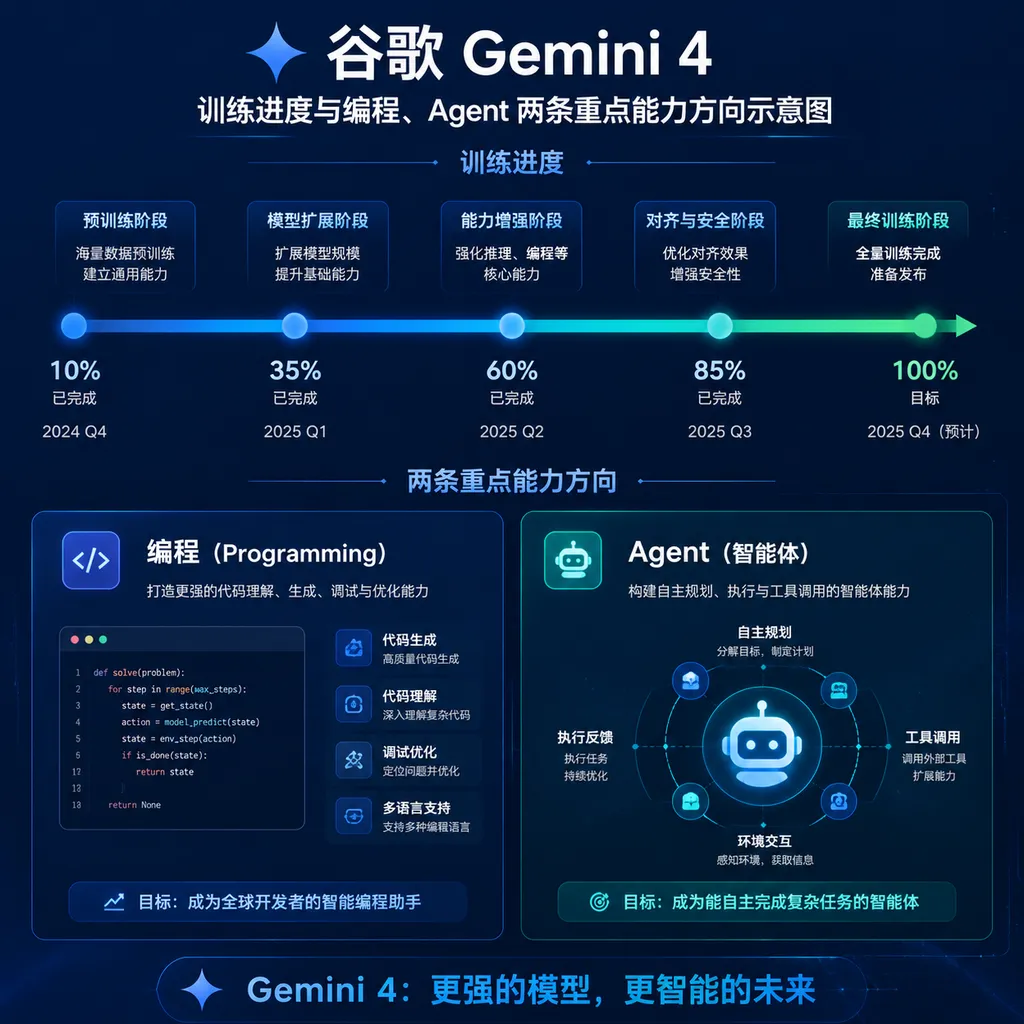
Google’s next-generation frontier model, Gemini 4, has entered training.
According to information disclosed during Alphabet’s Q2 2026 earnings call on July 26, Google CEO Sundar Pichai confirmed in response to an analyst’s question that the team is training Gemini 4 and has committed “very substantial resources” to the effort. He also said he was pleased with the progress so far and confident that the final product would satisfy users.
This is the first time Google’s CEO has explicitly confirmed the training status of Gemini 4. But more noteworthy than the fact that “the next-generation model is on the way” is Pichai’s assessment of the competitive landscape: Gemini still has shortcomings in coding and agents, and Google hopes to catch up with the frontier when Gemini 4 launches.
For a company that typically emphasizes its leadership “across multiple dimensions,” this was a remarkably candid admission.
As of July 27, Google had not disclosed Gemini 4’s parameter count, context window, training data, inference architecture, or official release date. Based on the Gemini series’ previous release cadence, technology media outlets have speculated that it could debut in November or December this year, but Google has not provided an official date.
With 3.5 Pro Absent, Gemini 4 Faces Greater Pressure
The news about Gemini 4 comes at a somewhat awkward moment.
Gemini 3.5 Pro, which the market had expected to launch in June, failed to appear on schedule. Google did not explain the delay in detail during the earnings call, but it has clearly affected external perceptions of the company’s ability to execute on the Gemini roadmap. With frontier models being updated on a cycle measured in months, the absence of an intermediate release could mean that evaluations fell short of targets, product integration lagged behind schedule, or Google revised its release strategy and redirected more resources toward its next-generation foundation model.
What can now be confirmed is that Gemini 4 is more than a routine generational upgrade. It has also been tasked with two objectives:
- Prove that scaling foundation-model training remains effective, continuing to deliver substantial gains from data, compute, and training methods;
- Close the gaps in coding and agent capabilities, enabling Gemini not only to excel at knowledge-based Q&A, multimodal understanding, and benchmarks, but also to take over complex workflows in practice.
These two objectives are not entirely the same.
A larger foundation model can improve knowledge coverage, raise the ceiling for reasoning, and enhance generalization across tasks. But the real-world effectiveness of a coding agent also depends on post-training, tool use, long-context management, environmental feedback, and error recovery. In other words, Google can train a smarter “brain” without necessarily producing a reliable “engineer.”
Pichai’s emphasis on the need for a larger foundation model in the next generation indicates that Google has not abandoned scaling. But by specifically naming coding and agents, he also acknowledged that simply expanding pretraining is no longer enough to define leadership.
The Main Battleground for Frontier Models Has Shifted
Over the past two years, competition among frontier models has often been reduced to a handful of intuitive metrics: parameter count, context length, math scores, and whether multimodality is native. In 2026, these capabilities remain important, but they increasingly resemble the price of admission.
The new dividing line is whether a model can reliably use tools, modify state, and take responsibility for execution outcomes over tasks lasting tens of minutes or even several hours.
Take programming as an example. Traditional coding benchmarks typically give a model a prompt and ask it to generate a function or complete a piece of code. Real-world software engineering tasks are entirely different. The model must complete an entire workflow:
- Read an unfamiliar repository and locate the relevant modules;
- Understand the requirements, historical implementation, and implicit constraints;
- Modify multiple files rather than generating a single function;
- Run tests, analyze errors, and continue iterating;
- Limit the scope of changes to avoid fixing one problem while introducing three regressions;
- When unable to complete the task, accurately identify the blocker instead of fabricating a successful result.
Agent tasks go a step further. A model may need to operate browsers, command lines, databases, internal enterprise APIs, and third-party services. A single incorrect tool parameter, permission error, or omitted piece of context can cause the entire task chain to fail.
This is why “smarter single-turn responses” do not necessarily translate into “more useful agents.” A chat model is like a student taking a closed-book exam, while an agent is more like an engineer who has just joined a team: it must not only know the answers, but also know where the code is, how to use the tools, how to roll back after a failure, and when to stop and ask a human for confirmation.
Google Does Not Lack Tools—It Lacks the Reliability to Connect Them
In terms of resources, Google has everything it needs to build agents.
It owns Search, Chrome, Android, Workspace, Cloud, one of the largest developer ecosystems outside GitHub, custom TPUs, and a complete data-center infrastructure. In theory, Gemini has access to a richer range of real-world task environments than the models of most other companies.
The problem is that product and infrastructure advantages do not automatically translate into model execution capabilities.
A genuinely useful agent must address at least four categories of problems:
1. Long-Horizon Planning Cannot Be Correct Only at the Beginning
Models can often produce seemingly reasonable task plans, only to drift away from the objective after executing a few steps. Long-running tasks require the model to continuously inspect intermediate states and revise its plan based on tool outputs, rather than mechanically following its initial steps to the end.
2. Tool Use Must Progress From “Capable” to “Rarely Wrong”
Correct function-call formatting is only the minimum requirement. Production environments care more about whether parameters are appropriate, permissions are correctly matched, calls are idempotent, and failures can be retried or rolled back. A successful one-off demonstration is not difficult; executing dozens of consecutive calls without errors is.
3. Coding Requires Repository-Level Understanding
What developers are truly willing to pay for is not the generation of boilerplate code, but a model that can take over an issue, fix a bug, add tests, and complete a refactor. In this setting, a longer context window does not mean the model can distinguish critical files from noise. Retrieval, code indexing, dependency graphs, and runtime feedback must all work together.
4. Cost and Latency Must Be Controllable
Agents repeatedly reason and call tools, potentially consuming dozens of times more tokens than an ordinary conversation. If every step depends on the highest-tier model, the task may lack commercial value even if it can be completed. Frontier models therefore typically need to work alongside faster, cheaper Flash-class models: the large model handles planning and critical decisions, while smaller models perform retrieval, classification, format conversion, and some tool operations.
This is the logic behind Google’s recent emphasis on the importance of highly efficient models for large-scale agent workflows. Agent products will ultimately compete not on peak scores for a single response, but on task-completion rates per unit of cost.
How Should We Interpret Gemini 4’s “Larger Scale”?
Pichai explicitly said that the next-generation frontier model requires a larger foundation model. This statement can easily be interpreted as a simple parameter race, but the actual investment likely spans more areas, including training compute, data cleaning and synthesis, reinforcement-learning environments, inference-time compute, and training trajectories designed for tool use.
It is currently impossible for outside observers to confirm whether Gemini 4 will adopt a new mixture-of-experts architecture or whether “larger scale” refers specifically to parameter count or total training compute. Google has not disclosed these technical details, so there is little value in debating a specific parameter figure at this point.
A more important question is how Google will allocate the additional compute.
If substantial resources continue to flow into general-purpose pretraining, Gemini 4 could see broad improvements in knowledge, multimodality, and complex reasoning. If more of the budget goes toward reinforcement learning in verifiable environments, its gains may be more pronounced in code repair, terminal operations, and browser-based tasks. The latter is also an area in which frontier labs are broadly increasing investment: allowing models to make repeated attempts in environments with clear outcome feedback, rather than merely learning from static text written by humans.
Code is naturally well suited to this type of training because whether tests pass, programs run, or performance improves can all provide relatively objective reward signals. Agents can also be trained in sandboxed environments, but their task states are more complex, rewards are sparser, and safety boundaries are harder to design.
Coding is therefore both a standalone product capability and a training ground on the path toward general-purpose agents. By highlighting these two areas, Google is not simply placing two parallel features on its roadmap—it is betting on a continuous path of capability development.
A Year-End Release Is Far From Certain
Based on Gemini’s previous release cadence, November or December is indeed a plausible window. But Gemini 3.5 Pro’s failure to launch as expected in June also shows that a release date cannot be inferred from historical cadence alone.
Large-model releases are also affected by multiple factors:
- Whether training converges as planned;
- Whether post-training and safety evaluations meet their targets;
- Whether inference infrastructure can support a large-scale rollout;
- Whether APIs, consumer products, and enterprise services are all ready at the same time;
- Whether the improvement over the previous generation is substantial enough to justify a new generational name.
Agent capabilities in particular are more prone than chat models to the gap between “impressive in a demo” and “unreliable in production.” Labs can select tasks that suit their models for demonstrations, but developers must contend with real systems involving chaotic permissions, missing dependencies, outdated documentation, and inconsistent environments. If Gemini 4 is to prove that it has caught up with the frontier, it cannot merely post a few new first-place benchmark results. It must demonstrate consistent gains in cross-repository coding tasks, long-horizon tool use, and error recovery.
Developers Should Not Rush to Redesign Their Architectures Around a Name
Gemini 4 entering training means Google has made its priorities for the next generation of model competition very clear, but it remains a product under development. Without an API, pricing, rate limits, or real-world test results, developers do not need to restructure their existing systems around Gemini 4 in advance.
Three preparations would be more practical:
- Decouple the model layer from the tool layer. Do not bind business processes to a single provider’s proprietary invocation format; preserve room for model replacement and routing.
- Build your own task set. Public leaderboards cannot represent internal enterprise codebases and workflows, so organizations should begin accumulating reproducible agent evaluation samples.
- Log complete execution traces. In addition to final answers, retain tool parameters, returned results, retry counts, token costs, and points of human intervention.
Once Gemini 4 is actually released, the standard for deciding whether it is worth migrating to should also be straightforward: on the same set of real-world tasks, can it complete more work at lower cost and with less human intervention?
Why This Confirmation Matters: Google Acknowledges That the Standard for Leadership Has Changed
The fact that Gemini 4 has entered training is not surprising in itself. Any company still competing at the frontier will continue training its next-generation systems. What is genuinely informative is that Google’s leadership has publicly acknowledged that it still needs to catch up in coding and agents, and has identified both as priority areas for Gemini 4.
This means the industry’s definition of the “most powerful model” has changed.
Whether a model can produce an elegant answer is becoming less important. The core of the next round of competition is whether it can enter a complex environment, understand its state, use tools, continuously correct itself, and deliver results. Programming is simply the first scenario to be validated at scale; office automation, data analysis, cybersecurity, and enterprise operations will all move in the same direction.
For Google, the key question for Gemini 4 is not whether it can once again top a new batch of benchmarks, but whether it can combine existing assets such as Search, browsers, cloud infrastructure, and developer tools into a reliable execution system. If only the foundation model is larger, it will be a routine upgrade. If coding and agent task-completion rates improve by a full generation, it could become the release that redefines Google’s position at the frontier.
For now, Google has merely confirmed that training has begun. The real test will start only after the model enters developers’ code repositories and production workflows.
References
- ITHome: Google CEO Sundar Pichai Says Gemini 4 Has Entered Training — Summarizes information from Alphabet’s Q2 2026 earnings call and reviews Gemini 4’s training status, priority capability areas, and external speculation about its release date.