The Surgical Robot Now Has Real-Time Dreams

NVIDIA recently open-sourced Cosmos-H-Dreams, which uses a generative world model to simulate in real time the visual changes resulting from surgical robot actions. What it truly addresses is the tissue deformation and complex visual feedback that traditional physics-based simulation struggles to capture.
NVIDIA Brings Generative Simulation into the Operating Room
NVIDIA recently released and opened access to Cosmos-H-Dreams, a real-time generative world model designed for training surgical robots. As of July 27, the model weights, inference instructions, and related code resources have been made public, allowing developers to feed robot kinematic actions into the model and continuously generate what will happen next in a surgical scene.
This is not an ordinary video generation model that creates surgical videos from prompts.
Cosmos-H-Dreams takes the current surgical view and robot actions—such as robotic arm poses, instrument opening and closing, and motion trajectories—and predicts the continuous RGB video frames that will appear after those actions are executed. NVIDIA’s intended use cases include surgical skills training, interactive demonstrations, closed-loop evaluation of robot policies, evaluation of vision-language-action models, and synthetic training data generation.
Simply put, a traditional simulator calculates where an instrument has moved; Cosmos-H-Dreams goes one step further and attempts to answer: After the instrument moves this way, what will the camera see?
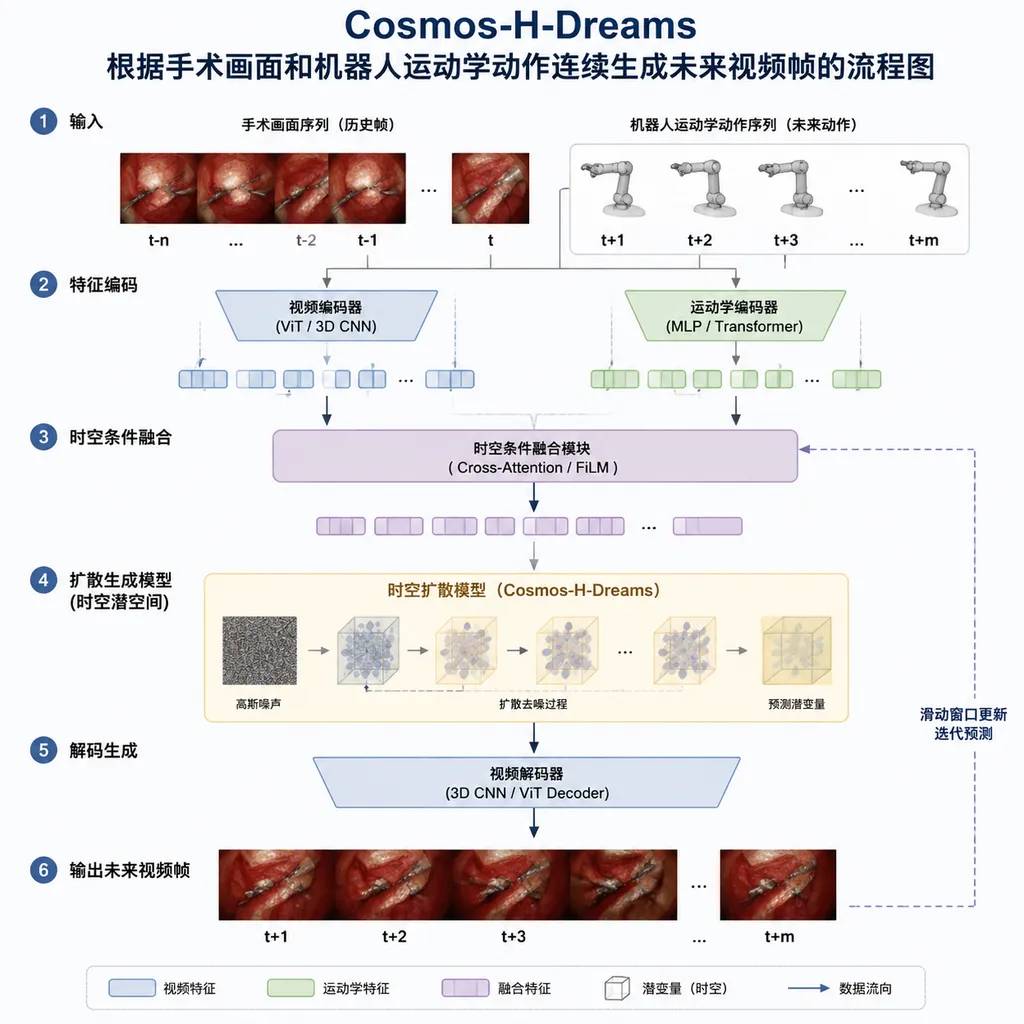
This is a noteworthy step. Surgical robots are not picking up blocks from a rigid tabletop. Soft tissue stretches, occludes, reflects light, and leaks fluid, while contact between instruments and tissue produces visual changes that are difficult to encode manually. In the past, this part of the problem relied either on expensive real-world data or on engineers modeling each element individually in a physics engine. Both approaches are slow.
The value of Cosmos-H-Dreams lies not in completely replacing physics engines, but in adding a real-time “visual consequence predictor” for surgical robots.
Generating 12 Frames at a Time, Then Continuing from the Result
Cosmos-H-Dreams is derived from NVIDIA’s Cosmos-Predict2.5-2B world foundation model for Physical AI. Its teacher model was warm-started from the Open-H 44D action-conditioned checkpoint of Cosmos-H-Surgical-Simulator, then converted through a teacher-student pipeline into a model better suited to real-time inference.
There are three key technical points.
1. The Generation Process Is Constrained by Robot Actions
An ordinary image-to-video model knows only that “the scene should move naturally”; it does not know what specific commands the robot controller has issued. Cosmos-H-Dreams uses robot kinematic actions as conditions, aligning the generated results with the robotic arm’s actual movements.
The difference can be summarized as follows:
- Ordinary video model: guesses how the scene is most likely to change;
- Action-conditioned world model: predicts how the scene should change after a specified action is executed.
Only the latter is suitable for integration into a closed-loop policy training system. If the robot moves left while the simulated video shows the instrument moving right, even the highest-quality generation has no training value.
The teacher checkpoint used by Cosmos-H-Dreams includes 44-dimensional action conditioning. These conditions are not natural-language prompts, but structured control signals associated with the robot’s state and kinematics. The model must learn not only the visual textures of surgical video, but also the mapping between actions and transitions in visual state.
2. Video Is Generated in 12-Frame Blocks
In each iteration, the model outputs a 12-frame video block, then feeds the new result into the next round of autoregressive generation. The logic can be abstracted as follows:
Current visual context + current kinematic action
                         ↓
             Generate the next 12 frames
                         ↓
Update context and action → Generate the next 12-frame block
This is better suited to robot control than generating an entire video in one pass. The controller does not need to know the full trajectory in advance. It can adjust its action after observing the new state, after which the model continues predicting based on the new action, creating an “observe–act–predict–observe again” loop.
In other words, it is not rendering a video from a predetermined script. It is attempting to build a generative environment that can be controlled in real time.
3. A Bounded KV Cache Keeps Long-Running Costs Under Control
Autoregressive models have a long-standing problem: the longer the context, the greater the memory usage and computational cost. Surgical trajectories may last for several minutes, and retaining every historical frame would quickly make inference costs unmanageable.
Cosmos-H-Dreams uses a bounded-memory KV cache for streaming generation, retaining only a limited amount of historical state. In theory, this allows the system to continuously generate surgical trajectories of arbitrary length rather than being constrained by a context window after a fixed number of seconds.
However, “capable of generating arbitrary lengths” does not mean “reliable at any length.” Each generation cycle depends on the results of the previous one, so minor errors can gradually accumulate. Drift in instrument position, abrupt changes in tissue texture, and incorrect occlusion relationships may all become amplified over long trajectories. This remains one of the most difficult technical debts facing generative world models.
It Addresses the Weaknesses of Traditional Simulation Rather Than Replacing Physics Engines
Surgical simulation has traditionally relied primarily on physics models: defining tissue material parameters, instrument geometry, collision relationships, and contact forces, then advancing the state through numerical computation. The advantage is clear causality and interpretable parameters. The disadvantage is the high cost of modeling soft tissue, while the visual results often still differ substantially from real surgery.
Generative models are almost the opposite. They excel at learning tissue appearance, lighting, smoke, reflections, and non-rigid deformation from data, without requiring engineers to write rules for every visual change. However, they do not inherently guarantee physical correctness.
Cosmos-H-Dreams is therefore more appropriately positioned as the visual layer in a hybrid simulation pipeline:
- The robot controller produces an action;
- A kinematics or physics module maintains a verifiable structural state;
- The generative model predicts the corresponding visual changes;
- The robot policy outputs the next action based on the new view;
- An evaluation system checks task completion, collisions, and abnormal behavior.
This division of labor resembles the separation between the logic and rendering layers in a game engine: the logic layer ensures that a character has actually hit a wall, while the rendering layer makes that wall look realistic. The difference is that Cosmos-H-Dreams does not “render” through traditional rasterization, but through data-driven future-state generation.
This is also why we believe it is more useful than a basic medical video generation model. Attractive videos are useful only for demonstrations; action-consistent video prediction with sufficiently low latency may become infrastructure for robot training.
Real Time Matters More Than Higher Resolution
Cosmos-H-Surgical could already perform high-quality surgical video prediction and cross-modal conversion, but high-quality generation typically required several minutes. Public test data shows that the end-to-end time needed to generate a task video on different data center GPUs could still reach hundreds or even thousands of seconds. That is suitable for offline synthetic data generation, but not for control loops.
Cosmos-H-Dreams takes a different approach: it distills a lighter 2B-parameter student model from the teacher model, shifting the focus from “generating the highest-quality video possible” to “continuously outputting the next state while receiving actions.”
For robot training, real-time performance does indeed take priority over cinematic image quality. A policy may need to observe and make decisions multiple times per second. If a simulator takes several minutes to generate a dozen frames, closed-loop training is simply impractical.
Related public materials also state that large-scale GPU parallelism can reduce certain training or evaluation workflows from more than five hours to under two minutes. However, such figures are highly dependent on the amount of hardware, scene scale, trajectory length, and measurement methodology. They should not be interpreted as meaning that “all surgical robot training is now 150 times faster.” The truly meaningful metrics remain:
- The frame rate of a single simulation instance and the action-to-image latency;
- The number of environments that can run in parallel across multiple GPUs;
- Whether action consistency degrades over long trajectories;
- Whether training with synthetic data improves success rates on real hardware;
- Whether abnormal actions and out-of-distribution scenarios cause simulation failures.
What NVIDIA has demonstrated so far is that real-time generative surgical simulation “can be made to run.” It has not yet demonstrated that it can unconditionally replace mature medical robot validation systems.
The Greatest Risk Is Not That the Images Look Unrealistic, but That the Errors Look Too Real
Surgical scenarios place far greater demands on world models than games or general-purpose robot videos.
If a household robot simulation generates a misshapen cup handle, it usually only reduces training efficiency. If a surgical simulation incorrectly predicts the contact relationship between an instrument and tissue, however, the policy may learn dangerous actions. More troublingly, generative model errors do not always manifest as obvious visual breakdowns. The model may generate results that look entirely plausible but are physically incorrect.
Developers must, at minimum, be alert to the following issues:
Contact and Force Cannot Be Validated from RGB Alone
The primary outputs of Cosmos-H-Dreams are RGB frames. The images may depict tissue being pulled, but they do not directly provide reliable information about contact force, stress distribution, or the extent of damage. Tasks involving suture tension, puncture depth, and tissue tearing still require physical sensors, force-feedback models, or specialized annotations.
Long-Horizon Autoregression Accumulates Drift
The 12-frame streaming architecture addresses context costs, but it does not eliminate error propagation. A short segment appearing correct does not mean that the instruments and tissue will remain topologically consistent several minutes later.
Data Coverage Determines the Limits of Capability
The model is more likely to handle instruments, procedures, and viewpoints that commonly occur in the training data. Rare bleeding events, lens contamination, instrument failures, and abnormal anatomy are precisely the areas that safety evaluations most need to cover—and the areas for which data is scarcest.
Success in Simulation Does Not Equal Clinical Safety
The model is suitable for pretraining, policy screening, and stress testing, but it cannot independently support medical device certification. Before clinical use, validation must still include experiments on real hardware, animal or ex vivo tissue testing, fault injection, and regulatory-compliant verification processes.
Cosmos-H-Dreams is therefore more like a high-throughput training ground than a digital operating room. It can allow robots to make millions of mistakes in a low-cost environment, but it cannot prove that they will not make mistakes on real patients.
Open Weights Give Hospitals and Robotics Companies the Opportunity to Build Their Own World Models
Cosmos-H-Dreams model resources are available on Hugging Face under the NVIDIA Open Model License and may be used in both commercial and non-commercial settings. It is important to note that this type of open-model license should not be treated as equivalent to an open-source software license as defined by the OSI. Before deployment, organizations should still review the specific terms, data compliance requirements, and regional restrictions.
Open weights are especially important to the healthcare industry. Data held by hospitals, research institutions, and surgical robotics companies is often highly proprietary and subject to privacy and ethical constraints, making it impossible to upload everything to a third-party closed service. A locally deployable model allows institutions to fine-tune, evaluate, and audit within their own data boundaries.
However, having 2B parameters does not mean the model can simply be loaded onto any consumer graphics card and used for a real-time closed loop. The primary burden of a video world model comes not only from its parameter count, but also from multi-frame visual features, intermediate activations, the KV cache, and continuous decoding. “Real time” in the model card should be understood as achieving interactive speeds on suitable NVIDIA GPUs with an optimized inference stack—not as plug-and-play performance on all hardware.
Generative Simulation Is Evolving from a Data Factory into a Training Environment
Over the past two years, the robotics industry has primarily used generative models to expand datasets: changing backgrounds, modifying lighting, and synthesizing different objects before using the resulting data for offline training. Cosmos-H-Dreams goes one step further by placing the generative model inside the control loop, allowing it not only to produce training datasets but also to directly serve as the environment.
If this approach proves viable, its significance will extend well beyond surgical robots.
Industrial robotic arms could use it to simulate reflective metals and flexible materials. Autonomous driving systems could generate continuous road states influenced by vehicle controls. Laboratory robots could practice pipetting, grasping, and manipulating flexible tubing in virtual environments. The common prerequisites are that generation speed must keep pace with control speed and that actions must remain consistent with state changes.
The most commendable aspect of Cosmos-H-Dreams at present is that it addresses both requirements simultaneously. Rather than focusing solely on resolution or visual appeal, it is designed around action conditioning, streaming output, bounded memory, and closed-loop evaluation.
However, it still has some way to go before becoming “infrastructure for surgical robots.” The next stage cannot merely showcase generated videos; it must deliver more rigorous results. Given the same budget for real-world data, can policies trained with this model improve success rates on real surgical tasks? In rare anomalous scenarios, can it uncover more policy flaws than traditional simulation? And to what extent will physical and visual errors accumulate during long-running operation?
If these questions receive positive answers, Cosmos-H-Dreams could become a high-concurrency training ground for surgical robots. Otherwise, it will remain merely a fast medical video generator that produces highly realistic images.
References
- Official NVIDIA Cosmos-H-Dreams Introduction: Introduces the design goals, use cases, and technical approach of real-time generative surgical simulation.
- Cosmos-H-Dreams Model Page: Provides the model description, output format, licensing information, and inference resources.
- Cosmos-H-Surgical GitHub Repository: Contains documentation for surgical video prediction and cross-modal generation projects, as well as performance data across different GPUs.
- Introduction to NVIDIA Medical Physical AI Models: Reviews the Cosmos-H-Surgical model family and its role in surgical robot simulation.