Lingguang Makes AI App Deployment a One-Click Process
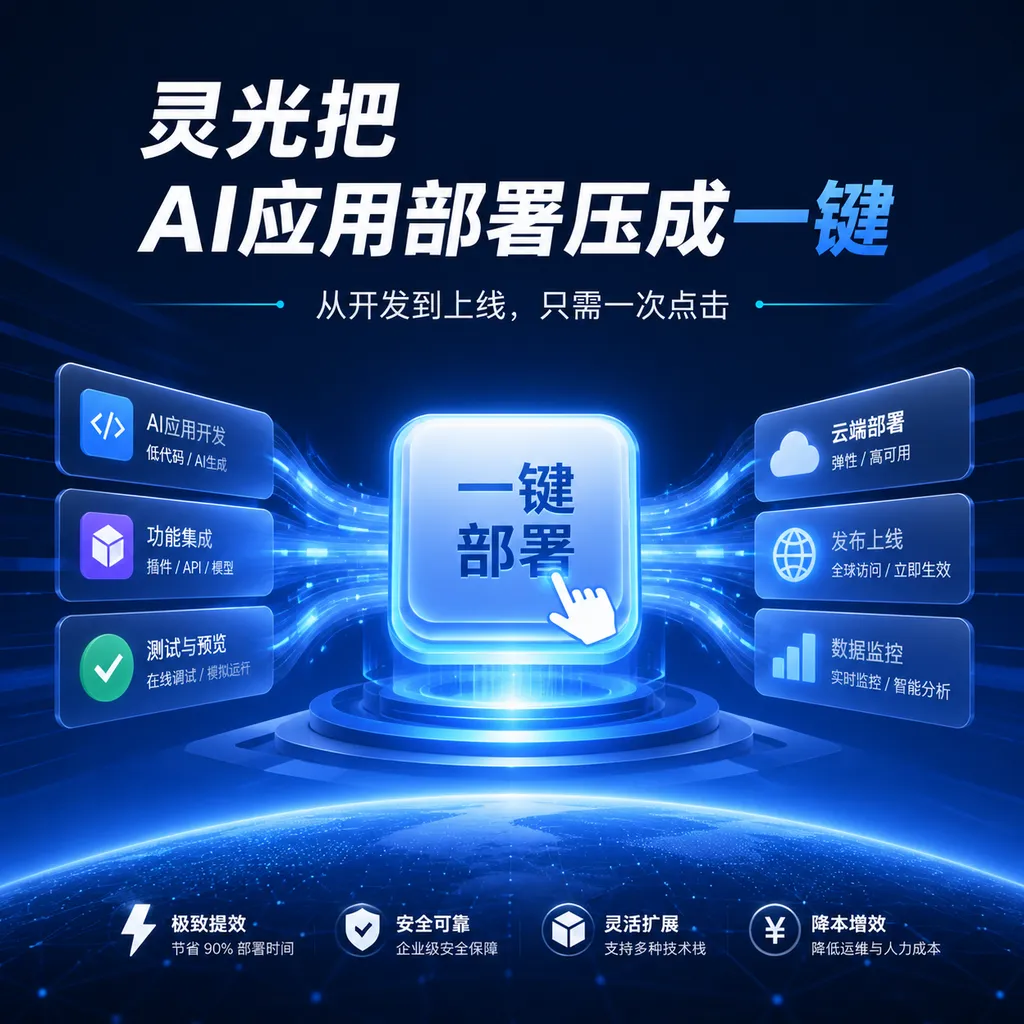
The Lingguang app recently made one-click deployment for mini apps available to all users, allowing apps generated by various AI coding tools to be published directly and distributed across platforms, while also providing more than 30 free capabilities.
Once AI Finishes the Code, Lingguang Takes Over Deployment
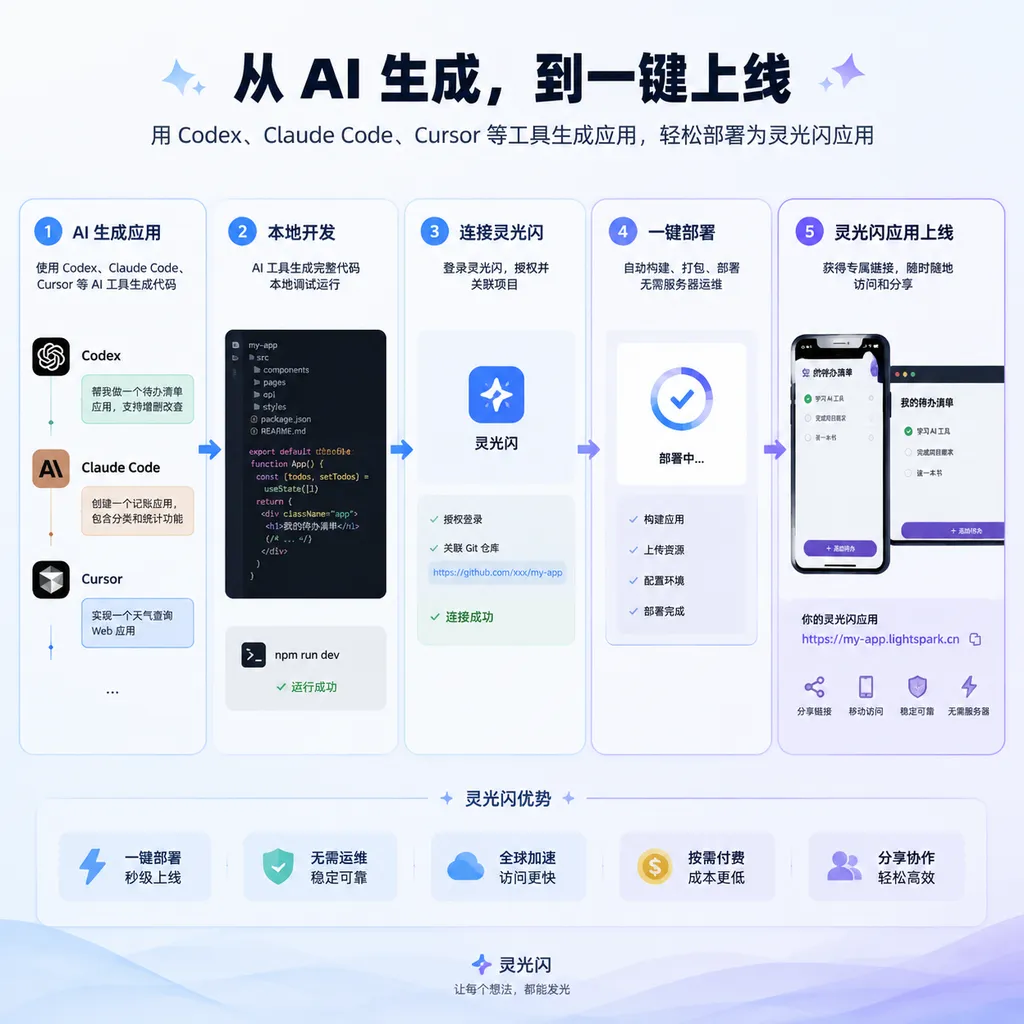
The Lingguang app recently opened its one-click “Flash App” deployment feature to all users.
After creating an application with AI coding tools such as Codex, Claude Code, Cursor, Qoder, Trae, or Workbuddy, users can invoke a deployment Skill provided by Lingguang to publish the project as a “Lingguang Flash App.” Once deployed, the application appears simultaneously on the PC client and in the Lingguang app, becoming part of Lingguang’s showcase and distribution ecosystem.
This update does more than add a “Publish” button to the development workflow. Lingguang is aiming to address one of the most obvious shortcomings of AI coding today: a model can generate a working demo in minutes, but turning that demo into a product that others can open and use still requires dealing with hosting, domains, runtime environments, mobile adaptation, and distribution channels.
Lingguang is attempting to compress that entire process into a single Skill invocation.
Support Goes Beyond Apps “Generated Within Lingguang”
According to the information released so far, one-click deployment can be used both to create new applications from scratch and to migrate existing web applications to Lingguang. Once deployment is complete, the application is automatically added to “My Creations,” and the system generates a preview QR code so developers can view and share it on mobile devices.
This is more important than simply adding an internal publishing entry point.
If Lingguang only allowed users to generate, modify, and publish applications within its own chat interface, it would remain a closed AI application generator. By actively supporting Codex, Claude Code, Cursor, Qoder, Trae, and Workbuddy, Lingguang is positioning itself in the latter half of the development pipeline: developers can choose which model, IDE, or agent they use to write code, while Lingguang primarily handles application intake, adds runtime capabilities, and completes distribution.
From a product-positioning perspective, this looks more like an “AI application runtime and distribution layer” than another AI IDE.
This is also a more sensible point of entry in the current market. The AI coding space is already extremely crowded: code editors, command-line agents, cloud agents, and traditional IDE extensions are all competing for developers. It is difficult to differentiate yet another code-generation interface, while deployment and distribution remain highly fragmented—especially for lightweight applications, personal tools, and mobile use cases.
The Skill Acts as a Deployment Adapter for Agents
Packaging deployment capabilities as a Skill also aligns with the changes seen in agent toolchains over the past year.
In the past, platforms typically required developers to read documentation, install a CLI, configure build commands, and then push code to a designated repository. The agent-era approach is different: the platform first organizes the deployment steps into a machine-readable and executable capability definition. After completing a project, the coding agent can then invoke that capability to inspect the project and initiate deployment.
For developers, the ideal workflow is no longer “have AI finish the code, then deploy it manually.” Instead, they can simply tell the agent:
Finish this tool, make sure it runs, then deploy it to Lingguang and give me a preview link.
The value of the deployment Skill lies in making the second half of that instruction a standard action.
However, “one-click deployment” does not mean that engineering problems have actually disappeared. It merely encapsulates steps such as environment detection, building, hosting, and publishing behind the platform. This abstraction is usually effective enough for structurally simple front-end tools, information lookup pages, form-based applications, casual games, and personal productivity tools. Once a project involves a custom backend, long-running tasks, complex databases, private networks, or specialized system dependencies, the extent of the platform’s abstraction will depend on future documentation and real-world compatibility.
The publicly available information does not yet fully disclose the following critical boundaries:
- Which front-end frameworks, build tools, and runtimes are supported;
- Whether custom server-side logic is permitted and what resource quotas apply;
- How application updates, version rollbacks, and log-based troubleshooting are handled;
- The usage quotas, rate limits, and commercial-use terms for the free APIs;
- What rules apply to application reviews, permission requests, and content governance;
- How user data, secrets, and third-party service credentials are stored.
The answers will determine whether this is ultimately a demo-oriented publishing tool or a runtime platform capable of hosting production applications.
More Than 30 Free Capabilities Matter More Than the Deployment Button
Alongside one-click deployment, Lingguang has also made more than 30 API capabilities available free of charge, including large language models, search, location-based services, maps, and storage.
This may be more important than “one-click publishing” itself.
Generating a static page with AI is no longer difficult. What truly slows development is integrating external capabilities. A weekend-trip planner, for example, requires at least search, geolocation, and maps. A knowledge assistant with history needs both a model and storage. A local lifestyle application may depend simultaneously on location-based services, place search, and content generation.
The traditional approach requires developers to register separate vendor accounts, obtain API keys, configure billing and security policies, and write adapter layers for different interfaces. For commercial projects intended to operate over the long term, this work is unavoidable. For lightweight applications designed to validate an idea, however, it often takes more time than building the interface itself.
By providing more than 30 capabilities at once, Lingguang is effectively selling—or, at this stage, offering for free—a pre-integrated application backend. Developers can test whether users want a product without first assembling a complete technology stack.
The offering can be summarized as follows:
- External AI tools produce the code: Developers continue using familiar tools such as Codex, Claude Code, or Cursor;
- The deployment Skill handles delivery: It converts the project into a Flash App that Lingguang can run and showcase;
- Platform APIs provide missing capabilities: Models, search, maps, and storage no longer need to be integrated individually;
- Lingguang clients handle distribution: Applications become available through both PC and mobile entry points.
It does not address whether models can write code. It addresses whether the things they build can reach users quickly.
“Flash Apps” Bet on an Explosion in the Supply of Small Tools
Lingguang calls these products “Flash Apps,” a name that also reveals the platform’s underlying judgment: the first category to see massive growth from AI coding may not be complex SaaS products, but small tools with short lifespans and highly specific purposes.
For example:
- Generating a half-day travel itinerary based on the user’s location;
- Searching and summarizing a collection of meeting notes;
- A shift-scheduling or quotation calculator for a specific team;
- Registration, lookup, and display pages for a temporary event;
- Data organization and visualization tools that serve only a handful of people.
In the past, these needs might have remained confined to spreadsheets, scripts, or group chats because developing and launching a standalone application was not cost-effective. AI coding reduces production costs, while one-click deployment further reduces delivery costs. Together, they may make it worthwhile to build applications that will be used for only a week—or even a single day.
This resembles how mini programs initially reduced installation friction, but the supply mechanism is different. Mini programs primarily lowered the barriers for users to access and use applications. AI combined with one-click deployment simultaneously lowers the barriers for developers to produce them. The former brought more services into a unified container; the latter may increase the number of applications by orders of magnitude.
That also creates a new problem: when anyone can generate and publish tools in bulk, the platform’s scarcest resources are no longer application volume, but quality filtering, trustworthiness, and stability.
Will an AI-generated mapping tool provide incorrect locations? How should applications powered by large language models warn users about hallucination risks? Do they explicitly request permission before accessing location data? If a publisher updates the code, can the previous version be restored? All of these questions are more difficult than whether an application can be deployed successfully.
Lingguang’s short-term metric may therefore be deployment volume, but its medium- and long-term competitiveness will depend on governance and distribution efficiency. If the platform quickly fills up with reskinned tools, one-click deployment will also turn the production of low-quality content into a one-click process.
It Is Solving a Different Problem From Vercel- or Cloudflare-Style Deployment
From a developer’s perspective, Lingguang’s one-click deployment is naturally reminiscent of Vercel, Netlify, or Cloudflare Pages. These platforms can likewise build and host web projects quickly, but Lingguang has a different emphasis.
Traditional cloud deployment platforms focus on engineering infrastructure: framework support, edge networks, function runtimes, observability, and team collaboration. They generally leave developers to solve the question of where their applications will acquire users.
Lingguang, by contrast, bundles the runtime environment, platform capabilities, and client-side distribution together. Developers are not delivering an isolated URL, but a Flash App that can be showcased, opened, and shared within Lingguang’s PC client and mobile app.
It is therefore better suited to three types of needs:
- Quickly validating a product idea without first building a complete cloud architecture;
- Applications that depend on common capabilities such as models, search, and maps, and whose needs can be covered by platform APIs;
- Projects that need a mobile entry point and in-platform distribution, rather than merely a public URL.
Conversely, traditional cloud platforms remain the safer option when a project requires highly controllable infrastructure, a complex backend, an independent branded domain, strict compliance isolation, or multi-cloud deployment. Lingguang does not need to replace these tools at this stage. What it needs to prove is whether an integrated platform can be more convenient than general-purpose cloud hosting for lightweight, AI-native applications.
The Real Test Comes After Deployment
This update is moving in the right direction and has more practical significance than adding yet another code-generation model.
The bottleneck in AI coding is shifting from “generating code” to “running, maintaining, and acquiring users.” As model capabilities continue to converge, the company that can connect requirements, coding, deployment, data capabilities, and distribution will come closest to becoming a complete application production platform.
But one-click deployment only addresses the initial launch. Whether an application remains viable over the long term also depends on debugging, monitoring, updates, costs, and user feedback. The next question Lingguang must answer is not how many more AI coding tools it can support, but whether the platform can provide sufficiently professional capabilities when developers encounter build failures, API quota overruns, production errors, or data migrations.
For individual developers and teams that want to prototype quickly, this feature is already worth trying. It substantially shortens the distance between “AI has finished the code” and “users can actually open the application.” For production-grade projects, however, it is currently more appropriate to treat Lingguang as a rapid validation channel rather than as an unassessed replacement for existing deployment systems.
In short: Lingguang has not joined the battle for the most crowded entry point in AI coding. Instead, it has chosen to cast its net at the exit. That position is more pragmatic, but it also places greater demands on the platform’s infrastructure and distribution capabilities.
References
Because the domain hosting the original report is not included in the permitted list of link domains for this article, no external link is provided. The information is compiled from 36Kr’s news brief on the launch of “one-click deployment” in the Lingguang app, as well as contemporaneous reports from Chinese media outlets including Sina Technology and Leikeji. The core updates are based on information made public in late July 2026.