Cursor’s India plan drops to RMB 45

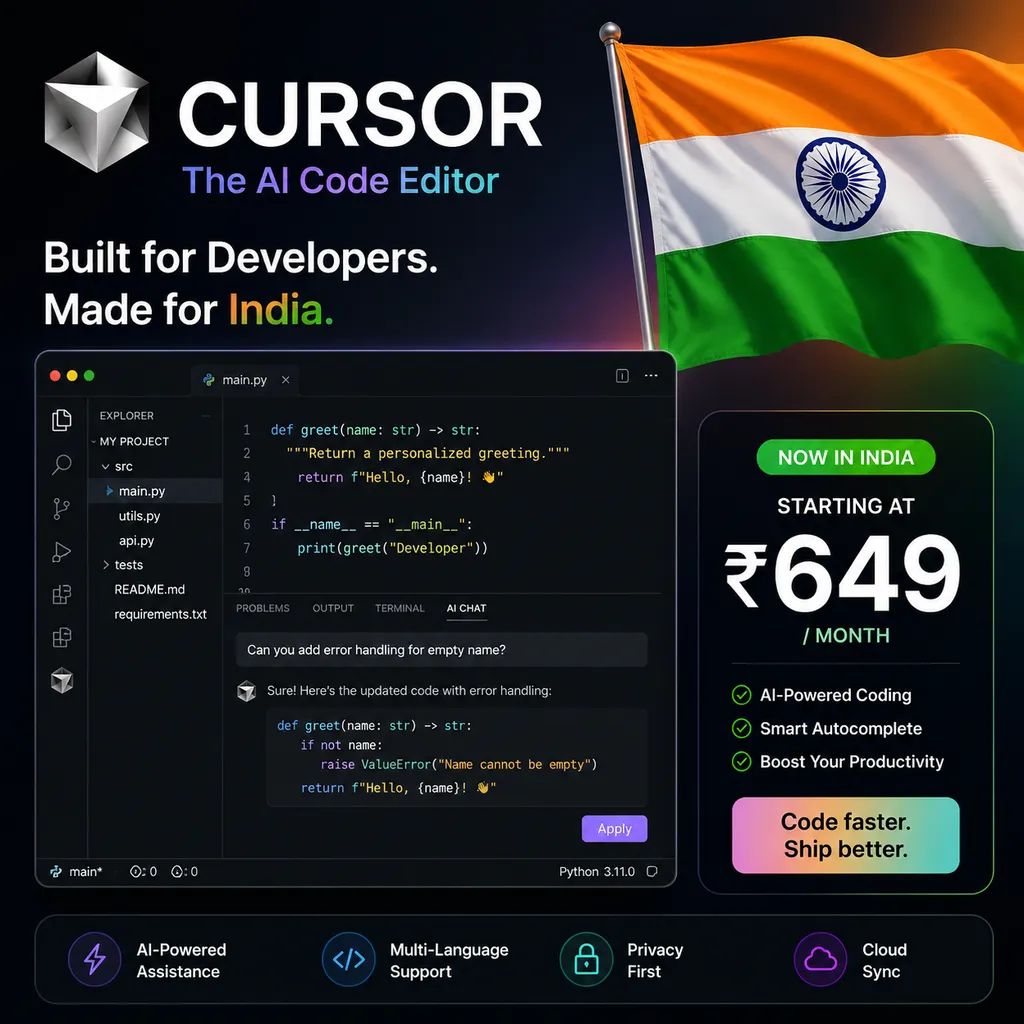
Cursor has launched a ₹649-per-month Start plan in India, priced at only about one-third of its standard plan. The low price is more than a simple promotion—it signals that AI coding tools are beginning to use regional pricing to compete for developers in high-growth markets.
Cursor Cuts Indian Subscription Price to 45 Yuan
Cursor announced today (July 28) that it is launching a new individual subscription plan in India called Cursor Start. The plan costs 649 Indian rupees per month, including tax—about 45.5 yuan or roughly $7 at current exchange rates.
What is most notable about this price is not that Cursor has “added yet another subscription tier,” but that it costs only about one-third of Cursor’s standard $20-per-month plan. For Indian developers, Cursor has moved for the first time from being a relatively expensive dollar-denominated subscription into a price range closer to everyday software spending.
What Do 649 Rupees Get You?
According to information published by Cursor, Start is aimed at individual paying users in India and includes the following core benefits:
- A relatively generous level of access to Cursor models;
- More agent requests than the free plan;
- Always-on cloud agents;
- The Cursor app for iOS;
- Integration between Cursor and development workflows.
Judging by the product structure, Start is not simply the free version repackaged with a monthly fee. Instead, it attempts to retain the capabilities Cursor is currently most eager to promote: agents, cloud execution, and cross-device use.
Of these, the agent request allowance—not whether the editor has a chat window—is what truly affects the user experience. Traditional code completion generally consumes only short contexts, keeping costs and latency relatively manageable. Agents, however, need to read repositories, search files, modify multiple modules, invoke tools, and repeatedly validate their work. A single task may involve multiple rounds of model inference. For developers who use Cursor every day for refactoring, adding tests, and fixing bugs, the agent allowance can easily become the clearest dividing line between paid plans.
The “always-on cloud agents” are also worth examining separately. They mean tasks do not necessarily have to remain tied to a local IDE session. Developers can hand time-consuming work over to the cloud to continue running, then check its progress from a mobile device. By including both the iOS app and cloud agents in Start, Cursor is clearly trying to evolve from “an editor with AI completion” into a development platform where work can be delegated asynchronously.
However, currently available information does not specify Start’s exact model quotas, the billing weights assigned to different models, or whether rate limits apply during peak periods. “Generous access” does not mean unlimited use. For power users, whether 649 rupees buys a plan that is genuinely sustainable over the long term or merely serves as a stepping stone to the $20 plan will ultimately depend on the quota details.
At One-Third the Price, Cursor Is Not Simply Doing Currency Conversion
| Plan | Monthly fee | Equivalent in yuan | Primary positioning | |---|---:|---:|---| | Cursor Free | 0 | 0 | Occasional use, limited agent requests | | Cursor Start India | 649 rupees, including tax | About 45.5 yuan | Price-sensitive individual developers | | Cursor standard paid plan | $20 | About 135.5 yuan | More frequent, intensive professional use |
Model inference costs do not automatically fall simply because a user is located in India. For the same model, context, and agent execution chain, the underlying GPU resources required are essentially the same. Therefore, Cursor’s decision to price the subscription at one-third of its global standard plan is unlikely to be a mechanical adjustment based solely on local exchange rates.
A more reasonable interpretation is that Cursor is trading regional pricing for market scale.
Cursor says India is already its third-largest market worldwide. Over the past year, Cursor’s customer base in India has tripled, while India has more advanced users than any other individual market. Taken together, these figures show that India is not a potential market that must be educated from scratch. It already has a large number of active users, but the $20 monthly fee has constrained paid conversions.
For a full-time engineer in the United States, $20 may be no more than the price of lunch. For individual developers, students, independent developers, and outsourcing teams in India, however, the barrier to payment is clearly different. AI coding tools may deliver the same productivity gains, but users’ willingness to pay in absolute terms is not the same. Uniform dollar pricing may look simple, but in practice it leaves many users who have genuine demand but lower spending power stuck on the free tier.
Start is designed to bridge precisely this gap: the free plan is insufficient, the $20 plan is too expensive, and there has been no sustainable paid tier in between.
India Is Becoming a Testing Ground for AI Subscription Pricing
Cursor is not the first AI company to launch a lower-priced, India-specific plan. OpenAI previously introduced ChatGPT Go for 399 Indian rupees per month in selected regions. OpenAI and Google have also been using low-cost or free services to expand their reach in the Indian market.
Of course, general-purpose ChatGPT subscriptions and Cursor’s coding subscriptions cannot be compared directly. The former is designed for Q&A, writing, search, and multimodal consumption, while the latter must handle code repositories, long contexts, tool calls, and agent execution. Their compute cost structures per active user are different. Their business logic, however, is the same: first expand the paying user base with locally acceptable pricing, then increase per-user value through higher usage frequency, workflow lock-in, and higher-tier plans.
India is particularly well suited to this kind of experiment for straightforward reasons:
- A large developer population. The country’s many software engineers, IT services companies, outsourcing teams, and computer science students provide a natural user base for programming tools.
- A mature English-language development environment. Documentation, code comments, issues, and technical communication commonly use English, so model capabilities do not require complex localization for regional languages.
- High price sensitivity. Users are willing to try AI tools, but a globally standardized $20 subscription significantly suppresses conversion rates.
- Rapid tool adoption. Once usage habits take hold within teams or universities, editor configurations, rules files, and agent workflows can easily be copied and shared.
This is also why 649 rupees may look aggressive without necessarily being a loss-making proposition. Cursor does not need Start to cover every power user. As long as it converts users who would otherwise remain on the free tier into steady subscribers—and gets some of them to upgrade as their usage grows—the low-cost tier will have accomplished its purpose.
The Challenge for a Low-Cost Plan Is Keeping Agent Costs Under Control
There is one crucial difference between AI code editors and traditional SaaS: adding another account to conventional software generally has a very low marginal cost, while adding a high-frequency user to an AI tool can generate ongoing inference expenses.
This is particularly true in agent mode. An instruction such as “migrate this Node.js service to the new authentication module” may involve reading dozens of files, generating a modification plan, executing code, analyzing errors, and making further changes. If users frequently invoke high-cost models, a $7 monthly fee can quickly put pressure on gross margins.
Whether Start is viable therefore depends on how Cursor manages three variables:
- Quota design: The free, Start, and standard plans must offer a clear progression;
- Model routing: Lower-cost models should handle simple tasks, with more capable models reserved for complex work;
- Upgrade conversion: Individual users should be able to move naturally to higher-priced plans when their usage becomes more intensive.
This balance is difficult to achieve. If the quota is too low, users will see Start as merely “a paid version of the free plan.” If it is too high, users worldwide may attempt to bypass regional restrictions and purchase it, further undermining the existing $20 plan. Regional pricing is usually accompanied by checks on payment methods, account location, tax information, or region of use, but the information currently disclosed by Cursor is insufficient to determine what specific restrictions will apply.
For developers, the key questions to answer before subscribing are not about “how much cheaper” the plan is, but rather:
- Whether all commonly used models are included in Start;
- Whether agent requests are calculated by request count, tokens, or compute usage;
- Whether cloud agents are subject to limits on concurrent tasks and runtime;
- Whether exceeding the quota results in service suspension, throttling, or usage-based charges;
- Whether there are usage boundaries between teams, commercial codebases, and personal accounts.
If these restrictions are too tight, 45 yuan is merely an attractive entry price. If the quota is enough to cover routine completion, code-related Q&A, and moderately frequent agent tasks, Start will become a highly competitive individual plan.
Cursor Is Competing for More Than Subscription Revenue
Cursor’s competition is no longer limited to “which editor offers faster completion.” GitHub Copilot, Claude Code, Gemini CLI, and various terminal-based agents are all competing to become the interface through which developers issue task instructions.
Once that interface becomes established, switching costs gradually rise. Developers accumulate project rules, prompts, codebase indexes, MCP tool configurations, and expectations about agent behavior within a particular tool. Teams also adapt their code review, testing, and task assignment processes around it. At that point, competition shifts away from the performance of individual model calls and toward who is embedded more deeply in the development workflow.
Cursor’s willingness to lower subscription prices in India is therefore effectively a subsidy for habit formation. The sooner students and junior engineers begin treating agents as their default way of developing software, the more likely Cursor is to remain part of their tool stacks when they join companies, build teams, or become technical decision-makers.
This is similar to the way development tools historically used educational discounts and community editions to win developers’ mindshare. The difference is that subsidies are more expensive in the AI era: an IDE license can be developed once and distributed repeatedly, while every task executed by an agent continues to consume compute resources.
A Noteworthy Price Cut, but Not a Global One
For users in India, Cursor Start is undoubtedly more practical. A monthly fee of around 45 yuan lowers the barrier to a level that makes long-term subscription feasible while retaining core capabilities such as agents, cloud tasks, and mobile access. Compared with simply increasing the free allowance, it is also more conducive to establishing a stable paying relationship.
However, this update should not be interpreted as a global price cut from Cursor. Start is currently positioned explicitly for the Indian market, while users in other regions still face the existing pricing structure. The significance of the regional plan is that Cursor has now acknowledged that a single global price of $20 cannot easily cover developer markets with widely varying income levels and purchasing power.
What is more worth watching next is whether Cursor replicates Start in high-growth regions such as Southeast Asia and Latin America, and whether competitors follow suit with regional pricing. If low-cost plans can drive paid growth without significantly increasing inference costs, AI coding tool subscriptions may evolve from today’s simple “free plan plus $20 plan” model into a multi-tiered structure segmented by region, model quota, and agent capabilities.
Cursor made the right call with this price cut. India already has enough developers and sufficiently rapid user growth that insisting on a uniform global price would simply cede the market to cheaper alternatives. For power users, however, whether 649 rupees truly represents good value still depends on one crucial figure that has yet to be fully disclosed: exactly how much work the agent is allowed to do.
References
- ITHome: Competing for India’s Developer Market, Cursor Launches Start Plan at 649 Rupees per Month — Covers Cursor Start’s pricing in India, its main benefits, and Cursor’s local user growth.