
Grok 4.2 Beta2 Launch: Can Musk Deliver on His “Weekly Evolution” Promise?
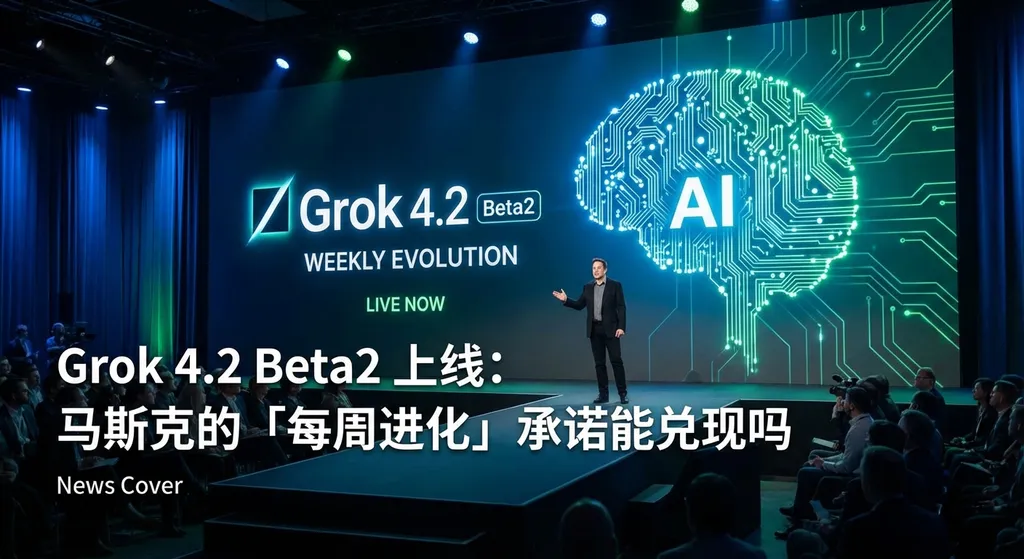
xAI releases Grok 4.2 Beta2, highlighting its rapid learning capability with weekly iterations. The 500B-parameter "small model" has sparked polarized reactions — some praise its strong coding ability, while others criticize its responses for leaning toward Elon Musk's own views.
Grok 4.2 Beta2 Launch: Can Musk Deliver His “Weekly Evolution” Promise?
xAI released Grok 4.2 Beta2 amid a wave of personnel turmoil. This 500B-parameter model isn’t pushed automatically — users must manually switch to use it. Musk claims it has “rapid learning capability” and can iterate weekly — sounds great on paper, but how does it perform in reality?
The King of Delays Finally Ships, But It’s Just a Beta
The release timeline of Grok 4.2 can be described as the “evolution of the delay king.” Since last December, Musk has repeatedly teased it on X, promising “launch within 3–4 weeks” or “release next week,” only to delay again and again. Five days ago, several xAI co-founders resigned, prompting speculation that the project might be dead.
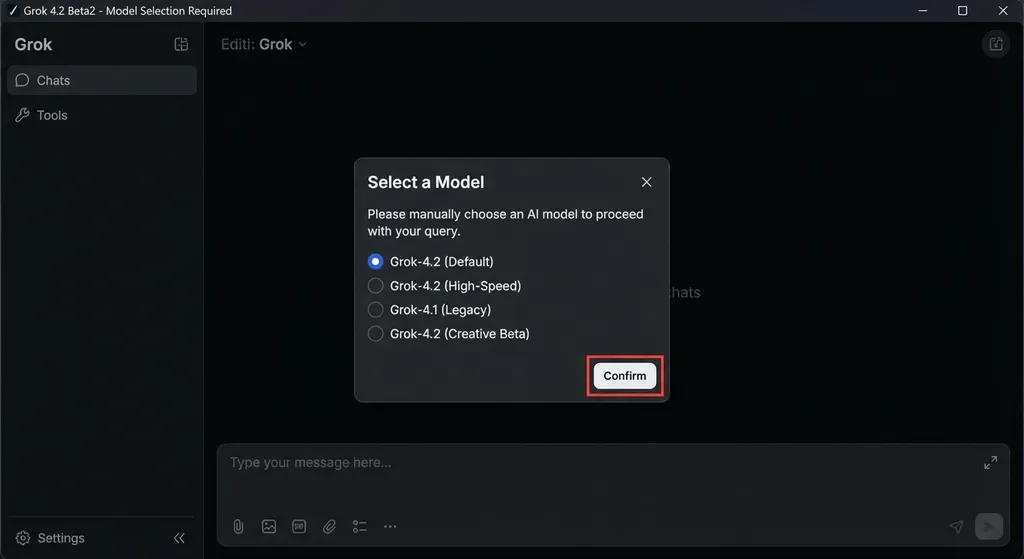
Yet Musk released it anyway — as a Beta version. More importantly, the release was unusually low-key — no technical report, no major publicity, and not even an automatic rollout. You have to manually select “Grok 4.2” in the interface to activate it.
This approach is quite uncharacteristic of Musk. Some on Reddit speculate it’s because the model’s capability still can’t compete head-to-head with OpenAI’s or Anthropic’s latest ones, so xAI opted for a “soft landing” release strategy.
A 500B-Parameter “Small Model” with Polarized Performance
Compared with models that boast tens of trillions of parameters, Grok 4.2’s 500B seems modest. But fewer parameters don’t necessarily mean weaker performance — at least according to Musk, who reposted nearly ten tweets praising Grok 4.2 to prove its strength.
User feedback so far shows strange polarization:
Positive reactions:
- Coding ability is both fast and high-quality; generation speed has improved significantly.
- Passes spatial reasoning tests such as the “car wash 50 meters away” scenario.
- Performs impressively in certain niche tasks.
Negative reactions:
- Answers show strong alignment with Musk’s own opinions — so-called “unbiasedness” doesn’t hold.
- Leaderboard rankings are mediocre, possibly due to lab-centered tuning.
- Often exhibits misunderstanding in real usage.
This polarization is interesting: when a model draws both “amazing” and “terrible” reviews, it likely shines in some cases but lacks overall stability.
“Weekly Evolution”: Gimmick or True Capability?
The biggest selling point of Grok 4.2 is its “rapid learning” feature. According to Musk, the model can self-iterate weekly through real user interactions, continuing to evolve without waiting for a major update.
It’s a smart concept. Traditional large models require lengthy retraining or fine-tuning to update their knowledge. Grok 4.2 aims to enable quick adaptability through some mechanism. If this truly works, the model could grasp new information faster, offering more accurate answers on time-sensitive topics.
But xAI hasn’t disclosed any technical details yet. We don’t know how this “rapid learning” works or what the weekly iteration mechanism involves. Musk only said, “Public testing will last until next month; afterward, Grok 4.2 will be much faster and smarter than Grok 4.” — which sounds more like wishful thinking.
A more practical issue is that weekly iteration implies frequent changes in model behavior. For developers, that could be a nightmare — the prompt you tuned this week might fail next week. Unless xAI provides detailed release notes and version management, this “advantage” could turn into a burden.
Mid-to-Large Versions Still on the Way
AI engineer Mark Krechman revealed that the currently released Grok 4.2 is the “small” version with 500B parameters; medium and large versions will come later. Musk personally reposted and confirmed this.
This is significant. If 500B is considered “small,” how large will the mid and large versions be? 1T? 2T? The key question is — why release in batches?
One possible reason: insufficient compute resources. Training and deploying massive models demand enormous computing power; xAI may still be expanding its infrastructure. Another possibility is a strategic rollout — starting small, collecting feedback, and then launching the larger version to reduce risk.
Whatever the reason, it shows Grok 4.2 isn’t the final form yet. If you’re developing based on it now, be prepared for major changes later.
How Can Developers Use It?
Currently, Grok 4.2 can only be accessed through the X platform interface; xAI hasn’t released an API yet. However, it’ll likely provide one later, compatible with the OpenAI format.
If you want to prepare ahead, you can refer to how previous Grok versions were called. Assuming the API goes live, the sample code might look like this:
import openai

# Unified call via OpenAI Hub
client = openai.OpenAI(
    api_key="your-openai-hub-key",
    base_url="https://api.openai-hub.net/v1"
)

response = client.chat.completions.create(
    model="grok-4.2-beta2",
    messages=[
        {"role": "system", "content": "You are a helpful assistant"},
        {"role": "user", "content": "Explain Grok 4.2’s rapid learning capability"}
    ],
    temperature=0.7
)

print(response.choices[0].message.content)
Note that if Grok 4.2 truly iterates weekly, you might need version control in your code — for instance, specifying grok-4.2-beta2-20260413 to prevent inconsistent outputs due to updates.
The advantage of aggregation platforms like OpenAI Hub is that you can quickly switch between models using the same code for A/B testing. If Grok 4.2 doesn’t perform well for a given task, you can instantly swap in Claude or GPT-4 without changing your code.
How Far Can Musk’s AI Ambition Go?
The timing of Grok 4.2’s release is delicate. xAI just went through core team departures, and doubts linger about its technical and managerial strength. Launching a Beta now feels like both a “we’re still alive” signal and an attempt to reassure investors and users.
Strategically, xAI is taking a different approach: rather than chasing parameter size, it’s emphasizing rapid iteration and learning capacity. That’s not a bad concept — bigger isn’t always better; solving real problems matters more. But xAI hasn’t provided convincing evidence yet.
Leaderboard performance is mediocre, user feedback is polarized, and technical explanations remain vague — all making people skeptical about Grok 4.2’s actual competency. Musk says “it’ll be much faster and smarter after public testing,” but we’ve heard that promise many times before.
The bigger picture: competition in the AI model space is now red-hot. OpenAI, Anthropic, Google, Meta are racing ahead, while Chinese players like DeepSeek, Zhipu, Moonshot are rapidly catching up. For xAI to hold its ground, Musk’s personal influence alone won’t be enough.
Worth Trying, But Don’t Expect Too Much
Grok 4.2 Beta2 is worth attention, but not worth going all in. If you’re interested in AI models, try manually activating it on X and see how it performs in your use case. But if you’re a developer planning to build products around it, better wait — at least until the API is live, technical docs are complete, and model stability is proven.
“Weekly evolution” sounds cool, but also introduces uncertainty. In AI, faster isn’t always better — stability and predictability matter too. Whether Musk can deliver on his promise will depend on how the next few weeks unfold.
As for the jokes about Grok 4.2’s answers reflecting Musk’s own views — that’s quite amusing. When an AI model inherits its founder’s worldview and expression style, is that a bug or a feature? Even Musk himself might not know.
References
- Musk xAI’s New Model Grok 4.2 Goes Live - ITHome – detailed report including user feedback and testing results
- Musk: Grok Returns Today! - Zhihu – Zhihu column analyzing Grok 4.2’s rapid learning mechanism
- Everything You Want to Know About Grok 4.2 - Linux.do – Linux.do community discussion and real user experiences with Grok 4.2 Beta2


