Doubao Search Starts Feeding Answers to Agents

Volcengine launched the Doubao Search service today. Rather than creating yet another search box, its focus is on packaging real-time web content, structured data, and source governance into an information layer that agents can consume directly.
Volcano Engine Turns Search into an Information Interface for Agents
On July 28, Volcano Engine officially launched Doubao Search, providing enterprises and developers with cross-lingual, multimodal, and multi-vertical online information retrieval capabilities.
The key point of this product update is not to give users another search box, but to process search results into context that AI agents can use directly. The service can return original content in Markdown, summaries, and structured data, while automatically rewriting queries, conducting follow-up searches, and filling information gaps based on the task.
In other words, a traditional search engine delivers a page of links, while Doubao Search aims to deliver a package of information that can be inserted directly into a model’s context.
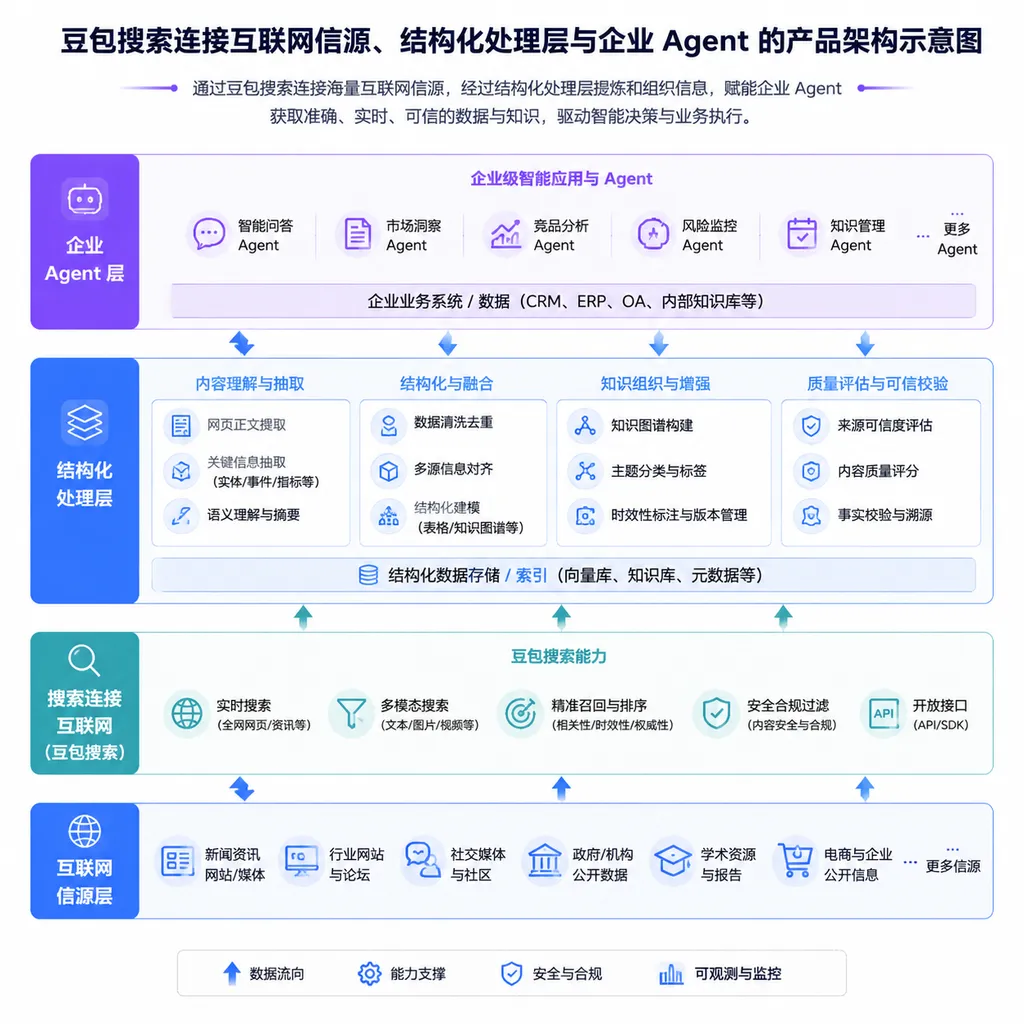
For teams building web-connected Q&A, investment research assistants, intelligent customer service, or deep research products, this change has practical value. In agent projects, the most time-consuming part is often not calling a large language model, but building an entire search pipeline around it: query rewriting, webpage crawling, main-text extraction, deduplication, ranking, source attribution, and context compression, followed by handling dead pages and SEO spam.
Doubao Search is attempting to turn this pipeline into a standardized service.
It Returns Consumable Information, Not Just Links
Conventional search APIs typically return titles, links, and short snippets. Developers still have to do the rest: crawl webpages, remove navigation bars and ads, split long texts, and determine which passages are worth passing to the model.
Doubao Search is designed more like an agent-oriented retrieval middleware layer. According to information released by Volcano Engine, it supports returning original content in Markdown and various types of structured data, and offers the following retrieval capabilities:
- Precise targeted queries: When an agent already knows which organization, website, or vertical domain to search, it can reduce interference from irrelevant webpages;
- Broad-search semantic rewriting: Converts natural-language tasks into query formulations better suited for execution by search systems;
- Multi-round retrieval enhancement: Identifies gaps based on first-round results and continues searching for supplementary material;
- Cross-lingual retrieval: Even when a task is submitted in Chinese, it can cover information sources in other languages;
- Multimodal results: In addition to text, it can return images, cards, and other content, making it suitable for product, news, and content-understanding scenarios.
None of these capabilities is particularly novel in a single Q&A interaction. What truly deserves attention is that they have been integrated into a search service that adjusts its strategy as the task progresses.
For example, suppose a business analysis agent receives a task such as: “Summarize a consumer electronics company’s product launch cadence over the past six months and determine whether it has changed its pricing strategy.” It cannot simply search for the company’s name once. At a minimum, it needs to find product launch dates, introductory prices, prices in different regions, changes in promotions, and management statements in stages, then align the results by date and model.
If the search layer can only return ten webpage links, task planning, result filtering, and evidence assembly must all be handled by the agent above it. Doubao Search instead aims to complete some query planning and supplementary searching within the retrieval layer before passing relatively clean material to the model for reasoning.
This should reduce cases where an agent “pretends to have completed the research” while holding nothing more than a pile of links.
ByteDance’s Real Differentiators Are Its Content Supply and Ranking Expertise
Judging by the feature list, query rewriting, multi-round search, and structured results are not unique to Doubao Search. Many search APIs, RAG platforms, and agent tools in China and elsewhere are developing similar capabilities. Volcano Engine’s advantages primarily come from two areas.
The first is content supply.
Doubao Search says it integrates information from across the public internet, specialized industry knowledge, and ByteDance’s exclusive content resources. The last category means that, beyond publicly accessible webpages, it may be better positioned to cover information from ByteDance’s content ecosystem, including Toutiao and Douyin. Such data has clear value for consumer trends, breaking events, brand developments, and content creation.
Traditional web search excels at finding official websites, media reports, and long-form materials, but much of the latest information first appears in short videos, creator accounts, or platform posts. If multimodal content can be reliably retrieved, understood, and cited, it will expand the boundaries of what agents can see.
The second is expertise in search ranking and content governance.
ByteDance has long dealt with large-scale recommendation, search, and content safety challenges, giving it experience in identifying clickbait, reposted content, advertorials, and low-quality creators. Doubao Search emphasizes that it has established an authority-tiering system across both websites and creators, along with industry-specific vertical governance. This is clearly an effort to productize that accumulated expertise.
Volcano Engine also says that Doubao Search already serves as the information engine behind the intelligent assistants of 90% of China’s leading smartphone manufacturers. This claim currently comes mainly from the company’s own disclosures, without a specific list of manufacturers or details on the statistical methodology. At the very least, however, it suggests that the technology has not just emerged from the lab, but is already operating in high-concurrency, end-user-facing scenarios.
That is more convincing than simply presenting a search demo.
“Authority Tiering” Is Useful, but It Does Not Guarantee Factual Accuracy
Doubao Search positions “real-time, authoritative, and trustworthy” information as its core selling point. Most commendably, it directly addresses one of the most difficult problems facing today’s web-connected agents: the declining information density of the internet.
Search results pages are filled with SEO aggregation sites, mass-produced AI articles, and content repeatedly reposted without an original source. Large language models are also prone to mistaking fluent language for factual reliability. Once low-quality webpages enter the context, a model may reorganize false information in a way that makes it sound even more credible.
Tiering information sources can at least reduce contamination at the point of retrieval. In areas such as public policy, healthcare, finance, and corporate announcements, official institutions, primary documents, and verified professional creators should receive greater weight.
However, it must be emphasized that an authoritative source does not necessarily mean its content is correct, much less that conclusions generated by the model are reliable.
A company’s official website is a primary source for information about its products, but it may not be a neutral source for evaluating the company’s market position. An early report from an authoritative media outlet may also be corrected as events develop. Financial data involves factors such as price-adjustment methodologies, transaction timing, and currency conversion, which cannot be addressed through website rankings alone.
Enterprises should therefore not treat “authority tiering” as a substitute for fact-checking. A truly reliable agent still needs to:
- Preserve metadata such as source links, publication times, and authors;
- Cross-check key conclusions against multiple sources;
- Distinguish among primary facts, third-party judgments, and model inferences;
- Establish human review and refusal mechanisms in high-risk scenarios;
- Preserve traceable snapshots of dynamic webpages and cited content.
Doubao Search can reduce the cost of this work, but it cannot assume ultimate responsibility for an enterprise’s decisions.
Public Benchmark Results Are Not Enough; Enterprises Care More About Long-Tail Reliability
Volcano Engine says that Doubao Search performs well on public benchmarks such as SimpleQA, FreshQA, and BrowseComp-ZH. These benchmarks cover factual Q&A, fresh information, and complex browsing tasks, respectively, broadly aligning with agents’ web access requirements.
However, as of July 28, the publicly available information did not include complete disclosure of specific scores, comparison targets, testing configurations, or statistical methods in the launch announcement. “Strong performance” is therefore better viewed as a product capability claim than as a directly reproducible technical conclusion.
For enterprise developers, benchmarks are also only the first hurdle. Whether a search service can enter production depends on more mundane questions:
- Are results stable when the same query is called repeatedly?
- How quickly can breaking news become searchable?
- How are citations handled after an original webpage is deleted or modified?
- Do structured fields remain consistent?
- What is the recall rate for long-tail vertical websites?
- Are the latency and cost of multi-round retrieval controllable?
- Are clear rate limits, timeout policies, retry mechanisms, and service-level commitments provided?
- Can enterprises configure blocklists, allowlists, and preferred sources?
A good result from a single search does not mean the service will remain usable across ten thousand calls. In production environments, what agents fear most is not an occasional inability to answer, but silent changes in result structures and evidence chains that cause downstream workflows to continue executing incorrect actions.
The publicly released materials focus on capabilities and use cases, but pricing, usage limits, latency distribution, SLAs, and more detailed API constraints remain to be disclosed. For teams preparing to integrate the service, these metrics are no less important than benchmark scores.
General-Purpose Chatbots Will Not Be the First to Benefit
The use cases listed by Volcano Engine include AI Q&A, workplace collaboration, financial investment research, business analysis, and content production. These fields share one characteristic: models already have reasoning capabilities, but their internal knowledge cannot cover events happening today.
Workplace and Knowledge Q&A
Workplace agents often need to read internal enterprise documents and public online information at the same time. For example, when sales representatives prepare materials for a client visit, they need to review past communication records in the CRM while also searching for recent news about the client, product launches, and management changes.
Doubao Search can handle the external information component, but enterprises still need to implement access controls and internal data connections at the application layer. It is more like an external knowledge interface than a complete enterprise knowledge base.
Financial Investment Research
Financial use cases have the highest requirements for timeliness and source quality. Announcements, news, research reports, and market data are updated at different rates, and any timestamp error may change the conclusion.
Doubao Search provides access to authoritative news and vertical financial databases, making it suitable for discovering research leads, summarizing news, and collecting evidence. However, if the application involves trading recommendations, risk ratings, or automated execution, developers should still place specialized databases and deterministic computing systems at the core of the workflow. General-purpose search results must not directly trigger actions.
Business Analysis
Business analysis is where this type of service can most readily demonstrate its value. Competitor developments, policy changes, channel pricing, and public sentiment are scattered across different websites, making manual collection highly time-consuming. The ability to return structured material directly means that an agent does not have to begin by cleaning webpages every time.
However, business analysis may also be susceptible to biases in ByteDance’s content ecosystem. Popularity within a platform reflects the attention of a particular user group and does not necessarily represent overall market demand. When using exclusive content, enterprises must understand the boundaries of the sample.
Content Production
ByteDance’s content resources are naturally attractive to content creation agents, helping them discover trending topics, examples, and visual materials. However, enterprises must still independently verify copyright, citation permissions, and platform rules governing secondary use. Being able to retrieve content does not automatically grant the right to reuse it.
It Is Not the Same as RAG or a Model’s Built-in Web Access
Developers can easily conflate web search, RAG, and a model’s built-in browsing capabilities, but the three address different problems.
| Capability | Primary Data Sources | Best Suited For | Main Limitations | |---|---|---|---| | Enterprise RAG | Internal documents and databases | Permission-controlled knowledge Q&A and queries about processes and policies | Cannot naturally cover real-time public internet information | | Model built-in web access | Search tools preset by the model provider | Rapid development of general-purpose Q&A and research features | Usually offers limited configurability, result structure, and source control | | Independent search service | Public web, vertical data, and platform content | Providing unified real-time information to different models and agents | Still requires upper layers to handle reasoning, permissions, and risk control |
Doubao Search belongs to the third category. Its value lies not in replacing large language models, but in separating web retrieval from the model and turning it into an independently governable information layer.
This architecture is especially useful for multi-model systems. A company may simultaneously use different models specializing in reasoning, coding, Chinese, or multimodal tasks, but may not want to build a separate search workflow for each one. A unified retrieval layer can provide each model with similar materials and citation formats, while also making it easier to maintain audit logs and control costs.
Of course, this separation also introduces additional latency. A complex task may pass through multiple stages, including planning, searching, reranking, searching again, and model generation. If the search strategy expands excessively, the agent may repeatedly make calls to fill marginal information gaps, ultimately producing a highly comprehensive report that is already out of date.
Beyond retrieval quality, developers therefore need to set limits on the number of search rounds, time budgets, the number of sources, and termination conditions. Searching more does not necessarily make an agent smarter.
Assessment: The Direction Is Right, but the Outcome Will Be Decided by Engineering Metrics, Not the Feature List
The launch of Doubao Search shows that competition among Chinese cloud providers for agent infrastructure has expanded from model APIs to search, knowledge bases, tool use, and execution environments.
As model capabilities become increasingly similar, enterprises are paying more attention to what lies beyond the model: whether they can access the latest information, cite it reliably, audit it, and trace errors back to specific sources. Search is therefore no longer merely an optional chatbot feature, but a critical component determining whether agents can enter production environments.
Doubao Search is moving in the right direction. It combines query rewriting, multi-round retrieval, content cleaning, authority tiering, and structured output, reducing the need for developers to reinvent the wheel. ByteDance’s content ecosystem and search governance expertise also provide genuine differentiation.
However, the launch information alone is not enough to conclude that it has solved the problem of “trustworthy search.” Coverage of authoritative sources, latency on complex tasks, stability of structured output, citation traceability, pricing, and SLAs are the metrics enterprises will actually compare when making procurement decisions. Public benchmark claims also require more complete supporting data.
More precisely, Doubao Search has not found absolutely correct answers for agents. Instead, it has equipped them with a more efficient research assistant that knows to prioritize primary sources. Whether the final report is trustworthy still depends on whether model reasoning, business rules, and human review can properly process the material it provides.
References
- ITHome: Volcano Engine Launches Doubao Search, Providing Agents with Real-Time, Authoritative, and Trustworthy Search Capabilities — Covers Doubao Search’s launch date, core features, public benchmarks, and primary use cases.