Unity Engine 2.0: Turning AI into a Developer
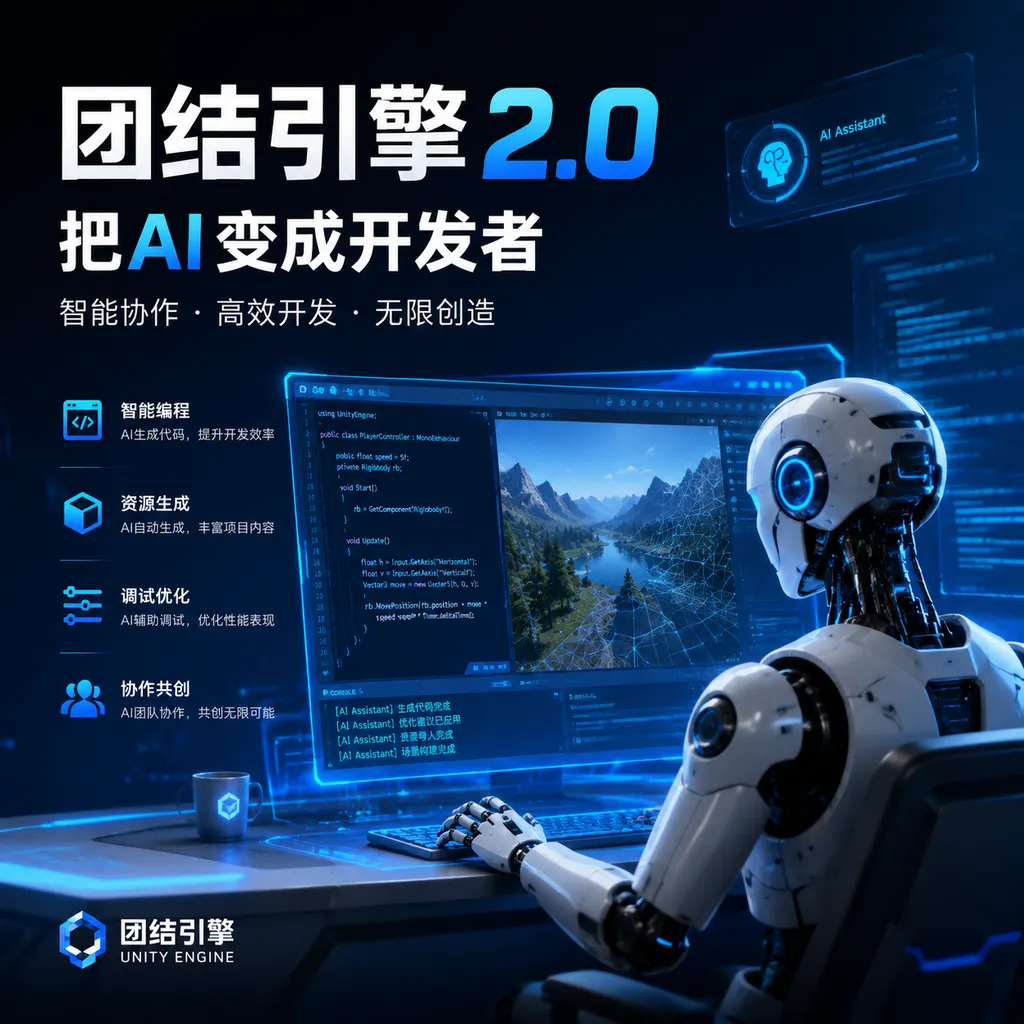
Unity China has released Tuanjie Engine 2.0, featuring a rearchitected core, expanded support for console platforms, and Tuanjie Codely, an AI agent capable of coding, testing, and fixing issues.
AI Is No Longer Just Completing Code—It Is Starting to Take Over Entire Development Tasks
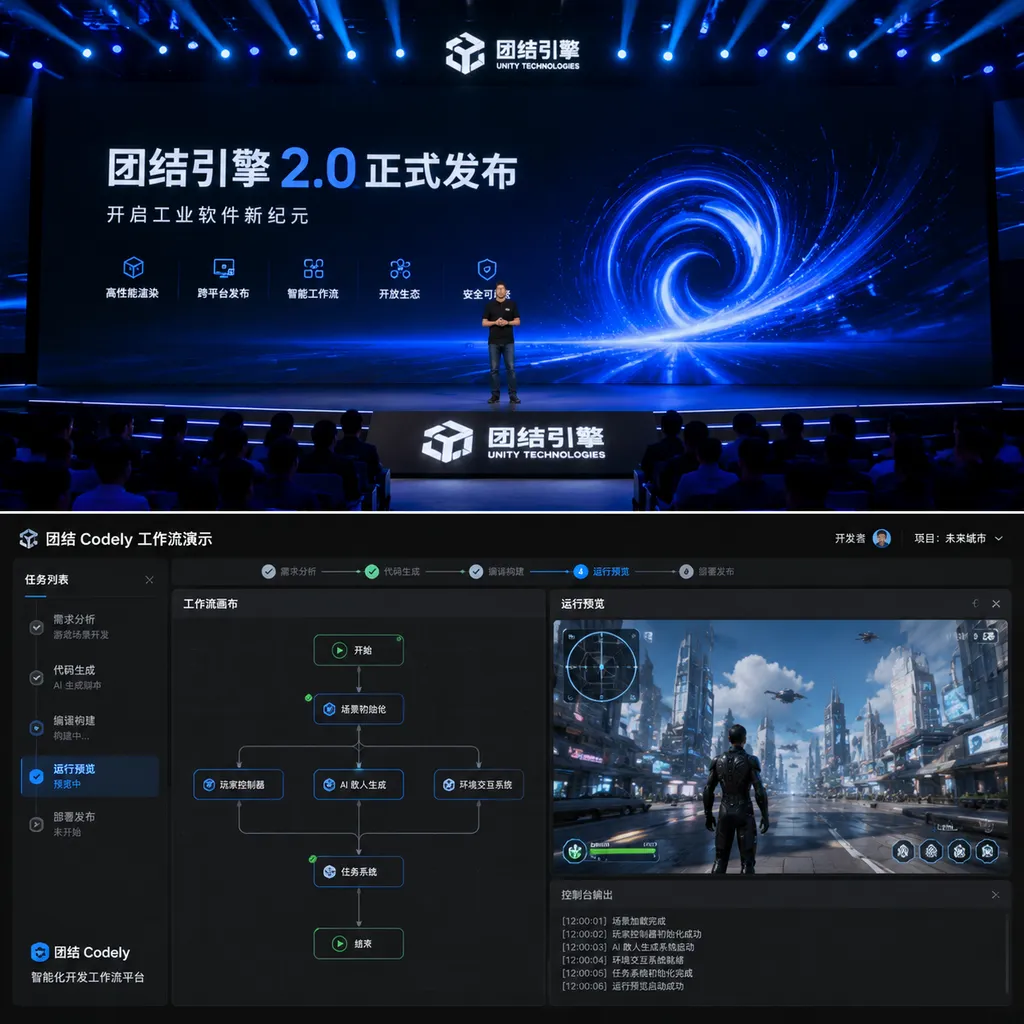
On July 28, Unity China officially released Tuanjie Engine 2.0. This is the most extensive upgrade since the engine’s launch: its underlying architecture has been comprehensively rebuilt, support has been added for PlayStation 5, Xbox Series X|S, Nintendo Switch, and Switch 2, and the “Tuanjie Codely” AI Agent has been introduced.
The most noteworthy development is not any particular rendering feature, but Codely’s attempt to independently complete game development tasks.
According to information released by Unity China, the Agent can understand requirements, write code, build scenes, run tests, analyze errors, fix issues, and ultimately deliver results for developers to review. In other words, rather than merely performing the “next-line prediction” of a code completion tool, it is designed to receive a goal and continuously operate within the engine until the task is complete or human intervention is required.
This is also the clearest product signal from Tuanjie Engine 2.0: Unity China is no longer content to build a localized version of the editor. It wants to turn Tuanjie Engine into production infrastructure spanning development, testing, marketing, and publishing.
The Key to Codely Is Not That It “Can Write Code”
Today, nearly every mainstream IDE includes AI coding features. If Codely merely generated a C# script from a prompt, it would struggle to differentiate itself from GitHub Copilot, Cursor, or other agentic programming tools.
Nor has code ever been the only difficult part of game development.
A seemingly simple requirement—such as “add a destructible wooden crate to the current level that explodes after three hits and deals area-of-effect damage to nearby enemies”—involves at least the following:
- Creating or reusing models, materials, and colliders;
- Configuring scene objects and component relationships;
- Writing health, hit-response, and explosion logic;
- Handling particle, sound, and animation triggers;
- Running the scene and checking for null references, collision-layer issues, and performance problems;
- Confirming that the changes have not broken existing Prefabs or other levels.
Traditional coding assistants can cover only part of this process. A true engine Agent must understand scene hierarchies, component dependencies, asset references, and runtime state. It must also be able to operate the editor, launch tests, and read logs.
To support this, Tuanjie Engine 2.0 has changed the underlying representation of assets and projects, allowing AI to understand projects, manipulate scenes and scripts, and connect three modes of creation: natural language, visual nodes, and code. This is more important than simply adding a chatbot to the editor’s sidebar. Whether AI can work reliably depends on whether a project can be consistently read and modified by machines—not on how many lines of seemingly correct code a model can produce.
Unity China calls this methodology “Loop Engineering.” It emphasizes a closed loop: receive a task, make changes, run validation, identify errors, continue fixing them, and then hand the results to a human for review. The value of AI thus shifts from one-off content generation to the continuous advancement of engineering tasks.
This is the right direction. Code generation is already relatively mature, but what game-development Agents truly lack are execution environments, state feedback, and validation mechanisms. The engine itself has access to the full project context and can directly run the game and read errors, giving it a better chance than general-purpose programming Agents of creating a complete closed loop.
However, being “capable of independent execution” is still not the same as being “safe to ship.” The information released so far demonstrates Codely’s product direction, but it is not enough to prove that the Agent can reliably handle large commercial projects. Challenges include cross-scene references, complex state machines, third-party plugins, custom render pipelines, legacy technical debt, and issues involving visuals and game feel that cannot be assessed through unit tests alone.
When AI Modifies a Project, It Must Leave Records Like an Engineer
Once an Agent enters a real-world project, the greatest danger is often not that it cannot do the work, but that it does something wrong and no one notices.
Game projects contain numerous implicit dependencies. If an Agent modifies a shared Prefab, it may affect dozens of scenes at once. Changing a collision layer might cause a character to fall straight through the floor in another level. Deleting a component to fix an error could turn an obvious failure into a difficult-to-reproduce logic bug.
Tuanjie Engine 2.0 therefore adds mechanisms such as change comparisons, version traceability, and permission controls, allowing AI output to be reviewed and managed like a human engineer’s commits. This design may be less eye-catching than “generating a game from natural language,” but it is far closer to what teams actually require before they are willing to use an Agent.
For a development team, a practical Codely should answer at least three questions:
- What did it change? Assets, scenes, scripts, and project settings must have clear diffs;
- Why did it make those changes? Each operation should be traceable to the original task and relevant error messages;
- Can the changes be reverted if something goes wrong? The Agent’s permission boundaries, version history, and rollback path must be explicit.
If these capabilities can operate reliably in large projects, Codely may initially replace not lead programmers or technical artists, but large volumes of mechanical, repetitive, and well-contextualized development work—for example, placing scene objects in batches, adding missing components, generating basic interactions, running regression tests, and locating common errors.
It is more like a fast junior engineer whose work requires code review than a producer capable of independently determining a product’s direction.
From Mini Games to Consoles, Tuanjie Engine Adds a Critical Piece
Tuanjie Engine 1.0’s strengths were primarily concentrated in China’s domestic ecosystem, including WeChat and Douyin Mini Games, OpenHarmony, and smart-vehicle cockpit HMI applications. Version 2.0 clearly extends those boundaries toward mainstream global platforms.
The new version adds development support for the following console platforms:
- PlayStation 5;
- Xbox Series X|S;
- Nintendo Switch;
- Nintendo Switch 2.
Combined with its existing support for PC, mobile devices, Mini Games, OpenHarmony, and in-vehicle platforms, Tuanjie Engine now offers a remarkably broad publishing matrix. Developers can advance projects within a unified workflow and then adapt them to each platform’s performance budget, input devices, and release requirements.
This is strategically significant. Chinese teams seeking to cover both domestic distribution channels and overseas console markets have often had to switch repeatedly between toolchains, plugins, SDKs, and porting processes. If Tuanjie Engine can bring domestic platform adaptation and console publishing pipelines into a single project system, it will establish a relatively clear point of differentiation.
However, console support does not mean “one-click porting.” Console projects also involve platform authorization, development kits, certification requirements, performance optimization, and the release processes of different storefronts. An engine can lower technical barriers, but it cannot eliminate this work. For commercial teams, the real questions are whether console export pipelines are stable, whether the plugin ecosystem is complete, and whether timely support is available when platform-level issues arise.
Rendering Upgrades Target Large, High-Quality Projects
To support open-world and high-quality cross-platform projects, Tuanjie Engine 2.0 also introduces systematic upgrades to rendering, lighting, animation, particle effects, and parallel computing.
Among them, Virtual Geometry allows high-resolution models to be imported directly into a project, with the engine handling loading and scheduling. It addresses a long-standing and labor-intensive task in game art: teams generally need to create multiple LOD versions of the same model at different levels of detail to accommodate different viewing distances and devices. Virtual Geometry shifts more of those decisions to the engine, potentially reducing the cost of manual asset processing.
Real-time dynamic global illumination, meanwhile, attempts to reduce reliance on pre-baking. For games with day-night cycles, destructible environments, or seamless transitions between indoor and outdoor spaces, static baking cannot cover every possible change, while rebaking slows iteration. Real-time solutions allow lighting to change dynamically with the environment, but they also impose greater demands on GPU performance, denoising, and cross-platform consistency.
The upgraded shadows, animation, particle systems, and parallel rendering capabilities all point toward a common goal: enabling Tuanjie Engine to support not only lightweight content and domestic platforms, but also larger projects with more complex assets.
These capabilities still need to be validated by actual shipped titles. The mere “existence” of rendering features is only the first step. Whether the tools are stable, performance is predictable, and quality can scale down smoothly on mobile devices and consoles will determine whether teams are willing to use them in projects that span several years.
What Tuanjie Engine Is Really Competing for Is the Workflow
Competition among game engines has traditionally centered on rendering quality, platform coverage, asset stores, and developer ecosystems. With the arrival of AI Agents, the focus is beginning to shift toward “who can understand and operate an entire project.”
General-purpose AI programming tools benefit from rapid model iteration and support for numerous languages. Engine vendors, meanwhile, have access to structured project data, editor operation interfaces, and runtime feedback. They may not possess the strongest foundation models, but they are better positioned to know which scene contains an object, which components are attached to it, and whether newly generated code can actually run.
Codely’s moat, therefore, will not be its chat box or model capabilities alone. It will be the project representation, operation interfaces, testing loop, and permission system that Tuanjie Engine 2.0 has rebuilt for the Agent. If these capabilities work only in demo projects, Codely will become just another AI showcase feature. If it can enter real projects with strict version management and massive asset libraries, its value will far exceed that of an ordinary coding assistant.
For now, more information from Unity China is still needed, including Codely’s availability, pricing model, model selection, data boundaries, on-premises deployment capabilities, and permissions within console projects. For unreleased games in particular, whether source code and assets are uploaded, whether data is used for training, and whether enterprises can control models and log retention will directly affect adoption decisions.
A Pragmatic Assessment: The Direction Is Sound, but the Results Must Be Proven in Production Projects
Tuanjie Engine 2.0 does not merely add a few features. It attempts to solve three problems simultaneously: supporting larger projects through upgraded rendering and parallel computing capabilities, expanding publishing reach through console support, and transforming production workflows with an AI Agent.
Together, these three elements are far more meaningful than launching a standalone AI coding assistant.
Codely’s most realistic short-term value lies in reducing the time from requirements to a playable prototype and taking over low-risk tasks such as testing, bug fixing, and batch configuration. As for “independently developing a complete game through natural language,” that remains more of an industry vision for now. A game is not merely functioning software; it also encompasses level pacing, combat feel, artistic style, and countless design judgments that are difficult to quantify. Passing tests alone cannot prove that these elements are correct.
What is certain, however, is that Agents have begun moving beyond IDEs and into the depths of game engines. The tools developers use in the future will no longer be editors that simply wait for instructions, but collaborators capable of reading projects, making changes, and proactively validating the results.
Tuanjie Engine 2.0 has moved early to embed this logic into its underlying architecture. The question is no longer whether AI will participate in game development, but how far it can proceed independently in real-world projects.
References
- ITHome: Unity China Releases Tuanjie Engine 2.0 With a Completely Rebuilt Underlying Architecture, Console Support, and Deep AI Integration — Key information from the launch event, including Codely, console platform support, and rendering capability upgrades.