AgiBot WITA-Omni Tops the Omni-Modal Leaderboard
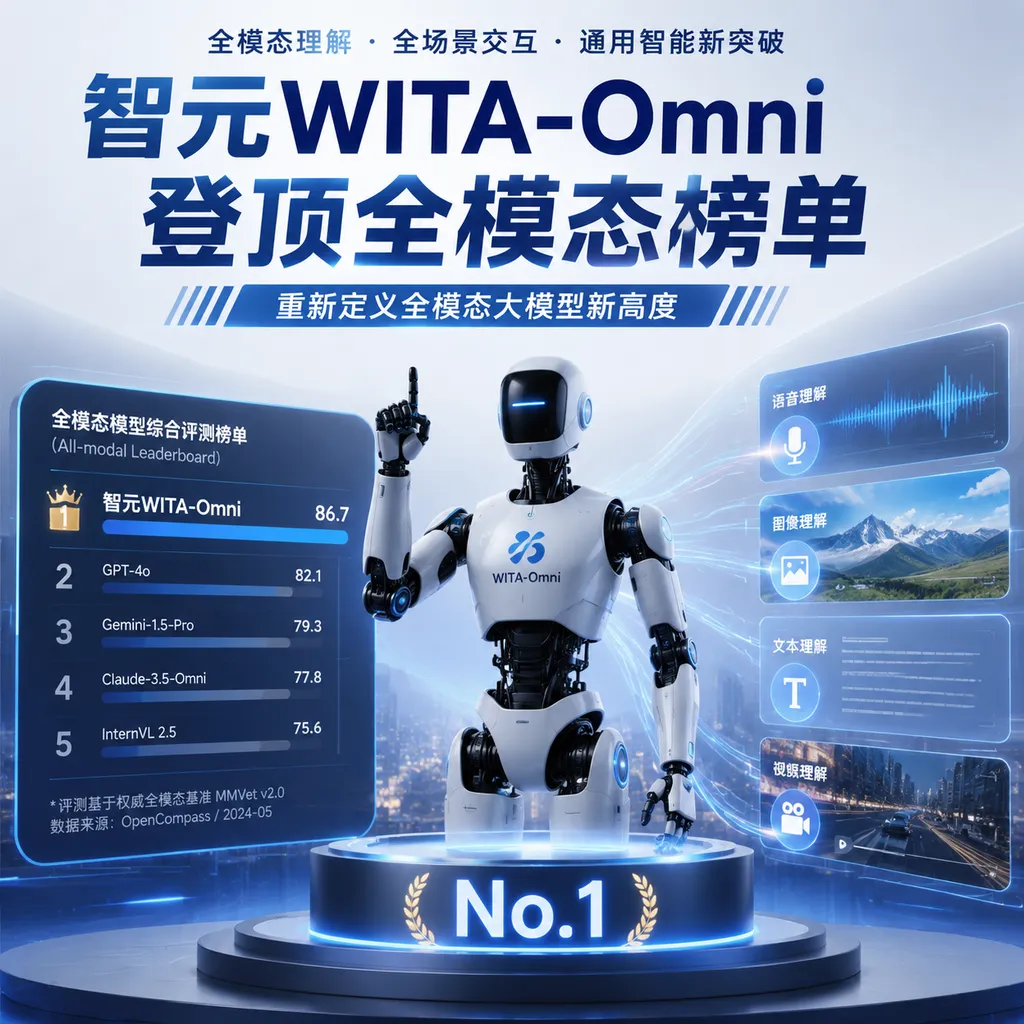
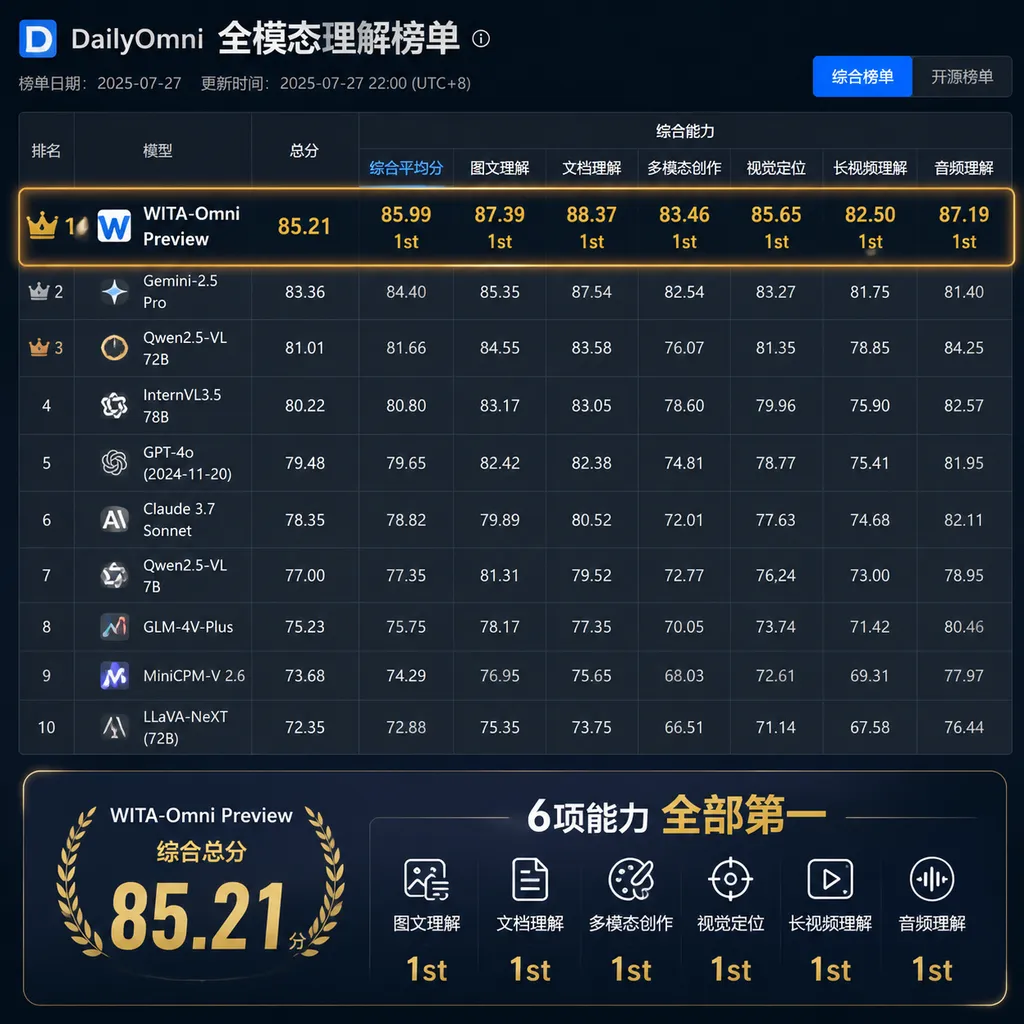
The WITA-Omni Preview embodied AI model from AgiBot topped the DailyOmni leaderboard with a score of 85.21, ranking first in six of the eight metrics. More noteworthy than the ranking itself is that joint audio-visual reasoning is emerging as a new dividing line for robotics models.
AgiBot Tops DailyOmni, but This Is More Than Just Benchmark Chasing
On July 28, AgiBot announced the latest results for its embodied-native omni-modal foundation model, WITA-Omni Preview. The model ranked first on DailyOmni, a third-party audio-video understanding benchmark, with a score of 85.21, outperforming participating models from Qwen, Gemini, Doubao, NVIDIA, and others. It also placed first in six of the benchmark’s eight subcategories.
First, it is important to define the limits of this “world No. 1” claim: it refers to the highest overall score on the current DailyOmni leaderboard. It does not mean the model leads in every capability, such as general language, image understanding, or robotic manipulation. A leaderboard is only a snapshot; rankings may change as model versions and evaluation settings evolve.
Even so, the result is worth noting. DailyOmni does not test whether a model can “generate a plausible-looking description for a video.” It tests whether the model can understand sound and visuals along the same timeline. For chat assistants, this is an advanced capability; for robots that need to operate in the physical world, it is a foundational one.
Audio-Video Understanding Is Not Simply About “Adding Another Modality”
Over the past two years, multimodal models have primarily focused on solving vision-language problems: given an image, the model identifies objects, reads text, and combines that information with a language model to answer questions. Video understanding is usually built on top of this architecture by sampling frames and breaking a video into a sequence of images for the model to process.
This approach can identify “what is in the frame,” but it may not know “what actually just happened.”
Consider a simple example: before a cup falls to the floor, a collision is heard off-screen. The robot then turns its head and sees the cup wobbling near the edge of a table. A model that processes only images may discard the sound entirely, while a system that only transcribes speech will not preserve this kind of environmental audio. A genuine joint audio-video model must determine the source of the sound, the sequence of events, and whether the audio matches the visuals before deciding where to look or whether to alert the user.
This is where DailyOmni’s value lies. Much of its content comes from real-world, open environments, with a focus on evaluating whether:
- Audio events and visual events can be aligned correctly;
- The model can identify the sequence of actions, sounds, and speech;
- The model can complete cross-modal semantics when critical information is present only in either the audio or the visuals;
- The model can maintain stable temporal reasoning over longer videos and continuous events;
- The model can identify the actual evidence when environmental sounds, speech, and visual actions conflict.
This is closer to the problems robots encounter than conventional video question answering. Homes, stores, and factories are not datasets with clean subtitles: machinery may drown out speech, the speaker may not be centered in the camera frame, and users will not wait for a robot to finish processing the previous interaction before continuing to act. If a model can only “see” and “hear” separately before merging two summaries, it can easily make mistakes in temporal reasoning.
In other words, multimodality is not simply a matter of connecting multiple encoders to the same language model. The real challenge is getting different modalities to refer to the same event at the same moment.
From Thinker–Talker to Thinker–Talker–Actor
According to information disclosed by AgiBot, WITA-Omni does not simply install a general-purpose chat model in a robot. Instead, it adds an Actor to the Thinker–Talker paradigm, creating a Thinker–Talker–Actor architecture.
The three components can be broadly understood as follows:
| Module | Primary Responsibility | What It Means for Robots | | --- | --- | --- | | Thinker | Fuses audio, visuals, and context to perform reasoning | Determines what is happening in the environment and how to respond | | Talker | Generates speech and conversational content | Controls what to say, when to say it, and how to interrupt or take turns | | Actor | Produces movements and expressions | Incorporates nodding, turning, gaze, and body movements into a unified response |
The key change is that movements are no longer merely secondary outputs translated by a separate engineering module after the language model generates a line of text. Movements and expressions are elevated to first-class outputs alongside speech.
Traditional robot interaction pipelines are usually lengthy: cameras handle visual recognition, microphones feed into speech recognition, a language model generates text, speech synthesis produces spoken output, and a motion controller ultimately decides how the body should move. Each module can work independently, but the longer the pipeline, the more errors and latency accumulate. The model may already have said “Okay” while the robot’s body has yet to turn toward the user, or it may begin speaking before the user has finished.
A native end-to-end architecture attempts to place all these stages on a unified timeline, making “looking at the speaker,” “nodding,” and “beginning to answer” a coordinated set of outputs. This is a more important product direction for WITA-Omni than its leaderboard score.
However, a sound architectural objective does not mean the engineering challenges have already been solved. The final robot experience still depends on perception latency, time to first token, motion-planning frequency, safety controls, and hardware execution error. A model may answer an offline video question correctly but still be unable to respond on-site within a few hundred milliseconds.
Tens of Millions of Hours of Data, but Interaction Timing Is the Truly Scarce Resource
AgiBot says WITA-Omni used tens of millions of hours of open-source and proprietary multimodal data during mid-training, expanding its text and vision foundation into an omni-modal model capable of processing audio and video and performing joint audio-visual reasoning.
Tens of millions of hours is an eye-catching figure, but total data volume is not the only variable when training embodied models. Public videos usually contain visuals, audio tracks, and subtitles, but they lack the annotations that robot interaction actually requires: who is speaking to whom, when it is the robot’s turn to respond, which movement corresponds to which utterance, and whether an expression changes before or after the speech.
AgiBot has therefore also built datasets for real-world interaction scenarios that preserve the natural temporal relationships among sound, visuals, language, movements, and expressions. The value of this type of data is similar to that of continuous driving sequences in autonomous driving: individual road images can train object detection, but only continuous trajectories can teach a vehicle to reason about cause and effect.
For embodied models, the scarcest resource is not another million online videos. It is closed-loop data that completely records “how a person initiates an interaction—when the robot understands—how it should speak and move.” Public videos can teach a model to recognize the world; real interaction data may teach it to participate in the world.
This also explains why audio-video understanding is becoming a new battleground. Text and image data have already been extensively captured from the internet, but synchronized data covering audio, motion, expressions, and spatial states is difficult to obtain directly from public webpages. The companies that can continuously deploy robots, collect high-quality interaction trajectories, and establish robust data-cleaning pipelines may be the ones that build the deepest data moats.
How Far Is a No. 1 Ranking from a Robot That Is Actually Useful?
WITA-Omni Preview’s score of 85.21 demonstrates one thing: at least on joint audio-video understanding tasks, a model specifically designed for embodied interaction can outperform some larger and more broadly capable general-purpose models. Model competition is no longer only about parameter counts; data structure and training objectives are beginning to determine the upper limits of specialized capabilities.
However, the information disclosed so far remains limited. As a Preview release, it still leaves several key questions insufficiently answered:
- No complete technical report. The model’s parameter count, context length, audio-video sampling strategy, and training-data mix have not been fully disclosed.
- No on-device or real-time metrics. Leaderboard scores do not directly reflect time to first word, ongoing conversation latency, or inference cost.
- No closed-loop action evaluation. DailyOmni primarily evaluates understanding and does not equate to robotic task success rates, motion naturalness, or safety.
- Reproduction conditions remain unclear. The use of subtitles, audio sample rates, video frame rates, and inference prompts can all affect audio-video benchmark results.
- Availability to external developers is unknown. Current information focuses on model capabilities and future product plans, without providing a public API, model weights, or pricing for developers.
A more accurate assessment at this stage is therefore that WITA-Omni Preview has earned a meaningful first-place ranking in a specialized benchmark and demonstrated AgiBot’s progress in embodied omni-modal data and training. It is not yet comprehensive proof of general robotic capabilities.
Why Joint Audio-Video Reasoning Will Become the Next Major Divide
In the past, model vendors could quickly build multimodal products using cascaded ASR, vision-model, and LLM pipelines. Modular architectures are easy to maintain and make it convenient to switch providers. They remain practical for tasks such as customer service and meeting transcription.
But robots and real-time agents will push this architecture toward its limits. The reasons are straightforward:
- ASR preserves only text, losing tone, environmental sounds, and speech timing;
- Frame-sampled vision misses fleeting actions and struggles to determine event order reliably;
- Multiple modules maintain separate clocks, making it difficult to synchronize audio, visuals, and movements;
- Once intermediate results are compressed into text, the model cannot revisit the original perceptual evidence;
- Cascaded pipelines add latency, and the more real-time the interaction, the more apparent the problem becomes.
The goal of native Omni models is to allow sound, visuals, language, and even movements to share the same context, rather than first translating all information into text. For developers, this means future robot systems may no longer be built around “an LLM plus a collection of perception plug-ins.” Instead, a unified omni-modal model may serve as the central hub, while traditional modules are relegated to tools, safety controls, and deterministic execution.
This will not make modular solutions disappear immediately. Tasks involving industrial safety and high-precision control will still require conventional planners, rule-based systems, and hard real-time control. A more realistic architecture is one in which the Omni model understands the environment, manages interaction, and generates high-level action intents, while lower-level controllers turn those intents into verifiable and interruptible movements.
AgiBot’s Next Challenge Is Not Winning a Few More First Places
According to previously disclosed plans, AgiBot expects to launch WITA Omni 1.0 in the third quarter of this year and reduce interaction latency to under 500 milliseconds. If this target can be achieved consistently on real robots, it will be more significant than continuing to break records on offline benchmarks: response times of around half a second only begin to approach the requirements of natural conversation and timely motion feedback.
WITA-Omni Preview’s first-place result sends a clear signal. Competition among multimodal models is shifting from “Can they recognize audio and video?” to “Can they organize sound, visuals, language, and movement into a closed loop over continuous time?”
General-purpose models such as GPT, Gemini, and Qwen will continue expanding their modality coverage, while robotics companies will attempt to use embodied data to establish advantages in interaction timing and action generation. The two approaches will likely converge at the same point: models must not only answer what the world is, but also decide what to say next, where to look, and how the body should move.
For AgiBot, taking first place on DailyOmni is an effective technical showcase, but the real proving ground is not the leaderboard page. It is the noisy, continuous, and unpredictable physical world. Only when the model’s advantage in audio-video reasoning can be reliably translated into lower latency, more natural interactions, and higher task success rates will this “first place” become a product moat rather than merely a scorecard.
References
- ITHome: AgiBot’s WITA-Omni Preview Tops the DailyOmni Omni-Modal Understanding Leaderboard—Includes officially disclosed information on the score of 85.21, first-place rankings in six subcategories, the model architecture, training data, and more.