PIRL Gives Reinforcement Learning a Rearview Mirror
PIRL no longer assumes by default that every policy update is an improvement; instead, it looks back and verifies whether the new policy is genuinely better than the old one. What it adds is not a new reward, but the feedback loop that has long been missing from RL post-training.
Reinforcement Learning Is Finally Asking: Was the Last Step Actually Better?
As of July 28, Policy Improvement Reinforcement Learning (PIRL), proposed by teams from Beihang University, Peking University, and Meituan, is generating discussion in the reinforcement learning community. Its engineering implementation is called Policy Improvement Policy Optimization (PIPO): after completing a parameter update, the system does not immediately discard the old data. Instead, it looks back to verify whether the new policy is actually stronger than the pre-update policy, then decides whether to reinforce or correct the direction of that update.
This may sound like common sense, but it pinpoints a long-overlooked issue in reinforcement learning post-training for large models: a lower training objective does not necessarily mean stronger model capabilities, and a higher reward on the current batch does not necessarily mean the policy has improved overall.
PPO, GRPO, GSPO, DAPO, on-policy distillation, self-distillation, and other methods differ in their loss functions, advantage estimation, and sampling strategies, but their training loops are broadly similar:
- Sample a batch of responses from the current policy;
- Generate learning signals using a reward model, rule-based verifier, or teacher model;
- Update the parameters based on this batch of data;
- Discard the current batch and move on to the next round.
The problem lies in step four. Whether the updated policy has actually improved is generally not verified directly within the training loop. The optimizer only knows that it has pushed a local proxy objective in the intended direction; it does not know what has happened to the model under the actual generation distribution.
What PIRL does is add a “rearview mirror” to this process.
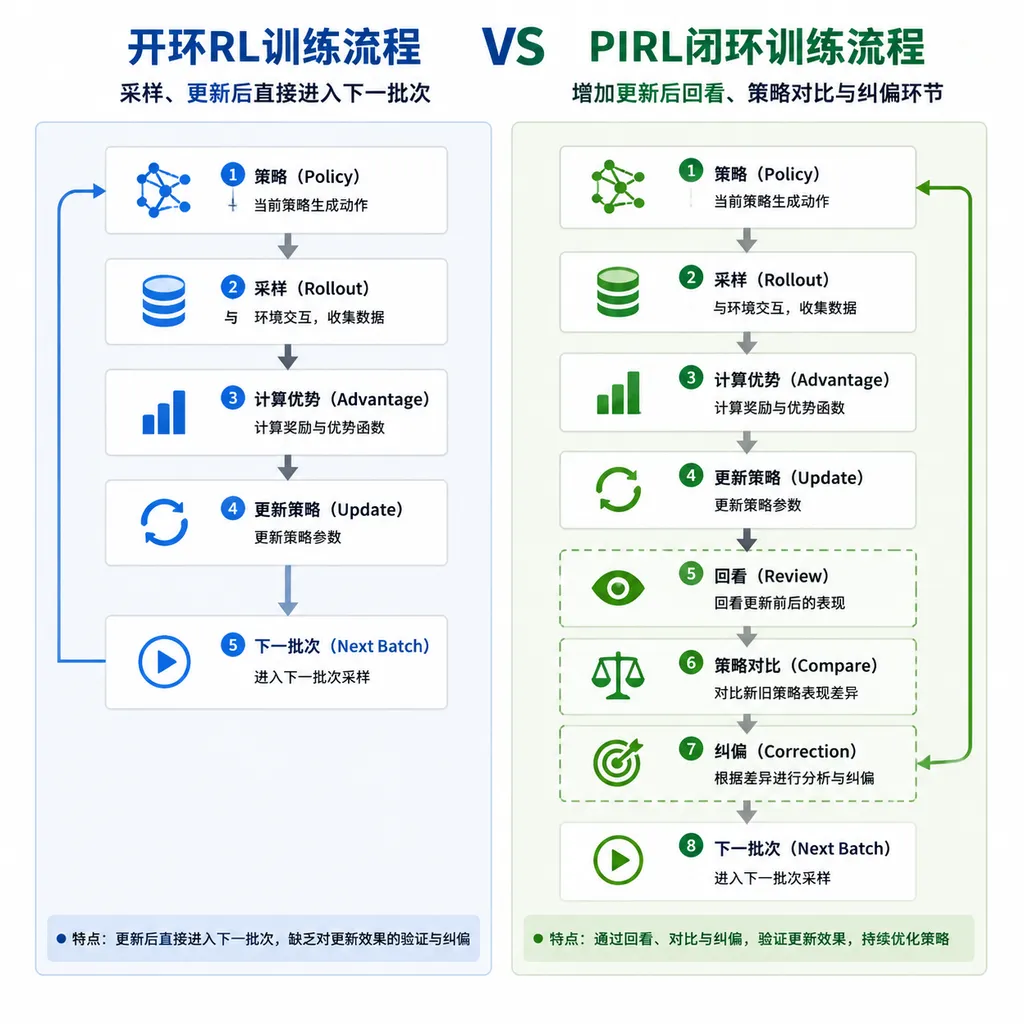
Today’s Large-Model RL Is Still Fundamentally Open-Loop Control
Traditional reinforcement learning does not lack the concept of policy improvement in theory. Policy iteration, trust-region constraints, and monotonic improvement bounds all attempt to answer whether a new policy can outperform the old one. In practical post-training systems for large models, however, computational scale, long-sequence generation, and reward noise force training to rely on limited samples and proxy objectives.
As a result, theoretical “policy improvement” is often reduced in engineering practice to “the optimization objective improved on this batch of data.”
The existing workflow can be compared to driving:
- The reward tells you whether to steer left or right;
- PPO clipping or KL constraints prevent you from turning the wheel too sharply;
- But after the turn, the system does not immediately check whether the car is actually closer to the center of the road.
As long as the local loss looks normal, the gradients do not explode, and the training reward continues to rise, the process simply moves forward.
This is what PIRL calls “open-loop exploration.” It does not mean that PPO or GRPO has no feedback at all. Rather, it means that feedback occurs primarily within a single batch, without cross-batch verification of the outcome of the previous parameter update.
This gap is especially pronounced in large language models, for at least four reasons.
1. Limited Sampling Can Mistake Chance Outcomes for Stable Capabilities
Given the same prompt, a model may generate the correct answer or may go astray midway through its reasoning. If only a small number of trajectories are sampled for each problem, reward differences can easily result from randomness rather than a reliable change in the policy itself.
Getting two more questions right on a particular batch does not necessarily mean the update was effective; the model may simply have been luckier in that round of sampling.
2. Rewards Do Not Fully Align With the True Objective
The final answer to a math problem can be verified automatically, but a single outcome reward has difficulty capturing whether the reasoning is reliable, whether the model is exploiting formatting loopholes, or whether it has sacrificed other capabilities.
When the reward contains loopholes, a policy that becomes better at optimizing the reward may actually move farther away from the model developers truly want. Traditional workflows continue reinforcing that direction because all they see is a “high score.”
3. Token-Level Credit Assignment Is Imprecise
When a long reasoning trace ultimately produces a wrong answer, was the error caused by a bad branch at token 20 or a calculation mistake at token 800? Many algorithms can only propagate a sequence-level reward across the entire trajectory through an advantage function.
Even when the local objective is optimized correctly, the update may inadvertently damage reasoning patterns that were originally useful.
4. The Policy Distribution Shifts After Every Update
The current batch comes from the old policy, while the new policy after the gradient update already represents a different distribution. Probability adjustments that appear beneficial during training may be amplified layer by layer through changes in the prefix distribution once they enter actual autoregressive generation.
This is also why examining the loss offline makes it difficult to determine whether a generative model has truly improved. A language model is not a classifier: changing one earlier token redefines the state in which every subsequent token is generated.
PIRL Adds Post-Update Acceptance Testing, Not a New Reward
PIRL’s central question can be expressed directly. Suppose the policy before the update is π_t and the policy after the update is π_{t+1}. For the same set of problems x, what truly matters is:
Δ_t(x) = E[R(y) | y ~ π_{t+1}(.|x)] - E[R(y) | y ~ π_t(.|x)]
If Δ_t is positive, the update has likely produced a policy improvement. If it is negative, the system should at least recognize that the previous learning direction is questionable.
In practice, it is impossible to calculate the expected rewards of both policies precisely over the entire task distribution. PIPO’s approach is to establish approximate feedback for this difference through affordable historical lookbacks and reevaluation: retain relevant information from the previous round, examine how the new policy’s performance changes on historical problems, and convert the results into reinforcement or corrective signals for the next round.
The most important change here is that training data is no longer treated as disposable after a single use.
A simplified loop can be understood as follows:
Sample from the current policy on batch_t
Compute rewards and advantages to obtain a candidate update
Apply the update to obtain the new policy

Revisit the previous round or historical problems
Compare the results of the new and old policies on these problems
If the update produces a stable improvement: reinforce the relevant direction
If the update causes degradation: weaken or correct the relevant direction

Then proceed to batch_(t+1)
This is not a complete description of PIPO’s implementation details, but it is the simplest way to understand its closed-loop logic: act first, then validate the result—and feed that validation result back into the controller.
PIRL is therefore not a simple replacement for PPO, GRPO, or DAPO. The latter methods primarily address “how to perform an update based on the current samples,” while PIRL focuses on “how to determine whether that update is worth retaining.” PIPO is described as a plug-and-play framework precisely because it is more like an outer policy-improvement layer around the training loop than a ground-up redefinition of the entire optimization process.
What It Really Addresses Is the “False Prosperity” of Training Rewards
In recent years, RLVR (Reinforcement Learning with Verifiable Rewards) has become an important approach for training reasoning models. Mathematical, coding, and logical tasks can receive relatively reliable rewards through answer matching, unit tests, or rule-based verifiers, while training costs are also more manageable than with human preference annotation.
However, RLVR has an increasingly scrutinized side effect: a model’s pass@1 may continue to improve while its pass@k at high sampling counts—or the coverage of problems it can solve—actually declines.
In other words, the model becomes increasingly proficient at producing a small number of high-probability, easy-to-reward paths, while potentially losing low-probability but effective exploration paths. It may appear stronger when given a single attempt, yet the boundary of its capabilities may not expand and may even contract.
This is also why PIRL must be evaluated with a clear-eyed perspective. PIRL can verify whether a particular update improves performance on a specified distribution and metric, but it cannot automatically answer whether the model has acquired entirely new reasoning capabilities. If the closed-loop feedback considers only average reward or pass@1, it may still validate an update that narrows the policy distribution.
Therefore, “genuine improvement” cannot be represented by a single scalar. A more reasonable policy-improvement check should include at least several groups of metrics:
- Average success rate: Is the model more likely to produce the correct answer under standard sampling?
- Coverage: Does the set of solvable problems expand as the sampling budget increases?
- Generation entropy and diversity: Is the policy collapsing prematurely onto a small number of templates?
- Length and cost: Is the reward improvement achieved merely by producing longer chains of thought?
- Out-of-distribution performance: Are the gains preserved on problems not involved in lookback validation?
- Safety and formatting metrics: Is the model obtaining superficially high scores by exploiting reward loopholes?
If the same biased reward function is merely run one more time, the closed loop may do nothing more than “confirm the bias more frequently.”
PIPO Goes One Step Beyond Running an Evaluation Set After Training
One might ask: wouldn’t running an evaluation every few steps also tell us whether the model has improved?
The difference is that traditional evaluations are generally used only for observation and do not directly participate in subsequent updates. After seeing a metric decline, developers may stop training, roll back a checkpoint, or adjust hyperparameters, but the evaluation result does not become a sample-level or update-level learning signal.
PIPO emphasizes bringing validation into the training loop:
- Instead of discovering model degradation only after an hour of training;
- It uses historical performance in the next or an adjacent update to assess the previous update;
- Rather than merely making a global decision to “continue or stop,” it also attempts to reinforce effective update directions and correct ineffective ones.
This is closer to an online control system than a periodic health check.
From a development perspective, this may offer more practical value than designing yet another sophisticated advantage function. The difficulty with large-model RL is often not a lack of sufficiently elegant formulas, but a lack of attribution within the training process: when rewards suddenly rise, has the model learned to reason, standardized its output format, or simply encountered easier samples by chance? PIRL at least requires the system to make an explicit comparison between “before the update” and “after the update.”
Closed Loops Are Not Free: They Increase Sampling and State-Management Costs
PIRL’s direction is reasonable, but its engineering costs are equally clear.
The first cost is additional inference. Validating differences between new and old policies requires resampling or rescoring historical problems. For long-chain-of-thought tasks, generation is often more expensive than backpropagation. If large-scale replay is performed after every update, the benefits of the closed loop may be offset by lower throughput.
The second cost is policy version management. The system needs to know which checkpoint generated each sample, what sampling parameters were used at the time, whether the verifier version has changed, and whether the new and old policies are being compared under equivalent conditions. Otherwise, changes in temperature, maximum length, or the reward service may be misinterpreted as policy improvements.
The third issue is statistical significance. Two different generations from the same model are not enough to prove that a parameter update was effective. A reliable implementation generally needs to consider:
- Performing paired comparisons on the same prompts;
- Fixing or recording sampling configurations;
- Increasing the number of samples for high-variance tasks;
- Setting confidence intervals or minimum thresholds for the magnitude of improvement;
- Avoiding repeated corrections in response to minor random fluctuations.
Finally, historical data becomes stale. If the system continually revisits early problems, the model may gradually overfit to a set of “training-time regression tests.” If it looks only at the previous batch, however, the scope of validation may be too narrow. How the historical buffer is sampled will directly determine whether PIPO is validating general policy improvement or merely training the model to memorize old questions.
This means that while PIPO is described as plug-and-play, integrating it does not eliminate the need for tuning. It reduces intrusiveness at the algorithm-interface level, not complexity at the system-design level.
Development Teams Can Adopt Its Principles Before Rewriting Their Training Frameworks
Even without fully reproducing PIPO for now, teams performing RL post-training can immediately introduce several closed-loop principles.
Establish Update-Level Regression Sets
Do not retain only a single evaluation set that runs after training is complete. Maintain a small rolling regression pool covering recently failed samples, samples that have just received rewards, and fixed anchor tasks. After every major update, perform paired comparisons between the new and old checkpoints.
Monitor Both pass@1 and High-k Coverage
An increase in pass@1 only shows that the preferred output has become more effective; it does not prove that the boundary of the model’s capabilities has expanded. For reasoning models, performance under multiple sampling budgets should be monitored alongside the diversity of answers and reasoning paths.
Treat Rollbacks as a Normal Operation
Many training pipelines assume that the latest checkpoint is automatically the best checkpoint. Closed-loop training requires acknowledging that parameter updates can be harmful. Preserving policy versions, reward configurations, and sampling metadata is a prerequisite for reliable rollback.
Separate “Higher Reward” From “Better Policy”
A reward is a measurement tool, not the ground truth itself. If a reward increase is accompanied by abnormal growth in output length, increasingly templated formatting, changes in refusal rates, or a rapid drop in entropy, it should trigger additional validation rather than an automatic declaration of training success.
Version the Verifier as Well
Closed-loop training depends on validation results, so upgrading the verifier changes the entire feedback system. Rules, reward models, test cases, and parsers should all be versioned; otherwise, policy differences across steps are not comparable.
Assessment: PIRL Is Not a More Powerful Accelerator, but a Set of Brakes and a Dashboard
The most commendable aspect of PIRL is not its promise of a higher benchmark score, but the way it changes the default assumption of RL post-training: an update that satisfies the optimization objective should not automatically be regarded as a policy improvement.
This matters for current large-model training. Over the past year, the community has devoted enormous attention to reward design, advantage estimation, sampling efficiency, and training stability, while asking comparatively less often: under the same conditions, is the updated model truly better than the checkpoint that preceded it?
PIPO’s answer is a closed-loop framework. However, it is not magic that automatically guarantees monotonic improvement. Policy comparisons are still affected by limited sampling, verifier bias, and task distribution. If the definition of “stronger” is too narrow, the system will merely optimize the wrong objective more consistently.
Our assessment of PIRL is therefore: the direction is correct and comes closer to the real pain points of training than simply revising the loss function yet again. Its ultimate value, however, depends on whether the validation signals are multidimensional, whether the comparisons are statistically reliable, and whether the additional sampling costs can be controlled.
For developers, the most practical takeaway is not to migrate every PPO task to PIPO immediately, but to first abandon one dangerous habit: do not assume that the model has improved simply because the training reward has increased. Requiring every important update to undergo an acceptance test under equivalent conditions—one that is traceable and capable of triggering corrective feedback—is the genuinely useful part of closed-loop reinforcement learning.
References
- Reddit: PIRL — From Open-Loop Exploration to Closed-Loop Reinforcement Learning: A public introduction to PIRL and PIPO, outlining the open-loop problem in existing RL post-training and the lookback validation mechanism.
- Zhihu: A Survey of Reinforcement Learning Issues in Large Language Models: Reviews RLVR, policy optimization, and debates over capability improvement in large-model reinforcement learning, providing context for understanding pass@1, coverage, and reward-proxy issues.