Agent Mini: Breaking the Black Box Back Down into 3,000 Lines

Agent Mini was recently open-sourced. It implements a local-first agent in about 3,000 lines of Python, integrates with Ollama by default, and includes built-in shell, file, search, memory, and vision tools. Its value lies not in having the most features, but in finally allowing developers to read through the entire execution pipeline.
A Local Agent You Can Read in an Afternoon Has Just Been Open-Sourced
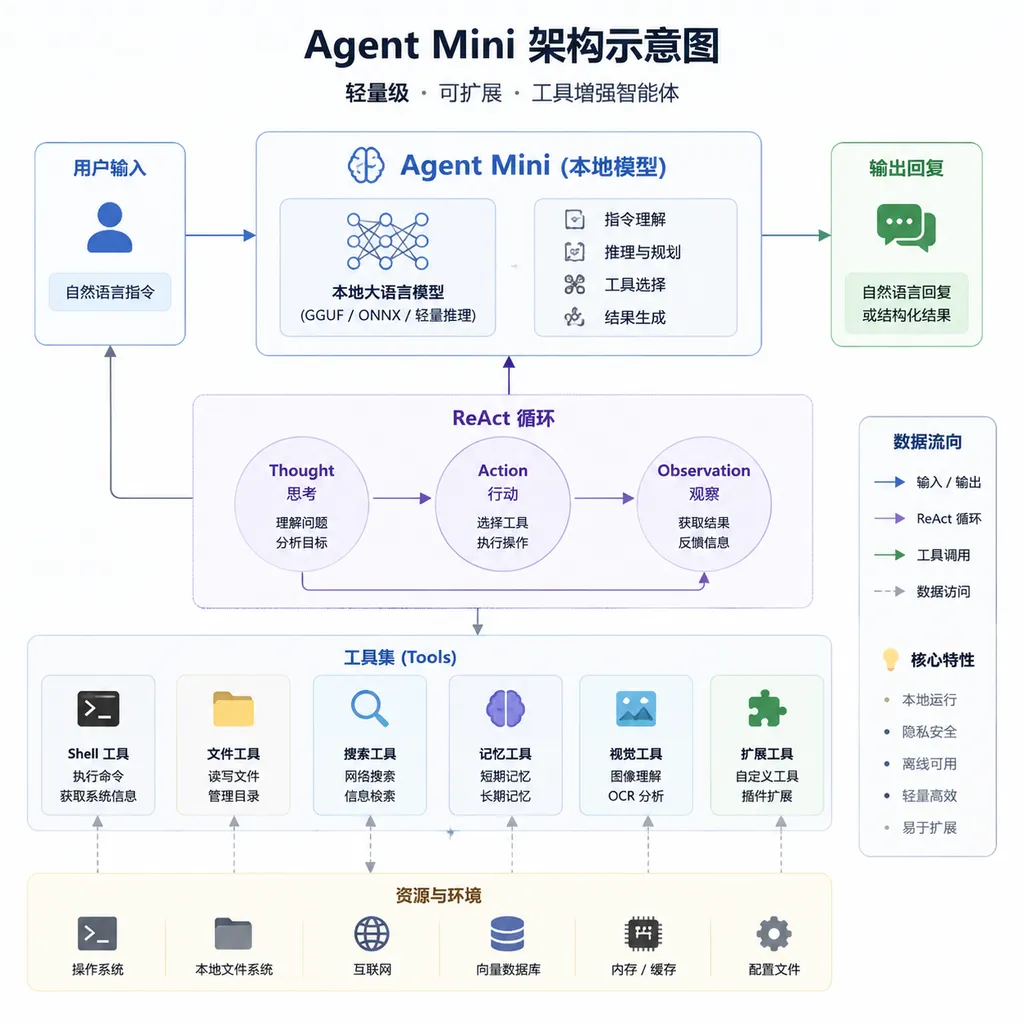
Agent Mini was recently open-sourced. It is a local-first AI agent written in approximately 3,000 lines of Python. By default, it uses Ollama to run local models and provides common tools for shell commands, file operations, web search, memory, and vision. A compact ReAct loop ties together model reasoning, tool execution, and result feedback.
The project deliberately avoids LangChain, LiteLLM, and other large agent frameworks. Its main dependencies are asyncio and httpx, and its goal is straightforward: to build an agent that developers can understand in a single afternoon without reducing it to a mere educational toy.
As of July 28, 2026, Agent Mini is available both as source code on GitHub and as a Python package. Getting started takes just three steps:
pip install agent-mini
agent-mini init
agent-mini chat
This may not look like a technical breakthrough. ReAct, tool calling, memory management, and local models are not new concepts. But as agent frameworks grow heavier and accumulate more layers of abstraction, Agent Mini addresses a genuine need: many developers do not need yet another all-in-one suite—they need an implementation that is complete enough to be useful, yet small enough to read from beginning to end.
The Point of 3,000 Lines Is Not That It Is “Small,” but That Its Boundaries Are Clear
“Approximately 3,000 lines” is Agent Mini’s most eye-catching label, but a small codebase is not inherently valuable.
A chat script that merely forwards user questions to a model can be written in a few dozen lines. A ReAct demo offering only a shell tool can be compressed into one or two hundred lines. mini-swe-agent has already demonstrated that the core agent loop for software engineering tasks can be extremely short.
Agent Mini takes a different approach: rather than pursuing code golf, it leaves room for both readability and practical utility.
Based on its public description, it covers several key components required to run a local agent in practice:
- Model communication: Connects to Ollama by default, keeping model inference on the local machine;
- Agent loop: Uses a ReAct process tuned for local and smaller models;
- Tool execution: Supports shell commands, file reading and writing, and web search;
- Context management: Provides memory capabilities instead of blindly stuffing the entire history back into the prompt;
- Multimodal entry point: Supports vision tasks, although actual performance depends on whether the connected model has vision capabilities;
- Asynchronous orchestration: Organizes calls with
asyncioand handles network communication withhttpx.
This feature set is not extravagant, but it is enough to cross the line between “sample code” and “usable tool.” Developers can ask it to inspect a local project, read logs, search for information, modify files, and continue making decisions based on execution results—all without first having to understand a framework’s callback system, Runnable abstractions, model adapter layers, and plugin registration mechanisms.
Three thousand lines also means that the project still retains a proper engineering structure. Exception handling, tool parameters, state persistence, asynchronous requests, and command-line interaction all require code; none of them can be solved with an elegant while loop alone. Compared with “build an agent in 100 lines” demos, Agent Mini is better suited as a project template. Compared with enterprise frameworks, it does not hide control flow behind multiple layers of objects and decorators.
In other words, it is not the shortest agent. It is trying to become one of the shortest practical agents.
Avoiding LangChain Is About More Than Reducing Dependencies
Agent Mini’s emphasis on not using LangChain, LiteLLM, or a large framework stack can easily be interpreted as yet another round of anti-framework marketing. What actually matters is not having a few fewer packages to install, but returning control over the agent to the application code.
In large frameworks, a single tool call often passes through multiple layers: model adapters, message conversion, tool description generation, structured output parsing, middleware, callbacks, and state persistence. This is not without value. When a team needs to connect dozens of models, trace call chains, organize multi-agent workflows, integrate MCP, and enforce access controls, unified abstractions can significantly reduce duplicated effort.
The problem is that abstractions come at a cost.
When a model produces invalid arguments, a tool result is not fed back correctly, or an agent becomes trapped in a loop, developers often have to trace the problem deep into the framework. At that point, the real difficulty is not understanding how agents work, but determining whether a particular behavior came from the model, the application code, or a framework default.
Agent Mini shortens this chain. It uses a compact ReAct loop whose core mechanism can be summarized as follows:
- Give the model the task, context, and available tools;
- Let the model decide whether to answer directly or select a tool;
- Have the application execute the tool and obtain the result;
- Feed the result back to the model;
- Repeat until the model produces a final answer or a stopping condition is triggered.
There is nothing mysterious about this. Most of what is described as agent “autonomy” is simply this loop combined with tools, state, and boundary controls. Agent Mini’s advantage is that it does not repackage the process under layers of framework terminology.
For developers learning about agents, this transparency matters more than “support for 100 integrations.” You can directly observe how tools are described in the prompt, how model output is parsed, how tool errors are returned, and when memory enters the context. When you want to replace a mechanism, you modify ordinary Python instead of first searching for the framework’s extension points.
Ollama by Default Shows That It Treats Small Models as First-Class Citizens
Another important signal from Agent Mini is its use of Ollama by default, along with its explicit claim that the ReAct loop has been adjusted for local or smaller models.
Many agent frameworks nominally support local models but implicitly assume that the model has strong instruction-following and tool-calling capabilities. Once replaced with a smaller model, common problems quickly emerge:
- Incorrect tool names or argument formats;
- Planning too many steps at once and drifting away from the task;
- Repeatedly calling a tool even after it has executed successfully;
- Forgetting the original goal as the context grows;
- Failing to determine reliably when to stop.
For this reason, “supporting Ollama” involves more than changing the request URL to localhost. The experience is determined by whether the agent loop limits the complexity of each decision, whether tool descriptions are sufficiently clear, whether it can recover from parsing failures, and whether sensible limits are placed on rounds and timeouts.
Agent Mini has not published an authoritative benchmark establishing the upper limits of its capabilities, so it should not yet be interpreted as the definitive performance solution for local agents. It is better understood as a modifiable experimental foundation: when a model behaves unreliably, developers can see where the problem occurs and adapt the prompts, parser, or tool protocol to their particular model and task.
That is precisely the value of a local-first architecture. It offers more than offline operation:
- Sensitive files do not have to be uploaded to an external service by default;
- Inference costs can shift from per-token pricing to local hardware costs;
- Model versions and runtime environments are easier to pin down;
- File analysis and local automation can continue during network outages;
- Developers can replace the model without rewriting the entire agent.
Of course, local-first does not mean local models are necessarily better. Complex code modifications, long-horizon planning, and high-precision visual understanding still depend heavily on model capabilities. Agent Mini addresses how to organize those capabilities transparently; it does not make the model itself smarter.
It Is Not the Same Kind of Product as mini-swe-agent or Enterprise Frameworks
Agent Mini naturally invites comparison with mini-swe-agent. Both emphasize minimalism, readability, and few dependencies, but they are not designed for exactly the same tasks.
mini-swe-agent is more like a specialized scalpel. It is built around software engineering tasks, focusing on enabling models to browse code, edit files, and run commands while producing measurable results on benchmarks such as SWE-bench. Its core agent can be compressed to roughly a hundred lines, although the complete project also includes environments, model interfaces, trajectory viewers, batch inference, and other capabilities.
Agent Mini is more like a general-purpose workbench. Shell and file operations are only part of its toolset; it also includes search, memory, and vision as default capabilities, making it suitable for personal automation, local document processing, research assistance, and agent prototyping. Its strength is not achieving the best result on a particular benchmark, but allowing several common components to coexist in a relatively clear structure.
Platform-level solutions such as Microsoft Agent Framework, OpenAI Agents SDK, and LangChain address a different layer of problems: multiple model providers, observability, session state, middleware, standard protocols, team collaboration, and production deployment.
If you are building an enterprise agent that interacts with multiple business systems and dozens of tools while requiring permission approvals and end-to-end auditing, 3,000 lines of code will not automatically eliminate that complexity. On the contrary, the team may ultimately have to recreate capabilities already provided by existing frameworks.
A more accurate way to choose is:
| Scenario | More Suitable Approach | |---|---| | Learning agent loops and quickly modifying low-level behavior | Agent Mini | | Experimenting with code repositories and SWE-bench | mini-swe-agent | | Multiple models, multiple teams, complex workflows, and production governance | Enterprise-grade agent frameworks | | Only a single model call or fixed workflow is required | Write ordinary application code directly; an agent may not be needed at all |
Agent Mini is not trying to prove that frameworks are useless. Instead, it reminds developers: do not buy into abstractions before your requirements are complex enough to need them.
The Real Risk Is the Shell, Not Whether the Model Can “Think”
An agent capable of invoking a shell, reading and writing files, and accessing the network is already close to an automated process with local system privileges. Its primary risk is not that its answers may be insufficiently intelligent, but that poor decisions can have real side effects.
For example, web search results may contain prompt-injection content that instructs the agent to read environment variables, upload configuration files, or execute dangerous commands. The model may also treat deleting files, overwriting data, or installing dependencies as reasonable steps toward completing a task. Even when everything runs on a local model, tool execution may still access the public internet or modify the host system.
Agent Mini is therefore better suited to controlled environments. At a minimum, developers should consider:
- Running it inside a container, virtual machine, or dedicated user account;
- Restricting readable and writable directories to an explicitly defined workspace;
- Requiring human confirmation for high-risk actions such as deleting files, uploading data, or installing software;
- Limiting command execution time, output length, and the maximum number of loop iterations;
- Keeping API keys, SSH keys, and production credentials out of the agent’s reach;
- Recording model decisions, tool arguments, and execution results for later review;
- Treating content from web pages, files, and terminal output as untrusted input.
A lightweight framework is not automatically secure, and readable code is not necessarily secure by default. But transparency at least makes security boundaries easier to inspect. Developers can clearly see which arguments the shell tool accepts, which locations the file tool can access, and whether the stopping conditions are reliable. This is more controllable than dealing with default behavior hidden inside a framework.
A Foundation Worth Forking, but Not Yet a Production-Grade Answer
Agent Mini is best suited to three groups.
The first is developers who want to truly understand agents. Rather than piecing together the execution process from conceptual diagrams and framework documentation, they can read a complete implementation that includes models, tools, memory, and asynchronous workflows.
The second is teams building local agent prototypes. Three thousand lines are enough to cover the basic infrastructure without making the project too heavy to modify. Teams can fork it, replace the model interface, add private search, adjust the memory strategy, or move tool execution into a sandbox.
The third is developers dissatisfied with the debugging experience of existing agent frameworks. Agent Mini does not offer an equally rich ecosystem, but it keeps the call chain short and direct.
For now, it is not suitable as an out-of-the-box enterprise agent platform. The access controls, reliable retries, task recovery, auditing, metrics, concurrency isolation, and tool governance required in production cannot be replaced simply by having less code. The project’s more important contribution at this stage is providing a clearly structured reference implementation, not claiming that yet another general-purpose agent platform has reached maturity.
Overall, Agent Mini is a valuable exercise in subtraction. It does not invent a new reasoning paradigm or use benchmark numbers to generate hype. Instead, it strips the agent back out of layers of abstraction and returns it to ordinary Python.
As agent development enters the engineering phase, readability itself becomes infrastructure. Models and tools will continue to change, but developers will always need to know who made a decision, which code performed an action, where state was saved, and why a task failed to stop.
If an implementation of approximately 3,000 lines makes those questions easier to answer, it is already more useful than many frameworks that offer more features but are far harder to debug.
References
- Agent Mini GitHub Repository: Project source code, installation instructions, and feature descriptions.
- Reddit: Agent Mini Launch Discussion: The author introduces the project’s design goals, technology stack, and local-first philosophy.
- mini-swe-agent GitHub Repository: A contrasting approach to designing a minimalist agent for software engineering tasks.