
Microsoft is integrating OpenClaw into 365 Copilot — whose rice bowl are they trying to take?
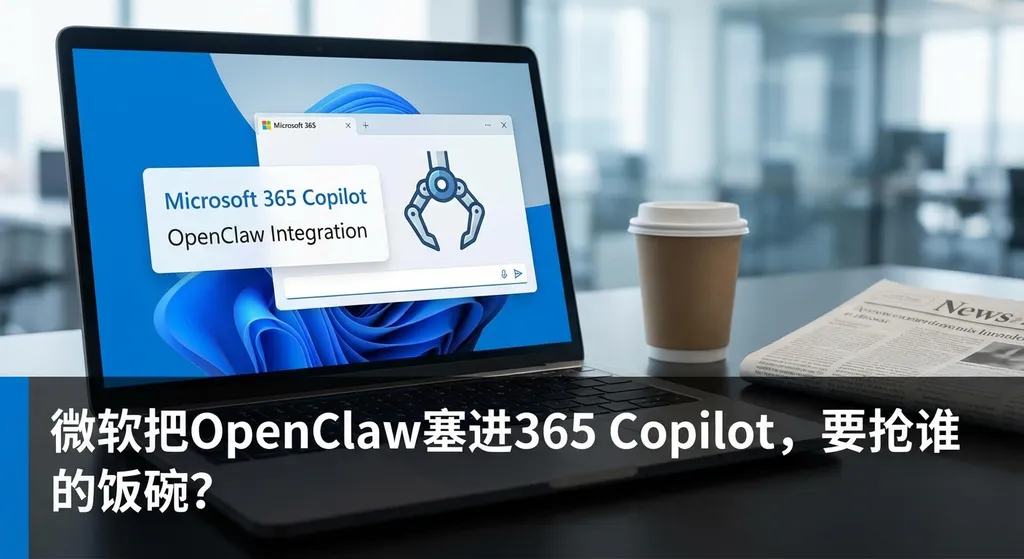
Microsoft is testing the integration of OpenClaw-like agent capabilities into Microsoft 365 Copilot, aiming to create AI agents for enterprise customers that can operate autonomously around the clock, perform complex multi-step tasks, and feature enhanced security controls.
Microsoft no longer wants to let OpenClaw have the “AI agent” field all to itself.
On April 14, according to tech media outlet The Information, Microsoft has been internally testing an important new capability — integrating OpenClaw-like agent functionalities directly into Microsoft 365 Copilot. This is not a proof of concept — it is a project being developed by a dedicated team led by Corporate Vice President Omar Shahine, with a clear goal: to build a group of AI agents that can operate autonomously around the clock, handling complex tasks without requiring the user to issue one instruction at a time.
Microsoft has confirmed this news to the media, emphasizing that the new feature will target enterprise customers and will include a more complete security control mechanism than the open-source OpenClaw.
In other words, Microsoft is building an "enterprise-grade, cloud-based, security-wrapped OpenClaw."
Why Now?
To understand Microsoft’s move, we first need to look at what OpenClaw has done over the past six months.
OpenClaw is an open-source computer-use agent that runs on a user’s local computer and can operate your desktop just like a human assistant — clicking buttons, filling out forms, switching between applications, and performing multi-step tasks. Essentially, it combines large language models’ reasoning abilities with on-screen control capabilities, making AI not just “chat” but truly “work.”
Over the past few months, OpenClaw’s user base has grown rapidly. An interesting side effect is that Mac Mini sales surged because of OpenClaw — the small, inexpensive desktop machine became the go-to platform for OpenClaw users, with many people buying a Mac Mini specifically as a 24/7 AI workstation.
To Microsoft, that’s a warning sign.
Not because OpenClaw itself threatens Windows’ market share (it runs on Windows too), but because it represents a trend: users are beginning to bypass Microsoft’s ecosystem, using open-source tools and local hardware to build their own AI workflows. If this model becomes mainstream, the Microsoft 365 Copilot ecosystem that Microsoft has spent years building could be undermined.
What Cards Does Microsoft Already Hold?
In fact, Microsoft has already made several moves toward AI agents — each step, however, has been not quite as “OpenClaw.”
Copilot Cowork (March 2025)
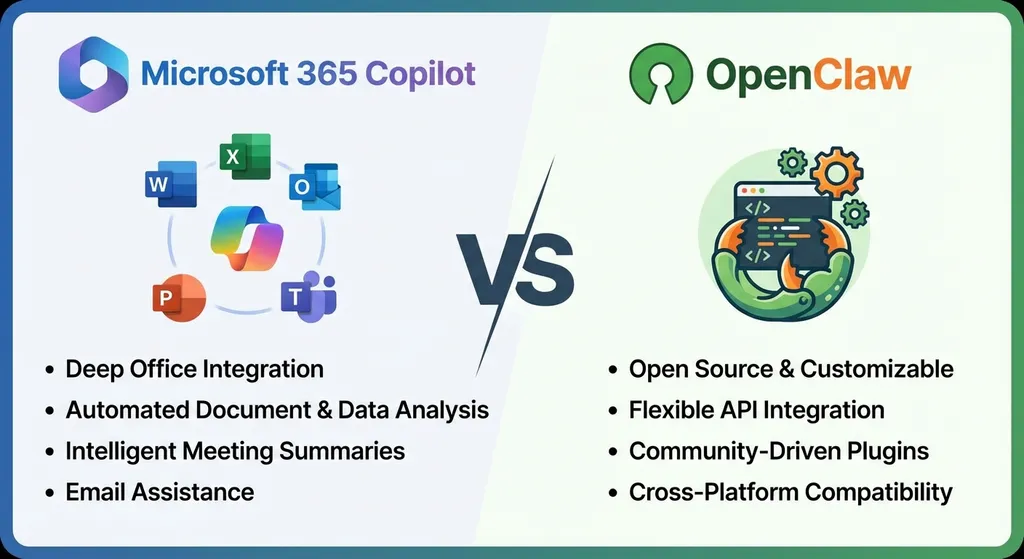
This is currently Microsoft’s product closest to OpenClaw. Cowork is more than a chat window — it can directly execute operations within Microsoft 365 apps like Word, Excel, Outlook, Teams, and PowerPoint. For example, if you say, “Organize last week’s sales data into a table and send it to marketing,” Cowork can complete that task across apps.
Cowork is powered by Microsoft’s self-developed “Work IQ” technology — an intelligent layer that understands the context of your work: what project you are working on, with whom you are collaborating, and which files are relevant. This is something OpenClaw cannot do, since OpenClaw only sees pixels on the screen without understanding your business context.
It’s worth noting that after Microsoft’s partnership with Anthropic late last year, the Claude model was introduced into Cowork as an optional model. This choice is telling — Claude happens to be the most popular underlying model in the OpenClaw community. Clearly, Microsoft has been studying its competitor’s user preferences.
Yet Cowork’s limitations are equally obvious: it can only operate within the Microsoft 365 ecosystem and cannot manipulate arbitrary desktop software like OpenClaw can.
Copilot Tasks (February 2025)
Another task-oriented agent, released as a preview version, is aimed at high-end personal users. It can manage tasks like organizing emails, planning schedules, booking meetings, and even some tasks outside of the Office suite.
However, Copilot Tasks functions more like an “advanced reminders + automation” tool — still far from a truly autonomous agent. It cannot “see” and “interact with” arbitrary UI elements on the screen as OpenClaw can.
The New OpenClaw-like Agent (Under Testing)
This new project Microsoft is testing is positioned differently from the two above. Based on available information, its key features include:
- 24/7 operation: Essentially a “never-offline” version of 365 Copilot that can continuously execute tasks in the background
- Multi-step workflows: Capable of handling complex, multi-phase processes
- Enterprise-grade security: Includes authorization control, audit logs, and data isolation — corporate necessities missing in OpenClaw’s “bare” mode
What’s still unclear is a key question: will it support local execution?
One of OpenClaw’s biggest selling points is that it runs locally, keeping data on the device. For users sensitive about data security, this is the main reason to pick OpenClaw over cloud-based solutions. If Microsoft’s new agent only runs in the cloud, it will not be competing in the same arena as OpenClaw.
The Enterprise Market Is the Real Battlefield
Microsoft positioning this feature for enterprise users is both sensible and very “Microsoft.”
Although OpenClaw is popular, it faces several fatal issues in enterprise scenarios:
First, excessive security risk. OpenClaw can control everything on your computer — see your screen, click any button, input any content. That’s fine for personal use, but in enterprise environments it means an AI agent could access confidential files, customer data, or internal systems. Without permission control, operation audit, or data isolation, no responsible IT department would approve deploying it in production.
Second, lack of compliance. Industries like finance, healthcare, and government have strict compliance requirements for data handling. As an open-source project, OpenClaw offers no SLA, compliance certification, or enterprise-grade support. If something goes wrong, no one is accountable.
Third, high management cost. If a 500-person company wanted to deploy OpenClaw, it would mean installing, configuring, and maintaining it on 500 computers. The IT team would need to manage 500 local instances — ensuring each runs properly and is not misused. Many enterprises won’t accept that overhead.
Microsoft’s solution happens to fix all these problems. Running in the cloud means centralized management; integration into 365 means natural compatibility with existing permission systems and compliance frameworks; targeting enterprises means dedicated support and SLAs.
For enterprise IT decision-makers, the choice is clear: use an open-source tool with no safety guarantees, or use a Microsoft 365–built-in function with enterprise-grade controls and support.
Divergent Technical Paths
Technically, Microsoft’s approach and OpenClaw’s represent two fundamentally different routes.
OpenClaw’s core technology is computer-use — controlling the PC via screenshots, identifying UI elements, and simulating mouse and keyboard operations. Its main strength is universality — in theory, it can operate any graphical software. The downside: low efficiency, higher error rates, and heavy reliance on a model’s visual understanding ability.
Microsoft’s Copilot system follows an API integration route — using Microsoft Graph API and internal app interfaces to directly manipulate data and functions. This method is efficient, accurate, and doesn’t depend on visual recognition, but it can only operate applications with API access.
Put simply: OpenClaw is like an intern sitting in front of the computer, completing tasks by looking at the screen and moving the mouse; Microsoft’s approach is like a sysadmin running automation scripts through back-end APIs — less flexible but more reliable.
The new Microsoft agent under test will likely attempt to blend the two approaches — using API integration within the Microsoft 365 ecosystem for efficiency and accuracy, while adopting computer-use methods for out-of-ecosystem scenarios to push its capability boundaries.
What This Means for Developers
If you’re a developer building AI-agent applications, Microsoft’s move sends several signals:
1. The battleground is shifting from “can it be done” to “how to do it securely.” OpenClaw proved that AI agents are technically feasible; enterprise adoption, however, requires addressing security, compliance, and manageability — each a huge business opportunity on its own.
2. Multi-model support is becoming the norm. Microsoft’s Cowork supports both its own and Claude models; OpenClaw is inherently multi-model. Agent apps shouldn’t lock onto a single model but should be capable of flexible model switching.
3. Long-running agents are the next frontier. Microsoft’s emphasis on “24/7 operation” and “multi-step tasks” marks a fundamental shift from the traditional Q&A mode — running agents for hours or days introduces new demands for infrastructure, state management, and error recovery.
For developers integrating multiple language models in a project, flexible model switching is a real engineering concern. For example, one might want to use a reasoning-strong model for planning, a faster model for execution, and a multimodal model for visual tasks. With API aggregation platforms such as OpenAI Hub, a single Key can access mainstream models like GPT, Claude, Gemini, and DeepSeek — eliminating the hassle of integrating separate APIs and ensuring reliable connectivity under domestic network conditions.
Here’s an example of how concise the code can be when invoking different models in such a setup:
from openai import OpenAI

# Unified model invocation through OpenAI Hub
client = OpenAI(
    base_url="https://api.openai-hub.net/v1",
    api_key="your-openai-hub-key"
)

# Planning stage: use Claude for task decomposition
planning_response = client.chat.completions.create(
    model="claude-sonnet-4-20250514",
    messages=[
        {"role": "system", "content": "You are a task-planning agent responsible for breaking down complex tasks into executable steps."},
        {"role": "user", "content": "Organize all customer emails this week, categorize them by priority, and draft responses for high-priority ones."}
    ]
)

# Execution stage: use GPT-4o for fast subtask processing
execution_response = client.chat.completions.create(
    model="gpt-4o",
    messages=[
        {"role": "system", "content": "You are an email-processing agent responsible for classification and response drafting."},
        {"role": "user", "content": planning_response.choices[0].message.content}
    ]
)

# Visual tasks: use a multimodal model to interpret screen content
vision_response = client.chat.completions.create(
    model="gpt-4o",
    messages=[
        {
            "role": "user",
            "content": [
                {"type": "text", "text": "Identify all actionable elements in this interface."},
                {"type": "image_url", "image_url": {"url": "data:image/png;base64,{screenshot_base64}"}}
            ]
        }
    ]
)
The API format is fully compatible with the OpenAI SDK — switching models only requires changing the model parameter, making it extremely useful when building multi-model collaborative agents.
The Bigger Picture
Stepping back, Microsoft’s latest move is another case of a tech giant “absorbing” an open-source AI innovation.
We’ve seen this pattern many times: the open-source community creates a groundbreaking tool that proves a new direction’s feasibility; then a big company follows quickly, leveraging its platform power, enterprise relationships, and engineering muscle to build an “enterprise edition.” The open-source version continues to serve developers and enthusiasts, while the enterprise edition captures the most profitable commercial segment.
OpenClaw now faces a situation familiar to many open-source projects before it — thriving in the tech community but facing hurdles in security, compliance, and support that bar entry into enterprise markets. Microsoft doesn’t need to build a better product than OpenClaw — it just needs to create one that’s “good enough” and “secure enough” and integrate it into Microsoft 365, which already has hundreds of millions of users.
It’s not necessarily bad news for OpenClaw. The enterprise market was never its main battlefield anyway, and Microsoft’s move further validates the value of this direction — possibly attracting more developers to contribute to the OpenClaw ecosystem.
However, for startups trying to build enterprise-grade solutions based on OpenClaw, Microsoft’s step does narrow their survival space. Once similar functionality becomes native to 365, few enterprise customers will seek third-party alternatives.
What to Watch Next
This project is still in testing, but several key questions remain worth monitoring:
- Will it support local execution? This determines whether it can serve high-security data scenarios.
- Can it operate apps outside Microsoft 365? This determines whether it’s just a Cowork upgrade or a true OpenClaw rival.
- What is the pricing model? Is it included in existing 365 subscriptions, or offered as a premium feature?
- What models will it use? Only Microsoft’s own, or also third-party models like Claude as in Cowork?
Microsoft will likely reveal more details at this year’s Build conference (typically held in May). Until then, much about this project remains uncertain.
But one thing is clear: AI agents are moving from geek toys to productivity tools — and that shift is happening much faster than most people expected.
References
- ITHome: Microsoft is developing another OpenClaw-like agent, to be integrated into Microsoft 365 Copilot — The main source for this article’s core information, including Microsoft’s official confirmation and product details.


