OpenAI Revamps Speech Transcription
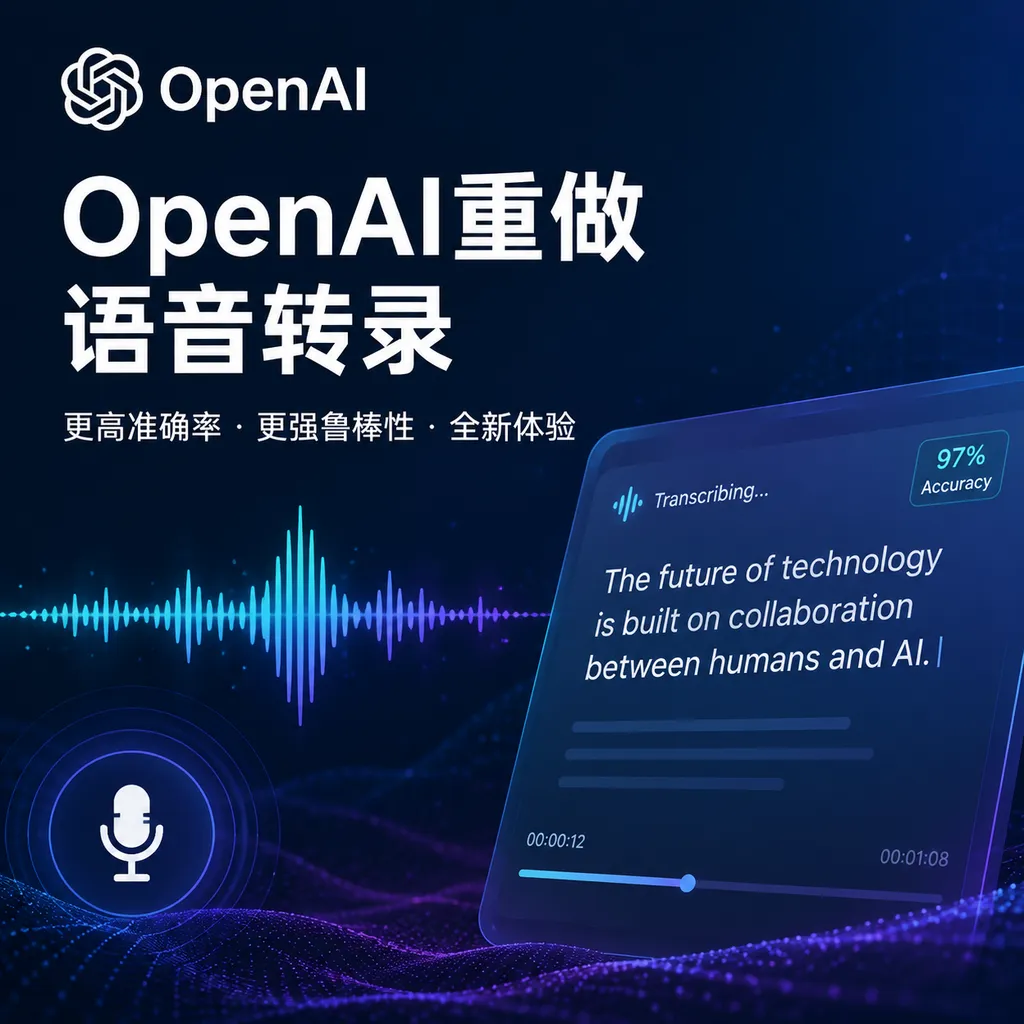
The OpenAI API has added GPT-Live-Transcribe and GPT-Transcribe, with a focus on improving recognition accuracy for real-world background noise, accents, numbers, and technical terminology. Rather than merely chasing benchmark scores, this update more directly addresses production pain points in real-time customer service, meetings, and voice agents.
OpenAI today added two new speech transcription models to its API: GPT-Live-Transcribe and GPT-Transcribe.
The direction of improvement for both models is clear: they are designed not merely to transcribe a sentence in a quiet environment, but to better handle real-world audio—including different accents and languages, background noise, phrases, numbers, and specialized terminology. OpenAI placed particular emphasis on the models’ understanding of context. This means the transcription system no longer guesses words solely from their sounds, but makes greater use of surrounding semantics to determine what is actually being said.
At first glance, this may look like nothing more than two new model names in the Audio API. In practice, it addresses the part of speech applications most likely to fail in production.
Two Models for What Is “Being Said” and What Has “Already Been Said”
OpenAI’s announcement did not fully detail the latency, pricing, context length, or supported formats of the two models, nor did it disclose their word error rates on a standardized test set. It would therefore be premature to infer specific performance differences based solely on their names.
However, judging from the product names and the existing division of responsibilities within the Audio API, their positioning is not difficult to understand:
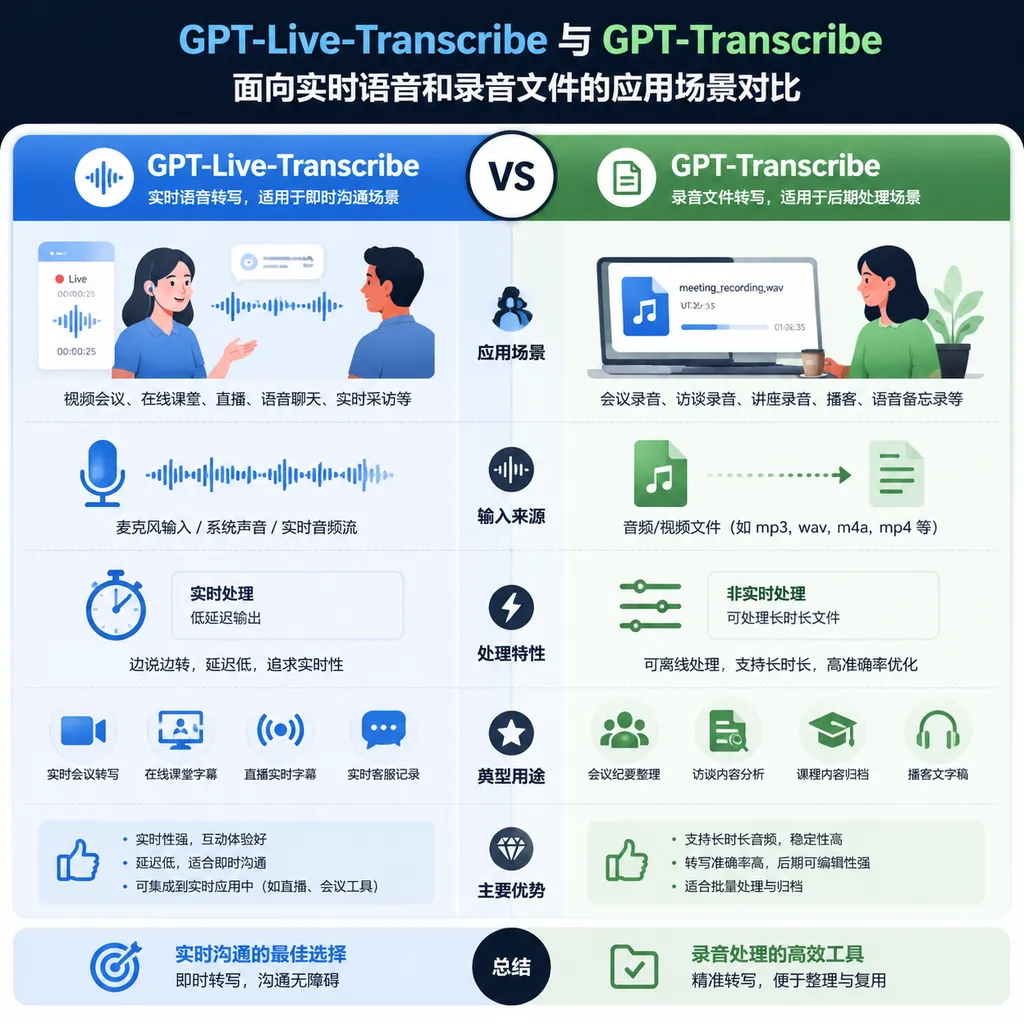
- GPT-Live-Transcribe is designed for real-time, continuous audio streams, with an emphasis on producing text as someone speaks;
- GPT-Transcribe is geared more toward transcribing recordings or complete audio segments, where overall accuracy and contextual consistency are typically the priorities.
The former is suitable for phone-based customer service, live captions, remote meetings, voice input, and real-time Voice Agents. The latter is better suited to podcast processing, interview archiving, meeting minutes, quality assurance analysis, and audio/video content retrieval.
These two types of tasks have different optimization goals.
Real-time transcription cannot wait indefinitely for later context, or latency will make subtitles and conversational systems unusable. But committing results too early can lead to errors when a word has not yet been fully spoken. File transcription, by contrast, can “look back” and use longer context to correct homophones, sentence boundaries, and numbers. Although a single model could conceivably cover both tasks, optimizing them separately is generally better aligned with the needs of production systems.
It is worth noting that OpenAI has not yet specified the official API endpoints, streaming event formats, or regional availability for the two models in this brief announcement. Before integration, developers should rely on the model IDs actually available in the console rather than hard-coding the display names into production systems.
The Real Challenge Is Not Hearing, but Understanding
Traditional automatic speech recognition systems generally divide audio into small segments and then predict the most likely text corresponding to each segment. This process is already quite mature when Mandarin is clearly spoken in a quiet environment at a steady pace, but real-world audio is far less orderly.
For example, a salesperson might say over the phone:
Our Q3 ARR target is 1.5 million, and the renewal rate needs to reach 92%.
This sentence contains an English abbreviation, a quarter, an amount, a decimal, and a percentage. Even if the model hears every sound clearly, it may still output “Q seven,” interpret “1.5 million” incorrectly, or split ARR into meaningless words.
Medical, legal, financial, and developer meetings are even more challenging. Kubernetes, PostgreSQL, EBITDA, drug names, part numbers, and people’s names are often absent from the high-frequency distribution of everyday language. If a model relies only on local acoustic features, it can easily replace rare terms with more common words that sound similar.
This is where OpenAI’s claim of “better contextual understanding” becomes valuable. Based on the entire sentence—or even a longer conversation—the model can determine whether the current context involves financial metrics, cloud infrastructure, or everyday life. It is not simply giving the transcription system better ears; it is adding a degree of linguistic reasoning.
This is also where GPT-series transcription models are beginning to differentiate themselves from the Whisper approach in terms of product positioning. Whisper’s strengths are its maturity, local deployability, and complete ecosystem, which allow developers to control inference hardware and data boundaries. API-based models, meanwhile, benefit from continuous updates and make it easier to combine acoustic recognition, linguistic context, and real-time services.
The two are not simply substitutes for one another. Whisper remains irreplaceable in scenarios where data cannot leave a designated environment, predictable costs are essential, or offline operation is required. For online applications such as customer service, multilingual meetings, and Voice Agents—where accuracy, latency, and operational efficiency are critical—the new models are more worthy of testing.
Number Recognition Is an Underrated Production Metric
Transcription demos tend to showcase natural conversations, but enterprises often care most about numbers.
Phone numbers, identity document numbers, dates, amounts, order IDs, verification codes, and device serial numbers can lose all business value if even one digit is wrong. If a function word is incorrect in an ordinary sentence, a person can usually still understand it. If one digit in a bank account number is wrong, the downstream automation process may fail outright.
The same applies to specialized terminology. If meeting minutes misspell a product name, an employee can still correct it manually. But if a voice bot misrecognizes a drug dosage, quote, or ticket number and then submits the incorrect result to a CRM, database, or downstream Agent, the impact extends far beyond the captioning layer.
Therefore, whether GPT-Live-Transcribe and GPT-Transcribe are truly useful cannot be judged solely by average word error rate. At a minimum, developers should test the following metrics separately:
- Number accuracy: Whether sequences of digits, decimals, percentages, amounts, and dates are recognized consistently;
- Proper noun recall: Whether company names, product names, technology stacks, and industry terminology are preserved correctly;
- Noise robustness: Whether keyboard sounds, traffic noise, overlapping speech, and telephone compression cause significant degradation;
- Real-time stability: Whether streaming results are frequently revised and when the final text is confirmed;
- Cross-language switching: Whether the model misidentifies the language when Chinese, English, and abbreviations are mixed within a sentence;
- Hallucination rate: Whether the model invents content that was not present during silence, music, or unclear audio;
- End-to-end latency: The time from audio capture until usable text reaches the downstream system—not merely the model’s time to first token.
The final metric is particularly important. The latency of a real-time speech system is determined collectively by audio capture, network transmission, server-side buffering, model inference, result confirmation, and downstream processing. Even if the model is 100 milliseconds faster, users will barely notice the improvement if the client still uploads audio in five-second chunks.
The Impact on Voice Agents Is Greater Than on Captioning Tools
Over the past two years, much of the attention around voice Agents has focused on whether their voices sound human. In practice, however, what usually determines whether they can complete a task is the text in the middle of the pipeline.
A typical voice Agent pipeline can be simplified as:
User speaks → Speech transcription → LLM reasoning or tool call → Speech synthesis → User hears response
Once the transcription is wrong, even the most powerful downstream model can only reason from incorrect input. For example, if a user says, “Cancel my appointment at 3 p.m. on Friday,” but the system recognizes it as “Check my appointment at 3 p.m. on Friday,” the tool call is already headed in the completely opposite direction.
The potential value of GPT-Live-Transcribe lies in making real-time transcription better suited to serving as an Agent’s perception layer. More accurate contextual understanding can reduce accidental tool triggers, incorrect parameter entry, and unnecessary follow-up questions. This is especially important in customer service, where users often pause, correct themselves, or change what they are saying mid-sentence. The system cannot execute an action immediately after detecting a single keyword.
However, developers should not equate “stronger contextual understanding” with “results can be trusted unconditionally.” High-risk operations involving payments, deletions, or appointment changes still require confirmation mechanisms—for example, repeating critical parameters, displaying structured results, or requiring the user to confirm a second time.
A model upgrade reduces the probability of errors; it does not eliminate engineering responsibility.
API Integration: Start with File Transcription Through a Compatible Endpoint
This is a newly released set of proprietary OpenAI models and API capabilities. The following example demonstrates file transcription using an OpenAI Audio API-compatible interface. Because the new models may be rolled out in phases, model IDs, request fields, and supported formats should be verified in the actual console.
If you use an OpenAI-format-compatible aggregation service such as OpenAI Hub, you can preserve your existing SDK call pattern by changing the base_url and API key, provided that routing for the corresponding model is already available.
import os
from openai import OpenAI

client = OpenAI(
    api_key=os.environ["OPENAI_API_KEY"],
    base_url=os.environ.get(
        "OPENAI_BASE_URL",
        "https://<your-compatible-api-address>/v1"
    )
)

with open("meeting.m4a", "rb") as audio_file:
    result = client.audio.transcriptions.create(
        model="gpt-transcribe",  # Use the actual model ID shown in the console
        file=audio_file
    )

print(result.text)
The corresponding cURL request can be written as:
curl "$OPENAI_BASE_URL/audio/transcriptions" \
  -H "Authorization: Bearer $OPENAI_API_KEY" \
  -F "model=gpt-transcribe" \
  -F "file=@meeting.m4a"
Real-time models typically do not work by repeatedly submitting an indefinitely growing file to a transcription endpoint. Instead, they send audio frames over a WebSocket or another persistent connection and receive incremental text, revised results, and final confirmation events. This announcement did not provide enough information to confirm the official event protocol for GPT-Live-Transcribe, so developers should not guess request fields based on older model interfaces.
A production integration should distinguish at least the following states:
- Provisional text: Returned with low latency and subject to later revision;
- Confirmed text: The model considers the current segment stable;
- End of turn: The text can be submitted to a downstream Agent for processing;
- Errors and reconnection: How to resend audio after a network interruption without creating duplicate text.
If the frontend writes every provisional result directly to the database, streaming revisions will create large amounts of duplicate and dirty data. If it waits only for final results, the real-time experience will degrade into file transcription. A good implementation usually displays provisional text in the interface while sending only confirmed segments to business systems.
Don’t Rush to Replace Whisper—Test with Your Own Messy Data First
This update is moving in the right direction, and it is more practical than simply adding more languages. Real-world business audio consists precisely of accents, noise, terminology, numbers, and incomplete sentences. By placing these issues at the center of its release announcement, OpenAI is signaling that its goal is no longer to build a more polished transcription demo, but to compete for a foundational role in customer service, meetings, content production, and voice Agents.
However, without public pricing, latency data, and standardized evaluation results, it is still too early to conclude that the new models comprehensively outperform Whisper or GPT-4o Transcribe.
A more sensible upgrade path is shadow traffic testing: send the same batch of authorized and anonymized audio to both the existing and new models without affecting production results, then compare their outputs. The test set should not contain only studio-quality samples. It should also cover your company’s own failure cases, such as dialects, calls over poor networks, overlapping speakers, product names, long order numbers, and extended silence.
The cost of correction should also be included in the evaluation. Even if a model costs more per minute, it may still have a lower total cost if it reduces manual review, incorrect tickets, and repeated confirmations. Conversely, if the business only needs searchable captions for public videos, a locally deployed Whisper model may already be sufficient.
OpenAI Is Dividing Speech Capabilities into Clearer Product Layers
From Whisper to GPT-4o Transcribe and now to separately named Live and non-Live transcription models, OpenAI’s product direction is becoming increasingly clear: speech is no longer merely an input modality for large language models, but a set of foundational services that can be purchased and optimized independently.
For developers, this is a positive development. Real-time conversations and offline processing should not be forced to use exactly the same models and parameters. A clearer division of responsibilities makes it easier to balance accuracy, latency, and cost, while also simplifying the design of fallback strategies for different business scenarios.
Three issues remain particularly important to watch: whether the official pricing is suitable for high-concurrency call scenarios, how stable the Live model is over persistent connections, and whether OpenAI will provide more comprehensive speaker diarization, word-level timestamps, and terminology-guidance capabilities. These factors will determine whether the new models represent merely an improvement in recognition quality or can truly reshape the existing speech technology stack.
What is already clear is that the focus of competition in speech transcription has shifted—from “Can it turn speech into text?” to “Can it accurately capture critical information, in real time, amid the chaos of real-world environments?” GPT-Live-Transcribe and GPT-Transcribe are competing for precisely this position.
References
- OpenAI Python SDK: OpenAI’s official Python SDK repository, which can be used to verify general Audio API usage and client configuration.
- Whisper Large V3 model page: Information on the open-weight Whisper model, which provides background for comparing locally deployed speech recognition solutions and model capabilities.
Note: The source page for this product update is not within the approved list of domains whose links may be retained, so the corresponding external link has not been included at the end of this article.