Grok Is Learning to “Build Apps”

xAI is testing Grok Build with SuperGrok Heavy users, aiming to evolve Grok from a chat model into an agent capable of generating deployable applications. The direction makes sense, but until its APIs, evaluations, and runtime environment are made public, it remains more of a product preview.
News on July 29: xAI has begun testing a Build model for Grok, with the initial group of users consisting mainly of SuperGrok Heavy premium subscribers.
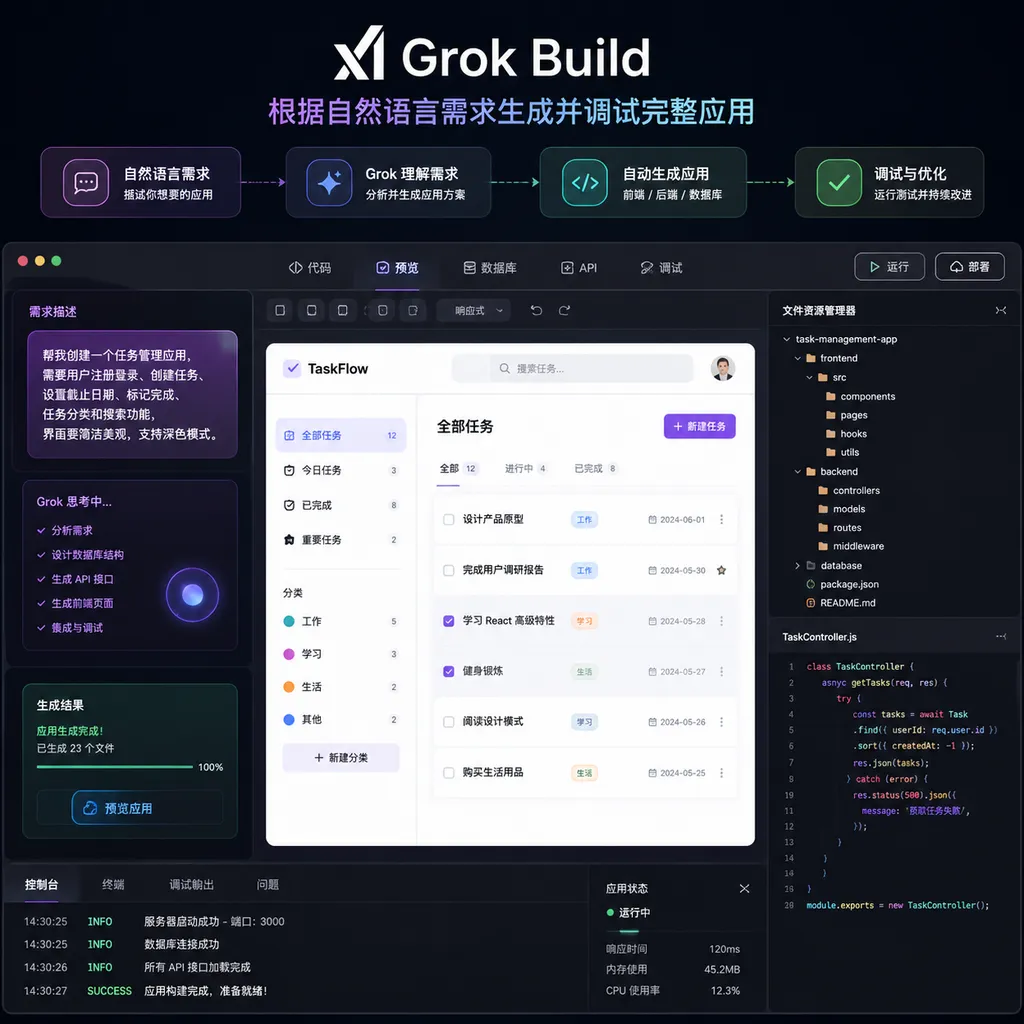
Public information remains limited: Grok Build is still in the early testing stage, and xAI has not yet fully disclosed the model parameters, context window, tool permissions, standalone pricing, or API availability plans. However, judging from the product name and testing focus, it is intended to do more than simply “help developers fill in a few lines of code.” Instead, it aims to complete an entire workflow based on natural-language requirements, from understanding requirements and generating code to delivering a runnable application.
This is a capability xAI must add.
Over the past year, the focus of competition among model providers in programming has shifted from code completion to coding agents. A truly valuable product does not merely generate a React component that looks correct in a single pass. It can understand an existing repository, modify multiple files, install dependencies, run tests, diagnose errors, and then deploy the result as an application that users can open.
That is precisely the workflow Grok Build is now targeting.
Build Is More Than Just a Grok That Is “Better at Writing Code”
“AI application generation” can easily be understood as a web template generator: enter “build a to-do app,” and the model outputs HTML, CSS, and JavaScript, then stops.
But if Grok Build intends to enter real-world development scenarios, it must handle at least five layers of tasks:
- Understand requirements: Identify pages, data models, permissions, APIs, and non-functional requirements;
- Plan the project: Select frameworks, create the directory structure, and break down front-end, back-end, and database tasks;
- Operate the environment: Create files, install dependencies, execute commands, and read terminal output;
- Establish a feedback loop: Continue making changes based on compilation errors, test failures, and browser results;
- Deliver the application: Provide a runnable version rather than a collection of code snippets that must be manually assembled.
A traditional chat model is like a senior engineer sitting nearby and answering questions. A Build-style agent is more like an engineer who has been given a development machine: it not only offers suggestions but must actually enter the repository, modify code, run tests, and take responsibility for the outcome.
The capability requirements for these two types of systems are entirely different.
If a chat model occasionally writes a function incorrectly, the user can still fix it manually. But if an application-generation agent misunderstands the database structure early on, dozens of subsequent file modifications may be built on a false premise. The longer the task chain, the more errors can compound. Therefore, Build’s key metric is not its score on single-turn coding problems, but whether it can operate tools reliably over extended periods and recover after failures.
What xAI Really Needs to Catch Up On Is the “Engineering Feedback Loop”
The AI programming market has already developed several relatively clear product approaches:
- Using the IDE as the entry point to complete, explain, and modify code within the editor;
- Using the terminal as the entry point, allowing an agent to operate directly on a local repository;
- Using a cloud sandbox as the entry point to complete tasks asynchronously and submit changes;
- Using application generation as the entry point to produce a previewable, deployable product directly from a single requirement.
Terminal agents such as Claude Code have already demonstrated that developers are willing to grant models broader repository permissions. Codex-style products have reinforced the idea of asynchronously executing tasks in the cloud. Development tools built around models such as Gemini are also continuously shortening the path from prototype to deployment.
The challenge facing Grok Build is not whether it can generate a demo page, but why developers should migrate from their existing tools.
xAI may have two cards to play.
The first is Grok’s own reasoning and coding capabilities. If Build uses a model further optimized for long-running tasks, tool use, and software engineering, it may be better suited than general-purpose Grok to handle cross-file modifications.
The second is xAI’s product distribution capabilities. If Build is integrated with the Grok web interface, the X account ecosystem, and future developer tools, it could quickly reach existing paying users without having to cold-start as a standalone plugin.
For now, however, these advantages remain possibilities. For professional developers, the model name and subscription tier are not the core concerns. The following questions are what truly matter:
- Can it reliably read repositories containing more than 100,000 lines of code rather than focusing only on recently opened files?
- Before modifying code, does it build a reliable index of dependencies and call chains?
- Does it support terminal, browser, database, and external API tools?
- Are permission confirmation and sandbox isolation provided before dangerous commands are executed?
- Can it resume after a task is interrupted rather than consuming the entire context again from the beginning?
- Are generated changes accompanied by tests, logs, and reviewable diffs?
- Does it support team policies, such as prohibiting access to secret files or preventing code from being sent to external services?
If these capabilities are not addressed, Build will merely be a code model wrapped in an agent interface. If they are addressed, it may become a genuine development environment.
Limiting the Initial Release to Heavy Users Suggests the Compute Economics Are Not Yet Settled
The fact that this test is primarily available to SuperGrok Heavy users also reveals some information.
Application generation is a typical high-token, high-tool-usage, long-inference-time workload. A single user request may trigger dozens of model calls behind the scenes: first scanning the repository, then generating a plan, followed by modifying files, running a build, reading errors, and retrying. The cost of a single task is significantly higher than that of an ordinary chat session.
Placing the early version behind a premium subscription tier allows xAI to control concurrency and inference costs while also selecting heavy users who are more tolerant of issues and capable of providing more specific feedback. For xAI, this is a reasonable staged rollout strategy. For developers, however, it means the product is not yet suitable for integration into formal production workflows.
It is worth noting that external reports about access to Grok Build are not entirely consistent. Some claims suggest availability to a broader range of SuperGrok or paying X users. Given that the product is still undergoing a staged rollout, account region, subscription tier, and usage volume may all affect whether the entry point appears. At this stage, the most reliable way to determine availability is still to check the product interface for a specific account rather than infer a full release from other users’ screenshots.
It Is Too Early to Say It Has “Surpassed” Anything
The community has already begun discussing different test versions of Grok Build, and claims have emerged that its capabilities surpass those of certain mainstream Grok versions. These conclusions are not yet worth overinterpreting.
Coding agents are particularly susceptible to evaluation illusions. A model scoring higher on public coding benchmarks does not mean it can complete real repository tasks more reliably. Likewise, an impressive application-generation demo does not mean the system can handle permissions, migrations, concurrency, and failure recovery.
A more meaningful way to evaluate Grok Build is to assign it a set of real engineering tasks:
- Fix a defect spanning the front end and back end in an unfamiliar repository;
- Add comprehensive tests to a legacy module while preserving compatibility with existing interfaces;
- Upgrade a dependency containing breaking changes and resolve the resulting type and build errors;
- Modify a page according to a design mockup without breaking the mobile layout;
- Integrate a payment or authentication service while correctly managing environment variables;
- Explain the cause of a failure, roll back incorrect changes, and replan the task.
Ultimately, the key measures are not how polished the model’s first response looks, but its task completion rate, the number of human interventions required, average cost, completion time, and proportion of incorrect changes.
This is also our assessment of Grok Build at its current stage: the direction is important and the product deserves attention, but there is not yet enough evidence. xAI has secured a ticket to the next phase of AI programming competition, but it has not yet demonstrated that it can match leading products in engineering reliability.
The API Remains Unclear, So Developers Should Not Hard-Code a Model Name Yet
So far, public information has not confirmed that Grok Build offers a standalone API, nor is there a stable, dependable official model ID. Developers are therefore advised not to guess names such as grok-build or build-0.1 and insert them directly into production code.
A safer approach is to configure the model ID as an environment variable and preserve the ability to switch models through an OpenAI-compatible interface. OpenAI Hub already supports unified access to Grok and other leading proprietary models. If Build is later added to the list of callable models, existing OpenAI SDK projects will generally need only to replace the model ID rather than rewrite the request layer.
The following is an API preparation template. It does not indicate that Grok Build is currently publicly available. XAI_BUILD_MODEL must be set to the official model ID actually returned by the platform:
import os
from openai import OpenAI

client = OpenAI(
    api_key=os.environ["OPENAI_HUB_API_KEY"],
    base_url="https://api.openai-hub.com/v1"
)

model_id = os.environ["XAI_BUILD_MODEL"]

response = client.chat.completions.create(
    model=model_id,
    messages=[
        {
            "role": "system",
            "content": "You are a software engineering agent. Analyze the repository and dependencies before proposing a modification plan; do not execute destructive commands without confirmation."
        },
        {
            "role": "user",
            "content": "Add JWT-based login functionality to the existing FastAPI project and provide comprehensive tests."
        }
    ]
)

print(response.choices[0].message.content)
However, the truly valuable part of Build may extend beyond the underlying model to include its tool-execution environment, file system, terminal permissions, and task-state management. Even if an API with the same name becomes available in the future, a single chat request may not reproduce the complete application-generation experience of the official product. Developers need to distinguish between “calling the Build model” and “using the Build agent product.”
xAI Is Evolving From a Model Company Into a Development Platform
The significance of Grok Build is not that xAI has added another model label, but that it has begun competing for the development entry points that sit above the model layer.
Foundation-model capabilities are rapidly converging, making it increasingly difficult to establish a lasting advantage based solely on chat responses. Whoever controls the code repository, runtime environment, deployment process, and developer workflow can gain more frequent usage, clearer feedback, and more stable paid relationships.
From this perspective, Build is a necessary expansion for xAI: Grok is no longer content merely to answer “How should this application be built?” It is beginning to try to build the application directly.
Yet a significant gap remains between “able to generate” and “trusted to deliver”—a gap involving permissions, security, testing, observability, and cost control. Early tests can attract attention with dazzling demos, but real adoption by development teams will depend on the unglamorous, labor-intensive work that does not make for compelling launch-event demonstrations.
The next developments worth watching are not another benchmark score, but when xAI discloses Build’s official availability, tool permissions, pricing, task evaluation results, and API plans. Only then will it be possible to determine whether Build is merely an advanced Grok subscription feature or xAI’s direct challenge to Claude Code, Codex, and the next generation of application-generation platforms.
References
- Reddit: Search for Grok Build community discussions: Used to observe early user feedback and version discussions; community content does not represent official conclusions and requires cross-verification.
- GitHub: Search for Grok Build-related projects: Used to track third-party integrations, sample projects, and developer experiments; these do not represent xAI’s official implementation.