
Hermes Agent 0.9.0 Released: Local Web Management Interface Launched
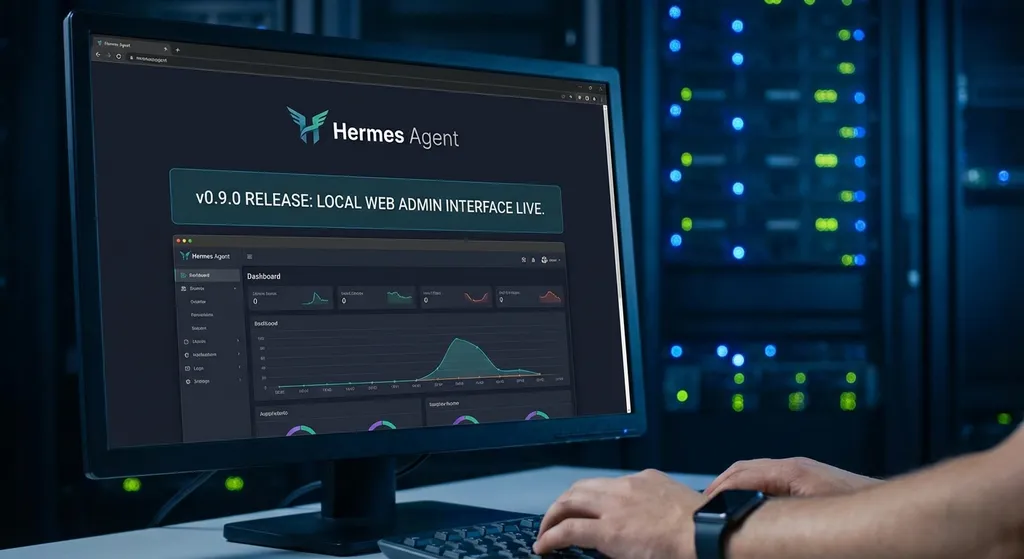
The open-source AI Agent framework **Hermes** has been upgraded to version **0.9.0**, introducing major new features such as a local Web Dashboard, a Fast Mode priority processing queue, and integration with iMessage and WeChat. These improvements significantly enhance the multi-model interaction experience while lowering the configuration threshold.
Hermes Agent 0.9.0 Released: Local Web Management Interface Now Available
The open-source AI Agent framework Hermes has just released version 0.9.0, with its biggest change being the introduction of a local Web Dashboard—a browser-based management interface that lets you avoid manually editing configuration files or running command-line commands. For many developers, this is a real productivity boost, especially in scenarios that require frequent model switching or parameter tuning.
This update is more than just adding a GUI. Hermes also launches a Fast Mode priority queue, full iMessage integration, and native support for WeChat and WeCom (Enterprise WeChat). Functionally, Hermes is evolving from a purely Agent framework toward “multi-model unified scheduling + multi-channel message integration.”
Web Dashboard: Farewell to Configuration File Hell
Hermes previously used classic open-source configuration methods: YAML files + command-line arguments. For developers familiar with DevOps, that wasn’t a big deal, but newcomers had to spend a lot of time figuring out what each option did.
The new Web Dashboard brings these operations into the browser:
- Configuration Management: Model parameters, API keys, timeout settings, and more can be edited directly through the interface
- Session Monitoring: View the Agent’s runtime status, request logs, and error messages in real time
- Skill Browser: Browse and manage supported Hermes Skills (tool invocation capabilities)
- Gateway Management: Centrally manage configuration and routing rules for multiple API gateways
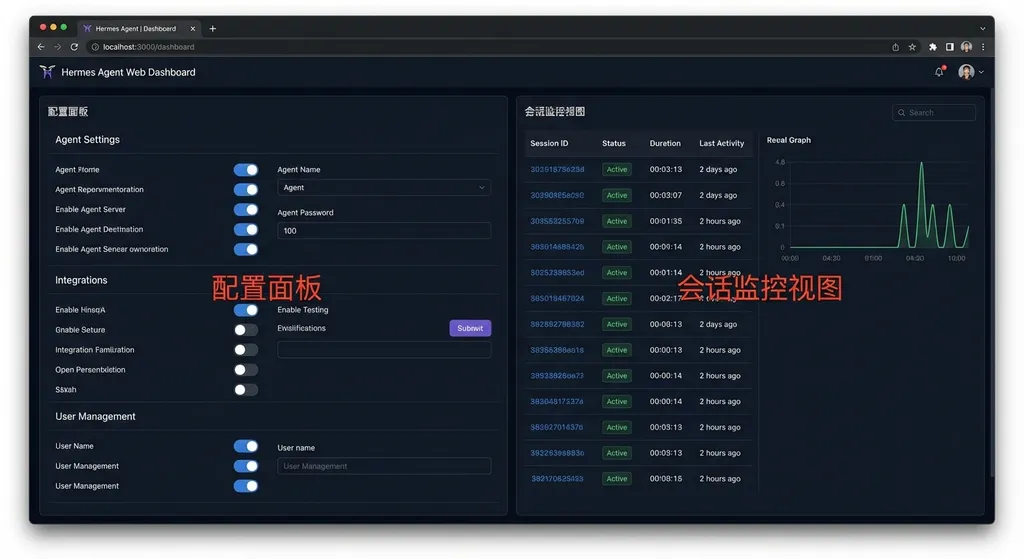
The Dashboard runs locally, with no need for additional server deployment. After starting Hermes, you can access it via localhost:port in your browser. For developers debugging Agent logic locally, this is much more intuitive than SSHing into a server to edit configuration files.
From a product perspective, this represents Hermes lowering its usability barrier. Similar trends are visible across many open-source projects—Kubernetes has a Dashboard, Prometheus has Grafana—the developer ecosystem is shifting from “CLI-first” to “GUI-optional.” CLI isn’t bad, but different contexts need different interaction modes.
Fast Mode: The Real Value of Priority Queuing
Hermes 0.9.0 introduces a /fast command that sends requests into a priority processing queue. Currently supported are selected models from OpenAI and Anthropic, including GPT-5.4, Codex, and Claude series.
The background: major AI providers have tiered API services. OpenAI offers Priority Processing, Anthropic has a Fast Tier—both essentially “pay more for faster service.” These priority tiers, however, are usually set at the account level, not per request.
Hermes’ Fast Mode adds a toggle at the Agent level, letting you decide per request whether to use the priority queue. This is practically useful:
- Interactive Conversations: When users are waiting for responses, latency sensitivity is high—use Fast Mode
- Batch Processing: For tasks like data analysis or content generation, a few seconds of delay are fine—use the normal queue to save money
- Mixed Scenarios: When one Agent handles both real-time and background tasks, toggle as needed
From a cost perspective, this is also an optimization. OpenAI’s Priority Processing costs 1.5–2× regular API rates, so if all requests used it, costs would rise sharply. Hermes allows fine-grained control—accelerate only when necessary.
If you use API aggregation platforms like OpenAI Hub, Fast Mode becomes even more valuable. Aggregators already support multi-model switching, and with priority controls added, you can dynamically choose “which model + which queue” based on task type, user tier, or budget.
iMessage and WeChat Integration: Expanding Communication Channels
Hermes 0.9.0 adds native support for two new messaging channels:
iMessage via BlueBubbles
BlueBubbles is an open-source project that forwards iMessage messages to other platforms. Hermes now integrates directly with BlueBubbles, meaning you can connect your AI Agent to iMessage and interact within Apple’s messaging ecosystem.
Possible use cases:
- Personal Assistant: Query the AI directly in iMessage without switching apps
- Team Collaboration: Add the Agent to iMessage group chats for real-time info lookup, task reminders, and more
- Automation Workflows: Combine with iOS Shortcuts to enable complex automation
The implementation includes automatic webhook registration, setup wizards, and crash recovery mechanisms. According to commit logs (#6437, #6460, #6494), the feature went through several iterations—showing that stability was a key focus.
WeChat and WeCom
Hermes supports WeChat via the iLink Bot API and adds a Callback Mode adapter for WeCom. For Chinese developers, this is an important update—AI bot demand in the WeChat ecosystem has always been high, but official API limitations and review processes made development tricky.
WeCom’s Callback Mode is the standard method for custom enterprise app integration. Hermes’ adapter supports:
- Streaming Responses: Typing-effect message pushes
- Media Uploads: Handle images, files, and other media content
- Markdown Rendering: Display formatted AI replies directly in WeCom
Technically, Hermes doesn’t use third-party WeChat Bot frameworks (like Wechaty) but connects directly to official APIs. This approach offers greater stability and feature completeness, though it requires enterprise authentication and app approval—making it better suited for formal enterprise use.
The Real Challenges of Multi-Model Scheduling
Hermes is fundamentally an AI Agent framework, but its core capability is “multi-model unified scheduling.” The new Web Dashboard, Fast Mode, and multi-channel integration all reinforce this capability.
In practice, multi-model scheduling is more complex than it sounds:
1. Model Capability Differences
Different models excel at different tasks. GPT-4 handles reasoning well, Claude is strong with long texts, DeepSeek excels at code generation. A robust Agent framework must choose models automatically based on task type—or allow flexible routing configuration.
2. Balancing Cost and Latency
GPT-4 is powerful but expensive; DeepSeek is cheaper but sometimes less effective. Developers must balance cost and output quality, requiring fine-grained control at the framework level.
3. API Compatibility Issues
Most models claim to be OpenAI-compatible, but implementation details vary. Parameter names, error codes, and streaming formats often differ. A mature Agent framework must handle these discrepancies.
4. Multi-Channel Message Format Conversion
iMessage, WeChat, Slack, Discord—all have different message formats. AI-generated Markdown must be converted for each platform. Media handling also varies per platform.
Hermes’ update pushes forward across all these fronts. The Web Dashboard lowers configuration hurdles, Fast Mode enables cost optimization, and multi-channel integration improves message format handling.
Working with API Aggregation Platforms
If you use platforms like OpenAI Hub, Hermes becomes even more useful. Aggregators solve the “one key for all models” problem, while Hermes adds a higher-level layer of functionality:
Agent Workflow Orchestration
The aggregation platform handles model calls; Hermes handles Agent workflow composition. For example, a customer support bot might first use an embedding model for retrieval, then an LLM for reply generation, and finally a TTS model for speech synthesis—all orchestrated by Hermes.
Multi-Channel Message Routing
Users might start conversations through WeChat, iMessage, or a web page. Hermes can route all messages to the same Agent instance, maintaining context continuity.
Cost and Performance Optimization
Combining aggregator multi-model support with Hermes’ Fast Mode enables precise cost-control strategies, such as:
- VIP users: GPT-4 + Fast Mode
- Standard users: Claude 3.5 Sonnet
- Batch tasks: DeepSeek
Example configuration combining OpenAI Hub and Hermes:
# Example Hermes configuration
models:
  - name: gpt-4-turbo
    provider: openai-hub
    api_key: ${OPENAI_HUB_KEY}
    base_url: https://api.openai-hub.net/v1
    priority: high

  - name: claude-3-5-sonnet
    provider: openai-hub
    api_key: ${OPENAI_HUB_KEY}
    base_url: https://api.openai-hub.net/v1
    priority: medium

  - name: deepseek-chat
    provider: openai-hub
    api_key: ${OPENAI_HUB_KEY}
    base_url: https://api.openai-hub.net/v1
    priority: low

routing:
  - condition: user.tier == "vip"
    model: gpt-4-turbo
    fast_mode: true

  - condition: task.type == "code_generation"
    model: deepseek-chat
    fast_mode: false

  - default:
    model: claude-3-5-sonnet
    fast_mode: false

channels:
  - type: imessage
    bluebubbles_url: http://localhost:1234

  - type: wechat
    ilink_api_key: ${WECHAT_KEY}

  - type: wecom
    corp_id: ${WECOM_CORP_ID}
    callback_token: ${WECOM_TOKEN}
Python usage example:
import asyncio
from hermes import HermesAgent, Message

async def main():
    # Initialize Hermes Agent
    agent = HermesAgent(
        config_path="hermes_config.yaml",
        dashboard_enabled=True,
        dashboard_port=8080
    )

    # Send message to Agent
    message = Message(
        content="Write me a Python implementation of quicksort",
        user_id="user_123",
        channel="imessage",
        metadata={
            "user_tier": "vip",
            "task_type": "code_generation"
        }
    )

    # Use Fast Mode
    response = await agent.send(
        message,
        fast_mode=True  # enable priority queue
    )

    print(f"Model: {response.model_used}")
    print(f"Latency: {response.latency_ms}ms")
    print(f"Content: {response.content}")

    # View Dashboard info
    print(f"Dashboard URL: http://localhost:8080")

    await agent.close()

if __name__ == "__main__":
    asyncio.run(main())
This example demonstrates Hermes’ key capabilities:
- Define multiple models and routing rules via configuration
- Automatically select models based on user tier and task type
- Dynamically control Fast Mode usage
- Support unified multi-channel message access
The Competitive Landscape of Open-Source Agent Frameworks
Hermes isn’t the only open-source Agent framework. Similar projects include LangChain, AutoGPT, and AgentGPT, each with distinct focuses:
LangChain: Leans toward being a foundation library for LLM app development. It provides a rich component ecosystem but has a steep learning curve.
AutoGPT: Emphasizes autonomy—Agents can plan tasks, call tools, and iterate independently—but fully autonomous Agents tend to be hard to control.
Hermes: Focuses on multi-model scheduling and multi-channel integration, resembling a production-grade Agent runtime. The Web Dashboard and Fast Mode reinforce this positioning.
Strategically, Hermes has chosen a pragmatic path: rather than chasing AGI-level autonomy, it focuses on solving engineering problems in real-world settings—model switching, cost optimization, message routing, configuration management. These may seem unglamorous but are what developers actually face in production.
Noteworthy Details
Besides major features, Hermes 0.9.0 also includes several technical highlights:
1. Crash Recovery Mechanism
The iMessage integration explicitly mentions crash resilience, which is crucial for long-running Agent services. Network instability, API timeouts, and memory leaks can cause process crashes. A good framework must handle auto-recovery and state persistence.
2. Streaming Cursor Handling
The WeChat integration supports a streaming cursor—a subtle but important feature. Sending every token immediately makes messages flicker continuously, harming UX. A better approach batches tokens or sends them at punctuation marks. Hermes’ implementation accounts for this.
3. Multiple Code Iterations
According to GitHub PR numbers, many features went through multiple revisions. iMessage integration has #6437, #6460, #6494; Fast Mode has #6875, #6960, #7037—showing the team’s emphasis on code stability instead of “merge once and done.”
Real-World Applications
Based on these updates, Hermes fits several scenarios well:
Enterprise Internal AI Assistants
With WeCom integration, companies can quickly build internal AI assistants. Employees ask questions in WeCom, and the Agent selects suitable models automatically—cheap models for simple queries, GPT-4 for complex reasoning.
Multi-Channel Customer Support Bots
Connect via WeChat, iMessage, and web pages simultaneously. Maintain seamless context across platforms. Fast Mode offers VIP users quicker responses.
Developer Tool Integration
Integrate Hermes into IDEs or CLI tools for code generation, bug analysis, or documentation queries. Use the Web Dashboard to easily tune model parameters and inspect logs.
Content Generation Workflows
Batch-creating articles, translations, or summaries. Configure different models and priorities to balance cost and quality—for example, draft with a cheap model, refine with GPT-4.
Conclusion
Hermes 0.9.0’s direction is clear: lower the usability barrier, enhance multi-model scheduling flexibility, and expand messaging channel coverage. The Web Dashboard makes configuration intuitive, Fast Mode optimizes cost, and iMessage/WeChat integration extends use cases.
In terms of positioning, Hermes is evolving from a pure Agent framework into a production-grade AI application runtime. That’s a sound direction—developers need not just demos that run, but stable, manageable, and cost-controlled production systems.
If you’re building multi-model AI applications or integrating Agents across multiple messaging platforms, Hermes is worth trying—especially when paired with API aggregation platforms like OpenAI Hub for quick deployment of feature-rich and cost-efficient AI services.
References
- Hermes upgraded to 0.9.0 discussion thread - Linux.do — Community discussions and user feedback on the new Hermes 0.9.0 features


