Tokenless delegates model switching to the router
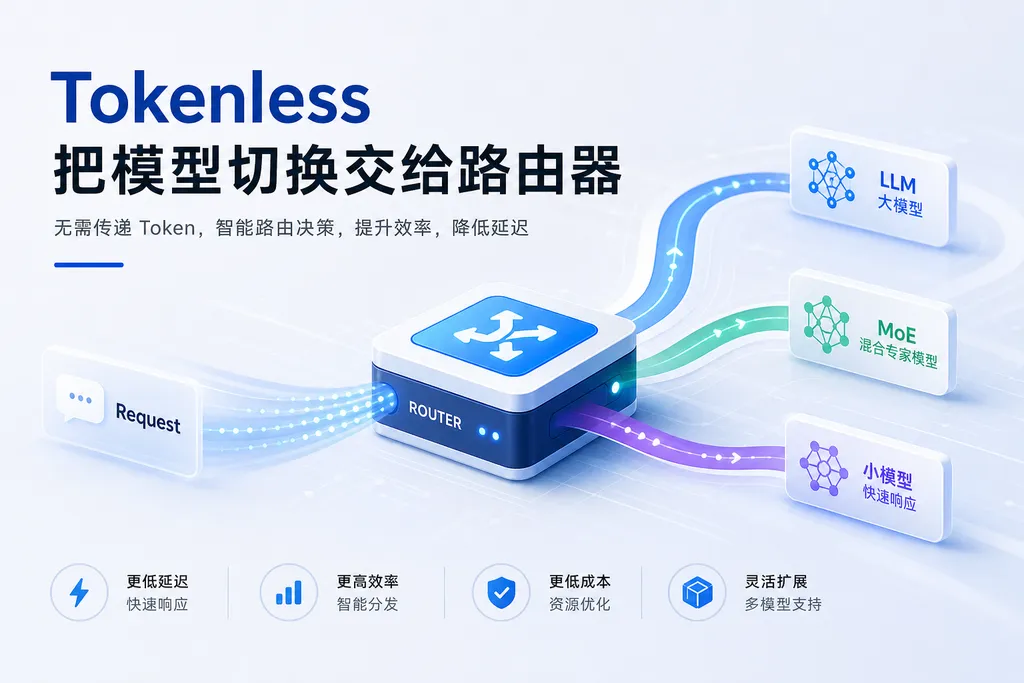
YC S26 startup Tokenless recently launched an automatic model-switching service that dynamically selects models based on task difficulty, aiming to balance quality, latency, and API costs.
Automatic Model Switching: Tokenless Wants to Eliminate the “Capability Tax” in AI Applications
YC S26 startup Tokenless recently launched on Hacker News. It provides an automatic model-routing layer that switches among different large language models, sending simple requests to cheaper models and escalating complex tasks to more capable, more expensive ones, thereby reducing the overall inference costs of AI applications.
This is not a new model, nor is it yet another API gateway that merely resells tokens. Tokenless is targeting an increasingly real problem in the model-calling pipeline: developers may have integrated multiple models, yet production traffic often remains permanently routed to the most expensive one.
The reasons are straightforward. Manually maintaining routing rules is cumbersome, while model versions and pricing constantly change. More importantly, development teams struggle to determine, before sending a request, whether a task truly warrants the strongest model. To avoid occasional quality failures, many products simply route every request through a frontier model.
That is like assigning a senior engineer to handle every support ticket—it certainly works, but the cost structure is hard to justify.
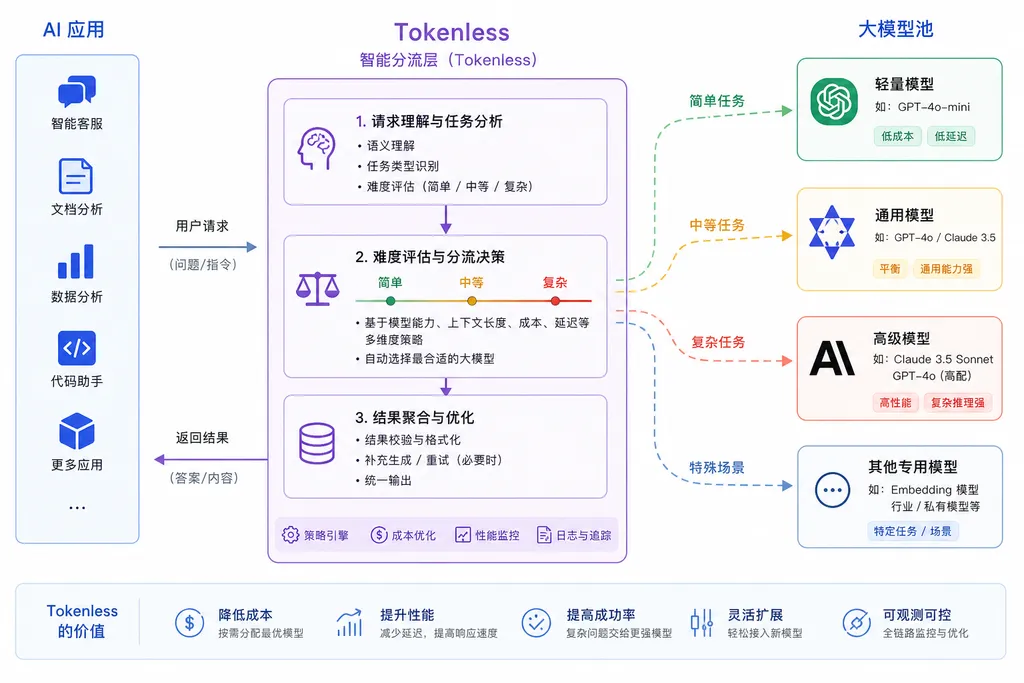
Tokenless aims to place a “dispatcher” between applications and model providers. The application continues to submit requests, while the routing layer determines the task type, difficulty, and constraints before selecting a more appropriate model.
“Tokenless” Does Not Mean No Tokens—It Means Worrying Less About Them
The name can be misleading. Tokenless does not eliminate token-based billing for large language models, nor can it make model inference free. What it actually seeks to eliminate is the need for developers to write large amounts of static logic around token pricing and model selection.
Traditional multi-model applications usually implement logic along these lines:
- Use low-cost models for summarization, classification, and information extraction;
- Use high-performance models for code generation and complex reasoning;
- Fall back to a stronger model when the low-cost model errors out or produces an unacceptable response;
- Switch to a backup provider when one provider imposes rate limits.
This approach works well at the prototype stage. Once it enters production, however, problems multiply rapidly: prompts change, models are upgraded, providers adjust their prices, and context lengths can vary by dozens of times even within the same task category. What began as a dozen lines of conditional logic eventually grows into a routing system that nobody dares touch.
Tokenless’s value proposition is to extract these decisions from application code. Instead of explicitly specifying which model must handle each request, developers let the router choose automatically based on the request’s characteristics.
From an engineering perspective, products like this typically need to solve three problems:
- Identify request difficulty. Distinguish among tasks such as casual conversation, extraction, translation, code modification, mathematical reasoning, and long-context analysis.
- Predict model performance. A model’s capabilities are uneven across different tasks, and having more parameters does not mean it performs better in every scenario.
- Handle failure escalation. When a low-cost model fails to satisfy formatting, confidence, or business requirements, can the system quickly switch to a stronger model instead of returning an incorrect answer directly to the user?
The real challenge is not switching—it is knowing when to switch.
Model Routing Is Evolving from an Optimization into Infrastructure
Automatic routing is not a new concept. Over the past two years, developers have experimented with keyword-based rules, model cascades, classifier-based routing, and approaches such as “have a small model answer first, then let an evaluator decide whether to escalate.”
But since the beginning of 2026, model routing has become significantly more important. The reason is not that one particular model suddenly became expensive, but that the usage patterns of AI applications have changed.
Chat products generally follow a question-and-answer pattern. Agents, by contrast, continuously plan, retrieve information, invoke tools, read results, modify files, and then begin another round of reasoning based on the execution state. A single user action may trigger a dozen or even dozens of model requests, and each step may resend the context.
Under these conditions, small differences in per-model pricing are magnified by the number of calls.
For example, a coding agent does not need the strongest model for every step:
- A cheaper model can identify file types, organize directories, and extract error messages;
- A stronger model can be called when modifying cross-file dependencies or analyzing concurrency bugs;
- Deterministic tasks such as formatting output and generating commit messages can even be handled by rules or local models;
- Paying the premium for a frontier model is worthwhile only when architectural decisions or complex debugging are involved.
This is precisely the opportunity for products like Tokenless. The more models there are—and the greater the differences in pricing—the more room there is for the routing layer to optimize.
Savings Depend on How Well It Matches Models to Tasks
Automatic routing sounds sensible, but developers should not look only at advertised cost reductions. At least four metrics must be evaluated together:
| Metric | Question to answer | | --- | --- | | Cost | How much has the actual total cost per successful task decreased? | | Quality | Does the task success rate decline when low-cost models handle more requests? | | Latency | How much response time is added by routing decisions, retries, and escalations? | | Reliability | Can the system reliably fall back when models are rate-limited, time out, or change their APIs? |
The metric most easily overlooked is the cost per successful task, rather than the price of a single API request.
Suppose a cheap model costs only one-tenth as much as a premium model, but frequently fails on complex tasks, forcing the system to call the premium model afterward. In that case, the task not only fails to save money but also incurs the cost of the smaller model and adds extra waiting time. If the initial failure triggers an incorrect tool call, the additional cost will be even higher.
Model cascading therefore works only under two conditions: the low-cost model can handle a sufficiently large share of simple requests, and the system can accurately detect failures at low cost.
This is also what Tokenless must prove next. As of publication on July 29, the publicly released materials do not yet provide sufficiently comprehensive routing benchmarks, including the composition of the task set, quality evaluation methods, routing overhead, and the actual savings compared with a fixed-model strategy. The case for automatic switching is plausible, but production data will ultimately have to validate it.
It Is Best Suited to High-Volume, Heterogeneous, and Evaluatable Tasks
Not every AI application needs automatic routing. If a product makes only a small number of calls each day, the engineering costs of routing, monitoring, and regression testing may exceed the savings on model usage.
Tokenless is better suited to the following scenarios:
1. Large Volumes of Requests with Clear Differences in Task Difficulty
A customer service system may handle both standard questions such as “How do I reset my password?” and complex complaints that require reviewing orders, policies, and previous conversations. Sending all of them to the same model is inherently a misallocation of resources.
2. Agents with Many Mechanical Internal Steps
Web data extraction, log categorization, parameter organization, and result formatting generally do not require top-tier models. If a router can identify these steps, the savings accumulate as the agent’s call chain grows longer.
3. Outputs That Can Be Automatically Verified
Structured JSON can be checked against a schema, code can be tested, and SQL can undergo syntax and permission validation. The easier a task is to verify, the more confidently the system can try a low-cost model first, because it can promptly escalate after a failure.
4. Teams Already Using Models from Multiple Providers
If an application already integrates models such as GPT, Claude, Gemini, and DeepSeek, the marginal cost of adding a unified routing layer is relatively low. Conversely, if the business depends heavily on a particular model’s proprietary tools, caching semantics, or specific output behavior, switching models will not be easy.
The Biggest Risk Is Not Choosing the Wrong Model, but Turning the Routing Layer into a Black Box
Automatic model routing introduces a new infrastructure dependency. Previously, when something went wrong, developers at least knew which model had received the request. With dynamic routing, the same prompt may be assigned to different providers at different times, changing the output style, latency, and content-safety policies.
This directly affects debugging and compliance.
A routing service suitable for production should provide at least the following observability data:
- Which model was ultimately selected for each request;
- The basis for the selection or the routing-policy version;
- Input and output tokens, along with any additional routing overhead;
- Whether retries, escalations, or provider switches occurred;
- Quality, latency, and cost distributions for each task category;
- Which model providers and regions actually received the data.
If the service offers only a dashboard showing “how many dollars were saved this month” but cannot explain why specific requests were routed as they were, it is more of a financial black box than reliable model infrastructure.
Another issue is feature overlap. On the surface, different model APIs can all accept arrays of messages, but the capabilities they support are not identical. Tool-calling parameters, structured output, image input, context caching, reasoning-effort controls, and safety filters all differ. If the routing layer supports only the lowest common denominator, it sacrifices the proprietary capabilities of frontier models. If it fully adapts to every provider’s API, maintenance costs rise significantly.
Therefore, “compatibility with a single interface” solves only the integration problem; it does not mean models can be interchanged without loss.
Tokenless Is Moving in the Right Direction, but Its Value Must Be Measured by Failure Rates
Our assessment is: automatic model routing is the right direction and will become a standard component of agent infrastructure, but it is not a business that can succeed on pricing tables alone.
A truly valuable router does not always choose the cheapest model. Instead, it selects the lowest-total-cost execution path that remains above the business’s minimum acceptable quality threshold. That “total cost” should also include latency, failure retries, engineering maintenance, and the business losses caused by incorrect results.
Tokenless is entering the market at a time when it directly addresses one of developers’ clearest pain points. The number of model providers continues to grow, pricing and capabilities are changing rapidly, and statically binding an application to a single model is becoming increasingly uneconomical. For applications with sufficiently high request volumes, moving even a portion of classification, extraction, and formatting tasks away from expensive models could produce substantial savings.
But routing systems can also create false optimizations: token costs decline on paper while task completion rates deteriorate; average latency appears stable while tail latency worsens because of repeated escalations; model selection becomes more flexible while debugging becomes less controllable.
Teams evaluating Tokenless or similar services should therefore avoid handing over all production traffic immediately. A safer approach is to begin with shadow testing: let the router select models for historical requests without affecting live results. Then replay and compare real tasks based on success rate, latency, and cost before gradually increasing traffic.
Teams should also retain the ability to pin tasks to a specific model manually. High-risk workflows involving payments, healthcare, legal services, and code deployment should not be automatically downgraded solely on the basis of an opaque difficulty score. Routing policies should follow business-criticality tiers, not the other way around.
Tokenless is solving a real problem. But for products like this, launching automatic switching is only the first step. The harder task is building trust: it must prove not only that it can save tokens, but also that it knows which tokens must never be cut.
References
- Zhihu: The Token Economics of OpenClaw and Model-Routing Practices—Discusses the hidden cost of calls in agent workflows and approaches to reducing costs by switching models according to the task.